
Bloomsbury, London
Bloomsbury, London: A Historic and Cultural Heart of the Capital
Where History, Culture, and Green Spaces Meet
Bloomsbury is located in Central London, within the London Borough of Camden. It lies immediately north of Holborn and south of Euston Road.- Western Bloomsbury — where major institutions like the British Museum are found, surrounded by historic garden squares like Russell Square and Bedford Square.
- Eastern Bloomsbury — a quieter, primarily residential area with charming streets and university buildings.
Size and Population of Bloomsbury
Bloomsbury covers roughly 1.25 square kilometres (around 0.48 square miles).As of recent estimates, the population of Bloomsbury is approximately 14,000 residents. However, due to the many institutions, hotels, and offices, the daytime population swells significantly with students, tourists, and workers.
Streets in Bloomsbury
History of Bloomsbury
The name "Bloomsbury" is believed to derive from "Blemondisberi," a 13th-century manor owned by William de Blemond, a Norman landowner.By the 17th century, the Russell family (the Dukes of Bedford) began transforming the area into a fashionable residential neighbourhood, laying out elegant garden squares.
Throughout the 19th and early 20th centuries, Bloomsbury became synonymous with intellectual and literary life, home to the famous Bloomsbury Group — a collective of influential writers, artists, and thinkers including Virginia Woolf and E.M. Forster.
Demographics of Bloomsbury
Bloomsbury’s population is notably diverse, with a significant proportion of students, academics, and international residents.Thanks to the proximity of institutions like University College London (UCL), SOAS University of London, and the University of London’s main campus, a large segment of the population is under 30 years old.
There’s also a sizable professional and cultural community, with many employed in education, healthcare, arts, and public service sectors.
Map of Bloomsbury, London
Roads in Bloomsbury
- Bedford Avenue
- Bedford Square
- Bloomsbury Street
- Euston Road
- Gower Street
- Great Russell Street
- Streatham Street
- Tottenham Court Road
Important Buildings and Landmarks in Bloomsbury
Bloomsbury is dotted with significant landmarks and cultural institutions, including:- The British Museum — One of the world's greatest museums, housing millions of artefacts from around the globe.
- Russell Square — A beautiful, large garden square with a central café and plenty of green space.
- The Foundling Museum — Telling the story of London’s first home for abandoned children.
- Senate House — An iconic art-deco building serving as the administrative centre for the University of London.
- The Charles Dickens Museum — Set in the author's former home on Doughty Street.
- Bloomsbury Square — One of London’s oldest squares, laid out in the early 1660s.
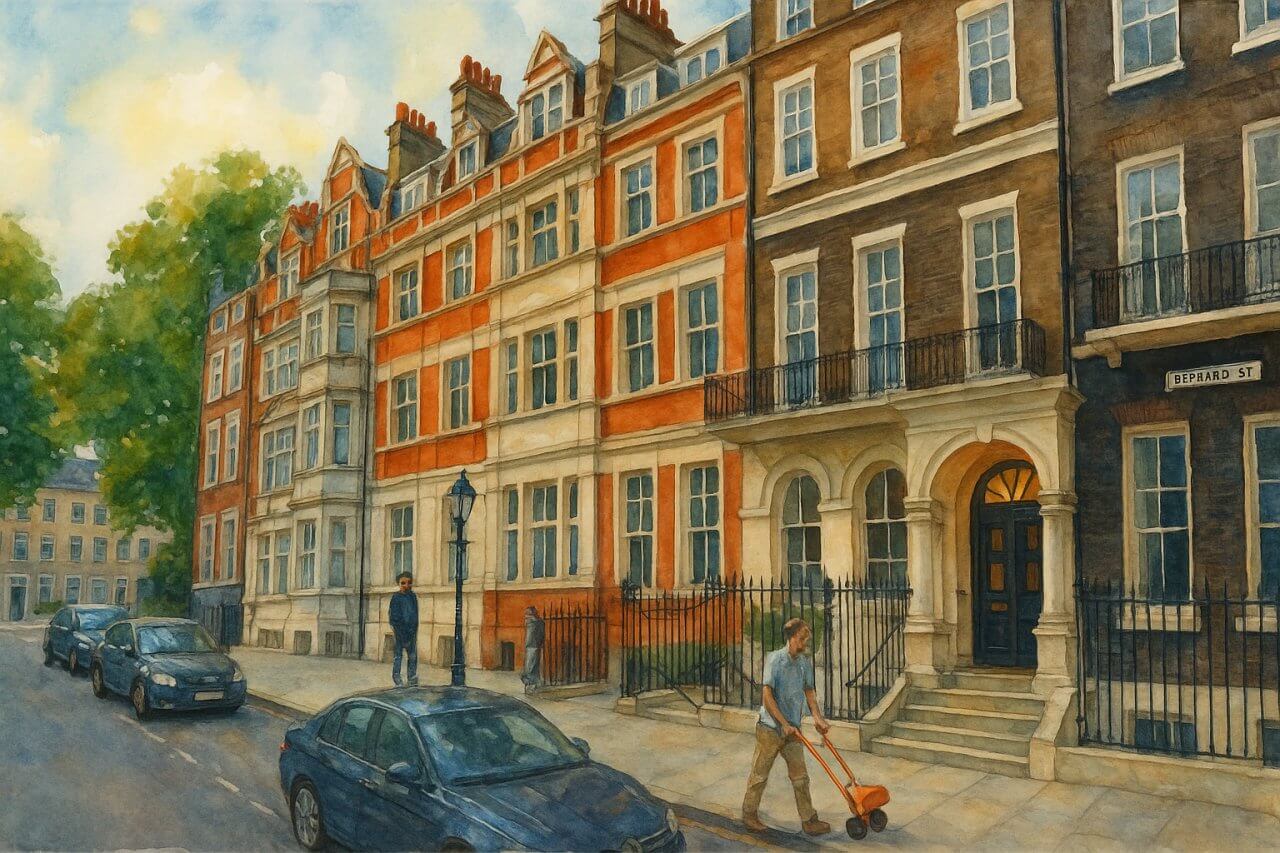
Painting of Bloomsbury
Characteristics of Bloomsbury
Bloomsbury is known for its:- Literary and academic culture — A historic centre for writers, scholars, and students.
- Elegant garden squares — Providing peaceful green spaces in a busy part of London.
- Historic architecture — Featuring Georgian terraces, Victorian townhouses, and grand institutional buildings.
- Cultural sophistication — Home to world-class museums, art galleries, and academic institutions.
Real Estate Prices in Bloomsbury
As of 2025, the average property price in Bloomsbury stands at around £1.1 million. For a budget of £1.1 million, a buyer might expect to purchase a spacious one-bedroom or a smaller two-bedroom flat in a period building, typically offering between 600 to 800 square feet.Compared to wider Central London, Bloomsbury remains somewhat more affordable than areas like Mayfair or Knightsbridge, though it commands a premium due to its location, historic charm, and proximity to top universities.
Nearest London Underground Stations
Bloomsbury is exceptionally well-connected by the Tube network, with several nearby stations:- Russell Square Station (Piccadilly Line)
- Holborn Station (Central and Piccadilly Lines)
- Goodge Street Station (Northern Line)
- Tottenham Court Road Station (Central, Northern, and Elizabeth Lines)
- Euston Square Station (Circle, Hammersmith & City, and Metropolitan Lines)
Fun Facts about Bloomsbury
Bloomsbury’s garden squares were among the earliest examples of urban planning for green spaces in London. The British Museum was the first national public museum in the world, founded in 1753. Virginia WoolfSenate HouseList of Places in London, Map of Places in London
Want to share your London travel experiences or get tips from fellow travellers?
Join the London Travel Tips Facebook GroupMore information for visiting London
Here are some related articles to help you get to know London better.- Cost of Living in London: Discover the true cost of living in London, including housing, transport, groceries, and more - plus tips for budgeting in one of the world's most expensive cities.
- Driving in London: Planning to drive in London? Learn about roads, car rentals, parking, tolls, and key tips for tourists and visitors from outside the capital.
- Driving Tips for Visiting London: Thinking of driving to London? Discover the best times to travel, congestion tips, parking apps, breakdown help, and petrol advice for a smoother journey.
- Evolution of London's Streets: Discover the fascinating history of how London's streets developed from ancient footpaths to today's complex network of roads across the capital.
- History of Immigration to London: Discover the rich history of immigration to London, from Huguenots to Bangladeshis, and how diverse communities have shaped the city's vibrant identity.
- How Big Is London Compared to Other World Cities?
- How London's Streets Measure Up: A Global Comparison of Road Widths
- How Streets of London are Named: Discover how London streets get their names, who decides them, and how historic, political, and public influences shape street naming in the capital.
- How the Grosvenor Family Came to Own Much of Mayfair, Belgravia and Pimlico: Explore how the Grosvenor family came to own much of Mayfair, Belgravia, and Pimlico, and learn about their historical connection (or lack thereof) with the British royal family and government.
- Living and working in London
- London's Quiet Collapse: How Living Standards Fell as Costs Skyrockted (1975-2025): Explore how London residents endured rising costs and falling living standards from 1975 to 2025 - from rocketing rents to wage stagnation and inflation.
- Marvel of the London Underground: Discover the history, challenges, and triumphs of the London Underground - the world's first underground railway and a vital transport lifeline for the UK capital since 1863.
- Moving to London: Expat Tips for Settling in Westminster: Essential advice for expats moving to London's Westminster: neighborhood insights, cost of living, transportation, housing, healthcare, schools, and tips to help you feel at home in the heart of the city.
- Places in London that aren't pronounced the way they're spelled
- Shopping in London: Discover London's diverse shopping scene
- Taking the bus in London: This is your complete guide to taking the bus when in London.
- The Anglican Faith: A Visitor's Guide to the Church of England: Learn about the Anglican faith and its deep ties to London's landmarks like Westminster Abbey and St Paul's Cathedral.
- Top 10 London Streets Every Visitor Must See: Discover London through its most iconic thoroughfares - 10 streets every visitor must experience. From historic Abbey Road to vibrant Camden High Street, explore culture, shopping, and hidden gems.
- Why are most roads in Central London so narrow? Learn why there are so few multi-lane roads and elevated highways in the heart of the city.
 Latest Pages & Updates
Buy Me A Coffee
If you enjoy the information I provide and want to support the work I do, please buy me a coffee! I appreciate it immensely, thank you so much!
