
Tuas Travel Guide
The Tuas Planning Area (Simplified Chinese: 大士, Traditional Chinese: 大士, Pinyin: Dàshì, Malay: Tuas, Tamil: துவாஸ்) is located at the western tip of Singapore, within the West Region. Covering an area of about 30.0 square kilometres, it is one of the largest planning areas in Singapore by land size but has a very low residential population due to its primary use as an industrial zone. Tuas is known for housing heavy industries, infrastructure facilities, and the Tuas Second Link, one of two land connections to Malaysia.
History of Tuas
The name “Tuas” likely derives from the Malay word tuas, which can mean “lever” or “to lever up.” Historically, Tuas was a fishing village, with residents living along the coast and engaging in fishing and small-scale farming. The area underwent significant reclamation and industrialisation beginning in the 1970s, transforming it into one of Singapore’s key industrial zones.
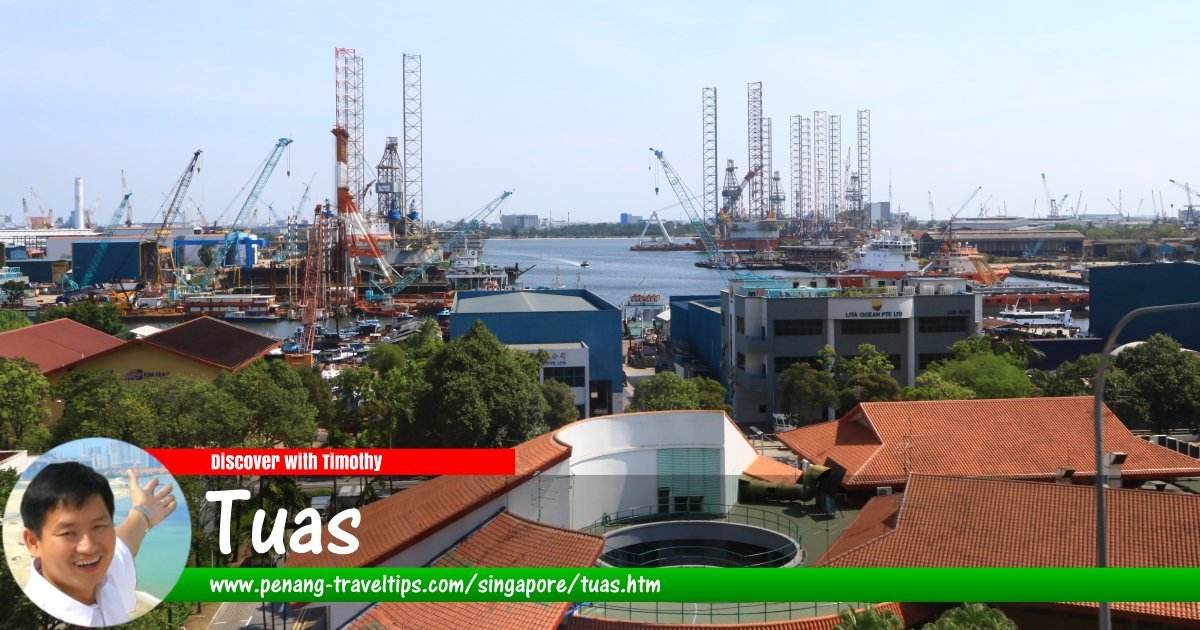 Tuas, Singapore (29 July 2017)
Today, Tuas is most famous for the construction of the Tuas Port, a next-generation mega port that will eventually consolidate Singapore’s container operations from Tanjong Pagar, Keppel, Brani, and Pasir Panjang into one location. The project began in 2015 and is expected to be completed in phases until 2040, with a final handling capacity of 65 million TEUs per year.
Geography and Boundaries
Tuas is bordered by Pioneer to the east, the Straits of Johor to the north and west, and the Singapore Strait to the south. The area is largely reclaimed land, with vast tracts set aside for industrial use, including oil refining, waste management, and heavy manufacturing.
Industrial and Economic Significance
Tuas is home to many heavy industries, including petrochemical plants, engineering firms, and logistics hubs. It also houses Singapore’s main incineration facilities, including the Tuas South Incineration Plant and the Tuas Nexus Integrated Waste Management Facility. These infrastructure projects highlight Tuas’ role as an essential backbone of Singapore’s economy and utilities network.
The Tuas Biomedical Park is another highlight, providing space for global pharmaceutical and biomedical companies to set up manufacturing operations in Singapore.
Tuas Port
One of the most ambitious projects in Tuas is the Tuas Port. Built on reclaimed land, this mega port is designed to be automated and highly efficient, featuring automated guided vehicles (AGVs) and remote-controlled cranes. Once completed, it will be the world’s largest fully automated container terminal, strengthening Singapore’s position as a global maritime hub.
Transport and Connectivity
Tuas is connected to the rest of Singapore by major expressways such as the Ayer Rajah Expressway (AYE) and the Pan Island Expressway (PIE). It is also the site of the Tuas Second Link, the second road bridge linking Singapore to Johor, Malaysia, opened in 1998. This link serves as an alternative to the Causeway and helps ease traffic congestion between the two countries.
The area is served by four MRT stations on the East West Line Tuas West Extension: Gul Circle (EW30), Tuas Crescent (EW31), Tuas West Road (EW32), and Tuas Link (EW33). Tuas Link station is the western terminus of the East West Line.
Residential Aspect
Tuas has very limited residential housing. Most people working in Tuas commute from neighbouring towns such as Jurong West, Pioneer, or Bukit Batok. As such, there is no significant real estate market within Tuas itself, and property prices are typically referenced to nearby towns instead.
Fun Facts about Tuas
- Tuas houses Singapore’s westernmost MRT station: Tuas Link (EW33).
- The Tuas Second Link is less congested than the Causeway and is often preferred for commercial traffic.
- When completed, Tuas Port will be the world’s largest fully automated container terminal.
- Tuas is one of the least populated planning areas in Singapore despite its large size.
Map of Tuas, Singapore
MRT Stations in Tuas, Singapore
- Gul Circle MRT Station (GPS: 1.31968, 103.6607)

- Tuas Crescent MRT Station (GPS: 1.32116, 103.64901)

- Tuas Link MRT Station (GPS: 1.34032, 103.63682)

- Tuas West Road MRT Station (GPS: 1.33005, 103.63961)

Quick Facts
- Total Area: ~30.0 sq km
- Region: West Region
- Population: Very low (primarily industrial workers commuting from outside)
- Known for: Tuas Port, Tuas Second Link, heavy industries
- MRT: Gul Circle (EW30), Tuas Crescent (EW31), Tuas West Road (EW32), Tuas Link (EW33)
- Postal District: District 22
References
- Urban Redevelopment Authority – Tuas
- Maritime and Port Authority of Singapore – Tuas Port
- Singapore Infopedia – Tuas
Page Details
This page was created on 9 September 2025. Hi, my name is Timothy and created it from my research, for my own entertainment, knowledge and to satisfy my curiosity. I am providing the information to you in good faith and hope it is useful. I try to get the details as accurate as possible. I also try to update the page whenever I stumble on new details. So this and all my other pages are perpetual work in progress. If you discover any error, please politely inform me, pointing out where the error lies, and I will correct it as soon as possible. Your helpfulness will keep this page accurate, relevant and helpful to those who need the information.My videos of Singapore
Want to share your Singapore travel experiences or get tips from fellow travellers?
Join the Singapore Travel Tips Facebook GroupMore information for visiting and living in Singapore
Here are some related articles to help you get to know Singapore better.- Cost of Living in Different Singapore Neighbourhoods (2025 Guide)
- EZ-Link Card
- Owning a Car in Singapore
- Singapore MRT Map & Guide 2025
- Singapore Postal Districts and Postcodes
- Singapore Tourist Pass
- Taking the Bus in Singapore: A Visitor's Guide
- Understanding CCR, RCR and OCR in Singapore real estate
 Latest Pages & Updates
Buy Me A Coffee
If you enjoy the information I provide and want to support the work I do, please buy me a coffee! I appreciate it immensely, thank you so much!
