
Canary Wharf, London
Canary Wharf contains three of the tallest buildings in the United Kingdom: One Canada Square, sometimes called Canary Wharf Tower, at 771 feet (235.1 metres), and HSBC Tower and Citigroup Centre, both at 654 feet (199.5 metres). It was built on the site of the old West India Docks, once one of the busiest docks in the world. The name Canary Wharf comes from the sea trade of the docks with the Canary Islands, which in turn got their names from the dogs (Latin canis), producing a coincidence that Canary Wharf, on the Isle of Dogs, was named after the Dog (Canary) Islands.
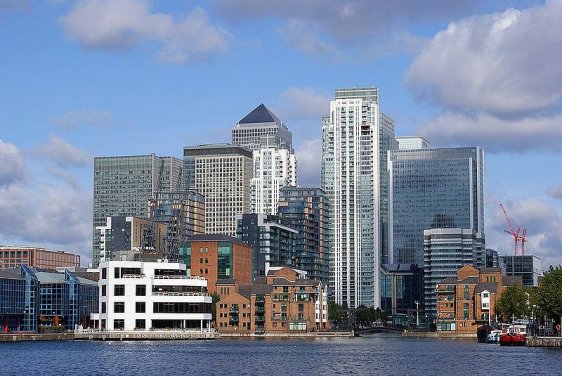 Canary Wharf, London
Source: https://commons.wikimedia.org/wiki/File:Canary_Wharf_200810.jpg
Author: WiNG

The project to revitalise the Docklands began in 1981 under the government of Margaret Thatcher. The idea for a new business centre at Canary Wharf can be traced back to 1984 when the late Michael von Clemm, chairman of Credit Suisse First Boston, visited the London Docklands over lunch, and compared the warehouses to those in Boston harbour, which have been converted into offices and business premises.
At that time, there was also a need to provide for large corporations, which need large areas of office space. The City of London, the traditional financial centre, has been resisting any attempts at building skyscrapers that would have housed the needs of big corporations. American property adviser G Ware Travelstead was instrumental in persuating the government of Margaret Thatcher to develop the docks into a new financial services district.
 Skyscrapers of Canary Wharf
Source: https://commons.wikimedia.org/wiki/File:Canary_Wharf_looking_up_from_ground_level.jpg
Author: neiljs
Construction of Canary Wharf began in 1988, with phase one completed in 1991. One Canada Square was topped out in 1990, becoming the tallest building in UK, and a powerful symbol of the regeneration of Docklands.
When the world property market collapsed in the early 1990s, saddling the financier of Canary Wharf, Olympia and York, with a US$20 billion debt. It filed for bankruptcy in May 1992. At that time the underground train connection was not ready, and the only accessible link was through the Docklands Light Railway. As a result, tenant demand evaporated, and the scheme went into administration.
An international consortium backed by the former owners of Olympia and York bought over Canary Wharf in 1995. As the property market recovered, demand for space slowly improved.
HSBC Tower and Citigroup Centre were both designed by Norman Foster. Construction began in 1999 and the towers were completed in 2001.
Apart from HSBC and Citigroup, the tenants of Canary Wharf include Credit Suisse, Lehman Brothers, Morgan Stanley, Bank of America, and Barclays. In 1999, just 15,000 people worked in Canary Wharf. The number increased to 63,000 in 2004. Today about 90,000 people work there.
Getting there
The Canary Wharf Station is served by the Jubilee Line. It is the busiest station of the London Underground outside of Central London, and the busiest served by just one line. Canary Wharf is also served by the Docklands Light Rail at the Canary Wharf DLR Station, Heron Quays DLR Station, and West India Quay DLR Station.List of Places in London
Want to share your London travel experiences or get tips from fellow travellers?
Join the London Travel Tips Facebook GroupMore information for visiting London
Here are some related articles to help you get to know London better.- Cost of Living in London: Discover the true cost of living in London, including housing, transport, groceries, and more - plus tips for budgeting in one of the world's most expensive cities.
- Driving in London: Planning to drive in London? Learn about roads, car rentals, parking, tolls, and key tips for tourists and visitors from outside the capital.
- Driving Tips for Visiting London: Thinking of driving to London? Discover the best times to travel, congestion tips, parking apps, breakdown help, and petrol advice for a smoother journey.
- Evolution of London's Streets: Discover the fascinating history of how London's streets developed from ancient footpaths to today's complex network of roads across the capital.
- History of Immigration to London: Discover the rich history of immigration to London, from Huguenots to Bangladeshis, and how diverse communities have shaped the city's vibrant identity.
- How Big Is London Compared to Other World Cities?
- How London's Streets Measure Up: A Global Comparison of Road Widths
- How Streets of London are Named: Discover how London streets get their names, who decides them, and how historic, political, and public influences shape street naming in the capital.
- How the Grosvenor Family Came to Own Much of Mayfair, Belgravia and Pimlico: Explore how the Grosvenor family came to own much of Mayfair, Belgravia, and Pimlico, and learn about their historical connection (or lack thereof) with the British royal family and government.
- Living and working in London
- London's Quiet Collapse: How Living Standards Fell as Costs Skyrockted (1975-2025): Explore how London residents endured rising costs and falling living standards from 1975 to 2025 - from rocketing rents to wage stagnation and inflation.
- Marvel of the London Underground: Discover the history, challenges, and triumphs of the London Underground - the world's first underground railway and a vital transport lifeline for the UK capital since 1863.
- Moving to London: Expat Tips for Settling in Westminster: Essential advice for expats moving to London's Westminster: neighborhood insights, cost of living, transportation, housing, healthcare, schools, and tips to help you feel at home in the heart of the city.
- Places in London that aren't pronounced the way they're spelled
- Shopping in London: Discover London's diverse shopping scene
- Taking the bus in London: This is your complete guide to taking the bus when in London.
- The Anglican Faith: A Visitor's Guide to the Church of England: Learn about the Anglican faith and its deep ties to London's landmarks like Westminster Abbey and St Paul's Cathedral.
- Top 10 London Streets Every Visitor Must See: Discover London through its most iconic thoroughfares - 10 streets every visitor must experience. From historic Abbey Road to vibrant Camden High Street, explore culture, shopping, and hidden gems.
- Why are most roads in Central London so narrow? Learn why there are so few multi-lane roads and elevated highways in the heart of the city.
 Latest Pages & Updates
Buy Me A Coffee
If you enjoy the information I provide and want to support the work I do, please buy me a coffee! I appreciate it immensely, thank you so much!
