
Bukit Dumbar Travel Guide
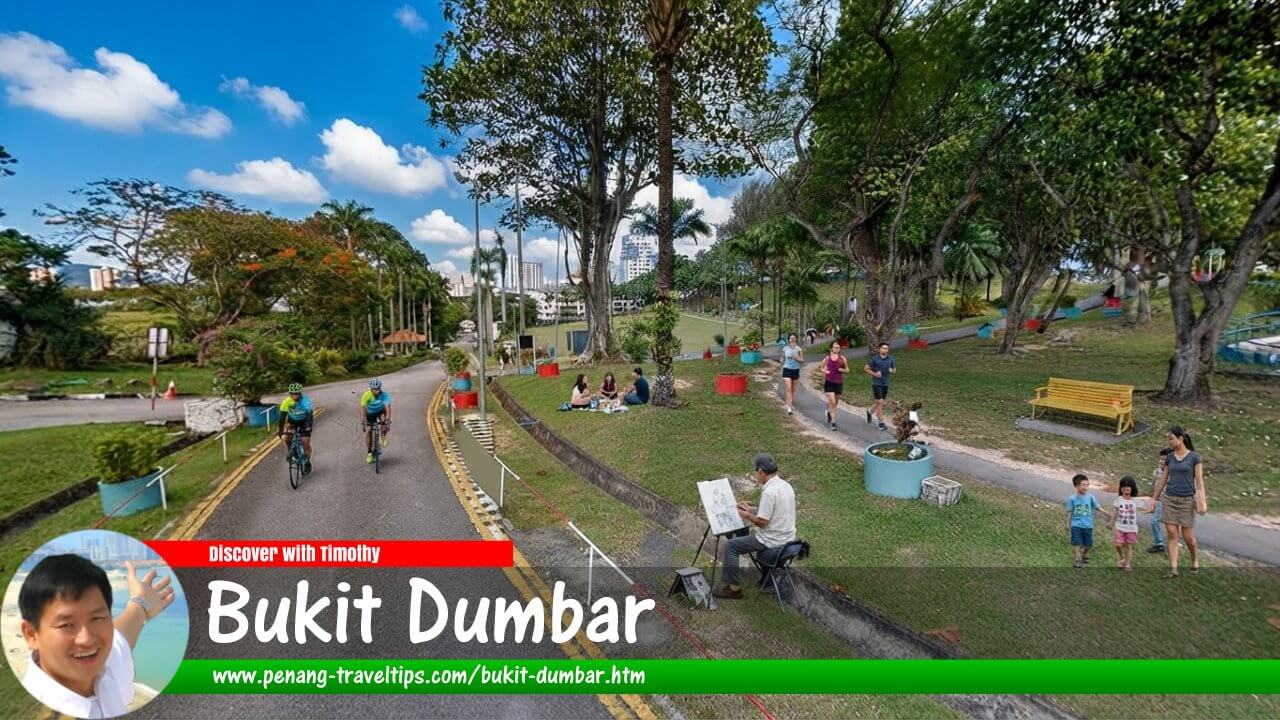 Bukit Dumbar Travel Guide (AI generated on 17 October 2026)

Also available: Panduan Melawat Bukit Dumbar
Bukit Dumbar is a hilltop recreation area in the Jelutong–Gelugor area of Penang Island, Malaysia. Located approximately 4 kilometres south of central George Town, it is known for its public park, underground water reservoirs and the Nicol David International Squash Centre. The surrounding neighbourhood contains residential areas, places of worship and local businesses, making Bukit Dumbar a place of interest for visitors who wish to explore parts of Penang beyond its best-known tourist districts.1
Fakta Ringkas
- Name: Bukit Dumbar
- Location: Between Jelutong and Gelugor, Penang Island, Malaysia
- Administrative district: Northeast Penang Island District (Daerah Timur Laut)
- Approximate distance from central George Town: 4 kilometres
- Main attraction: Bukit Dumbar Recreation Park
- Notable facility: Nicol David International Squash Centre
- Infrastructure: Bukit Dumbar Reservoir and Pumping Station Complex
- Nearby localities: Jelutong, Gelugor, Batu Lanchang and Udini
- Access: Jalan Jelutong and nearby local roads, with Rapid Penang bus services
- Character: Recreation area, water-supply infrastructure and residential neighbourhood
Geography and Location
Bukit Dumbar is situated in the southeastern part of George Town's wider urban area, near the boundary between Jelutong and Gelugor. Although its name means "Dumbar Hill" in Malay, the place is not simply a natural hill. The elevated recreational area is associated with a man-made landform constructed over an underground water-storage complex.1
The surrounding landscape has changed considerably as Penang Island's urban area expanded. Residential buildings, local roads, shops and other urban facilities occupy the lower slopes and neighbouring areas. Bukit Dumbar therefore combines a green recreational space with important public infrastructure and an established urban neighbourhood.
Jalan Jelutong is one of the principal roads for reaching the area. Smaller roads, including Jalan Bukit Dumbar, provide access to nearby residential streets and places of worship. The wider area is connected to Gelugor, Batu Lanchang and other parts of George Town by the island's road network.
History of Bukit Dumbar
From agricultural land to urban development
During the nineteenth century, the area formed part of the agricultural landscape surrounding George Town. Historical accounts associate Bukit Dumbar with the former Udini Estate, which included a coconut plantation. As the city expanded during the twentieth century, land that had previously been used for agriculture gradually became integrated into the growing urban area.2
The history of Bukit Dumbar is also connected to the Japanese occupation of Penang during the Second World War. Accounts of the occupation identify the area among the locations associated with the killing and burial of Chinese civilians during the Japanese military police's Sook Ching operations. This forms part of the wider history of wartime violence in Penang. Visitors should treat this history with respect, and specific claims about individual burial sites should be supported by reliable historical evidence.
Development of the water reservoirs
One of the most significant changes to Bukit Dumbar occurred after the Second World War, when the growing population and expanding urban area increased demand for a dependable water supply. Underground reservoirs were constructed beneath the elevated site. By 1958, two reservoirs reportedly had a combined capacity of approximately 8 million imperial gallons, equivalent to about 36 million litres.2
The reservoir complex subsequently developed into an important component of Penang's water-distribution system. Treated water from the Sungai Dua Water Treatment Plant in Seberang Perai is conveyed to the island through submarine pipelines before being stored and pumped onward from Bukit Dumbar. The facility supports water supply to southern parts of Penang Island, including residential communities and industrial areas around Bayan Lepas.3
In 2018, a fourth reservoir was commissioned as part of the Bukit Dumbar Reservoir and Pumping Station Complex. The expansion was intended to strengthen the storage and distribution of treated water to areas served by the complex.3 The reservoirs are operational public utilities rather than tourist attractions, so visitors should respect access restrictions and avoid entering infrastructure areas that are not open to the public.
The recreation park
The elevated ground above the reservoir complex was developed as a public recreation area during the twentieth century. The park has provided a green space for residents of Jelutong, Gelugor and nearby neighbourhoods. Its location above the water infrastructure gives it a distinctive role in the urban landscape: a recreational setting occupies the surface, while major water-supply facilities operate beneath and around it.1
Origin of the Name Bukit Dumbar
The Malay word bukit means "hill". The meaning and origin of "Dumbar", however, are less certain. The name is also found in local road names, including Jalan Dumbar and Lorong Dumbar, indicating that it has become established in the area's local geography.
Without a reliable historical record explaining the name, it is best not to attribute "Dumbar" to a particular person, family or event. The precise origin of the name remains unconfirmed. Visitors interested in the area's history may find it useful to distinguish between the literal meaning of bukit and the uncertain history of the proper name "Dumbar".
Things to See and Do in Bukit Dumbar
1. Bukit Dumbar Recreation Park
The recreation park is the principal public attraction at Bukit Dumbar. It provides a green space within a densely developed part of Penang Island and is used by local residents for outdoor exercise and relaxation. People visit to walk, jog, stretch and enjoy time outdoors, particularly during the cooler hours of the morning and evening.1
The park is more suited to everyday recreation than to a full-day sightseeing excursion. Visitors should wear comfortable footwear, bring drinking water and take care on slopes and steps. Facilities and access conditions may change, so it is sensible to check conditions locally before making a special journey.
As the park is surrounded by urban development, it offers a different experience from Penang's forested hill trails and coastal parks. It is a convenient place to take a break from sightseeing, especially for travellers staying in Jelutong or Gelugor.
2. Nicol David International Squash Centre
The Nicol David International Squash Centre is one of Bukit Dumbar's best-known sporting facilities. The centre developed from a squash training facility established in the late twentieth century and was renamed in honour of Malaysian squash champion Nicol David in 2010, recognising her achievements in the sport.2
The centre is associated with the development of squash in Penang and Malaysia. It is of particular interest to sports enthusiasts and visitors wishing to learn more about the facilities that have supported the training of Malaysian squash players.
Visitors should not assume that courts are available for casual use or that the facility is open for unrestricted sightseeing. Access, coaching programmes, training sessions and court bookings depend on the centre's current arrangements. Contact the relevant operator before visiting specifically to use the facilities.
3. Local temples and places of worship
The wider Bukit Dumbar area contains several places of worship reflecting Penang's multicultural population. These include Chinese temples such as Pu Xian Temple and San Hai Kong Temple, as well as Hindu religious sites in the surrounding neighbourhood.1
One notable religious site on the slopes of Bukit Dumbar is Sri Ranganatha Swami Madalayam, a Hindu sanctuary associated with spiritual practice and the religious teacher Sri Ragunatha Swami. Historical information about the sanctuary places its completion in the early 1930s.4
These sites are primarily places of worship rather than conventional tourist attractions. If visiting, dress respectfully, observe any rules displayed at the entrance and avoid photographing worshippers or ceremonies without permission. Some premises may be closed outside prayer times or religious events.
4. Explore the surrounding neighbourhood
A short excursion around Bukit Dumbar can also introduce visitors to the everyday urban environment of Jelutong and Gelugor. The neighbourhood includes older residential streets, local businesses, apartment buildings, small eateries and community facilities. The contrast between the park's greenery and the surrounding built-up areas is part of the locality's character.
Walking around the wider neighbourhood can be interesting for travellers who enjoy observing ordinary city life. However, some roads are busy and pedestrian facilities vary. Use designated crossings where available and avoid walking along high-traffic roads when a safer alternative exists.
Nearby Places to Explore
Jelutong
Jelutong lies around the northern and western approaches to Bukit Dumbar. It is a densely populated urban area with traditional neighbourhoods, shops, food stalls, schools and local religious buildings. Travellers interested in local food and the daily life of Penang residents may wish to explore its commercial streets.
Gelugor
Gelugor lies to the south and southeast of Bukit Dumbar. It provides access to residential areas, educational institutions and roads leading towards the southern part of Penang Island. It is also a useful reference point for visitors travelling between George Town and destinations farther south.
Batu Lanchang
Batu Lanchang is another nearby locality known for its residential areas and local commercial activity. It can be included in a wider exploration of the neighbourhoods between central George Town and Gelugor. Travellers may find everyday food outlets and markets in the wider area, although specific opening hours should be checked independently.
Udini and nearby shopping facilities
The Udini area and nearby retail facilities provide options for shopping, groceries and casual meals. These commercial areas are more practical for daily needs than the recreation park itself. Travellers who want to combine a short visit to Bukit Dumbar with shopping or a meal can plan to visit nearby retail areas before or after spending time at the park.
What to Eat in Bukit Dumbar
Bukit Dumbar is primarily a residential and recreational locality, rather than a major food destination in its own right. Nevertheless, its position between Jelutong and Gelugor puts visitors within reach of the varied food culture of urban Penang.
Local hawker food
Nearby neighbourhoods offer the kinds of everyday dishes commonly found around Penang, including noodle dishes, rice meals, fried snacks and local breakfast fare. The range varies by street and time of day, so visitors looking for a particular dish should explore the surrounding commercial areas rather than expect a dedicated food court inside the park.
Penang's food scene includes both Chinese hawker cooking and Malay and Indian-Muslim food. Travellers can look for nasi kandar, roti canai, mee goreng mamak and other familiar Malaysian dishes in the wider area. Availability differs from one outlet to another.
Food for Muslim travellers
Muslim visitors should confirm that a restaurant or stall meets their dietary requirements instead of assuming that every local food outlet is halal. Look for clear halal certification where relevant, or ask the operator about ingredients and food preparation. Malay-Muslim eateries and Indian-Muslim restaurants may provide convenient choices, but the status of each individual establishment should be verified.
Where to find more dining choices
For a wider choice of restaurants and cafés, visitors can travel towards Jelutong, Gelugor and nearby shopping areas. George Town also offers a much broader selection of Penang cuisine, including established hawker centres and restaurants, but travelling there adds time to the excursion.
Where to Stay Near Bukit Dumbar
Bukit Dumbar itself is not a major hotel district. Its surroundings are predominantly residential, with apartment complexes, housing estates and local amenities. Visitors wishing to stay close to the park should search for accommodation in the wider Jelutong and Gelugor areas and confirm the exact location before booking.
Jelutong and Gelugor
These areas may suit travellers who want to stay outside the busiest parts of George Town while remaining within reach of the city. Depending on availability, accommodation may include hotels, serviced apartments and short-term rental units. Check guest reviews, transport access, parking arrangements and the property's current operating status before making a reservation.
Central George Town
Travellers who want to combine Bukit Dumbar with heritage buildings, museums, shopping and a wider choice of restaurants may prefer to stay in George Town. From there, Bukit Dumbar can be visited as a short excursion by bus, taxi or e-hailing service.
Choosing accommodation
When comparing accommodation, consider the distance to a bus stop, access to food outlets and the time needed to reach your other destinations. If you plan to visit the park early in the morning, staying in Jelutong or Gelugor may reduce travel time. If Bukit Dumbar is only one stop on a broader Penang itinerary, central George Town may be more convenient.
How to Get to Bukit Dumbar
By car or taxi
Bukit Dumbar can be reached by road from George Town and other parts of Penang Island. Jalan Jelutong is a useful approach road, while local roads lead towards the park and nearby residential areas. Visitors driving themselves should use a navigation application to select the appropriate entrance and check parking arrangements on arrival.
Taxi and e-hailing services are practical choices for visitors unfamiliar with the local road network. When booking a ride, specify Bukit Dumbar Recreation Park or the Nicol David International Squash Centre, as these are clearer destinations than the name of the locality alone. Allow extra time during busy traffic periods.
By Rapid Penang bus
Rapid Penang buses serve the Jalan Jelutong corridor near Bukit Dumbar. Routes reported at nearby stops include services 13, 301, 302, 303 and 401, although the precise stop served and the best route depend on the direction of travel.5
- Route 13: Connects areas including the Paya Terubong and Jelutong corridors.
- Route 301: Serves the Relau–Weld Quay corridor.
- Route 302: Serves the Batu Maung–Weld Quay corridor.
- Route 303: Serves the Bukit Gedung–Weld Quay corridor.
- Route 401: Serves the Teluk Kumbar–Weld Quay corridor.
Bus routes, timetables and stop locations can change. Before setting out, check the latest Rapid Penang information or a current public-transport application. Get off at a suitable stop along Jalan Jelutong and continue on foot where pedestrian access is available.
From Penang International Airport
Travellers arriving at Penang International Airport can reach Bukit Dumbar by taxi or e-hailing service. Public transport may also be possible using a suitable Rapid Penang route and, where necessary, a transfer. The most practical route depends on the current bus network and the time of arrival.
If travelling by bus with luggage, allow extra time for transfers and walking between stops. For a direct journey, especially with several bags or a group of travellers, a taxi or e-hailing service is generally simpler.
From George Town
From central George Town, visitors can travel south by road towards Jelutong. A bus serving Jalan Jelutong may be suitable, depending on the starting point and the current route. By car or e-hailing service, the journey is relatively short under favourable traffic conditions, but travel time can increase during peak periods.
Getting Around Bukit Dumbar
The recreation park and nearby streets can be explored on foot, but the wider locality is spread across busy urban roads. Walking is most suitable for visiting the park and nearby places of interest within a manageable distance. Take care when crossing roads, and do not assume that every road has a continuous pavement.
For destinations farther away, such as shopping facilities, restaurants in other neighbourhoods or attractions elsewhere on Penang Island, use a bus, taxi or e-hailing service. If you plan to visit several places in one day, check the distance between them rather than assuming that all destinations around Bukit Dumbar are within easy walking distance.
Suggested Itinerary
A short visit to Bukit Dumbar
- Begin at Bukit Dumbar Recreation Park. Spend time walking or relaxing in the green space, depending on the weather and conditions.
- Learn about the water infrastructure. Read about the reservoir complex and its role in supplying treated water to southern Penang Island. Observe access restrictions around operational facilities.
- Visit the squash centre from the outside or by appointment. If interested in squash, check whether access, training or other activities are available before arriving.
- Explore the surrounding neighbourhood. If time permits, visit nearby streets or a place of worship that welcomes visitors.
- Have a meal nearby. Continue towards Jelutong or Gelugor for local food before returning to your accommodation.
This itinerary can be completed as a short outing rather than a full day of sightseeing. Visitors interested in Penang's wider heritage, beaches or nature attractions should combine it with other destinations suited to their interests.
Practical Tips for Visitors
- Choose the right time: Early morning or late afternoon is generally more comfortable for outdoor exercise in Penang's tropical climate.
- Prepare for rain: Bring water and an umbrella or light rain protection, and take care on wet paths.
- Wear suitable footwear: Comfortable walking shoes are useful for the park and surrounding streets.
- Respect public infrastructure: Reservoirs and pumping facilities are operational utilities. Do not enter restricted areas or attempt to access service structures.
- Respect places of worship: Observe local customs, dress appropriately and seek permission before photographing religious activities.
- Check transport information: Verify bus routes and timetables before travelling, particularly at night or on public holidays.
- Plan food and accommodation in advance: The area is not a dedicated tourist enclave, so confirm opening hours, booking details and dietary requirements where necessary.
Conclusion
Bukit Dumbar offers a glimpse of a different side of Penang Island. Its recreation park provides green space amid the urban development of Jelutong and Gelugor, while the reservoir and pumping station complex plays an important role in the island's water supply. The Nicol David International Squash Centre adds a sporting dimension, and nearby temples and residential streets reflect the area's local history and community life.
For most visitors, Bukit Dumbar is best approached as a short excursion rather than a standalone holiday destination. It can be included in a wider exploration of southern George Town, particularly for travellers interested in urban geography, public infrastructure, recreation and the everyday neighbourhoods of Penang.
 Map of Bukit Dumbar, Penang
High-Rise Residential Properties in Bukit Dumbar
- Bukit Dumbar Indah (GPS: 5.38159, 100.31006)

- Bukit Dumbar Permai (GPS: 5.38032, 100.31017)

- Bukit Dumbar Villa (GPS: 5.38119, 100.3117)

- Desa Bukit Dumbar (GPS: 5.38473, 100.31407)

- Dumbar Villa (GPS: 5.3866, 100.31413)

- Edge 360 (GPS: 5.38276, 100.31538)

- Morning Dew Tower (GPS: 5.38116, 100.31021)

- Sea Breeze Tower (GPS: 5.38152, 100.31128)

- Sinar Bukit Dumbar (GPS: 5.38335, 100.31545)

- Stallions Apartment (GPS: 5.38036, 100.31159)

- Sunshine Tower (GPS: 5.38146, 100.31075)

- Taman Bukit Dumbar (GPS: 5.38099, 100.31034)

- Villa Mas Ewani (GPS: 5.38494, 100.31475)

- Vista Bukit Dumbar (GPS: 5.38495, 100.31186)

 Landed Residential Properties in Bukit Dumbar
- Bukit Dumbar Residences (GPS: 5.38492, 100.31562)

- Emerald Heights (GPS: 5.38593, 100.31356)

Low-, Medium-Cost and Affordable Properties in Bukit Dumbar
- Taman Pusaka (GPS: 5.38226, 100.31457)

Sights in Bukit Dumbar
- Nicol David International Squash Centre
- Pu Xian Temple
- San Hai Kong Temple
- Shree Kumbamuneeshwarar Thirukovil
- Sri Muneeshwarar Temple
- Taman Bukit Dumbar Timur (GPS: 5.38297, 100.31484)

Roads in Bukit Dumbar
Nearby Shopping

Bukit Dumbar (10 August 2006)

Bukit Dumbar, Jelutong (10 August 2006)

Jogging path at Bukit Dumbar (10 August 2006)
Rujukan
- Penang Travel Tips, Bukit Dumbar, Jelutong, Penang. https://www.penang-traveltips.com/bukit-dumbar.htm
- JMediaWiki, Bukit Dumbar. https://www.jmediawiki.org/Bukit%20Dumbar/Bukit_Dumbar
- Perbadanan Bekalan Air Pulau Pinang (PBAPP), New Reservoir Benefits About 315,000 People and High-Tech Manufacturing Companies in Bayan Lepas, 1 June 2018. https://pba.com.my/pdf/bulletins/PBAPP_Sept_2018_Buletin_Web.pdf
- Penang Travel Tips, Sri Ranganatha Swami Madalayam, Bukit Dumbar, Gelugor. https://www.penang-traveltips.com/sri-ranganatha-swami-madalayam.htm
- BusMaps, Public Transit to Bukit Dumbar. https://busmaps.com/ms/malaysia/public_transit-stop-Bukit-Dumbar-4688246446483580357
Page Details
This page was created on 17 October 2026. Hi, my name is Timothy and created it from my research, for my own entertainment, knowledge and to satisfy my curiosity. I am providing the information to you in good faith and hope it is useful. I try to get the details as accurate as possible. I also try to update the page whenever I stumble on new details. So this and all my other pages are perpetual work in progress. If you discover any error, please politely inform me, pointing out where the error lies, and I will correct it as soon as possible. Your helpfulness will keep this page accurate, relevant and helpful to those who need the information.Want to share your Penang travel experiences or get tips from fellow travellers?
Join the Penang Travel Tips Facebook GroupUseful guides for visiting Penang
My Videos of Penang
Latest Pages & Updates
Buy Me A Coffee
If you enjoy the information I provide and want to support the work I do, please buy me a coffee! I appreciate it immensely, thank you so much!
