
Tiong Poh Road, Singapore
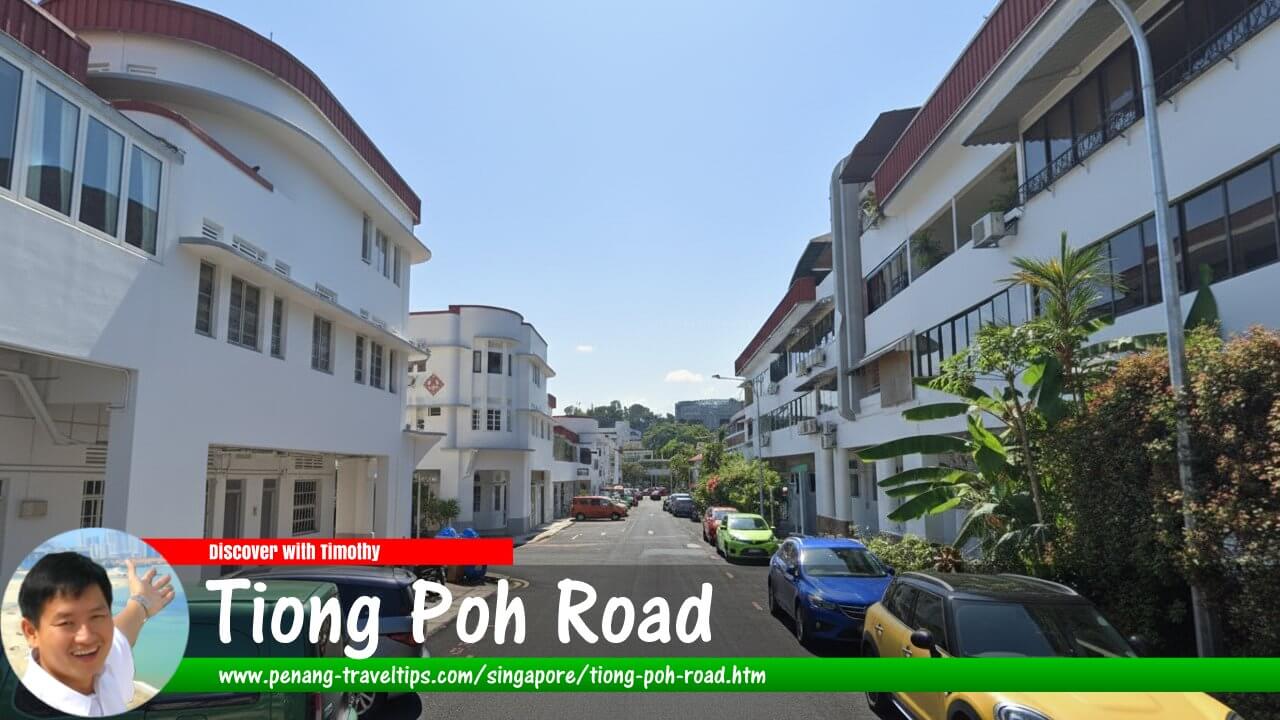 Tiong Poh Road, Singapore (AI-edited photograph on 26 December 2025)
Tiong Poh Road is a short but historically rich street in Singapore, located on the fringe of the well-known Tiong Bahru neighbourhood within the Bukit Merah planning area. Stretching approximately 355 metres, the road links Tiong Bahru Road in the northeast to Guan Chuan Street in the southwest, forming part of an older urban fabric shaped by trade, migration, and early municipal planning.
Quick Facts
- Road length: Approximately 355 metres
- Postal District: Bukit Merah
- Planning Area: 3
- Main connections: Tiong Bahru Road and Guan Chuan Street
- Nearest MRT station: Outram Park (EW16 / NE3 / TE17)
- Primary land use: Residential with light commercial activity
Introduction and Urban Setting
Tiong Poh Road sits at the edge of one of Singapore’s most distinctive residential estates, where early public housing experiments coexist with conserved shophouses and modern developments. While shorter and quieter than nearby arterial roads, it plays an important role in local connectivity and reflects the layered history of the Bukit Merah and Tiong Bahru districts.
The road’s modest scale and relatively low traffic volumes give it a neighbourhood feel, making it more residential in character compared to the busier Tiong Bahru Road nearby.
Historical Development
The area around Tiong Poh Road began to take shape in the late 19th and early 20th centuries, when Singapore was expanding beyond its original colonial core. Bukit Merah, once characterised by plantations and rural settlements, gradually urbanised as roads, housing, and port-related industries developed.
Tiong Poh Road was laid out as part of this expansion, providing access between major routes and serving the growing population living near the port and railway-related facilities. Its alignment suggests it was designed primarily for local access rather than long-distance travel.
Origin of the Name
According to Singapore Street Names by Victor R. Savage and Brenda S.A. Yeoh, Tiong Poh Road was named after Khoo Tiong Poh (1830–1892), a China-born merchant who rose to prominence in 19th-century Singapore1. He was a shipping magnate with extensive business interests that included tin mining, revenue farming, planting, rice milling, and insurance.
Khoo Tiong Poh was well connected both locally and internationally. In 1888, he was conferred an honorary title by the Manchu government in China, reflecting his standing within the Chinese mercantile world1.
Interestingly, What’s in the Name? by Ng Yew Peng notes that Khoo Tiong Poh was a Teochew, despite being commonly described elsewhere as Hokkien2. This highlights the complex identities and regional affiliations of early Chinese migrants in Singapore.
Street Character and Surroundings
Tiong Poh Road is primarily residential, lined with a mix of older low-rise apartments, walk-up flats, and some newer residential developments. The architectural styles vary, reflecting different phases of development from the pre-war period to the late 20th century.
The street is generally calm, with limited commercial activity. Small offices, studios, or home-based businesses occasionally occupy ground-floor units, but there is no concentration of retail outlets directly along the road.
Nearby Roads and Connections
The road’s significance lies in its proximity to several important streets and neighbourhoods. Tiong Bahru Road, at its northeastern end, is a major artery that connects the area to the Central Business District and Alexandra Road.
Other nearby streets include:
- Guan Chuan Street, which leads towards older industrial and residential pockets.
- Kim Tian Road, associated with early public housing developments.
- Eng Hoon Street, known for its conserved shophouses and cafés.
Points of Interest Nearby
Although Tiong Poh Road itself is quiet, it is within walking distance of several well-known landmarks. The Tiong Bahru estate, often cited as Singapore’s first public housing project, is nearby and admired for its distinctive Art Deco-style architecture.
The Tiong Bahru Market and Food Centre, a popular destination for both locals and tourists, is also close by. Additionally, the area features independent bookstores, cafés, and heritage trails that highlight the neighbourhood’s cultural significance.
Residential Property and Prices
Residential properties around Tiong Poh Road include older apartments and private residential developments. As of late 2024 and early 2025, private residential prices in the Bukit Merah and Tiong Bahru area typically ranged from about SGD 1,800 to SGD 2,600 per square foot, depending on age, condition, and proximity to MRT stations3.
Typical unit sizes range from approximately 500 to 1,200 sq ft (46–111 sq m). Sale prices often fall between SGD 900,000 and SGD 2.5 million. Rental rates generally range from SGD 3,200 to SGD 6,000 per month.
Compared to prime central districts, the area offers relatively better value while still being close to the city centre.
Public Transport Access
The nearest MRT station is Outram Park MRT Station, an important interchange served by the East–West Line (EW16), North East Line (NE3), and Thomson–East Coast Line (TE17)4. This provides excellent connectivity to almost all parts of Singapore.
Multiple bus services operate along Tiong Bahru Road and nearby arterials, with stops located within a short walking distance of Tiong Poh Road.
Neighbourhood Atmosphere
Life along Tiong Poh Road is generally quiet and residential, shaped by long-term residents and professionals who value the area’s heritage charm and central location. The street experiences little through traffic, contributing to its calm environment.
Fun Fact
Tiong Poh Road is one of several streets in the area named after prominent Chinese merchants, collectively reflecting the economic influence of early Chinese entrepreneurs on Singapore’s urban landscape.
Map of Tiong Poh Road, Singapore
References
- Victor R. Savage & Brenda S.A. Yeoh, Singapore Street Names
- Ng Yew Peng, What’s in the Name?
- Urban Redevelopment Authority – Residential Property Market Data
- Land Transport Authority – MRT System Map
Page Details
This page was created on 26 December 2025. Hi, my name is Timothy and created it from my research, for my own entertainment, knowledge and to satisfy my curiosity. I am providing the information to you in good faith and hope it is useful. I try to get the details as accurate as possible. I also try to update the page whenever I stumble on new details. So this and all my other pages are perpetual work in progress. If you discover any error, please politely inform me, pointing out where the error lies, and I will correct it as soon as possible. Your helpfulness will keep this page accurate, relevant and helpful to those who need the information.Streets of Singapore Directory
My videos of Singapore
Want to share your Singapore travel experiences or get tips from fellow travellers?
Join the Singapore Travel Tips Facebook GroupMore information for visiting and living in Singapore
Here are some related articles to help you get to know Singapore better.- Cost of Living in Different Singapore Neighbourhoods (2025 Guide)
- EZ-Link Card
- Owning a Car in Singapore
- Singapore MRT Map & Guide 2025
- Singapore Postal Districts and Postcodes
- Singapore Tourist Pass
- Taking the Bus in Singapore: A Visitor's Guide
- Understanding CCR, RCR and OCR in Singapore real estate
 Latest Pages & Updates
Buy Me A Coffee
If you enjoy the information I provide and want to support the work I do, please buy me a coffee! I appreciate it immensely, thank you so much!
