
Shopping Malls in Singapore
Shopping malls in Singapore are a defining feature of the city-state’s urban landscape, serving not just as retail destinations but also as social, cultural, and entertainment hubs. From iconic complexes along Orchard Road to community-oriented suburban centres, shopping malls play an integral role in Singapore’s lifestyle and economy.
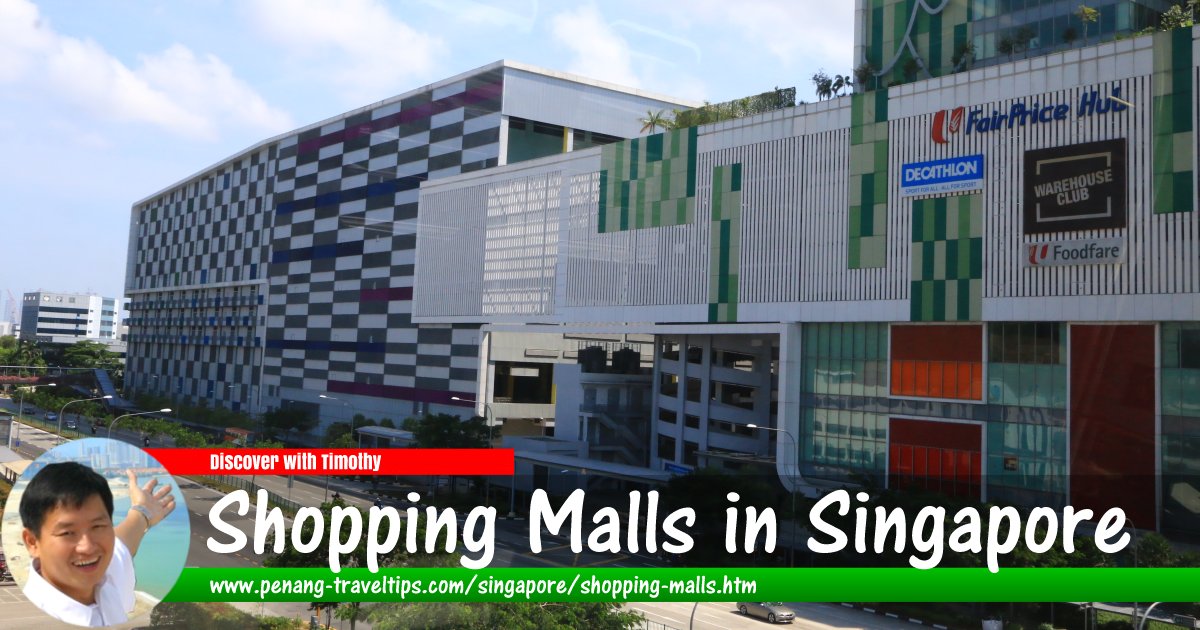 Shopping Malls in Singapore (29 July 2017)
Quick Facts
- First modern mall: People’s Park Complex (1970) 1
- Major retail belt: Orchard Road 2
- Suburban expansion began: late 1980s to 1990s 3
- Typical features: retail, dining, cinemas, supermarkets, lifestyle services
- Number of malls (approx.): Over 150 island-wide 4
- Notable developers: CapitaLand, Frasers Property, Lendlease, Mapletree, Far East Organization
History and Development
The story of shopping malls in Singapore began in the post-independence years of rapid urbanisation. The 1970 opening of People’s Park Complex in Chinatown marked a milestone — it was the country’s first mixed-use high-rise commercial development and introduced the concept of an enclosed shopping mall. 1
In the 1970s and 1980s, Orchard Road rose to prominence as the island’s premier retail boulevard. Malls such as Centrepoint, Paragon, Wisma Atria, and Tangs Plaza became synonymous with cosmopolitan shopping. 2 These complexes combined air-conditioned comfort with international brands, offering a modern retail experience that contrasted sharply with traditional shophouses and wet markets.
The Rise of Suburban Malls
By the late 1980s and early 1990s, Singapore’s Housing and Development Board (HDB) towns had matured, and the government began encouraging retail decentralisation to reduce congestion along Orchard Road. This policy shift led to the creation of suburban malls such as Tampines Mall, Jurong Point, Causeway Point, and Hougang Mall. 3
These neighbourhood centres were strategically built near transport nodes, especially MRT stations and bus interchanges, allowing residents to shop, dine, and enjoy leisure activities close to home. Malls like NEX in Serangoon, Northpoint City in Yishun, and Junction 8 in Bishan exemplify this trend. They blend retail, entertainment, and community services such as libraries and enrichment centres under one roof.
Iconic and Major Malls
Singapore boasts several landmark malls that attract both locals and tourists:
- ION Orchard – a high-end lifestyle mall with luxury boutiques and fine dining, connected to Orchard MRT. 2
- VivoCity – the largest shopping mall in Singapore, featuring rooftop promenades, a waterfront view, and direct access to Sentosa Island. 5
- Marina Bay Sands Shoppes – renowned for its canal and international designer labels, catering to visitors in the Marina Bay district. 6
- Jewel Changi Airport – a globally recognised lifestyle destination combining retail with nature, highlighted by the Rain Vortex, the world’s tallest indoor waterfall. 7
Neighbourhood and Community Malls
Beyond the glitzy icons, Singapore’s neighbourhood malls such as Compass One (Sengkang), Bedok Mall, Lot One (Choa Chu Kang), and Waterway Point (Punggol) play an equally important role. They provide everyday conveniences for residents, featuring supermarkets, medical clinics, tuition centres, and food courts. Many of these are integrated into residential developments or transport interchanges, making them an essential part of urban community living.
Evolution and Trends
Modern malls in Singapore have evolved beyond pure retail. With the rise of e-commerce, mall operators have shifted towards “experiential” concepts — offering lifestyle, entertainment, and wellness experiences that cannot be replicated online. Examples include trampoline parks, escape rooms, and pop-up art exhibitions. Many malls also host community events, farmers’ markets, and charity drives to strengthen local engagement. 8
Some newer developments combine office towers, residences, and hotels with retail podiums — for instance, Paya Lebar Quarter and Funan (redeveloped in 2019) which integrate technology, sustainability, and co-working spaces. 9
Fun Facts About Singapore’s Malls
- Singapore reportedly has one of the highest retail floor areas per capita in Asia. 4
- VivoCity spans more than 1 million sq ft of retail space — equivalent to about 18 football fields. 5
- Plaza Singapura was one of the first air-conditioned malls with an integrated cinema complex when it opened in 1974. 10
- Jewel Changi Airport is both a mall and a tourist attraction, drawing millions of visitors yearly even during transit layovers. 7
- Many malls are directly connected underground, especially along Orchard Road, allowing seamless access during rain. 2
Summary
From luxury shopping along Orchard Road to convenient suburban centres like NEX and Northpoint City, Singapore’s malls reflect the nation’s adaptability and urban ingenuity. They have grown from simple retail spaces into integrated lifestyle environments — places to shop, dine, work, learn, and gather. The continued evolution of these malls ensures they remain central to Singapore’s urban and social fabric.
Map of Shopping Malls in Singapore
List of Shopping Malls in Singapore
- 313@Somerset (GPS: 1.30118, 103.83836)

- Albert Centre (GPS: 1.30106, 103.85399)

- Albert Complex (GPS: 1.3024, 103.85379)

- Albert Court (GPS: 1.3039, 103.85106)

- Bedok Point (GPS: 1.32499, 103.93236)

- Bugis Junction (GPS: 1.29952, 103.85569)

- Bugis+ (GPS: 1.29958, 103.8542)

- Burlington Square (GPS: 1.30231, 103.85255)

- Causeway Point Shopping Centre (GPS: 1.43565, 103.78547)

- Century Square (GPS: 1.35242, 103.9438)

- China Square Central (GPS: 1.28389, 103.84735)

- Chinatown Point (GPS: 1.28532, 103.84495)

- City Square Mall (GPS: 1.31147, 103.85667)

- CityLink Mall (GPS: 1.29181, 103.85531)

- CityVibe (GPS: 1.31421, 103.76516)

- Clarke Quay Central (GPS: 1.28913, 103.84679)

- Eastpoint Mall (GPS: 1.34269, 103.95307)

- ERA Centre (GPS: 1.33237, 103.84774)

- FairPrice Hub (GPS: 1.30732, 103.83316)

- Far East Plaza (GPS: 1.30732, 103.83316)
- Far East Square (GPS: 1.28327, 103.84837)

- Forum The Shopping Mall (GPS: 1.30623, 103.82864)

- Funan (GPS: 1.29153, 103.84992)

- Havelock II (GPS: 1.28715, 103.84515)

- Hillion Mall (GPS: 1.37851, 103.76301)

- Holland Road Shopping Centre (GPS: 1.31037, 103.7955)

- Hong Lim Complex (GPS: 1.28467, 103.84565)

- Hougang Mall (GPS: 1.37246, 103.89378)

- Hougang 1 Mall (GPS: 1.37581, 103.87944)

- IMM (GPS: 1.33451, 103.747)

- International Building (GPS: 1.30616, 103.83098)

- ION Orchard (GPS: 1.30394, 103.83197)

- JCube (GPS: 1.33331, 103.74019)

- Jem (GPS: 1.33325, 103.74336)

- Leisure Park (GPS: 1.30218, 103.8765)

- Little India Arcade (GPS: 1.30571, 103.85182)

- Lot One Shoppers' Mall (GPS: 1.38508, 103.74494)

- Lucky Plaza (GPS: 1.30439, 103.83407)

- Mandarin Gallery (GPS: 1.30189, 103.83637)

- Marina Bay Link Mall (GPS: 1.27995, 103.85447)

- Marina Square (GPS: 1.29116, 103.85718)

- Millenia Walk (GPS: 1.29265, 103.8597)

- Mustafa Centre (GPS: 1.30998, 103.85546)

- myVillage (GPS: 1.36521, 103.86526)

- NEX Mall (GPS: 1.35071, 103.87202)

- Ngee Ann City (GPS: 1.30259, 103.83452)

- Northpoint Shopping Centre (GPS: 1.42956, 103.83612)

- OneKM (GPS: 1.31479, 103.8946)

- Orchard Central (GPS: 1.3007, 103.83962)

- Orchard Plaza (GPS: 1.30115, 103.84118)

- Orchard Point (GPS: 1.30129, 103.84055)

- OUE Tower (GPS: 1.28354, 103.85309)

- Pacific Plaza (GPS: 1.30637, 103.83216)

- Palais Renaissance (GPS: 1.30671, 103.82959)

- Parklane Shopping Mall (GPS: 1.30068, 103.84933)

- Paya Lebar Square (GPS: 1.3188, 103.89249)

- Peninsula Plaza (GPS: 1.29231, 103.85078)

- Peninsula Shopping Centre (GPS: 1.29184, 103.8503)

- People's Park Centre (GPS: 1.28583, 103.84389)

- People's Park Complex (GPS: 1.28408, 103.84257)

- Plaza Singapura (GPS: 1.30012, 103.84483)

- Queensway Shopping Centre (GPS: 1.28748, 103.80324)

- Raffles City (GPS: 1.29401, 103.85338)

- Rochester Mall (GPS: 1.30528, 103.78817)

- Scotts Square (GPS: 1.30588, 103.83295)

- Serangoon Plaza (GPS: 1.31089, 103.85523)

- Shaw House (GPS: 1.30568, 103.83168)

- Singapore Shopping Centre (GPS: 1.29816, 103.84413)

Stamford Housenow turned into hotel The Capitol Kempinski Hotel Singapore (GPS: 1.2941, 103.85079)
- Suntec City Mall (GPS: 1.29345, 103.85716)

- T Galleria by DFS (GPS: 1.3074, 103.8325)

- Tampines 1 (GPS: 1.35426, 103.94502)

- Tampines Mall (GPS: 1.35261, 103.94469)

- Tangs Department Store (GPS: 1.30498, 103.83299)

- Tanjong Pagar Plaza (GPS: 1.27565, 103.84271)

- The Adelphi (GPS: 1.29124, 103.85103)

- The Centrepoint (GPS: 1.30156, 103.83977)

- The Clementi Mall (GPS: 1.31491, 103.7643)

- The Heeren Shops (GPS: 1.30263, 103.8373)

- The Majestic (GPS: 1.28474, 103.84322)

- The Paragon (GPS: 1.30379, 103.8355)

- The Seletar Mall (GPS: 1.39121, 103.87636)

- The Star Vista (GPS: 1.30676, 103.78842)

- The Verge (GPS: 1.30455, 103.85262)

- Thomson Plaza (GPS: 1.3547, 103.83103)

- UE Square Shopping Mall (GPS: 1.29216, 103.84266)

- Upper Serangoon Shopping Centre (GPS: 1.35354, 103.87881)

- VivoCity (GPS: 1.26551, 103.8221)

- West Mall (GPS: 1.35011, 103.74921)

- Wheelock Place (GPS: 1.30474, 103.83055)

- White Sands (GPS: 1.37247, 103.94961)

- Wisma Atria (GPS: 1.30377, 103.83304)

- Yew Tee Point (GPS: 1.39701, 103.74679)

References
- “People’s Park Complex – Wikipedia”
- “Orchard Road – Wikipedia”
- “Tampines Regional Centre – Singapore Infopedia”
- “Singapore Has Over 150 Shopping Malls – Business Times”
- “VivoCity – Wikipedia”
- “The Shoppes at Marina Bay Sands – Wikipedia”
- “Jewel Changi Airport – Wikipedia”
- “Retail Evolves as Singapore Malls Emphasise Experiences – TODAY Online”
- “CapitaLand Reopens Funan – CapitaLand Press Release”
- “Plaza Singapura – Singapore Infopedia”
Page Details
This page was created on 21 October 2025. Hi, my name is Timothy and created it from my research, for my own entertainment, knowledge and to satisfy my curiosity. I am providing the information to you in good faith and hope it is useful. I try to get the details as accurate as possible. I also try to update the page whenever I stumble on new details. So this and all my other pages are perpetual work in progress. If you discover any error, please politely inform me, pointing out where the error lies, and I will correct it as soon as possible. Your helpfulness will keep this page accurate, relevant and helpful to those who need the information.Back to Residential Properties in Singapore main page
My videos of Singapore
Want to share your Singapore travel experiences or get tips from fellow travellers?
Join the Singapore Travel Tips Facebook GroupMore information for visiting and living in Singapore
Here are some related articles to help you get to know Singapore better.- Cost of Living in Different Singapore Neighbourhoods (2025 Guide)
- EZ-Link Card
- Owning a Car in Singapore
- Singapore MRT Map & Guide 2025
- Singapore Postal Districts and Postcodes
- Singapore Tourist Pass
- Taking the Bus in Singapore: A Visitor's Guide
- Understanding CCR, RCR and OCR in Singapore real estate
 Latest Pages & Updates
Buy Me A Coffee
If you enjoy the information I provide and want to support the work I do, please buy me a coffee! I appreciate it immensely, thank you so much!
