
Punggol Travel Guide
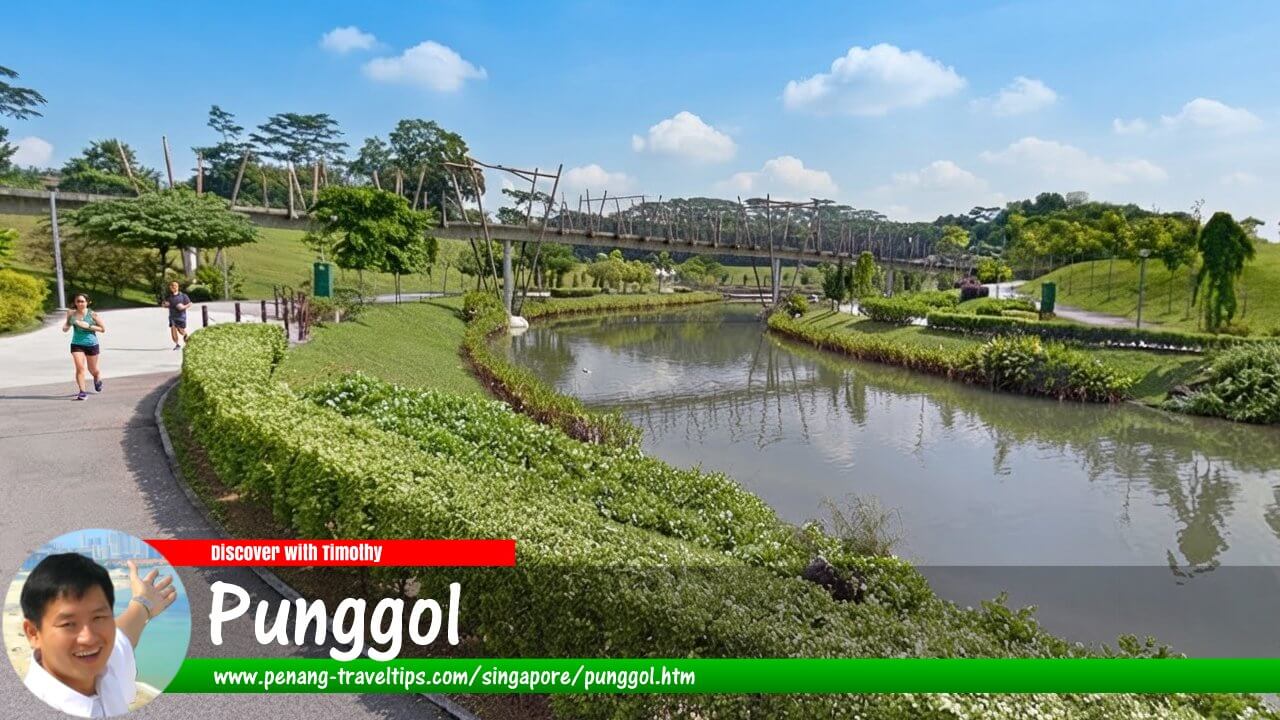 Punggol, Singapore (AI image created on 12 August 2026)
The Punggol Planning Area (Simplified Chinese: 榜鹅, Traditional Chinese: 榜鵝, Pinyin: Bǎng’é, Malay: Punggol, Tamil: புங்கோல்) is a vibrant residential new town located in the North-East Region of Singapore. Covering around 9.57 square kilometres, Punggol has undergone a dramatic transformation in recent decades, from a rural kampong and farming settlement into one of Singapore’s most modern and well-planned residential towns. With its reputation as Singapore’s first “Digital District” and its extensive network of waterways, parks, and smart technology, Punggol has become a showcase for sustainable urban living.
History of Punggol
The name “Punggol” comes from the Malay word “penggolek,” which refers to a place where fruits or produce are thrown together or piled up. Historically, Punggol was a fishing and farming village, with pig farms, plantations, and coastal activities dominating the landscape. During the 20th century, it was known for its seafood restaurants and beachside attractions. Large-scale redevelopment began in the 1990s, and today Punggol has been reborn as a waterfront town, with major housing estates, amenities, and transport infrastructure.
Name and Pronunciation
“Punggol” is pronounced /ˈpuːŋɡɔːl/ in English, though locals often say it as “Pong-gol.” In Chinese, it is Bǎng’é (榜鹅 / 榜鵝), while in Tamil it is புங்கோல். Its Malay name is the original, referring to its agricultural past.
Geography and Boundaries
Punggol is located at the northeastern tip of Singapore. It is bounded by the Serangoon Planning Area to the west, Sengkang Planning Area to the southwest, Pasir Ris Planning Area to the east, and the Johor Strait to the north. The town’s coastal position makes it ideal for waterfront parks and recreational spaces, many of which have been integrated into its urban design.
Transport and Accessibility
Punggol is served by the Punggol MRT/LRT Station on the North East Line, which is also an interchange with the Punggol LRT system that connects different residential estates. Future plans include the extension of the Cross Island Line (CRL) and the Thomson-East Coast Line (TEL), both of which will enhance connectivity. Major roads such as Punggol Road, Tampines Expressway (TPE), and Kallang-Paya Lebar Expressway (KPE) provide convenient access by car and bus.
Residential Character
Punggol is primarily residential, with a mix of HDB flats, executive condominiums, and private housing projects. It is well-known for thematic HDB precincts such as Punggol Waterway Terraces and waterfront-inspired developments. As of 2025, HDB resale flat prices in Punggol range from SGD 480,000 to 650,000 for 4-room units, while private condominiums average around SGD 1,300–1,600 per square foot (13,993–17,222 per sq m). Rentals are generally between SGD 2,600 and 3,800 per month, making Punggol attractive to families and young professionals.
Landmarks and Attractions
- Punggol Waterway Park – a scenic waterway integrated with cycling paths, bridges, and lush greenery.
- Coney Island (Pulau Serangoon) – a rustic offshore island connected by a bridge, popular for cycling and nature walks.
- Oasis Terraces – a modern neighbourhood centre with healthcare, retail, and dining options.
- Punggol Digital District (PDD) – Singapore’s first digital district, hosting high-tech businesses, institutes of higher learning, and innovation hubs.
Lifestyle and Amenities
Punggol offers extensive amenities designed for families and young residents. Shopping centres such as Waterway Point provide retail and entertainment, while hawker centres and neighbourhood malls cater to everyday needs. The town is also known for its cycling-friendly infrastructure, with park connectors linking residents to Sengkang, Pasir Ris, and the rest of the island.
Where to Stay
Punggol is an excellent place to visit, but it is not yet a major hotel district. Unlike Orchard Road, Marina Bay or the Downtown Core, Punggol has very little conventional hotel accommodation. Visitors who want to stay here should therefore be aware that the choice is much more limited than in central Singapore.
For most visitors, the practical solution is to stay in a nearby planning area and visit Punggol as part of an eastern or northeastern Singapore itinerary. Pasir Ris is one of the most convenient alternatives, particularly because it has D'Resort @ Downtown East, while Changi and Tampines also provide a wider range of conventional hotel accommodation.
For visitors who specifically want to experience Punggol over several days, serviced apartments and short-term accommodation may provide alternatives, although availability and eligibility vary. It is worth checking the accommodation's location carefully because Punggol is a large planning area and some properties described as being in Punggol may be considerably farther from the waterfront attractions than expected.
For most visitors, I would recommend staying near Punggol MRT Station or Punggol Coast MRT Station if accommodation within the planning area becomes available. These two stations provide access to the town centre, Waterway Point, Punggol Coast Mall, Punggol Digital District and the waterfront.
Punggol's lack of conventional hotels is not necessarily a disadvantage. It means that the area remains primarily a residential new town rather than a tourist enclave. Visitors who stay nearby can come into Punggol during the day, while those who have a particular reason to spend more time here can use the MRT and LRT networks to move around the planning area.
Families may also consider staying in Pasir Ris. D'Resort @ Downtown East is especially convenient because it provides resort-style accommodation beside Pasir Ris Park, while Punggol can be reached relatively easily from the neighbouring eastern planning areas.
Visitors who want a more conventional city-hotel experience should instead stay closer to the central area. Punggol is well connected by public transport, but travelling from the city centre to Punggol takes time. It therefore makes more sense to stay in Punggol when the waterfront, Coney Island, Punggol Digital District or the surrounding northeastern neighbourhoods are an important part of your itinerary.
What to Eat
Punggol has developed a surprisingly strong food scene. The planning area was once regarded primarily as a residential new town at the northeastern edge of Singapore, but its expanding population and the development of Punggol Coast have brought an increasingly diverse range of food outlets.
Visitors now have several distinct food destinations to choose from. The most important are One Punggol Hawker Centre, Punggol Coast Hawker Centre, Waterway Point, Punggol Coast Mall, Punggol Settlement and the restaurants around Punggol Waterway.
One Punggol Hawker Centre is located within the One Punggol community hub and provides a convenient introduction to everyday Singaporean hawker food. The centre is particularly useful for visitors staying or spending time around the older Punggol town centre.
Punggol Coast Hawker Centre is the newer destination and is especially interesting because it forms part of the rapidly developing Punggol Coast precinct. It provides inexpensive local food close to Punggol Coast Mall, Punggol Coast MRT Station and the Punggol Digital District.
Visitors looking for a modern restaurant environment can head to Waterway Point, beside Punggol MRT Station. The shopping centre contains a large variety of restaurants, cafés, fast-food outlets and dessert shops, making it one of the easiest places to find food in central Punggol.
Punggol Coast Mall has added another substantial food destination to the planning area. Its current directory includes restaurants and cafés serving Taiwanese, Japanese, Korean and other cuisines, as well as bakeries, coffee shops and dessert outlets.
For visitors wanting something more atmospheric, Punggol Settlement is worth considering. The cluster of restaurants near Punggol Point offers a waterfront setting and is particularly pleasant in the evening.
Punggol also has a good selection of halal food. Halal choices can be found at the hawker centres, shopping malls and independent restaurants throughout the planning area. The selection is especially useful for Muslim visitors because Punggol's residential population supports a substantial market for halal Malay, Indonesian and other cuisines.
Visitors who require formally halal-certified food should nevertheless check the current certification status of individual stalls and restaurants before dining, since tenants and certification status can change.
Where to Eat
Punggol is now large enough that it is useful to think of its food scene in several separate clusters. The following places are particularly useful for visitors.
- One Punggol Hawker Centre – A convenient local hawker centre within the One Punggol community hub. It provides a broad selection of inexpensive Singaporean dishes and is particularly useful for visitors exploring the town centre and Punggol Waterway.
- Punggol Coast Hawker Centre – One of the newer hawker centres in Singapore and an excellent choice for inexpensive local food. Its location beside Punggol Coast Mall makes it especially convenient for visitors exploring the new Punggol Coast precinct.
- Waterway Point – The principal shopping and dining centre beside Punggol MRT Station. It contains a wide variety of restaurants, cafés, bakeries, fast-food outlets and dessert shops, making it one of the safest choices when travelling with a group with different food preferences.
- Din Tai Fung at Punggol Coast Mall – A Taiwanese restaurant specialising in xiao long bao and other Taiwanese dishes. It is a useful choice for visitors wanting a familiar sit-down restaurant in the new Punggol Coast precinct.
- Ha Jun Korean – A Korean restaurant at Punggol Coast Mall offering Korean dishes in the new town-centre development. It provides an alternative to the local hawker food found nearby.
- Nayana K-Pop Cafe & Restaurant – A Korean-themed café and restaurant at Punggol Coast Mall, particularly suitable for visitors interested in Korean food and popular culture.
- Fun Toast at Punggol Coast Mall – A convenient place for a traditional Singaporean-style breakfast of kaya toast, eggs and Nanyang coffee.
- Swee Heng 1989 Classic at Punggol Coast Mall – A halal bakery offering breads, cakes and other baked goods. It is a useful option for Muslim visitors looking for a quick breakfast, snack or takeaway.
- Tara Na! by Easy Eatz SG – A halal Filipino restaurant at Punggol Container Park on Tebing Lane. It offers Filipino dishes such as sisig, grilled dishes and halo-halo, giving visitors an unusual halal option in the Punggol food scene.
- Thai Mama – A Thai food outlet at Oasis Terraces. It is a useful option for visitors exploring the southern side of Punggol Waterway and looking for something beyond Singaporean hawker food.
- Leong Ji Seafood – A zi char-style restaurant serving Chinese dishes and seafood. It is a useful choice for groups wanting to share several dishes.
- Keng Eng Kee Seafood at Punggol SAFRA – A branch of the established Singapore zi char restaurant, offering familiar Chinese seafood and zi char dishes in the Punggol area.
- Punggol Settlement – A cluster of restaurants and cafés near Punggol Point rather than a single restaurant. Its waterfront setting makes it particularly suitable for an evening meal after exploring the coast.
For visitors who want the most distinctly Singaporean food experience, I would recommend starting with One Punggol Hawker Centre or Punggol Coast Hawker Centre. These provide a much better introduction to everyday local food than the international restaurant chains found in the shopping malls.
For Muslim visitors, Punggol is relatively convenient. The planning area has halal choices in its hawker centres, malls and independent restaurants, while Swee Heng 1989 Classic at Punggol Coast Mall provides an easy halal bakery option.
The newest and most interesting halal addition is Tara Na! at Punggol Container Park. Opened in July 2026, it is described as a 100-per-cent Muslim-owned halal Filipino restaurant and gives Punggol a cuisine that is not commonly encountered elsewhere in Singapore.
For a meal with a view, head towards Punggol Settlement. The restaurants here are more about the atmosphere than about inexpensive hawker food, but the waterfront setting makes them particularly enjoyable around sunset.
For families, Waterway Point and Punggol Coast Mall are probably the easiest choices because they offer many different cuisines under one roof and provide air-conditioned surroundings, shopping and other facilities.
Exploring Punggol
Punggol is one of Singapore's most interesting examples of a modern waterfront new town. Although it is now dominated by high-rise residential estates and contemporary infrastructure, its history goes much further back. URA notes that Punggol was once a landscape of farming villages and waterfront settlements, with attractions such as the Japanese Fishing Pond and Basapa Punggol Zoo.
The transformation of Punggol began in earnest after plans were announced in 1982 to redevelop the area into a new residential town. Land reclamation, new roads, housing and infrastructure gradually transformed the northeastern tip of Singapore.
Today, Punggol is best known for its waterfront setting. The planning area combines residential neighbourhoods with waterways, parks, promenades, cycling routes and coastal recreation areas.
Punggol Waterway Park is the central recreational feature of the new town. The waterway winds through the residential estates and provides a continuous setting for walking, jogging and cycling.
The waterway is particularly attractive in the evening, when residents use the paths for exercise and recreation. For visitors, it provides an opportunity to see how Singapore has incorporated landscaped waterways and public recreation into a large new residential town.
Waterway Point sits beside the waterway in the heart of the town centre. The mall is directly connected with Punggol MRT Station and provides shopping, restaurants, entertainment and everyday services.
One of the best ways to experience Punggol is to combine Waterway Point with the waterfront. Have lunch at the mall, walk along the waterway and then continue towards the northern part of the planning area.
At the northern end of Punggol is Punggol Point Park, a small coastal park at the end of Punggol Road. NParks describes it as a coastal park with scenic sea views and recreational facilities, and it is connected to the North Eastern Riverine Loop of the Park Connector Network.
From Punggol Point, visitors can continue towards Coney Island Park. The island, also known as Pulau Serangoon, is connected to Punggol by bridges and contains a mixture of coastal habitats, woodland and park trails.
Coney Island is particularly enjoyable for visitors who like walking, cycling and nature. It feels considerably more rustic than the highly developed residential areas nearby.
The contrast between the new town and Coney Island is one of Punggol's greatest attractions. Within a relatively short journey, visitors can move from high-rise residential towers and modern shopping centres into a natural environment of trees, coastal vegetation and wildlife.
Punggol Point Walk and the surrounding waterfront promenade are also worth exploring. The coastal paths provide open views and are particularly pleasant during the early morning or late afternoon.
Punggol has become increasingly attractive to cyclists because of its extensive network of park connectors. The Punggol and North Eastern Riverine Loop connect the waterfront with other parts of northeastern Singapore, allowing visitors to explore much of the area without relying entirely on roads.
Another major attraction is the new Punggol Coast precinct. The opening of Punggol Coast MRT Station has strengthened the northern part of the planning area and made the waterfront and new developments more accessible.
Punggol Coast Mall is now part of this emerging town centre. The mall provides shopping, dining and community facilities, while the surrounding Punggol Digital District is creating a new employment and education hub.
The development of Punggol Digital District is one of the most important changes taking place in Singapore outside the traditional city centre. URA describes it as a 50-hectare district centred on digital and cyber-security industries, with the Singapore Institute of Technology campus integrated with JTC's business park developments.
The district is deliberately designed to be walkable, cycling-friendly and closely integrated with the waterfront. Its streets and public spaces are intended to connect workplaces, education, retail, dining and community facilities.
The Market Village and Nexus are part of this emerging environment. Nexus provides a sheltered community plaza connected to Punggol Coast MRT Station and the bus interchange, while the wider district is being developed with retail, dining and public spaces.
For visitors interested in architecture and urban planning, Punggol Digital District is particularly worthwhile because it provides a glimpse of how Singapore is planning its next generation of mixed-use neighbourhoods.
The district is also home to the Singapore Institute of Technology. The university campus is integrated into the wider Punggol Digital District rather than being an isolated campus, reinforcing the area's role as a place for living, working and learning.
Visitors should also explore One Punggol, a major community hub. It combines community facilities with a library, hawker centre and other services, illustrating the way Singapore's newer towns increasingly concentrate public facilities within integrated developments.
Punggol's history can be discovered through its older roads and waterfront names as well. The area was once much more rural, with kampongs, farms and seafood businesses along the coast. The modern town has replaced much of that landscape, but traces of the older Punggol survive around the waterfront.
The Punggol Settlement is particularly important in this respect. Located near the old coastal end of Punggol Road, it has become a leisure and dining destination while retaining the atmosphere of the old waterfront.
Another attraction is the area's proximity to Seletar and Lower Seletar. Visitors with more time can explore the wider northeastern region by bicycle or public transport.
Punggol is also a good place to experience Singapore's park connector network. The combination of waterways, coastal paths and cycling routes makes it possible to create an itinerary that involves relatively little time on conventional roads.
For families, a particularly enjoyable itinerary is to begin at Punggol MRT Station and Waterway Point, walk or cycle along Punggol Waterway, stop for food at one of the nearby restaurants, and continue northwards towards Punggol Point.
Nature lovers can extend the trip into Coney Island. Bring water, wear comfortable shoes and allow enough time to explore the trails rather than simply walking across the island.
For visitors interested in Singapore's future, the alternative itinerary is to begin at Punggol Coast MRT Station, explore Punggol Coast Mall and Punggol Digital District, then walk towards the waterfront promenade.
The latter itinerary shows a very different side of Singapore. Instead of colonial buildings and historic streets, visitors see a new urban district designed around technology, sustainability, public transport, cycling and waterfront recreation.
Punggol is also a particularly good destination at sunset. The northern coastline provides open views across the water, while the waterfront paths around Punggol Point and Punggol Settlement are pleasant places to spend the early evening.
Visitors should not expect Punggol to provide the same concentration of historical monuments as the Civic District, Chinatown or Little India. Its appeal is different. Punggol is about Singapore's transformation from rural waterfront settlement to modern new town and, increasingly, to a new economic and technology hub.
That transformation is precisely what makes the planning area interesting. The older waterfront, modern housing estates, waterways, parks, university campus and digital district all exist within the same planning area.
For visitors who have already seen Singapore's central attractions, Punggol provides an excellent opportunity to explore a more contemporary side of the country. It is particularly rewarding for visitors interested in architecture, urban planning, cycling, nature and local neighbourhood life.
A full day can easily be spent here. Begin with breakfast around Punggol MRT Station, explore Waterway Point and Punggol Waterway, continue north towards Punggol Point and Coney Island, then return to Punggol Coast for dinner.
Alternatively, spend the morning around Punggol Coast and the Digital District, have lunch at Punggol Coast Hawker Centre, and spend the afternoon exploring the waterfront and Coney Island.
Punggol's greatest strength is its combination of nature and new urban development. Few other planning areas allow visitors to see high-rise housing, a landscaped waterway, a digital business district, a university campus, a coastal park and a semi-natural island within such a compact area.
For that reason, Punggol deserves to be treated as a genuine destination in your Singapore Travel Guide rather than merely another residential planning area.
Accommodation and Food References
- Urban Redevelopment Authority – Punggol Digital District
- Urban Redevelopment Authority – Punggol Digital District Urban Design Guidelines
- National Parks Board – Punggol Point Park
- National Environment Agency – Hawker Centres Managed by NEA-appointed Operators
- Waterway Point – Official Website
- Punggol Coast Mall – Official Website
- Singapore Institute of Technology – Official Website
- JTC Corporation – Official Website
- D'Resort @ Downtown East – Official Website
- Islamic Religious Council of Singapore – MUIS
Fun Facts
- Punggol is often called Singapore’s “new waterfront town” due to its extensive use of waterways and coastal spaces in urban design.
- The upcoming Punggol Digital District is expected to generate thousands of jobs in technology and innovation sectors.
- Coney Island was once privately owned and earmarked for development into an amusement park before being conserved as a nature area.
Map of Punggol, Singapore
MRT and LRT Stations in Punggol
- Coral Edge LRT Station (GPS: 1.39386, 103.91273)

- Cove LRT Station (GPS: 1.39921, 103.90629)

- Damai LRT Station (GPS: 1.40567, 103.908)

- Kadaloor LRT Station (GPS: 1.3996, 103.91662)

- Meridian LRT Station (GPS: 1.39679, 103.90916)

- Nibong LRT Station (GPS: 1.41186, 103.90035)

- Oasis LRT Station (GPS: 1.40163, 103.9137)

- Punggol MRT Station (GPS: 1.4052, 103.90225)

- Punggol Point LRT Station (GPS: 1.41687, 103.90669)

- Riviera LRT Station/Riviera MRT Station (GPS: 1.39541, 103.91673)

- Sam Kee LRT Station (GPS: 1.40976, 103.90489)

- Samudera LRT Station (GPS: 1.41587, 103.90216)

- Soo Teck LRT Station (GPS: 1.40534, 103.89728)

- Sumang LRT Station (GPS: 1.40851, 103.89853)

- Teck Lee LRT Station (GPS: 1.41275, 103.90656)

Condominiums in Punggol
- A Treasure Trove (GPS: 1.4054, 103.89966)

Quick Facts
- Total Area: 9.57 sq km
- Population: ~174,000 (2020)
- Postal District: District 19
- Main MRT: Punggol (North East Line, Punggol LRT)
- Key Features: Punggol Waterway Park, Coney Island, Punggol Digital District
- Character: Modern waterfront residential town with smart city features
References
- Urban Redevelopment Authority – Planning Areas
- Singapore Department of Statistics
- NLB Infopedia – Punggol
- Housing and Development Board – Punggol Town
Page Details
This page was created on 8 September 2025. Hi, my name is Timothy and created it from my research, for my own entertainment, knowledge and to satisfy my curiosity. I am providing the information to you in good faith and hope it is useful. I try to get the details as accurate as possible. I also try to update the page whenever I stumble on new details. So this and all my other pages are perpetual work in progress. If you discover any error, please politely inform me, pointing out where the error lies, and I will correct it as soon as possible. Your helpfulness will keep this page accurate, relevant and helpful to those who need the information.My videos of Singapore
Want to share your Singapore travel experiences or get tips from fellow travellers?
Join the Singapore Travel Tips Facebook GroupMore information for visiting and living in Singapore
Here are some related articles to help you get to know Singapore better.- Cost of Living in Different Singapore Neighbourhoods (2025 Guide)
- EZ-Link Card
- Owning a Car in Singapore
- Singapore MRT Map & Guide 2025
- Singapore Postal Districts and Postcodes
- Singapore Tourist Pass
- Taking the Bus in Singapore: A Visitor's Guide
- Understanding CCR, RCR and OCR in Singapore real estate
 Latest Pages & Updates
Buy Me A Coffee
If you enjoy the information I provide and want to support the work I do, please buy me a coffee! I appreciate it immensely, thank you so much!
