
Moh Guan Terrace, Singapore
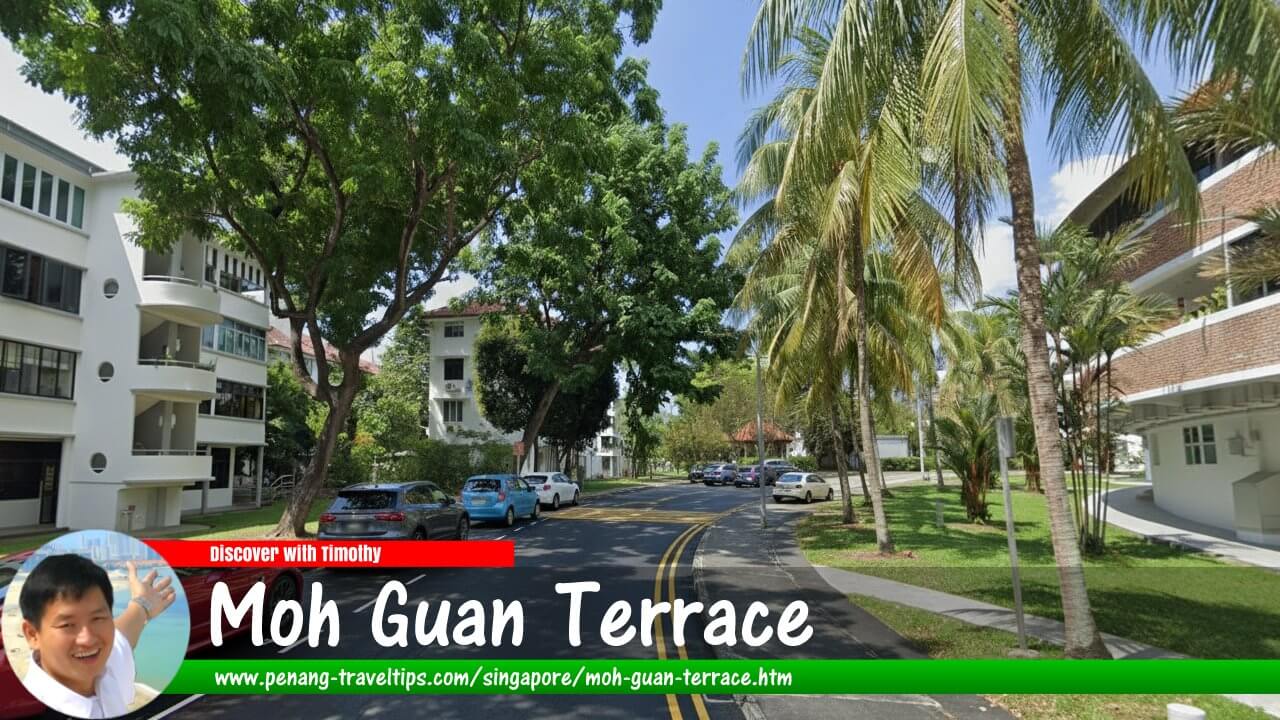 Moh Guan Terrace, Singapore (AI-edited photograph on 26 December 2025)
Moh Guan Terrace is a short one-way street in Singapore, located within the historic Tiong Bahru estate in the Bukit Merah planning area. Measuring about 164 metres in length, it connects Yong Siak Street in the west to Guan Chuan Street and Seng Poh Road in the east, placing it at the heart of one of the country’s earliest and most distinctive public housing neighbourhoods.
Quick Facts
- Road length: Approximately 164 metres
- Postal District: Bukit Merah
- Planning Area: 3
- Road type: One-way street
- Main connections: Yong Siak Street, Guan Chuan Street, Seng Poh Road
- Nearest MRT station: Tiong Bahru (EW17)
Introduction and Setting
Moh Guan Terrace forms part of the compact grid of streets that define the Tiong Bahru estate, an area widely regarded as a milestone in Singapore’s urban development. Although short in length, the street is significant for its association with early public housing, clan history, and community life.
The street’s scale and orientation reflect a neighbourhood designed for walkability, with amenities, markets, and transport nodes located within easy reach.
Historical Development
The Tiong Bahru area was developed in the late 1920s and 1930s as Singapore’s first large-scale public housing project, initially overseen by the Singapore Improvement Trust (SIT). Streets such as Moh Guan Terrace were laid out to serve low-rise and mid-rise flats intended to improve living conditions for working- and middle-class residents.
Much of the surrounding built environment dates from the pre-war and immediate post-war periods, giving the street a strong sense of continuity with Singapore’s early urban planning efforts.
Origin and Meaning of the Name
According to Singapore Street Names by Victor R. Savage and Brenda S.A. Yeoh, Moh Guan Terrace was named after See Moh Guan1. He was the son of See Hood Kee, a prominent figure regarded as the founder of the Hokkien clan in Singapore2.
The street is also locally known as Tiong Bahru Gor Lau, meaning “the Tiong Bahru five storeys”. This name refers to a distinctive five-storey flat in the area, which stood out at the time of its construction when most residential buildings were significantly lower1.
Street Character and Atmosphere
Moh Guan Terrace has a distinctly residential character, lined primarily with apartment blocks from the early public housing era. The buildings typically feature simple façades, open corridors, and practical layouts that prioritised ventilation and light.
The one-way configuration limits through traffic, contributing to a relatively calm and neighbourly atmosphere despite the street’s central location within Tiong Bahru.
Surrounding Streets and Connectivity
The street’s immediate connections place it within a dense and historically rich cluster of roads. Yong Siak Street to the west is well known for its cafés and independent shops housed in conserved shophouses, while Seng Poh Road to the east is a key local spine.
Nearby streets include:
- Guan Chuan Street, named after early Chinese businessman Soh Guan Chuan.
- Tiong Poh Road, another road commemorating a prominent merchant.
- Lim Liak Street, associated with early settlement patterns in the area.
Points of Interest Nearby
Although Moh Guan Terrace itself is quiet, it lies within walking distance of several notable attractions. The Tiong Bahru Market and Food Centre along Seng Poh Road is a major draw, known for traditional hawker fare.
The surrounding estate is also celebrated for its early Art Deco-inspired public housing blocks, many of which have been conserved. Heritage trails frequently pass through the area, highlighting the social history embedded in its streets and buildings.
Residential Property and Prices
Residential properties around Moh Guan Terrace consist mainly of older public housing flats and nearby private apartments. As of late 2024 to early 2025, resale HDB flats in the Tiong Bahru area typically ranged from around SGD 700,000 to over SGD 1.2 million, depending on size, floor level, and remaining lease.
Typical flat sizes range from about 700 to 1,200 sq ft (65–112 sq m). Rental rates for similar units generally fall between SGD 2,800 and SGD 4,500 per month.
Private apartments in the wider Bukit Merah area often command higher prices, with values commonly between SGD 1,800 and SGD 2,600 per square foot during the same period, reflecting strong demand for centrally located, character-rich neighbourhoods.
Public Transport Access
The nearest MRT station is Tiong Bahru MRT Station (EW17), which is served by the East–West Line. This provides direct rail access to the Central Business District, Jurong East, and other major nodes.
Bus stops are conveniently located along Seng Poh Road and Tiong Bahru Road, offering multiple routes that connect the neighbourhood to other parts of the island.
Community and Lifestyle
Moh Guan Terrace benefits from the broader Tiong Bahru lifestyle, which blends long-established residents with younger professionals attracted by the area’s heritage charm. Daily life here revolves around neighbourhood markets, cafés, and communal spaces rather than large shopping malls.
Fun Fact
The nickname Tiong Bahru Gor Lau highlights how a single five-storey building once became a local landmark, symbolising modern living in an era when such building heights were still a novelty in Singapore.
Map of Moh Guan Terrace, Singapore
References
Page Details
This page was created on 26 December 2025. Hi, my name is Timothy and created it from my research, for my own entertainment, knowledge and to satisfy my curiosity. I am providing the information to you in good faith and hope it is useful. I try to get the details as accurate as possible. I also try to update the page whenever I stumble on new details. So this and all my other pages are perpetual work in progress. If you discover any error, please politely inform me, pointing out where the error lies, and I will correct it as soon as possible. Your helpfulness will keep this page accurate, relevant and helpful to those who need the information.Streets of Singapore Directory
My videos of Singapore
Want to share your Singapore travel experiences or get tips from fellow travellers?
Join the Singapore Travel Tips Facebook GroupMore information for visiting and living in Singapore
Here are some related articles to help you get to know Singapore better.- Cost of Living in Different Singapore Neighbourhoods (2025 Guide)
- EZ-Link Card
- Owning a Car in Singapore
- Singapore MRT Map & Guide 2025
- Singapore Postal Districts and Postcodes
- Singapore Tourist Pass
- Taking the Bus in Singapore: A Visitor's Guide
- Understanding CCR, RCR and OCR in Singapore real estate
 Latest Pages & Updates
Buy Me A Coffee
If you enjoy the information I provide and want to support the work I do, please buy me a coffee! I appreciate it immensely, thank you so much!
