
McNair Road, Singapore
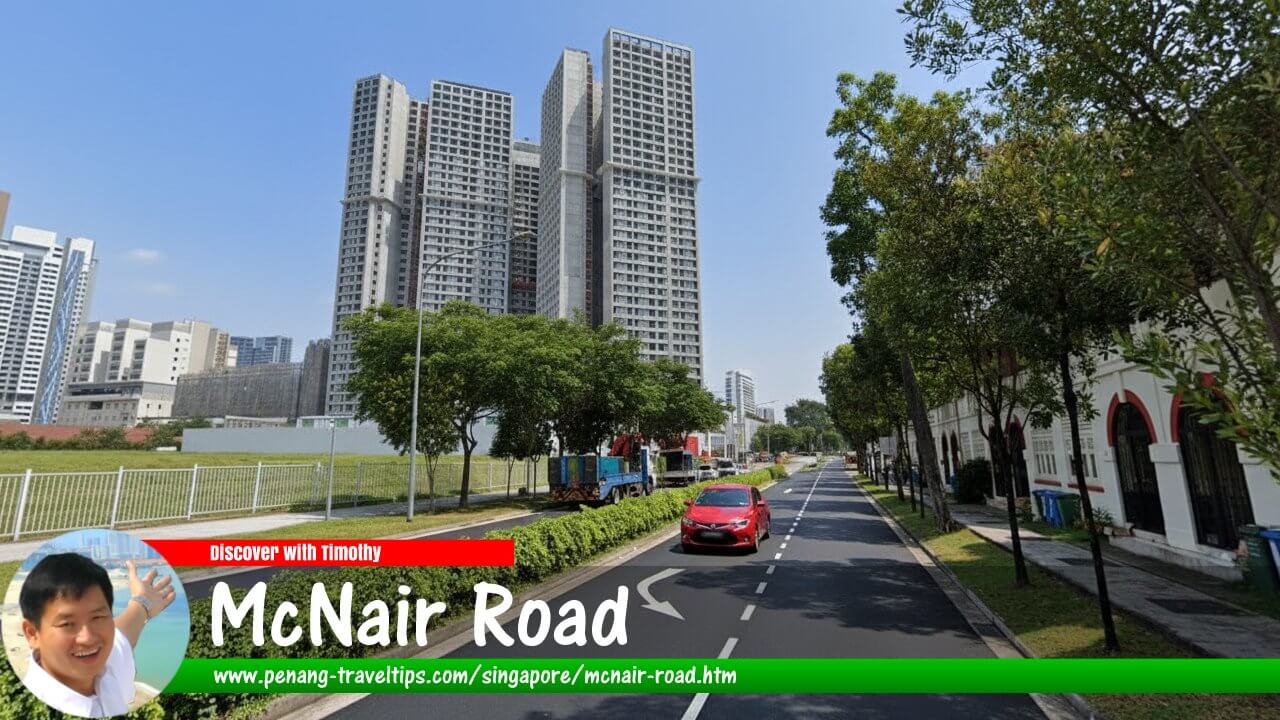 McNair Road, Singapore (AI-edited photograph on 26 December 2025)
McNair Road is a compact but historically rich street in Singapore, located within the Kallang planning area and closely associated with the old Townerville neighbourhood. Measuring about 611 metres in length, the road runs from Balestier Road in the southwest and extends into a residential enclave dominated by public housing, where it intersects Towner Road.
Quick Facts
- Road length: Approximately 611 metres
- Postal District: Kallang
- Planning Area: Kallang (Planning Area 12)
- Main connection: Balestier Road
- Intersecting road: Towner Road
- Nearest MRT station: Boon Keng (NE9)
- Primary land use: Residential (public housing)
Early History and Development
The area around McNair Road was largely undeveloped in the early 19th century, consisting of swamps, plantations, and scattered settlements along riverine corridors. As Singapore expanded beyond its original town centre, the Kallang area gradually took on greater importance due to its proximity to the city and its relatively flat terrain.
McNair Road emerged as part of the broader Townerville development in the early 20th century. This was a period marked by increasing urban planning efforts, when streets were laid out to support growing residential populations near Balestier Road, which had already become a significant arterial route linking town with the northern and eastern districts.
Origin and Meaning of the Name
According to Singapore Street Names by Victor R. Savage and Brenda S. A. Yeoh, McNair Road was named after Major John Frederick Adolphus McNair (1828–1910), Singapore’s first Colonial Engineer and one of the most influential figures in shaping the island’s 19th-century built environment1.
McNair’s legacy is deeply embedded in Singapore’s architectural and civic landscape. Among the most prominent buildings designed or built under his supervision are Government House (now the Istana), St Andrew’s Cathedral, the former Empress Place Building (now the Asian Civilisations Museum), and the Old Parliament House (now The Arts House). Naming a street after him reflected official recognition of his contributions to public works and urban planning.
McNair and the Townerville Context
McNair Road forms part of the Townerville cluster of streets, which also includes Towner Road and May Road. These streets were named during the same era and collectively represent a phase of planned residential development outside the colonial core.
While What’s in the Name? by Ng Yew Peng clarifies that Towner Road was named in 1934 after Henry Venus Towner, another colonial engineer2, the proximity of McNair Road and Towner Road highlights how this neighbourhood commemorated figures associated with Singapore’s early public works and engineering history.
Street Character and Surroundings
Today, McNair Road has a distinctly residential and community-oriented character. The street is lined predominantly with Housing and Development Board (HDB) flats, many of which date from the mid-20th century and have since undergone upgrading.
The road is relatively quiet compared to nearby Balestier Road, with limited through traffic. Mature trees, open courtyards, and neighbourhood amenities contribute to a lived-in atmosphere that appeals to families and long-term residents.
Nearby Roads and Connectivity
McNair Road is well connected to surrounding streets that define the character of the wider area:
- Balestier Road, a historic thoroughfare known for shophouses, eateries, and hotels.
- Towner Road, which intersects McNair Road and shares the Townerville heritage.
- May Road, located nearby and part of the same residential cluster.
This network of roads allows residents to move easily between Kallang, Novena, and the city fringe.
Places of Interest Nearby
While McNair Road itself does not host major landmarks, it sits close to several areas of interest. Balestier Road is renowned for its food culture, offering traditional bakeries, coffee shops, and long-established local restaurants.
The wider Kallang area also provides access to recreational facilities, community clubs, and heritage districts such as Jalan Besar, which features conserved shophouses and cultural sites.
Residential Properties and Market Values
Residential properties along McNair Road are primarily public housing flats. As of late 2024 and early 2025, resale HDB flat prices in the Kallang and Boon Keng area generally ranged from about SGD 650 to SGD 900 per square foot, depending on flat age, floor level, and proximity to MRT stations3.
Typical unit sizes range from approximately 700 to 1,200 sq ft (65–111 sq m). Three-room flats may transact between SGD 550,000 and SGD 700,000, while larger four- and five-room flats can exceed SGD 850,000. Rental rates commonly range from SGD 2,700 to SGD 4,300 per month.
Compared to prime central districts, prices remain relatively accessible, making the area attractive to owner-occupiers rather than speculative buyers.
Public Transport Access
The nearest MRT station is Boon Keng MRT Station (NE9) on the North East Line, which provides direct rail access to key destinations such as Little India, Chinatown, and HarbourFront4.
Bus services operate along Balestier Road, offering frequent connections to Novena, Toa Payoh, the Central Business District, and other parts of Singapore.
Cross-Border Historical Link
An interesting cross-reference is that John Frederick Adolphus McNair also served as acting Lieutenant-Governor of Penang between 1880 and 1884. In recognition of his service, Lebuh McNair in Penang was named after him, creating a rare historical link between street names in Singapore and Malaysia.
Fun Fact
Few residents realise that the quiet residential street they live on is named after the man responsible for some of Singapore’s most iconic colonial-era buildings, including the Istana and St Andrew’s Cathedral.
Map of McNair Road, Singapore
References
- Savage, V. R. & Yeoh, B. S. A., Singapore Street Names
- Ng Yew Peng, What’s in the Name?
- Housing & Development Board – Resale Flat Price Information
- Land Transport Authority – North East Line Overview
Page Details
This page was created on 25 December 2025. Hi, my name is Timothy and created it from my research, for my own entertainment, knowledge and to satisfy my curiosity. I am providing the information to you in good faith and hope it is useful. I try to get the details as accurate as possible. I also try to update the page whenever I stumble on new details. So this and all my other pages are perpetual work in progress. If you discover any error, please politely inform me, pointing out where the error lies, and I will correct it as soon as possible. Your helpfulness will keep this page accurate, relevant and helpful to those who need the information.Streets of Singapore Directory
My videos of Singapore
Want to share your Singapore travel experiences or get tips from fellow travellers?
Join the Singapore Travel Tips Facebook GroupMore information for visiting and living in Singapore
Here are some related articles to help you get to know Singapore better.- Cost of Living in Different Singapore Neighbourhoods (2025 Guide)
- EZ-Link Card
- Owning a Car in Singapore
- Singapore MRT Map & Guide 2025
- Singapore Postal Districts and Postcodes
- Singapore Tourist Pass
- Taking the Bus in Singapore: A Visitor's Guide
- Understanding CCR, RCR and OCR in Singapore real estate
 Latest Pages & Updates
Buy Me A Coffee
If you enjoy the information I provide and want to support the work I do, please buy me a coffee! I appreciate it immensely, thank you so much!
