
Jalan Hang Lekiu, Malacca
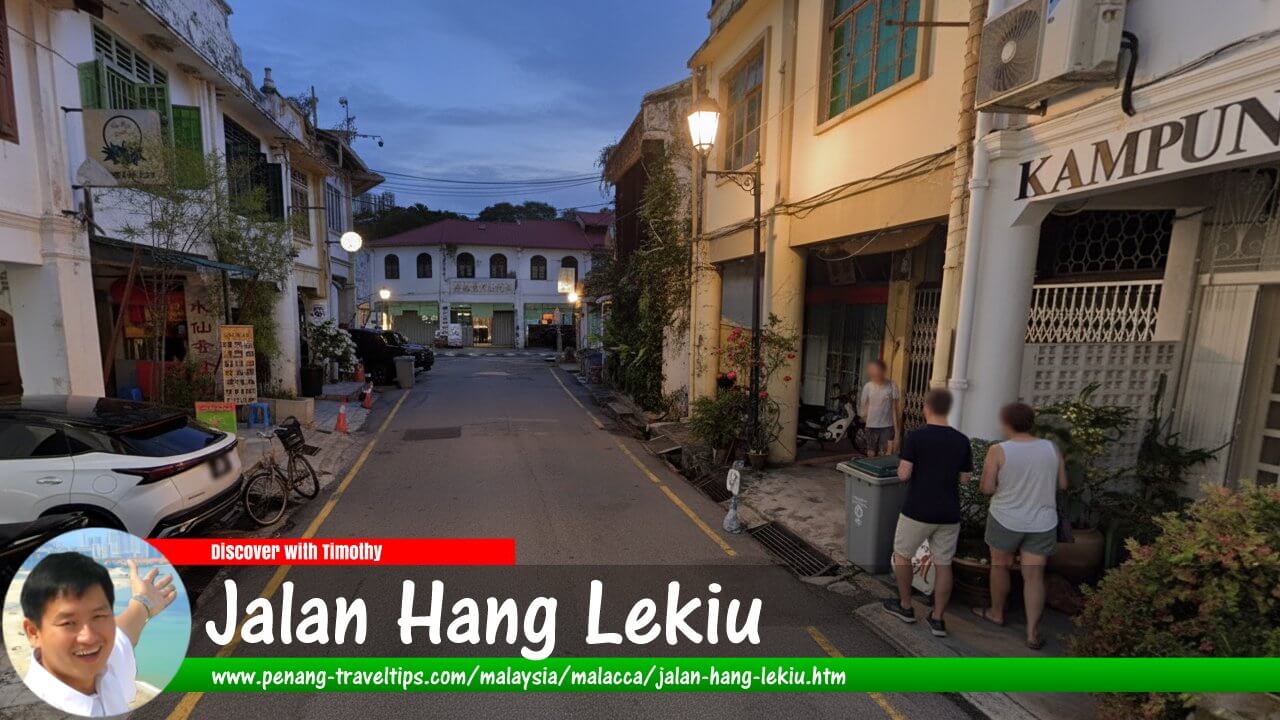 Jalan Hang Lekiu, Malacca (AI generated oN 31 December 2025)
Jalan Hang Lekiu is a short one-way heritage street in the historic heart of Malacca City (Melaka), Malaysia. At only 182 metres in length (≈0.18 km), it runs on a northeast–southwest axis, linking Jalan Hang Jebat (Jonker Street) at its southwestern end to the junction where Jalan Kampung Hulu meets Jalan Kampung Pantai in the northeast. The street sits within the UNESCO World Heritage core zone, forming part of a human-scaled pre-automotive urban grid that evolved as Melaka grew into a global maritime trading port.1
Despite its compact length, Jalan Hang Lekiu occupies an important spatial role in the old town: it is one of four perpendicular streets that connect the main spine of Jonker Street to the river-adjacent corridor of Jalan Kampung Pantai. The other parallel cross streets include Jalan Hang Kasturi, Jalan Tukang Besi and Jalan Tukang Emas—lanes historically associated with Malay warrior legend and artisan guilds. Unlike Jonker Street’s constant bustle, Jalan Hang Lekiu offers a calmer passage where heritage architecture and lifestyle businesses coexist, making it ideal for slow exploration.1
Quick Facts
- Length: 182 m
- Road Type: One-way street
- Orientation: Northeast ↔ Southwest
- Connects: Jalan Hang Jebat → Jalan Kampung Hulu / Jalan Kampung Pantai
- Heritage Zone: UNESCO core zone
- Urban Grid Role: One of four perpendicular connector lanes
- Nearest Transit Node: Buses via Rapid Melaka from Melaka Sentral
- Architecture: Pre-war heritage shophouses
- Street Character: Quiet heritage passage, cafés, guesthouses, small commerce
History of Jalan Hang Lekiu
Jalan Hang Lekiu is part of the earliest street network of Malacca’s riverine trading district, a quarter that flourished from the 15th century onward when Melaka was established as the capital of the Malacca Sultanate (1400–1511). Although precise construction dates for individual lanes are rarely recorded, the street likely took form incrementally between the late 15th to early 17th century, when urban settlement densified north of the Melaka River to support commerce, residential kampungs, and religious institutions.2
Following the Portuguese conquest (1511), then the Dutch era (1641), the area around the street continued to develop as a mercantile quarter for diverse communities including Malays, Chinese, Indian (Tamil, Chettiar), Javanese, Arab and Peranakan traders. The Dutch reinforced the grid street morphology, preserving short cross connectors like Jalan Hang Lekiu, which served foot and cart traffic moving between Jonker Street markets and river jetties along Jalan Kampung Pantai.2
During the British period (1824–1957), the street remained part of the city’s traditional commercial district, lined with masonry shophouses used as dwellings, clan shops, and workshops. In the 20th century, many of these buildings were rebuilt or remodelled in the Straits Eclectic and early Art Deco vocabulary seen today, characterised by shuttered windows, ceramic vents, plaster mouldings, and tiled walkways.1
By the 2000s, conservation regulations tied to UNESCO zoning shaped adaptive reuse along the lane, leading to restorations that avoided high-rise redevelopment. Instead, old residences and workshops were converted into cafés, boutique shops, hostels, and cultural businesses, maintaining a low-rise heritage streetscape unlike vertical city centres such as Singapore.1
Origin of the Name
The street is named after Hang Lekiu, one of the five legendary companions of the celebrated Malay warrior Hang Tuah, alongside Hang Jebat, Hang Kasturi, Hang Lekir and Hang Tuah himself. These warriors are central figures in the Hikayat Hang Tuah (Epic of Hang Tuah), a 17th-century Malay literary chronicle blending history, heroism, loyalty and tragedy. The practice of naming key old-town streets after these warriors emerged in the post-independence period as part of heritage-identity reinforcement, aligning with the adjacent Jalan Hang Jebat and Jalan Hang Kasturi corridors.1
The name reflects Malacca’s strong Malay cultural symbolism embedded within a multicultural quarter, offering a counterbalance to the more Chinese-identified Jonker Street spine while remaining fully integrated in the same historic neighbourhood.1
Street Character & Surroundings
Jalan Hang Lekiu carries a gentle heritage ambience. The street is narrow, flanked by two- to three-storey pre-war shophouses, many with restored timber shutters, pastel façades, and five-foot pedestrian walkways. The street scale encourages walking rather than driving, and traffic flows only one way, reinforcing a calmer pedestrian experience compared to the intense two-directional activity on Jonker Street.1
Its northeastern end opens toward the Kampung Hulu and Kampung Kling quarters—areas historically linked to Malay residential settlements and Indian Muslim merchant communities. To the southeast, Jalan Kampung Pantai runs parallel to the river, once lined with jetties and warehouses that supported Melaka’s role as a trading port. The proximity of mosques, temples and artisan lanes around Jalan Hang Lekiu makes the street a transitional cultural corridor linking commercial tourism, religious heritage and local living spaces.2
Nearby Streets
The street is surrounded by several culturally and historically significant roads and lanes:
Major Trunk & Connector Roads
- Jalan Hang Jebat (Jonker Street) – tourism and antique district, night market venue
- Jalan Kampung Pantai – river-adjacent commercial corridor
- Jalan Kampung Hulu – historic residential and mosque precinct
Parallel Perpendicular Lanes
- Jalan Hang Kasturi – adjacent connector lane
- Jalan Tukang Besi – historic metalworking lane
- Jalan Tukang Emas – former goldsmith guild street
These lanes collectively define the Old Town grid, once organised by craft guilds and community clusters, and are now preserved under conservation regulations that maintain their low-rise profile.1
Interesting Sights & Landmarks
Although the street itself is short, its immediate vicinity contains many iconic attractions:
- Cheng Hoon Teng Temple – one of Malaysia’s oldest Chinese temples
- Kampung Kling Mosque – Sumatran-Moorish architectural influences
- Sri Poyyatha Vinayagar Temple – 18th-century Hindu temple
- Heritage wall murals depicting local culture and history
- River walk access toward Jalan Kampung Pantai
These landmarks highlight Malacca’s multicultural religious heritage and sit only a few minutes’ walk from Jalan Hang Lekiu, making the lane a natural link on heritage walking trails.1
Cafés, Guesthouses & Lifestyle
The street has become part of Malacca’s emerging coffee culture. Limau Limau Café operates inside a restored shophouse nearby, offering local roasts, occasional live music and creative ambience—making the street a favourite detour among café explorers.3
Other adaptive-reuse businesses include:
- Heritage cafés with artisanal coffee
- Boutique shops selling lifestyle goods
- Hostels and guesthouses operating in restored shophouses
- Creative community spaces and music-friendly cafés
Real Estate Context
Properties on Jalan Hang Lekiu are primarily heritage shophouses, typically ranging from 1,000–1,500 sq ft (93–140 m²). In 2025, a nearby heritage shophouse listing was recorded at RM 1,500,000, translating to approximately RM 1,364 per sq ft, reflecting a heritage premium tied to tourism demand and UNESCO conservation zoning.4
Unlike Singapore’s vertical condominium market, Malacca’s old town remains low-rise, and direct comparisons should be understood in context. Singapore’s city-centre residential prices in 2025 are substantially higher, often several thousand SGD per sq ft due to land scarcity and high-density redevelopment norms, whereas Jalan Hang Lekiu properties are low-rise and mixed-use heritage assets more aligned to tourism commerce than pure residential living.1
Commercial rental leases in this precinct often command several thousand ringgit monthly depending on frontage and permitted use, while heritage guesthouse conversions are priced by room rather than floor area, making rents less standardised than Singapore’s square-foot-based residential rental market.
Public Transport & Bus Stops
The street is pedestrian-scaled and best explored on foot, but nearby bus stops are located along:
- Jalan Hang Jebat
- Jalan Kampung Pantai
Rapid Melaka buses from Melaka Sentral connect these stops to major city routes, providing convenient feeder access to the historic core for both tourists and locals.
Fun & Lesser-Known Facts
- The street forms part of a 4-lane connector grid rarely noticed on maps but critical to Old Town morphology.2
- Its name is part of a cluster honouring the five Malay warriors of legend.1
- Despite its small size, it sits within minutes of major shrines of different faiths, symbolising coexistence.1
- The lane is a favourite among coffee lovers seeking a quieter alternative to Jonker Street crowds.3
Map of Malacca, Malacca
References
- World Heritage Melaka Trail
- WHS Melaka Urban Grid & Heritage Streets
- Limau Limau Café
- iProperty Listing, 2025
Page Details
This page was created on 31 December 2025. Hi, my name is Timothy and created it from my research, for my own entertainment, knowledge and to satisfy my curiosity. I am providing the information to you in good faith and hope it is useful. I try to get the details as accurate as possible. I also try to update the page whenever I stumble on new details. So this and all my other pages are perpetual work in progress. If you discover any error, please politely inform me, pointing out where the error lies, and I will correct it as soon as possible. Your helpfulness will keep this page accurate, relevant and helpful to those who need the information.Streets of Malacca Directory
Want to share your Malacca travel experiences or get tips from fellow travellers?
Join the Malacca Travel Tips Facebook GroupInformation for visiting Malacca
Here are some related articles to help you get to know Malacca better.Introduction to Malacca
Information on buying property or renting in Malacca
 Latest Pages & Updates
Buy Me A Coffee
If you enjoy the information I provide and want to support the work I do, please buy me a coffee! I appreciate it immensely, thank you so much!
