
History of Malacca
 History of Malacca (AI generated on 31 December 2025)
Jalan Hang Kasturi runs through the historic heart of Malacca, a city whose story spans more than six centuries and reflects the rise and fall of empires, global trade, cultural exchange, and enduring myths that continue to shape its identity today.1
The history of Malacca as it is known today begins in the early 15th century and is reconstructed through a combination of oral traditions, court chronicles, foreign records, archaeology, and modern scholarship. The most influential indigenous source is the Sejarah Melayu (Malay Annals), a text rich in symbolism and political narrative but also one that blends fact with legend, requiring careful interpretation by historians.2
As historical research has matured, many long-held beliefs surrounding Malacca have been re-examined and, in some cases, debunked. Figures such as Hang Li Poh, Admiral Zheng He’s role in local affairs, Bukit Cina’s origins, and even the identity of Malacca’s most famous ruin have all been reassessed, revealing a past that is more complex and less romanticised than popular tradition suggests.
Early Regional Context Before Malacca
To understand Malacca’s emergence, one must first consider the political landscape of Southeast Asia around 1400 CE. The region was dominated by several powerful states:
- The Majapahit Empire in Java, a Hindu-Buddhist maritime power.
- The Siamese Kingdom of Ayutthaya to the north.
- The declining Srivijaya polity, once centred in Palembang and dominant over the Straits of Malacca.3
By the late 14th century, Srivijaya had weakened considerably due to internal fragmentation and repeated Majapahit attacks. It was from this political vacuum that the founder of Malacca emerged.
Parameswara and the Founding of Malacca
The man credited with founding Malacca is commonly known as Parameswara, a royal title rather than a personal name. A Hindu prince of Palembang origin, he was forced into exile following political conflict within the remnants of the Srivijayan world.4
After a brief and turbulent stay in Temasek (present-day Singapore), where he was implicated in the killing of the local ruler, Parameswara fled northwards. His journey included a temporary stop in Muar before reaching a sheltered river mouth along the west coast of the Malay Peninsula.
According to tradition, an encounter involving a mousedeer confronting his hunting dogs impressed Parameswara sufficiently for him to settle at the site, naming it Melaka after the local tree. While the story is symbolic rather than factual, most scholars place the founding of Malacca between 1400 and 1402.2
The Malacca Sultanate and Chinese Protection
Malacca’s survival depended on diplomacy. Sandwiched between Siam and Majapahit, the fledgling settlement sought protection through alignment with Ming China. This relationship is traditionally associated with Admiral Zheng He (Cheng Ho), whose fleets passed through Southeast Asia between 1405 and 1433.5
Modern historians generally agree that Malacca entered the Chinese tributary system, gaining political legitimacy and deterrence against regional aggression. However, Zheng He’s personal role in Malacca has likely been exaggerated by later narratives. Notably, the earliest datable tombstones on Bukit Cina appear more than two centuries after his voyages, casting doubt on claims of a direct link.6
Following conversion to Islam, Parameswara adopted the name Raja Iskandar Shah, marking the beginning of the Islamisation of the Malacca court. The sultanate would last just over a century, yet it profoundly shaped Malay political culture.
Sultans of Malacca
- 1403 – Raja Iskandar Shah (Parameswara)
- 1414 – Megat Iskandar Shah
- 1424 – Muhammad Shah
- 1445 – Abu Syahid (murdered)
- 1446 – Muzaffar Shah
- 1459 – Mansur Shah
- 1477 – Alauddin Riayat Shah
- 1488 – Mahmud Shah
Islamisation and Trade Networks
Islam did not arrive in Malacca directly from Arabia. Instead, it was introduced primarily by Indian Muslim traders from Gujarat and Bengal—the same regions that had earlier transmitted Hindu influences.7
Conversion offered tangible advantages: access to powerful trade networks, legal frameworks, and religious infrastructure that supported mercantile communities. The ruling elite converted first, and Islam quickly gained acceptance among the wider population.
Many sultans took Indian Muslim wives, reinforcing commercial and cultural ties that helped transform Malacca into the most important entrepôt in Southeast Asia by the mid-15th century.
Hang Li Poh and Court Legends
The marriage between a Malacca sultan and a Chinese woman later known as Hang Li Poh remains one of the most contested episodes in Malaccan history. While there is evidence of diplomatic marriages, most scholars now agree that she was unlikely to have been a Ming princess by birth.8
The surname “Hang” does not correspond with imperial Chinese lineage, and the famous well associated with her is now regarded as a later symbolic attribution. These legends nevertheless played an important role in expressing Sino-Malay relations within popular memory.
The Decline of the Sultanate
The reign of Sultan Mahmud Shah marked a period of internal division, court intrigue, and declining authority. His reliance on powerful merchant groups and disregard for succession norms weakened the state.
In 1509, the Portuguese arrived under Diogo Lopes de Sequeira. Influenced by Muslim merchant interests, the Sultan attacked the Portuguese delegation—an act that provided justification for invasion.
The Portuguese Conquest (1511)
Under Afonso de Albuquerque, the Portuguese launched a decisive assault on Malacca in 1511. Central to their strategy was the capture of the bridge across the Malacca River, cutting supply lines to the Sultan’s forces.9
After two major attacks, Malacca fell on 24 August 1511. The Sultan fled inland, eventually establishing successor states in Johor, but Malacca itself would never again be ruled by its original dynasty.
A Famosa and the Fortress City
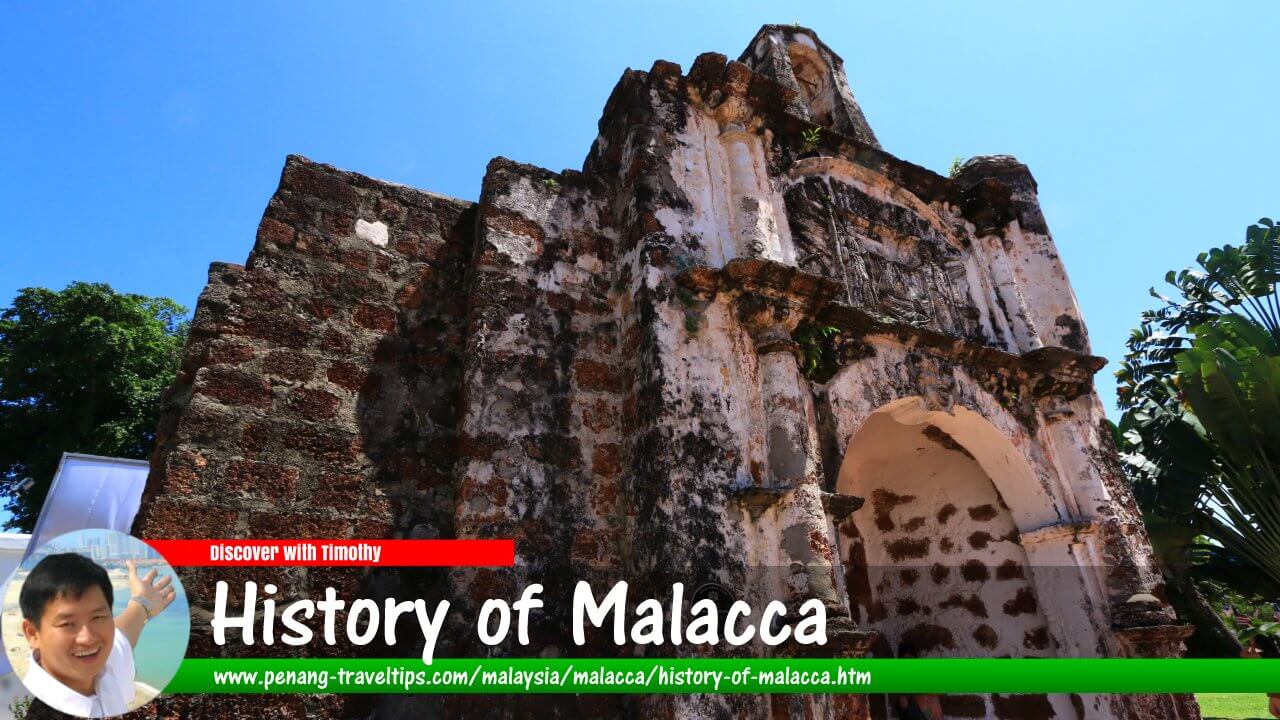
What is commonly called A Famosa today is, in fact, the Porta de Santiago, a surviving gate of a vast Portuguese fortress complex. The real fortress—known as Fortaleza de Malaca—once encircled Bukit Melaka (St Paul’s Hill) with massive laterite walls and bastions.10
Archaeological discoveries in the 21st century have confirmed the scale of this fortress, though modern development has often endangered these remains, prompting criticism from heritage advocates.
Malacca also became a base for Catholic missionary activity, most notably St Francis Xavier, who repeatedly criticised Portuguese corruption despite using the city as a staging point for missions to East Asia.
The Dutch Conquest (1641)
The Dutch, allied with Johor, laid siege to Malacca for five months. Starvation and disease devastated the population before the city fell on 14 January 1641.11
Determined to erase Portuguese influence, the Dutch destroyed nearly all Portuguese structures. Malacca was administered by the VOC from Batavia, yet it never regained its former commercial importance.
Religious repression followed, with Catholic worship banned until 1702. Only then were churches such as St Peter’s and later St Francis Xavier’s permitted.
The British Interlude and Survival of Malacca
British involvement began during the Napoleonic Wars, when Malacca was occupied to prevent French control. The most destructive act of this period was the demolition of the fortress under William Farquhar, narrowly halted by Stamford Raffles.12
The Treaty of London (1824) formally placed Malacca under British control, integrating it into the Straits Settlements. Though overshadowed by Penang and Singapore, Malacca survived as a historic town.
From Colony to Independence
Malacca remained under British rule until the mid-20th century. On 20 February 1956, Tunku Abdul Rahman proclaimed that Malaya would achieve independence from Padang Pahlawan in Malacca—a symbolic closure to over four centuries of colonial domination.
Today, Malacca stands as a UNESCO World Heritage Site, its layered past visible in streets, buildings, and communities that continue to embody the city’s role as a meeting place of worlds.
References
- UNESCO – Historic Cities of the Straits of Malacca
- Sejarah Melayu and Malay Historiography
- Srivijaya Empire
- Parameswara and Early Malacca
- Zheng He and Ming Voyages
- Bukit Cina Archaeology
- Indian Muslim Trade Networks
- Hang Li Poh Reconsidered
- Portuguese Conquest of Malacca
- A Famosa and Portuguese Fortifications
- Dutch Siege of Malacca
- Raffles, Farquhar, and the Demolition
Page Details
This page was created on 31 December 2025. Hi, my name is Timothy and created it from my research, for my own entertainment, knowledge and to satisfy my curiosity. I am providing the information to you in good faith and hope it is useful. I try to get the details as accurate as possible. I also try to update the page whenever I stumble on new details. So this and all my other pages are perpetual work in progress. If you discover any error, please politely inform me, pointing out where the error lies, and I will correct it as soon as possible. Your helpfulness will keep this page accurate, relevant and helpful to those who need the information.Want to share your Malacca travel experiences or get tips from fellow travellers?
Join the Malacca Travel Tips Facebook GroupInformation for visiting Malacca
Here are some related articles to help you get to know Malacca better.Introduction to Malacca
Information on buying property or renting in Malacca
 Latest Pages & Updates
Buy Me A Coffee
If you enjoy the information I provide and want to support the work I do, please buy me a coffee! I appreciate it immensely, thank you so much!
