
Victoria Embankment, London
Historical Context and Construction
The mid-19th century saw London grappling with severe sanitation issues, culminating in the infamous "Great Stink" of 1858. The River Thames had become heavily polluted, posing serious health risks to the city's inhabitants. In response, Sir Joseph Bazalgette devised an ambitious plan to overhaul the city's sewer system. A key component of this plan was the construction of the Victoria Embankment, which not only housed a major low-level interceptor sewer but also incorporated the Metropolitan District Railway (now part of the Circle and District Lines) beneath its surface. This innovative design reclaimed 37 acres of land from the Thames, providing space for new underground railways and a sewer system, while also creating a new thoroughfare and public space above.Map of Victoria Embankment, London
Connecting Roads and Features
Victoria Embankment, designated as part of the A3211 road, begins at Westminster Bridge, adjacent to the Palace of Westminster. It runs parallel to the Thames, passing notable landmarks such as Cleopatra's Needle and the Savoy Hotel, before concluding at Blackfriars Bridge. Along its route, several streets and thoroughfares intersect or branch off, including Horse Guards Avenue, Northumberland Avenue, Savoy Place, Savoy Street, Temple Place, Middle Temple Lane and Queen Victoria Street. The embankment also features the Victoria Embankment Gardens, a series of public gardens that provide a green respite amidst the urban landscape.Naming and Dedication
The embankment was named in honor of Queen Victoria, reflecting the era's penchant for commemorating the reigning monarch in public works. The official opening ceremony took place on July 13, 1870, presided over by the Prince of Wales and Princess Louise, marking a significant milestone in London's urban development.Nearest Underground Stations
For those utilizing public transportation, the London Underground stations most conveniently located near Victoria Embankment are Embankment and Temple. Embankment station provides access to the Bakerloo, Northern, Circle, and District lines, while Temple station serves the Circle and District lines. These stations facilitate easy exploration of the embankment and its surrounding attractions.Notable Landmarks and Features
- Cleopatra's Needle: Erected in 1878, this ancient Egyptian obelisk dates back to around 1450 BC and was originally commissioned by Pharaoh Thutmose III. Gifted to the United Kingdom by the ruler of Egypt and Sudan, Muhammad Ali, in 1819, it was transported to London and now stands prominently on the embankment, flanked by two faux-Egyptian sphinxes designed by architect George John Vulliamy.
- Victoria Embankment Gardens: Designed by landscape gardener Alexander McKenzie and opened between 1870 and 1875, these gardens were created on reclaimed land and offer a tranquil retreat featuring statues, memorials, and beautifully landscaped areas. Notable sculptures include those of John Stuart Mill and a memorial to the poet Robert Burns.
- York Watergate: Located within the Victoria Embankment Gardens, this historical structure was built in 1626 as a river entrance to the Duke of Buckingham's York House. Due to the embankment's construction and subsequent changes to the river's edge, the watergate now stands approximately 100 meters from the Thames, serving as a poignant reminder of the river's historical shoreline.
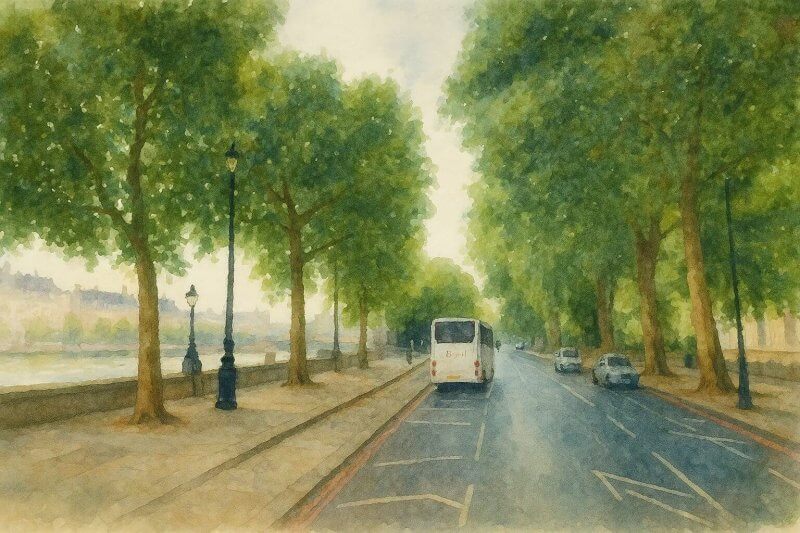
Painting of Victoria Embankment (View full-size image here)
Interesting Facts about the Victoria Embankment
- Pioneering Street Lighting: In December 1878, Victoria Embankment became the first street in Britain to be permanently lit by electricity. The initial lighting system featured 20 Yablochkov candles powered by a Gramme DC generator, marking a significant advancement in urban infrastructure and setting a precedent for future developments in street illumination.
- Architectural Influence: The concept of embanking the Thames to create a roadway was first proposed by Sir Christopher Wren in the 1660s. However, it wasn't until the 19th century that Bazalgette's vision brought this idea to fruition, showcasing the evolution of urban planning over the centuries.
- Monopoly Connection: Northumberland Avenue, which intersects with Victoria Embankment, is famously featured as a property on the British version of the Monopoly board game, highlighting its prominence in London's geography.
A Note on Geography:
Although much of Victoria Embankment lies on what many would think of as the "west" side of the River Thames - near Westminster and the West End - it is still considered part of the river's north bank. This is because the Thames flows generally from west to east through central London, and naming conventions for the banks are based on that flow direction rather than strict compass orientation.Conclusion
Today, Victoria Embankment stands as a testament to Victorian engineering prowess and urban planning. It seamlessly blends functionality with aesthetic appeal, offering Londoners and visitors alike a scenic route along the Thames adorned with historical landmarks and verdant gardens.Moving to London?
New to London and need a place to live? Read our Renting A Flat Guide. This guide covers everything you need to know about renting a flat in London, from viewing to signing.Streets of London
Come, let's explore and discover the streets of London together! Listed here afre the Streets of London that I have documented. Dive in and discover!Map of Streets in London
View all the streets that I have documented on Google Maps in this Map of Streets in London.Want to share your London travel experiences or get tips from fellow travellers?
Join the London Travel Tips Facebook GroupMore information for visiting London
Here are some related articles to help you get to know London better.- Cost of Living in London: Discover the true cost of living in London, including housing, transport, groceries, and more - plus tips for budgeting in one of the world's most expensive cities.
- Driving in London: Planning to drive in London? Learn about roads, car rentals, parking, tolls, and key tips for tourists and visitors from outside the capital.
- Driving Tips for Visiting London: Thinking of driving to London? Discover the best times to travel, congestion tips, parking apps, breakdown help, and petrol advice for a smoother journey.
- Evolution of London's Streets: Discover the fascinating history of how London's streets developed from ancient footpaths to today's complex network of roads across the capital.
- History of Immigration to London: Discover the rich history of immigration to London, from Huguenots to Bangladeshis, and how diverse communities have shaped the city's vibrant identity.
- How Big Is London Compared to Other World Cities?
- How London's Streets Measure Up: A Global Comparison of Road Widths
- How Streets of London are Named: Discover how London streets get their names, who decides them, and how historic, political, and public influences shape street naming in the capital.
- How the Grosvenor Family Came to Own Much of Mayfair, Belgravia and Pimlico: Explore how the Grosvenor family came to own much of Mayfair, Belgravia, and Pimlico, and learn about their historical connection (or lack thereof) with the British royal family and government.
- Living and working in London
- London's Quiet Collapse: How Living Standards Fell as Costs Skyrockted (1975-2025): Explore how London residents endured rising costs and falling living standards from 1975 to 2025 - from rocketing rents to wage stagnation and inflation.
- Marvel of the London Underground: Discover the history, challenges, and triumphs of the London Underground - the world's first underground railway and a vital transport lifeline for the UK capital since 1863.
- Moving to London: Expat Tips for Settling in Westminster: Essential advice for expats moving to London's Westminster: neighborhood insights, cost of living, transportation, housing, healthcare, schools, and tips to help you feel at home in the heart of the city.
- Places in London that aren't pronounced the way they're spelled
- Shopping in London: Discover London's diverse shopping scene
- Taking the bus in London: This is your complete guide to taking the bus when in London.
- The Anglican Faith: A Visitor's Guide to the Church of England: Learn about the Anglican faith and its deep ties to London's landmarks like Westminster Abbey and St Paul's Cathedral.
- Top 10 London Streets Every Visitor Must See: Discover London through its most iconic thoroughfares - 10 streets every visitor must experience. From historic Abbey Road to vibrant Camden High Street, explore culture, shopping, and hidden gems.
- Why are most roads in Central London so narrow? Learn why there are so few multi-lane roads and elevated highways in the heart of the city.
 Latest Pages & Updates
Buy Me A Coffee
If you enjoy the information I provide and want to support the work I do, please buy me a coffee! I appreciate it immensely, thank you so much!
