
St Paul's Cathedral, London
The present incarnation of St Paul's Cathedral dates to the 17th century. It is reckoned to be London's fifth St Paul's Cathedral, not counting every major reconstruction of the cathedral through the medieval period, and is one of the most visited sites in London.
During Roman time, there was already a cathedral in London at the site of St Paul's. The first Saxon cathedral was a wooden structure built on the site of the Roman one in AD604. The site is said to be that of an ancient megalith, a stone circle of pagan origin, and that there was a temple dedicated to the deity Diana, in alignment with the temple to Apollo on the site of present-day Westminster.
The wooden cathedral burnt down in AD 675, and rebuilt in stone in AD 685. The Vikings ransacked and destroyed it in AD 961. It was rebuilt in 962, also in stone. It was burnt down in a great fire that consumed the city in 1087.
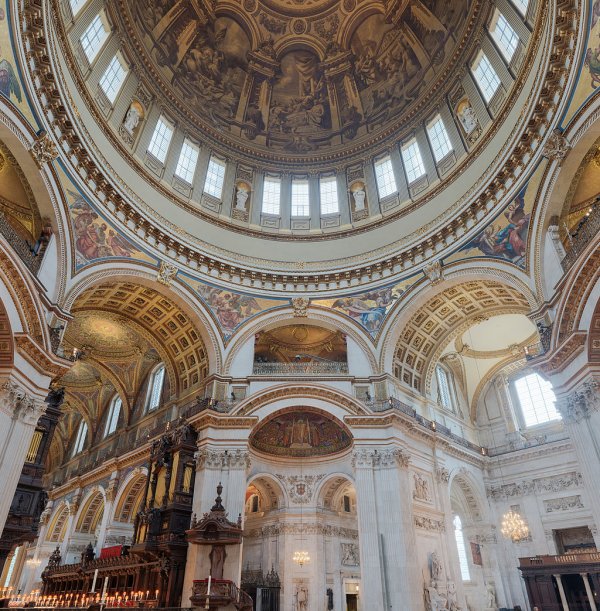 St Paul's Cathedral, interior dome
Source: https://commons.wikimedia.org/wiki/Category:Interior_of_St._Paul%27s_Cathedral#mediaviewer/File:St_Paul%27s_Cathedral_Interior_Dome_2_crop,_London,_UK_-_Diliff.jpg
Author: David Iliff

The fourth St Paul's Cathedral, also known as the Old St Paul's or the pre-Great Fire St Paul's, according to 19th century documents, was built by the Normans after the 1087 fire. The 4th St Paul's took two hundred years to build, and in between was damaged by another fire of 1136. It was consecrated in 1240 as a church, after which, an enlargement took place in 1256 and completed in 1314. It was consecrated as a cathedral in 1300. This 4th St Paul was 585 feet long - the third longest church in Europe - and had one of the tallest spires in Europe, at some 489 feet.
The fourth St Paul's was in a dilapidated state by the 16th century. The Dissolution of the Monasteries and Chantries Acts under King Henry VIII and King Edward VI emptied it of its decorative ornamentation and the destruction of its cloisters, charnels, crypts, chapels, shrines, chantries and other buildings in the churchyard.
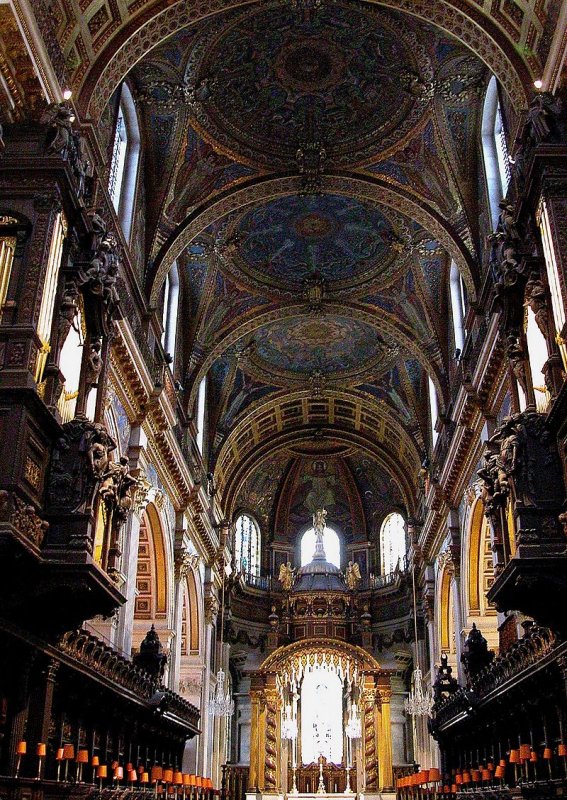 Interior of St Paul's Cathedral
Source: https://commons.wikimedia.org/wiki/Category:Interior_of_St._Paul%27s_Cathedral#mediaviewer/File:St_Paul%27s_Cathedral_London02-2.jpg
Author: Peter Morgan

In 1549 radical Protestant preachers incited a mob to destroy many of the fourth St Paul's interior decorations. When lightning destroyed the spire in 1561, both Protestants and Catholics took it as a sign of God's displeasure at the other faction's actions.
The "Old St Paul's" was gutted in the Great Fire of London of 1666. Although it could have been salvaged, there decision was to build a new cathedral, in the modern style.
The new and present St Paul's Cathedral was designed by Christopher Wren in 1668. His first design, to build on the foundation of the old cathedral, was rejected. His second design, in the form of a Greek cross, was also thrown back. A revision of that design, which can be seen on display in the crypt of the cathedral today, was also rejected. Finally the "warrant" design in 1675 was accepted, and construction began in June of that year. This design includes a small dome with a spire on top.
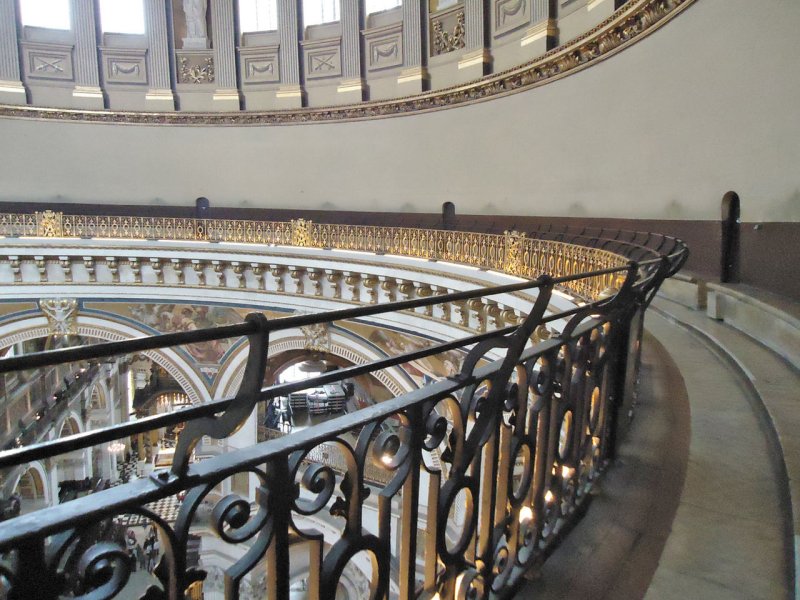 The whispering gallery at St Paul's Cathedral
Source: https://commons.wikimedia.org/wiki/Category:St._Paul%27s_Cathedral_Dome_(interior)#mediaviewer/File:St_Paul%27s_Cathedral_Whispering_Gallery.jpg
Author: Femtoquake
As King Charles II gave Wren permission to make "ornamental" changes to the approved design, Wren reworked the design to the current form seen today, with a large central dome and towers at the west end.
St Paul's Cathedral was completed on 20 October 1708, Wren's 76th birthday.
Visiting St Paul's Cathedral
Address: St Paul's Churchyard, London EC4Phone: 020 7246 8348
Opening Hours: Mondays-Saturdays: 8:30 am to 4:30 pm
Admission Fees: £6.00 adult, £3 for children 6-16, for entrance to the Cathedral, Crypt and Galleries
Tours: Mondays to Saturdays, at 11:00 am, 11:30 am, 1:30 pm and 2:00 pm, Adults £2.50, Children under 10: £1; Audiotours £3.50 available in English, French, German, Italian and Spanish.
Getting there
Take the London Underground to St Paul's Tube Station or Blackfriars Tube Station, or bus 4, 11, 15 and 17.List of Churches in London
Want to share your London travel experiences or get tips from fellow travellers?
Join the London Travel Tips Facebook GroupMore information for visiting London
Here are some related articles to help you get to know London better.- Cost of Living in London: Discover the true cost of living in London, including housing, transport, groceries, and more - plus tips for budgeting in one of the world's most expensive cities.
- Driving in London: Planning to drive in London? Learn about roads, car rentals, parking, tolls, and key tips for tourists and visitors from outside the capital.
- Driving Tips for Visiting London: Thinking of driving to London? Discover the best times to travel, congestion tips, parking apps, breakdown help, and petrol advice for a smoother journey.
- Evolution of London's Streets: Discover the fascinating history of how London's streets developed from ancient footpaths to today's complex network of roads across the capital.
- History of Immigration to London: Discover the rich history of immigration to London, from Huguenots to Bangladeshis, and how diverse communities have shaped the city's vibrant identity.
- How Big Is London Compared to Other World Cities?
- How London's Streets Measure Up: A Global Comparison of Road Widths
- How Streets of London are Named: Discover how London streets get their names, who decides them, and how historic, political, and public influences shape street naming in the capital.
- How the Grosvenor Family Came to Own Much of Mayfair, Belgravia and Pimlico: Explore how the Grosvenor family came to own much of Mayfair, Belgravia, and Pimlico, and learn about their historical connection (or lack thereof) with the British royal family and government.
- Living and working in London
- London's Quiet Collapse: How Living Standards Fell as Costs Skyrockted (1975-2025): Explore how London residents endured rising costs and falling living standards from 1975 to 2025 - from rocketing rents to wage stagnation and inflation.
- Marvel of the London Underground: Discover the history, challenges, and triumphs of the London Underground - the world's first underground railway and a vital transport lifeline for the UK capital since 1863.
- Moving to London: Expat Tips for Settling in Westminster: Essential advice for expats moving to London's Westminster: neighborhood insights, cost of living, transportation, housing, healthcare, schools, and tips to help you feel at home in the heart of the city.
- Places in London that aren't pronounced the way they're spelled
- Shopping in London: Discover London's diverse shopping scene
- Taking the bus in London: This is your complete guide to taking the bus when in London.
- The Anglican Faith: A Visitor's Guide to the Church of England: Learn about the Anglican faith and its deep ties to London's landmarks like Westminster Abbey and St Paul's Cathedral.
- Top 10 London Streets Every Visitor Must See: Discover London through its most iconic thoroughfares - 10 streets every visitor must experience. From historic Abbey Road to vibrant Camden High Street, explore culture, shopping, and hidden gems.
- Why are most roads in Central London so narrow? Learn why there are so few multi-lane roads and elevated highways in the heart of the city.
 Latest Pages & Updates
Buy Me A Coffee
If you enjoy the information I provide and want to support the work I do, please buy me a coffee! I appreciate it immensely, thank you so much!
