
Downing Street, London
Downing Street: The Heart of British Political Power
Downing Street is located in the heart of Westminster, central London, just off Whitehall. This short but historically important street lies within walking distance of the Houses of Parliament, Westminster Abbey, and Parliament Square.It runs west to east from Whitehall and ends at Horse Guards Road, placing it directly within the UK's seat of political power. Its central location makes it a key stop for tourists exploring London's most iconic landmarks.
How Long is Downing Street?
Downing Street is a very short street by London standards. It measures only about 200 feet (60 metres) in length. Despite its modest size, it has played a disproportionately large role in British and global affairs for more than two centuries.History and Construction
Downing Street dates back to the late 17th century. It was constructed in the 1680s under the orders of Sir George Downing, a diplomat and civil servant in the court of Charles II.Sir George acquired land near St James's Park and commissioned a series of townhouses to be built there. The original aim was to develop a row of fine homes for high-ranking government officials. The houses were built on land that was once part of the grounds of Whitehall Palace, which had been mostly destroyed by fire in 1698.
How Did Downing Street Get Its Name?
The street is named after its developer, Sir George Downing (1623–1684). He was a somewhat controversial figure—an able administrator and diplomat, but also remembered for switching sides during the English Civil War and later betraying former allies.The name "Downing Street" first appeared in records in the 1680s, shortly after the street was built. It is not named after a place but rather directly after Sir George himself, reflecting his personal investment in the area's development.
Roads Connected to Downing Street
Because of its short length, Downing Street connects with only a couple of streets:- Whitehall – This is the main street it connects with on its east end. Whitehall is a major thoroughfare running south from Trafalgar Square to Parliament Square.
- Horse Guards Road – On the western end, Downing Street terminates at this road which runs north-south along the eastern boundary of St James's Park.
- K Quinn Street – On the northern end, Downing Street branches off to a short off shoot that was given its own name some years ago.
Major Buildings on Downing Street
Downing Street is most famous for the official residences and offices of senior members of the British government. The two most important buildings are:- 10 Downing Street – The official residence and executive office of the Prime Minister of the United Kingdom. It is located on the north side of the street.
- 11 Downing Street – The official residence of the Chancellor of the Exchequer, also on the north side. The building is adjacent to Number 10 and shares a connecting interior.
- The Cabinet Office – A major government department that supports the Prime Minister and Cabinet. It occupies much of the southern part of Downing Street and extends into the surrounding complex.
Nearest London Underground Stations
Several Tube stations are located within easy walking distance of Downing Street:- Westminster Station – Served by the Jubilee, District, and Circle lines. This is the closest station, located about 3 minutes' walk from the street.
- Charing Cross Station – Served by the Bakerloo and Northern lines, plus National Rail services. It's about 7 minutes away on foot.
- Embankment Station – Also on the District, Circle, Bakerloo, and Northern lines, and located roughly 10 minutes' walk from Downing Street.
Fun Fact About Downing Street
One quirky fact: although 10 Downing Street is synonymous with the Prime Minister's residence, it's actually made up of three buildings combined into one!The iconic black door you see today fronts a complex that includes:
- The original house built by Sir George Downing
- An adjacent mansion at the back known as the "House at the Back" once used by the Earl of Grantham
- Modern office space added in recent centuries
Another point of interest: the "10" on the door of Number 10 is deliberately painted with a crooked "0", a subtle nod to tradition. The door itself is also not the original—it was replaced with a reinforced steel version following security concerns in the 1990s.
Map of Downing Street, London
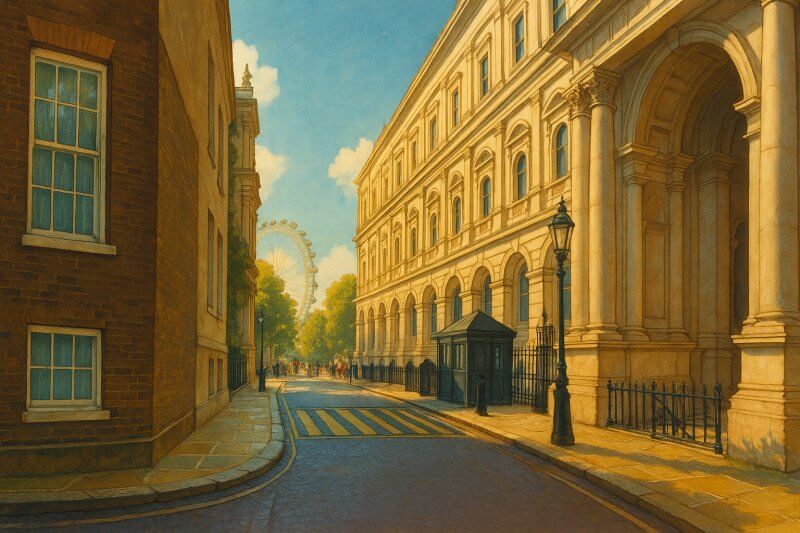
Painting of Downing Street (View full-size image here)
Moving to London?
New to London and need a place to live? Read our Renting A Flat Guide. This guide covers everything you need to know about renting a flat in London, from viewing to signing.Streets of London
Come, let's explore and discover the streets of London together! Listed here afre the Streets of London that I have documented. Dive in and discover!Map of Streets in London
View all the streets that I have documented on Google Maps in this Map of Streets in London.Want to share your London travel experiences or get tips from fellow travellers?
Join the London Travel Tips Facebook GroupMore information for visiting London
Here are some related articles to help you get to know London better.- Cost of Living in London: Discover the true cost of living in London, including housing, transport, groceries, and more - plus tips for budgeting in one of the world's most expensive cities.
- Driving in London: Planning to drive in London? Learn about roads, car rentals, parking, tolls, and key tips for tourists and visitors from outside the capital.
- Driving Tips for Visiting London: Thinking of driving to London? Discover the best times to travel, congestion tips, parking apps, breakdown help, and petrol advice for a smoother journey.
- Evolution of London's Streets: Discover the fascinating history of how London's streets developed from ancient footpaths to today's complex network of roads across the capital.
- History of Immigration to London: Discover the rich history of immigration to London, from Huguenots to Bangladeshis, and how diverse communities have shaped the city's vibrant identity.
- How Big Is London Compared to Other World Cities?
- How London's Streets Measure Up: A Global Comparison of Road Widths
- How Streets of London are Named: Discover how London streets get their names, who decides them, and how historic, political, and public influences shape street naming in the capital.
- How the Grosvenor Family Came to Own Much of Mayfair, Belgravia and Pimlico: Explore how the Grosvenor family came to own much of Mayfair, Belgravia, and Pimlico, and learn about their historical connection (or lack thereof) with the British royal family and government.
- Living and working in London
- London's Quiet Collapse: How Living Standards Fell as Costs Skyrockted (1975-2025): Explore how London residents endured rising costs and falling living standards from 1975 to 2025 - from rocketing rents to wage stagnation and inflation.
- Marvel of the London Underground: Discover the history, challenges, and triumphs of the London Underground - the world's first underground railway and a vital transport lifeline for the UK capital since 1863.
- Moving to London: Expat Tips for Settling in Westminster: Essential advice for expats moving to London's Westminster: neighborhood insights, cost of living, transportation, housing, healthcare, schools, and tips to help you feel at home in the heart of the city.
- Places in London that aren't pronounced the way they're spelled
- Shopping in London: Discover London's diverse shopping scene
- Taking the bus in London: This is your complete guide to taking the bus when in London.
- The Anglican Faith: A Visitor's Guide to the Church of England: Learn about the Anglican faith and its deep ties to London's landmarks like Westminster Abbey and St Paul's Cathedral.
- Top 10 London Streets Every Visitor Must See: Discover London through its most iconic thoroughfares - 10 streets every visitor must experience. From historic Abbey Road to vibrant Camden High Street, explore culture, shopping, and hidden gems.
- Why are most roads in Central London so narrow? Learn why there are so few multi-lane roads and elevated highways in the heart of the city.
 Latest Pages & Updates
Buy Me A Coffee
If you enjoy the information I provide and want to support the work I do, please buy me a coffee! I appreciate it immensely, thank you so much!
