
Birdcage Walk, London
Introduction
Birdcage Walk is a historic and scenic street located in the City of Westminster, running along the southern edge of St James's Park. It offers visitors a picturesque walk steeped in royal history, connecting some of London's most iconic sites.Location and Overview
Birdcage Walk runs in an east–west direction between Horse Guards Road on its eastern end and Buckingham Gate on its western side. The street is approximately 0.4 miles (0.6 kilometres) in length. On one side, it borders the beautiful greenery of St James's Park, while on the other lies a row of elegant buildings and memorials.History of Birdcage Walk
The origins of Birdcage Walk date back to the early 17th century during the reign of King James I. It was initially part of the royal grounds of the Palace of Whitehall and used for leisurely pursuits by the monarch and court.In the early 1600s, King James I created an aviary within the park, filling it with exotic birds. The adjacent path, which provided access to the aviary and served as a royal promenade, became known as Birdcage Walk.
Over the centuries, Birdcage Walk evolved from a royal path into a public road, with its name enduring as a curious reminder of its unique beginnings.
How Birdcage Walk Got Its Name
The street was named after the royal aviaries that once lined this area, filled with exotic birds kept for the enjoyment of the monarch and court. The name "Birdcage Walk" was in common use by the mid-17th century, and it stuck even after the aviaries were long gone.Rather than being named after a person or another place, the street's name is a direct reference to the literal birdcages that once lined the edge of St James's Park.
Connecting Roads
Birdcage Walk is part of a network of historic streets in central London and connects to several important roads:- Horse Guards Road – at the eastern end, near Whitehall and Parliament Square.
- Storey's Gate – runs north from Birdcage Walk toward Westminster Abbey.
- Spur Road – leading to the Victoria Memorial and Buckingham Palace.
- Buckingham Gate – at the western end, providing access to the surrounding area including Victoria.
Buildings and Landmarks Along Birdcage Walk
Birdcage Walk is surrounded by important institutions and memorials that reflect both military and royal associations.On the north (park) side:
- St James's Park – One of London's oldest royal parks, providing a lush and peaceful environment for walkers.
- The Wellington Barracks – Home to the Foot Guards who perform the Changing of the Guard at Buckingham Palace.
- The Royal United Services Institute (RUSI) – A British defence and security think tank with a long history.
- The Guards Museum – Offers insights into the history of the five regiments of Foot Guards.
Nearest London Underground Stations
Birdcage Walk is well-served by several nearby London Underground stations, making it highly accessible:- St James's Park Station – located to the northwest, served by the District and Circle lines.
- Westminster Station – to the southeast, served by the Jubilee, District, and Circle lines.
- Victoria Station – a short walk westward, served by the Victoria, District, and Circle lines, along with National Rail services.
Fun Fact
During the 19th century, Birdcage Walk had a rather exclusive status — it was originally closed to civilian traffic and used primarily by royalty and military personnel. In fact, the public wasn't allowed to drive along it until after the 1820s.Another fun fact: Author Virginia Woolf described Birdcage Walk in her novel Mrs. Dalloway, emphasizing its romantic and historic atmosphere — a literary connection that continues to attract fans of her work to this very spot.
Why Visit Birdcage Walk?
Birdcage Walk is more than just a road — it is a tranquil and scenic passage steeped in royal heritage. Walking along its length offers a unique perspective of central London's blend of natural beauty, military history, and royal tradition. It's the perfect route for a leisurely stroll between two of London's most famous landmarks: Buckingham Palace and Big Ben. Whether you're a local enjoying a peaceful walk or a tourist tracing the steps of kings and queens, Birdcage Walk is a delightful part of London's urban fabric.Summary
To recap, Birdcage Walk is:- Located in the City of Westminster.
- Roughly 0.4 miles long, running east to west.
- Named after 17th-century royal birdcages once kept by King James I.
- Connected to several key roads including Horse Guards Road and Buckingham Gate.
- Flanked by St James's Park to the north and military buildings like Wellington Barracks to the south.
- Accessible via nearby Underground stations: St James's Park, Westminster, and Victoria.
Map of Birdcage Walk, London
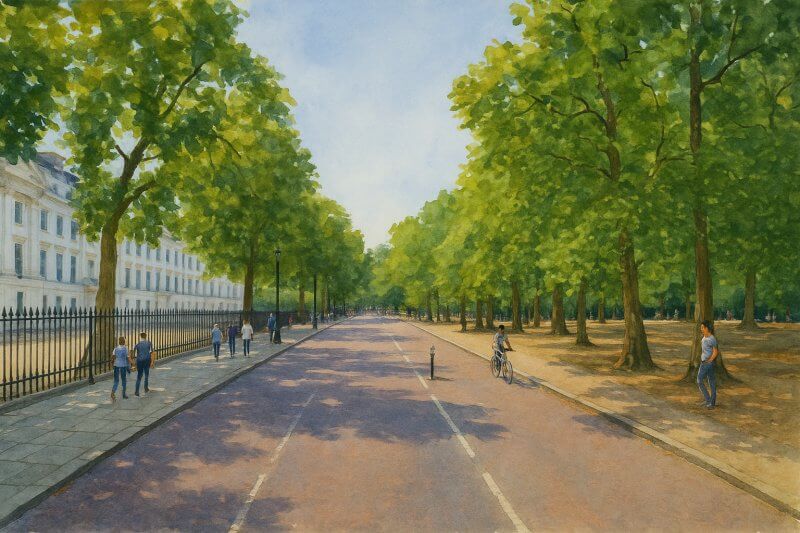
Painting of Birdcage Walk (View full-size image here)
Moving to London?
New to London and need a place to live? Read our Renting A Flat Guide. This guide covers everything you need to know about renting a flat in London, from viewing to signing.Streets of London
Come, let's explore and discover the streets of London together! Listed here afre the Streets of London that I have documented. Dive in and discover!Map of Streets in London
View all the streets that I have documented on Google Maps in this Map of Streets in London.Want to share your London travel experiences or get tips from fellow travellers?
Join the London Travel Tips Facebook GroupMore information for visiting London
Here are some related articles to help you get to know London better.- Cost of Living in London: Discover the true cost of living in London, including housing, transport, groceries, and more - plus tips for budgeting in one of the world's most expensive cities.
- Driving in London: Planning to drive in London? Learn about roads, car rentals, parking, tolls, and key tips for tourists and visitors from outside the capital.
- Driving Tips for Visiting London: Thinking of driving to London? Discover the best times to travel, congestion tips, parking apps, breakdown help, and petrol advice for a smoother journey.
- Evolution of London's Streets: Discover the fascinating history of how London's streets developed from ancient footpaths to today's complex network of roads across the capital.
- History of Immigration to London: Discover the rich history of immigration to London, from Huguenots to Bangladeshis, and how diverse communities have shaped the city's vibrant identity.
- How Big Is London Compared to Other World Cities?
- How London's Streets Measure Up: A Global Comparison of Road Widths
- How Streets of London are Named: Discover how London streets get their names, who decides them, and how historic, political, and public influences shape street naming in the capital.
- How the Grosvenor Family Came to Own Much of Mayfair, Belgravia and Pimlico: Explore how the Grosvenor family came to own much of Mayfair, Belgravia, and Pimlico, and learn about their historical connection (or lack thereof) with the British royal family and government.
- Living and working in London
- London's Quiet Collapse: How Living Standards Fell as Costs Skyrockted (1975-2025): Explore how London residents endured rising costs and falling living standards from 1975 to 2025 - from rocketing rents to wage stagnation and inflation.
- Marvel of the London Underground: Discover the history, challenges, and triumphs of the London Underground - the world's first underground railway and a vital transport lifeline for the UK capital since 1863.
- Moving to London: Expat Tips for Settling in Westminster: Essential advice for expats moving to London's Westminster: neighborhood insights, cost of living, transportation, housing, healthcare, schools, and tips to help you feel at home in the heart of the city.
- Places in London that aren't pronounced the way they're spelled
- Shopping in London: Discover London's diverse shopping scene
- Taking the bus in London: This is your complete guide to taking the bus when in London.
- The Anglican Faith: A Visitor's Guide to the Church of England: Learn about the Anglican faith and its deep ties to London's landmarks like Westminster Abbey and St Paul's Cathedral.
- Top 10 London Streets Every Visitor Must See: Discover London through its most iconic thoroughfares - 10 streets every visitor must experience. From historic Abbey Road to vibrant Camden High Street, explore culture, shopping, and hidden gems.
- Why are most roads in Central London so narrow? Learn why there are so few multi-lane roads and elevated highways in the heart of the city.
 Latest Pages & Updates
Buy Me A Coffee
If you enjoy the information I provide and want to support the work I do, please buy me a coffee! I appreciate it immensely, thank you so much!
