
Yunfu, China
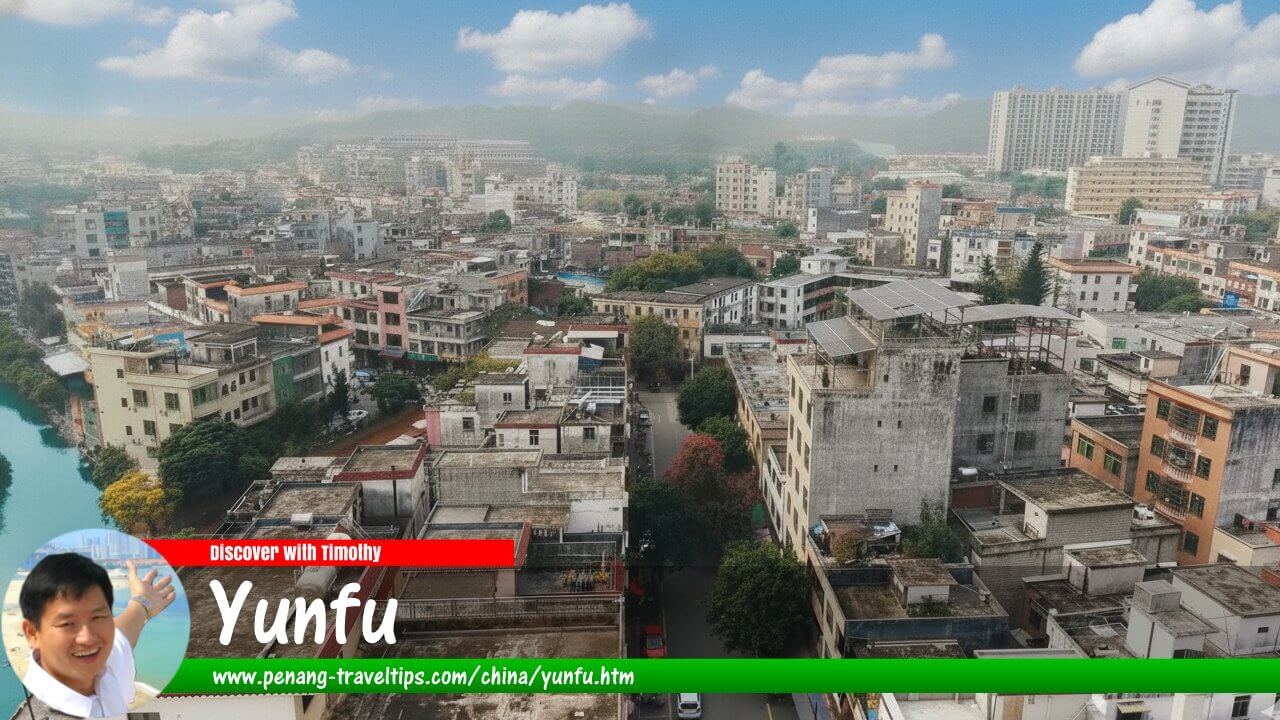 Yunfu, China (Photo edited with AI on 18 June 2026)
Yunfu (云浮, Yúnfú) is a prefecture-level city in western Guangdong Province, China. Located between the Pearl River Delta and the mountainous regions of western Guangdong, Yunfu is renowned for its rich mineral resources, especially marble and stone products, as well as its scenic karst landscapes, hot springs, traditional villages, and cultural heritage. Although less internationally known than Guangzhou or Shenzhen, Yunfu has developed into an important industrial and transportation hub while preserving much of its natural beauty and local traditions.1
Quick Facts
- English Name: Yunfu
- Chinese Name: 云浮
- Pinyin: Yúnfú
- Province: Guangdong
- Administrative Status: Prefecture-level city
- Location: Western Guangdong Province
- Area: Approximately 7,786 square kilometres
- Population: About 2.4 million
- Climate: Subtropical monsoon climate
- Major Industries: Stone processing, mining, manufacturing, agriculture, tourism
- Famous Product: Yunfu marble
- Nearest Major Airport: Guangzhou Baiyun International Airport
- Main Attractions: Panlong Cave, Tianlu Mountain, Longshan Hot Springs, Nanshan Forest Park
Name and Origin
The name Yunfu is written as 云浮 in simplified Chinese and romanized as Yúnfú in pinyin. The character "Yun" (云) means "cloud," while "Fu" (浮) means "floating." Together, the name may be interpreted as "floating clouds" or "clouds drifting above," reflecting the mountainous scenery and mist-covered landscapes that characterize the region.2
The area has been known by various administrative names throughout Chinese history. The modern name Yunfu became established as administrative boundaries evolved during the twentieth century. Today, the name symbolizes both the natural beauty and cultural identity of western Guangdong.
Geography
Yunfu is situated in western Guangdong Province, bordering Zhaoqing to the east, Jiangmen to the southeast, Yangjiang to the south, Maoming to the southwest, and Guangxi Zhuang Autonomous Region to the northwest. Its strategic location places it between the economically powerful Pearl River Delta and the interior regions of southern China.3
The city is characterized by rolling hills, mountain ranges, river valleys, and karst formations. Much of Yunfu consists of upland terrain covered by forests and agricultural land. The mountains create picturesque landscapes that attract visitors seeking nature and outdoor recreation.
The Xijiang River system, an important tributary of the Pearl River, flows through parts of Yunfu and contributes to transportation, irrigation, and economic development. Numerous smaller rivers and reservoirs support agriculture and local communities.
Yunfu experiences a humid subtropical monsoon climate. Summers are hot and rainy, while winters are generally mild. Annual rainfall is abundant, supporting lush vegetation and productive farmland. The climate is suitable for growing rice, fruits, vegetables, and various commercial crops.
The city is particularly famous for its abundant marble deposits. Geological conditions have made Yunfu one of China's leading centers for marble mining and stone processing, earning it a reputation as the "Stone Capital of China."4
Languages and Dialects
Mandarin Chinese is the official language used in government, education, and business. However, several regional Chinese dialects are spoken throughout Yunfu.
The most widely spoken local dialect is Cantonese (Yue Chinese), particularly in urban areas and among long-established local communities. The Cantonese spoken in Yunfu has some distinctive regional characteristics that differ from the varieties heard in Guangzhou or Hong Kong.
Hakka Chinese is also spoken in certain districts and rural communities. Hakka-speaking populations migrated into the region over several centuries and have maintained their linguistic and cultural traditions.
In addition, some villages preserve local dialects influenced by neighboring Guangxi and western Guangdong linguistic traditions. This diversity reflects Yunfu's historical position as a crossroads between different cultural regions.5
History
The area now known as Yunfu has been inhabited for thousands of years. Archaeological discoveries indicate that ancient communities lived in the region long before it became part of imperial China. During the Qin Dynasty, southern China was gradually incorporated into the Chinese state, bringing the region under centralized administration.6
Throughout the Han Dynasty and subsequent dynasties, Yunfu developed as an agricultural and trading region. Its location along river systems facilitated communication between inland southern China and coastal areas.
During the Tang and Song dynasties, settlement expanded and local economies flourished. Trade routes connected the region with other parts of Guangdong and neighboring provinces. Agricultural production increased as irrigation systems and farming techniques improved.
The Ming and Qing dynasties witnessed further development of local towns, markets, and cultural institutions. Temples, academies, and ancestral halls were constructed throughout the region, many of which survive today.
The modern city of Yunfu was established as a prefecture-level city in 1994. Since then, it has experienced significant economic growth driven by mining, manufacturing, transportation infrastructure, and tourism development. Despite modernization, Yunfu continues to preserve many aspects of its traditional culture and historical heritage.7
Economy and Products
Yunfu's economy is built upon a combination of mining, manufacturing, agriculture, construction materials, and tourism. The city is particularly famous for its stone industry, which has become one of the most important economic sectors in the region.8
Marble production is the city's best-known industry. Yunfu possesses extensive deposits of high-quality marble and granite. Local companies process stone products for use in buildings, monuments, sculptures, flooring, and decorative materials. Yunfu marble is exported throughout China and internationally.
Other mineral resources include pyrite, limestone, sulfur, and various industrial minerals. These resources support related manufacturing and construction industries.
Agriculture remains important, particularly in rural areas. Major crops include rice, sugarcane, fruits, vegetables, tea, and medicinal herbs. Livestock farming and aquaculture also contribute to local incomes.
Manufacturing sectors include machinery production, metal processing, chemical products, construction materials, and consumer goods. Improved transportation infrastructure has attracted investment and strengthened Yunfu's role within Guangdong's economy.
Tourism has become increasingly significant. Visitors are drawn by the city's caves, mountains, forests, hot springs, and cultural attractions. Eco-tourism and wellness tourism continue to expand.
How to Go There
By Air
Yunfu does not currently have a major commercial airport serving extensive passenger routes. Most international and domestic travelers arrive via Guangzhou Baiyun International Airport, located approximately 140 to 180 kilometres east of central Yunfu, depending on the destination within the municipality.
Guangzhou Baiyun International Airport is one of China's busiest airports and offers flights throughout Asia, Europe, North America, Oceania, Africa, and the Middle East. Major airlines serving the airport include China Southern Airlines, Air China, China Eastern Airlines, Cathay Pacific, Singapore Airlines, Emirates, Qatar Airways, and many others.9
Some travelers may also use Shenzhen Bao'an International Airport, Zhuhai Jinwan Airport, or airports in neighboring cities.
By Rail
Yunfu is connected to China's railway network through several stations, including Yunfu East Railway Station (Yunfu Dong) and Yunfu Railway Station. High-speed rail services connect the city with Guangzhou, Foshan, Zhaoqing, Nanning, Guiyang, Shenzhen, and other destinations.
Yunfu East Railway Station is located in Yuncheng District and serves as the city's principal high-speed rail hub.
By Long-Distance Bus
Several long-distance bus terminals operate in Yunfu, providing services to major cities throughout Guangdong Province and neighboring Guangxi. Frequent routes connect Yunfu with Guangzhou, Foshan, Zhaoqing, Shenzhen, Dongguan, Jiangmen, and other regional centers.
By Road
Modern expressways such as the Guangkun Expressway provide efficient road access to Yunfu. Private vehicles, tour buses, and coaches are commonly used by visitors.
How to Travel Locally
Yunfu offers a variety of local transportation options.
- Taxis: Metered taxis are available throughout the urban districts.
- E-Hailing Services: Didi Chuxing is widely used and functions similarly to Uber.
- Public Buses: An extensive bus network connects neighborhoods, railway stations, commercial districts, and tourist attractions.
- Private Cars: Rental vehicles and private transport services are available.
- Bicycles and E-Bikes: Common for short-distance travel.
Yunfu does not currently have a subway, MRT, LRT, tram, trishaw, rickshaw, or tuk-tuk system. Most residents rely on buses, taxis, and private vehicles for daily transportation.
Tourist Attractions
Panlong Cave
Panlong Cave is one of Yunfu's most famous natural attractions. The cave contains spectacular stalactites, stalagmites, underground chambers, and colorful lighting displays. Geological formations within the cave have developed over millions of years.
Tianlu Mountain Tourist Resort
Tianlu Mountain offers beautiful scenery, waterfalls, hiking trails, and cool mountain air. It is particularly popular during summer and attracts visitors seeking outdoor recreation.
Longshan Hot Springs
These natural hot springs are known for their mineral-rich waters and wellness facilities. Resorts in the area provide spa treatments and relaxation opportunities.
Nanshan Forest Park
Nanshan Forest Park features extensive woodland, walking trails, scenic viewpoints, and recreational facilities. It serves as an important green space for residents and tourists.
Yunfu Stone Culture Park
This attraction showcases the city's famous stone industry through sculptures, exhibits, artistic carvings, and displays of marble products.
Dawan Ancient Village
The village preserves traditional architecture, ancestral halls, and local customs that provide insight into the historical culture of western Guangdong.
Crab Eye Cave Scenic Area
Known for its unusual geological formations and natural scenery, this site attracts photographers and nature enthusiasts.
Xinxing Zen Temple Area
Xinxing County contains several Buddhist temples and religious sites that attract pilgrims and visitors interested in Chinese spiritual traditions.
Guoen Temple
One of the most significant Buddhist temples in Guangdong, Guoen Temple is associated with the Sixth Patriarch of Chan (Zen) Buddhism and possesses great historical and religious importance.
Local Marble Markets
Visitors interested in Yunfu's stone industry can explore markets and exhibition centers displaying marble products, sculptures, architectural materials, and decorative artworks.
Yunfu, China is  the Map of Cities in China
References
- Encyclopaedia Britannica – Guangdong Province
- Government of China – Administrative Geography
- China Daily – Guangdong Regional Development
- National Bureau of Statistics of China
- Encyclopaedia Britannica – Chinese Languages
- Encyclopaedia Britannica – History of China
- Guangdong Provincial Government
- The State Council of the People's Republic of China
- Guangzhou Baiyun International Airport
Page Details
This page was created/modified on 18 June 2026. Hi, my name is Timothy and created it from my research, for my own entertainment, knowledge and to satisfy my curiosity. I am providing the information to you in good faith and hope it is useful. I try to get the details as accurate as possible. I also try to update the page whenever I stumble on new details. So this and all my other pages are perpetual work in progress. If you discover any error, please politely inform me, pointing out where the error lies, and I will correct it as soon as possible. Your helpfulness will keep this page accurate, relevant and helpful to those who need the information.