
Maoming, China
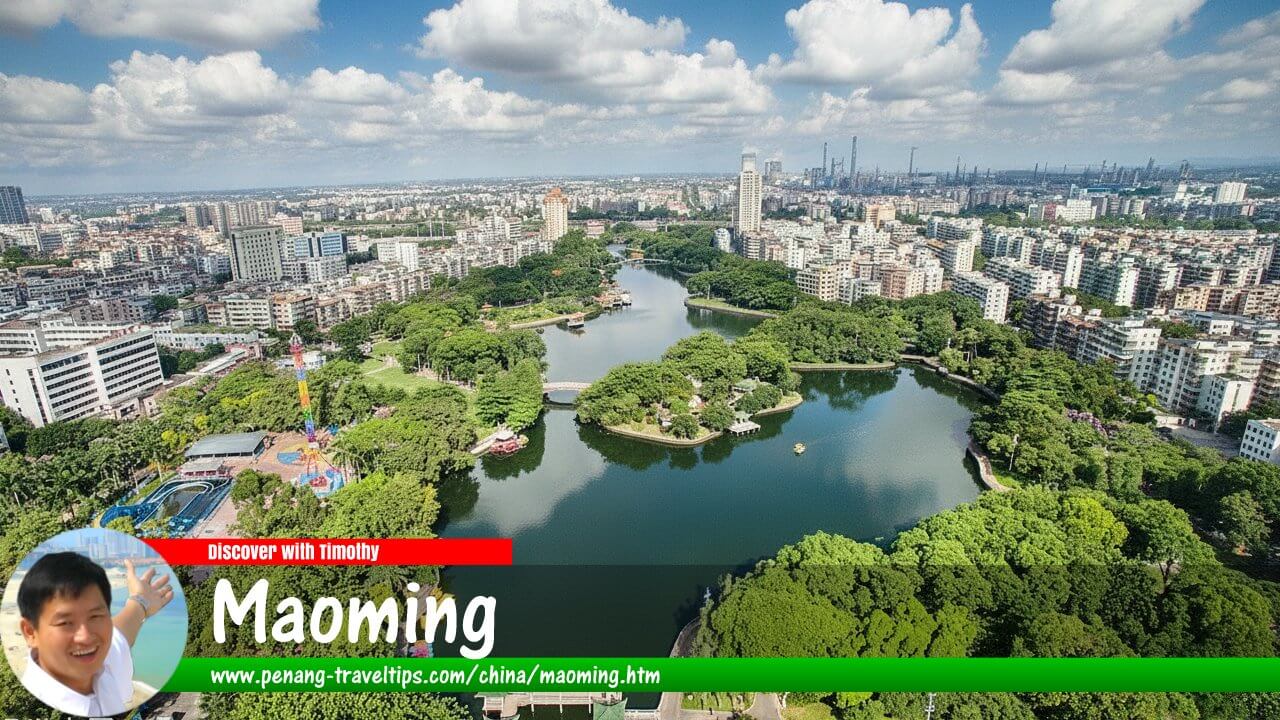 Maoming, China (Photo edited with AI on 16 June 2026)
Maoming (茂名, Màomíng) is a prefecture-level city located on the coast of southwestern Guangdong Province, China. Facing the South China Sea, it is one of the largest cities in western Guangdong and serves as an important centre for petrochemicals, agriculture, fisheries, and tourism.1 The city is also famous as one of China's largest producers of lychees and other tropical fruits. Modern Maoming was established as a prefecture-level city in 1959, although the region's history extends back more than two thousand years.2
The name "Maoming" originates from Pan Maoming (潘茂名), a legendary Daoist physician who lived during the Jin Dynasty. According to local tradition, Pan Maoming was renowned for his medical skills and contributions to the well-being of the local people. The county established during the Sui Dynasty was named in his honour, and the modern city inherited this name.3
Quick Facts
- Chinese Name: 茂名
- Pinyin: Màomíng
- Province: Guangdong
- Location: Southwestern Guangdong, China
- Area: Approximately 11,427 square kilometres
- Population: About 6.2 million
- Administrative Divisions: Maonan District, Dianbai District, Gaozhou, Huazhou, and Xinyi
- Main Languages: Mandarin, Cantonese, Gaozhou dialect, Hakka
- Main Industries: Petrochemicals, agriculture, fisheries, manufacturing
- Famous Products: Lychees, longans, bananas, seafood, petrochemical products
- Nearest Airport: Maoming Bohe Airport
- Major Tourist Attractions: Langmanhai Bay, Shuidong Bay, Yushui Ancient Hot Spring Resort, Tianma Mountain
Geography
Maoming is situated in southwestern Guangdong Province, bordering the South China Sea to the south. It lies between Zhanjiang to the west, Yangjiang to the east, and Yunfu to the northeast. Guangzhou, the provincial capital, is approximately 360 kilometres away.4
The city covers an area of more than 11,400 square kilometres and features a varied landscape of coastal plains, rolling hills, river valleys, forests, and beaches. Maoming possesses a coastline stretching more than 180 kilometres along the South China Sea, with numerous bays, fishing ports, and sandy beaches.5
The region has a humid subtropical climate characterised by warm temperatures throughout the year, abundant rainfall, and a long growing season that supports extensive agricultural production. Numerous rivers and reservoirs contribute to irrigation, fisheries, and water resources for the city.6
Languages and Dialects
Standard Mandarin is the official language used in education, government, and media. However, local residents commonly speak several Chinese dialects.
- Gaoyang Dialect: A variety of Yue Chinese spoken in Gaozhou, Huazhou, and surrounding areas.
- Cantonese: Widely understood and spoken, particularly in urban districts.
- Leizhou Min: Spoken in some southern coastal communities near the border with Zhanjiang.
- Hakka: Found in parts of Xinyi and mountainous inland regions.
These dialects reflect the city's position at the crossroads of several linguistic regions within Guangdong Province.
History
The history of Maoming dates back more than 2,000 years. During the Qin Dynasty (221–206 BC), the area formed part of Nanhai Commandery. It remained an important agricultural and coastal trading region throughout the Han, Tang, and Song dynasties.2
The county of Maoming was officially established during the Sui Dynasty (581–618 AD). The name commemorated Pan Maoming, the legendary physician whose reputation became deeply embedded in local culture.3
For centuries, the region's economy depended on agriculture, fishing, and trade. During the twentieth century, Maoming remained a relatively modest market town until the discovery of significant oil shale deposits in the 1950s. This discovery transformed the city into one of China's major petrochemical centres.1
In 1959, Maoming was established as a city. The development of oil refineries, chemical plants, railways, and port facilities accelerated industrial growth and urbanisation. Today, Maoming is among the most important economic centres in western Guangdong.1
Economy and Products
Maoming is often referred to as the "Southern Oil City" because of its significance in China's petrochemical industry. The city hosts major refining and petrochemical facilities operated by Sinopec and remains one of the country's key centres for petroleum processing and chemical production.7
Agriculture is another major pillar of the economy. Maoming is widely recognised as China's largest lychee-producing region and is also an important producer of longans, bananas, mangoes, pineapples, and other tropical fruits.7
The coastal location supports a thriving fishing and aquaculture industry. Shrimp, prawns, tilapia, oysters, and other seafood products are exported throughout China and overseas markets.2
In recent years, Maoming has diversified into tourism, renewable energy, logistics, and modern manufacturing while continuing to benefit from its strong agricultural and petrochemical sectors.7
How to Go There
By Air
Maoming is served by Maoming Bohe Airport, located approximately 40 to 50 kilometres southeast of the city centre. The airport opened in 2024 and provides domestic connections to major Chinese cities including Beijing, Shanghai, Guangzhou, Chengdu, Chongqing, Hangzhou, and Xi'an. Airlines operating there include China Southern Airlines, China Eastern Airlines, Air China, and several domestic carriers.
By Train
Maoming is connected to China's railway network through several stations, including:
- Maoming Railway Station – located within the urban area.
- Maoming West Railway Station – serving conventional rail services.
- Maoming South Railway Station – serving high-speed rail services.
High-speed rail connections provide convenient travel to Guangzhou, Shenzhen, Zhanjiang, Nanning, and other major cities.
By Long-Distance Bus
Several long-distance bus terminals operate within the city, including Maoming General Bus Station and regional passenger transport centres. Frequent services connect Maoming with Guangzhou, Shenzhen, Zhanjiang, Yangjiang, and neighbouring counties.
Local Transportation
Getting around Maoming is relatively easy due to its well-developed urban road network.
- Taxis: Widely available throughout the city.
- E-hailing Services: Didi Chuxing is the most popular ride-hailing platform.
- Public Buses: Extensive city and suburban bus routes connect major districts and attractions.
- Rental Cars: Available for visitors wishing to explore rural and coastal areas.
- Bicycles and E-bikes: Common for short-distance travel.
Maoming currently does not have a metro, subway, MRT, or LRT system. Traditional trishaws and rickshaws are generally not used as public transport.
Tourist Attractions
1. Langmanhai Bay (Romantic Coast International Tourism Resort)
This scenic coastal resort features sandy beaches, seaside promenades, luxury accommodations, and recreational facilities. It is one of Maoming's most popular tourist destinations.
2. Shuidong Bay
Located near Dianbai District, Shuidong Bay is known for its beautiful coastline, fishing communities, seafood restaurants, and pleasant seaside scenery.
3. Yushui Ancient Hot Spring Resort
This hot spring resort combines natural thermal waters with traditional Lingnan-style architecture. Visitors come for relaxation, wellness treatments, and cultural experiences.
4. Tianma Mountain Ecological Tourism Area
Located in Xinyi, Tianma Mountain offers waterfalls, forests, hiking trails, and panoramic views of the surrounding countryside.
5. Gaozhou Ancient City
Gaozhou preserves numerous historical sites, temples, ancient city walls, and traditional architecture reflecting the region's long history.
6. Genzi Lychee Cultural Tourism Area
This agricultural tourism destination showcases Maoming's famous lychee orchards. During harvest season, visitors can experience fruit picking and learn about local farming traditions.
7. Fangji Island
Situated off the coast, Fangji Island is known for crystal-clear waters, coral reefs, fishing activities, and marine recreation.
8. Xianren Cave Scenic Area
This natural attraction features caves, karst formations, mountain scenery, and local legends associated with Daoist immortals.
9. Pan Maoming Memorial Sites
Several temples and cultural sites commemorate Pan Maoming, the legendary physician after whom the city is named.
10. South China Sea Coastal Scenic Belt
The extensive coastline offers beaches, fishing villages, mangrove ecosystems, and opportunities for photography, birdwatching, and seafood dining.
Maoming, China is  the Map of Cities in China
References
- Encyclopaedia Britannica – Maoming
- China Daily – Introduction to Maoming
- Wikipedia – Maoming
- Wikipedia – Geographic Location of Maoming
- Maoming Travel Guide
- China Daily – Maoming Rivers and Geography
- Maoming Economy and Agriculture Overview
Page Details
This page was created/modified on 16 June 2026. Hi, my name is Timothy and created it from my research, for my own entertainment, knowledge and to satisfy my curiosity. I am providing the information to you in good faith and hope it is useful. I try to get the details as accurate as possible. I also try to update the page whenever I stumble on new details. So this and all my other pages are perpetual work in progress. If you discover any error, please politely inform me, pointing out where the error lies, and I will correct it as soon as possible. Your helpfulness will keep this page accurate, relevant and helpful to those who need the information.