
Zhanjiang, China
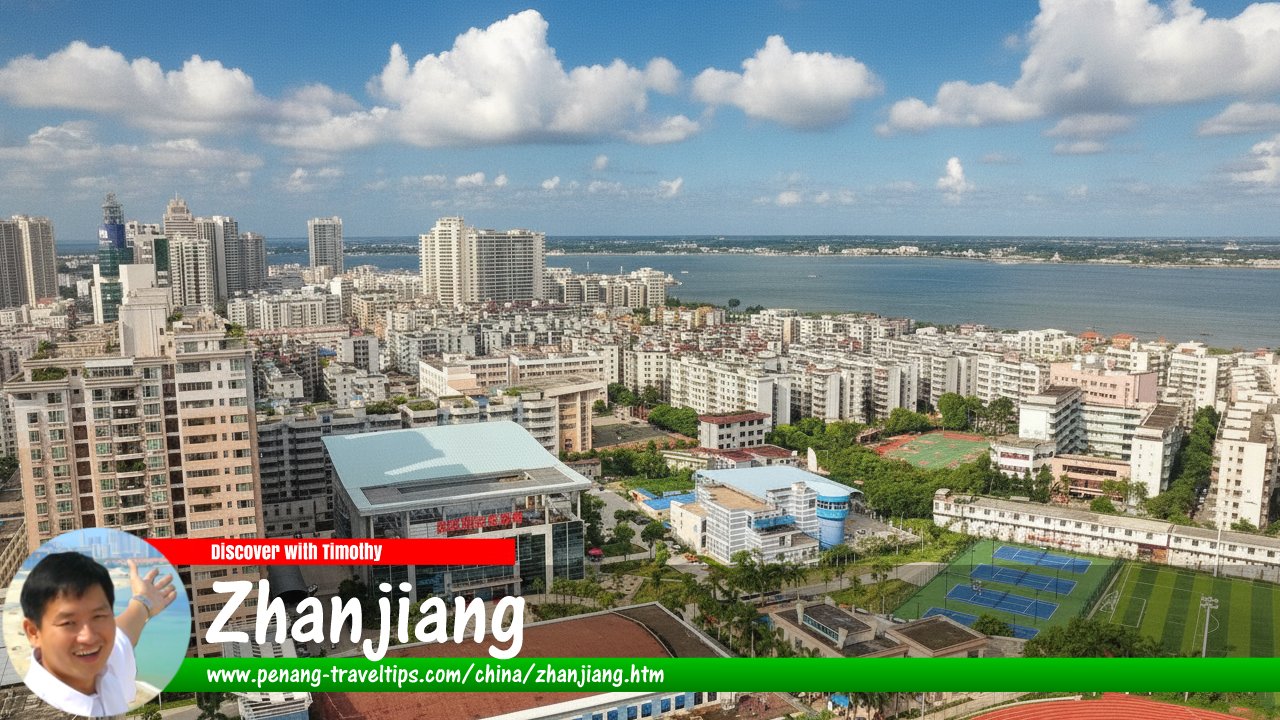 Zhanjiang, China (Photo edited with AI on 16 June 2026)
Zhanjiang (湛江, Zhànjiāng) is a prefecture-level city located at the southern tip of Guangdong Province in China. Facing the South China Sea and positioned on the Leizhou Peninsula, it is one of the most important port cities in southern China and serves as the economic, transportation, and cultural centre of western Guangdong.1 The city is renowned for its natural deep-water harbour, abundant seafood, tropical climate, and strategic location facing Hainan Island across the Qiongzhou Strait. Today, Zhanjiang is a major shipping hub, industrial centre, and growing tourist destination.
The name "Zhanjiang" combines the Chinese characters 湛 (zhàn) and 江 (jiāng), meaning "deep" or "clear" and "river" respectively. Historically, the area was known as Guangzhou Bay during the late Qing Dynasty and was leased to France from 1898 to 1945. After the end of World War II, the area reverted to Chinese administration and was renamed Zhanjiang in 1946.2
Quick Facts
- Chinese Name: 湛江
- Pinyin: Zhànjiāng
- Province: Guangdong
- Location: Southern tip of the Leizhou Peninsula
- Area: Approximately 13,263 square kilometres
- Population: About 7 million
- Administrative Centre: Chikan District
- Main Languages: Mandarin, Cantonese, Leizhou Min, Hakka
- Climate: Tropical to subtropical monsoon climate
- Main Industries: Port operations, steel, petrochemicals, fisheries, agriculture
- Famous Products: Seafood, prawns, lobsters, tropical fruits, sisal hemp
- Airport: Zhanjiang Wuchuan International Airport
- Major Attractions: Huguangyan, Donghai Island, French Quarter, Techeng Island
Geography
Zhanjiang occupies the southern part of the Leizhou Peninsula, the largest peninsula in Guangdong Province. It is bordered by the South China Sea on three sides and faces Hainan Province across the Qiongzhou Strait.3
The city's terrain consists mainly of coastal plains, volcanic landscapes, wetlands, mangrove forests, and low hills. Numerous rivers flow into the sea, creating fertile agricultural land and productive fishing grounds. The coastline extends for more than 1,500 kilometres, including mainland shores and offshore islands.4
Zhanjiang experiences a tropical and subtropical monsoon climate with warm temperatures throughout the year. Average annual temperatures range between 23°C and 24°C. The region receives abundant rainfall, especially during the summer monsoon season, making it suitable for agriculture and aquaculture.5
The city's most distinctive geological feature is Huguangyan, a rare maar volcanic lake formed by a volcanic eruption approximately 140,000 to 160,000 years ago. The site is considered one of the best-preserved maar lakes in the world.6
Languages and Dialects
Mandarin is the official language used in schools, government offices, and media. However, several Chinese dialects are widely spoken throughout Zhanjiang.
- Leizhou Min (雷州话): The dominant local language across much of the Leizhou Peninsula. It belongs to the Southern Min language family and differs significantly from Mandarin and Cantonese.
- Cantonese: Widely spoken in urban districts and among migrants from other parts of Guangdong.
- Hakka: Used by Hakka communities, particularly in inland counties and mountainous areas.
- Military and migrant varieties of Mandarin: Common due to population movement and economic development.
The linguistic diversity of Zhanjiang reflects centuries of migration and its position as a maritime gateway connecting Guangdong with Hainan and Southeast Asia.
History
The area now known as Zhanjiang has been inhabited for thousands of years. During the Qin Dynasty (221–206 BC), it formed part of Xiang Commandery. Subsequent Han, Tang, Song, and Ming dynasties administered the region as an important coastal frontier and trading area.7
The Leizhou Peninsula played a significant role in maritime trade between southern China and Southeast Asia. During imperial times, merchants transported ceramics, tea, silk, and agricultural products through ports along the peninsula's coastline.
A major turning point occurred in 1898 when the Qing government leased Guangzhou Bay to France for 99 years. The French developed administrative buildings, roads, churches, and port facilities, giving the city a distinctive colonial character that remains visible in some districts today.8
During World War II, Japanese forces occupied the territory. Following Japan's surrender in 1945, France relinquished its control and the area was returned to China. In 1946, the city officially adopted the name Zhanjiang.2
Following the establishment of the People's Republic of China in 1949, Zhanjiang developed into a major military, industrial, and commercial centre. Its excellent natural harbour led to significant investments in shipping, steel production, petrochemicals, fisheries, and logistics. Today, it is one of China's key coastal cities and an important gateway to the Beibu Gulf Economic Zone.9
Economy and Products
Zhanjiang's economy is anchored by its deep-water port, one of the largest and most important in southern China. Zhanjiang Port handles bulk cargo, containers, petroleum products, iron ore, and agricultural exports.10
The city is home to major industrial projects, including large steel manufacturing facilities, petrochemical complexes, energy plants, and shipbuilding operations. Investments by Baosteel and other major enterprises have strengthened Zhanjiang's role as an industrial powerhouse.11
Agriculture remains important. The region produces rice, sugarcane, bananas, pineapples, mangoes, and sisal hemp. Zhanjiang is one of China's leading producers of tropical fruits and agricultural commodities.
Fishing and aquaculture are particularly significant. The city is famous for prawns, lobsters, oysters, groupers, crabs, and other seafood products that are distributed throughout China and exported internationally.12
Tourism has grown rapidly due to the city's beaches, volcanic landscapes, colonial heritage, islands, and ecological attractions.
How to Go There
By Air
Zhanjiang is served by Zhanjiang Wuchuan International Airport, located approximately 35 kilometres northeast of the city centre. Opened in 2022, it replaced the older Zhanjiang Airport.
The airport handles flights operated by airlines including China Southern Airlines, Air China, China Eastern Airlines, Hainan Airlines, Shenzhen Airlines, Xiamen Airlines, and Spring Airlines. Destinations include Beijing, Shanghai, Guangzhou, Shenzhen, Chengdu, Chongqing, Xi'an, Kunming, Hangzhou, Nanjing, and many other Chinese cities.13
By Train
Zhanjiang is connected to China's rail network through several stations:
- Zhanjiang Railway Station – located in Xiashan District and serving conventional rail services.
- Zhanjiang West Railway Station – the principal high-speed railway station located northwest of the city centre.
- Zhanjiang North Railway Station – serving selected passenger and freight operations.
High-speed rail services connect Zhanjiang with Guangzhou, Shenzhen, Foshan, Nanning, and many other cities.
By Long-Distance Bus
Major bus terminals include Zhanjiang South Bus Station, Xiashan Bus Station, and Chikan Bus Station. Long-distance coaches operate to Guangzhou, Shenzhen, Zhuhai, Dongguan, Maoming, Yangjiang, and neighbouring provinces.
Local Transportation
Zhanjiang has an extensive transportation network that makes local travel convenient.
- Taxis: Widely available across the city.
- E-hailing Services: Didi Chuxing is the primary ride-hailing platform.
- Public Buses: A comprehensive bus network covers urban districts and surrounding counties.
- Ferries: Ferry services connect the mainland with islands such as Techeng Island.
- Bicycles and E-bikes: Popular for short-distance transportation.
Zhanjiang does not currently have a metro, MRT, LRT, or subway system. Traditional trishaws, rickshaws, and tuk-tuks are generally not part of the city's public transportation network.
Tourist Attractions
1. Huguangyan National Geopark
The city's most famous attraction, Huguangyan features a spectacular volcanic maar lake surrounded by lush vegetation, geological formations, and walking trails.
2. Donghai Island
One of China's largest islands, Donghai Island is famous for its long sandy beaches, coastal scenery, seafood, and water sports activities.
3. Techeng Island
This tranquil island near the city offers mangrove forests, fishing villages, beaches, and opportunities for cycling and eco-tourism.
4. Zhanjiang French Quarter
Historic colonial-era buildings dating from the French lease period provide a unique architectural heritage rarely found elsewhere in China.
5. Cunjin Bridge Park
A popular urban park featuring lakes, gardens, monuments, and recreational facilities.
6. Nansan Island
Known for its coastal scenery, fishing culture, and marine resources, Nansan Island offers a glimpse of traditional life on the Leizhou Peninsula.
7. Jinsha Bay
This waterfront district features beaches, promenades, modern city views, restaurants, and entertainment venues.
8. Leizhou Ancient City
Located within Zhanjiang Municipality, Leizhou preserves historic temples, stone archways, traditional architecture, and cultural relics.
9. Huguangyan Volcano Museum
The museum explains the geological history of the maar lake and volcanic activity that shaped the region.
10. South Asia Tropical Botanical Garden
This botanical garden displays tropical plants from China and Southeast Asia and serves as an educational and recreational destination.
Zhanjiang, China is  the Map of Cities in China
References
- Encyclopaedia Britannica – Zhanjiang
- Wikipedia – Zhanjiang
- Travel China Guide – Zhanjiang Geography
- China Daily – Zhanjiang Overview
- Climate Information for Zhanjiang
- UNESCO Tentative List – Huguangyan
- Encyclopaedia Britannica – Guangdong History
- Wikipedia – Guangzhouwan (French Lease)
- China Daily – Zhanjiang Development
- Zhanjiang Port Official Website
- Baowu Steel Group
- FAO Fisheries Information
- Zhanjiang Wuchuan International Airport
Page Details
This page was created/modified on 16 June 2026. Hi, my name is Timothy and created it from my research, for my own entertainment, knowledge and to satisfy my curiosity. I am providing the information to you in good faith and hope it is useful. I try to get the details as accurate as possible. I also try to update the page whenever I stumble on new details. So this and all my other pages are perpetual work in progress. If you discover any error, please politely inform me, pointing out where the error lies, and I will correct it as soon as possible. Your helpfulness will keep this page accurate, relevant and helpful to those who need the information.