
Yangjiang, China
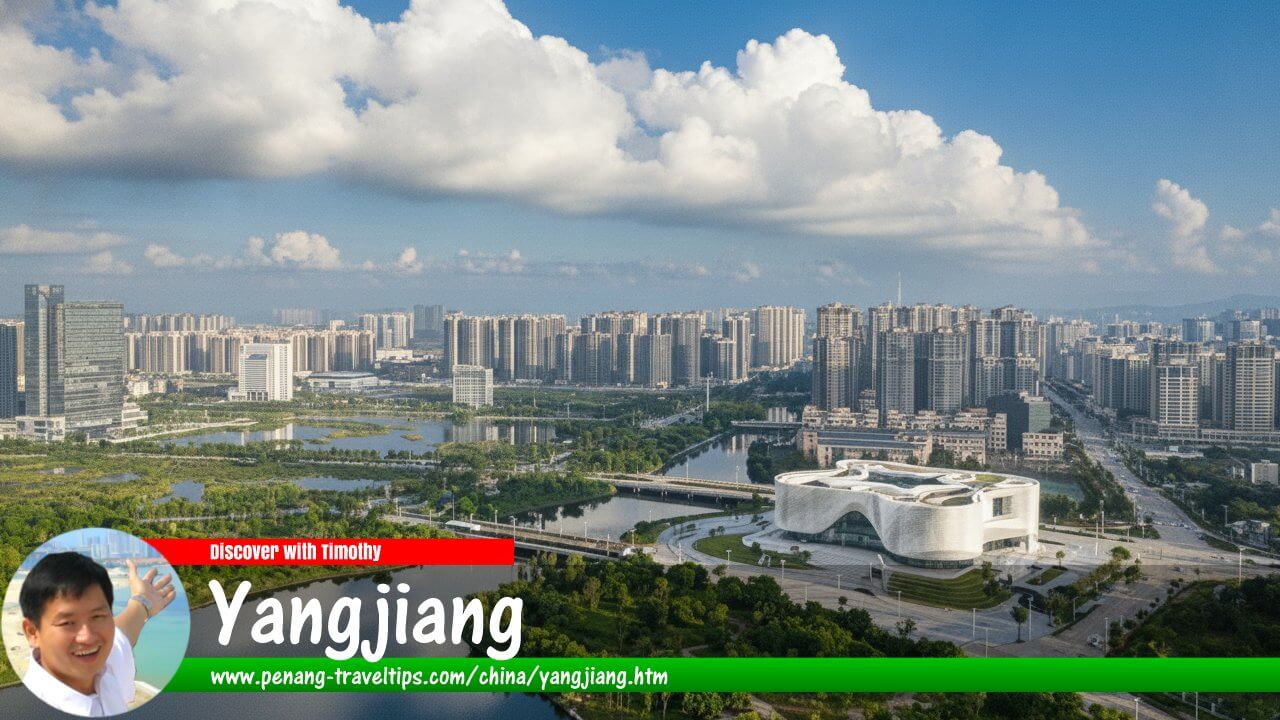 Yangjiang, China (Photo edited with AI on 16 June 2026)
Yangjiang (阳江, Yángjiāng) is a prefecture-level city located on the southwestern coast of Guangdong Province, China. Facing the South China Sea, it lies between Guangzhou and Zhanjiang and serves as an important transportation, manufacturing, fishing, and tourism centre in western Guangdong.1 The city is best known throughout China for its knife-making industry, beautiful beaches, offshore islands, hot springs, and abundant seafood. With a history spanning more than two millennia, Yangjiang combines rich cultural traditions with a modern economy driven by manufacturing, renewable energy, fisheries, and tourism.
The name "Yangjiang" literally means "Yang River." The character 阳 (yáng) traditionally refers to the sunny or southern side of a river or mountain, while 江 (jiāng) means "river." The city derives its name from its location along the Yangjiang River, which flows through the region before emptying into the South China Sea.2 The name has been associated with the area since ancient times and reflects the city's close relationship with its waterways.
Quick Facts
- Chinese Name: 阳江
- Pinyin: Yángjiāng
- Province: Guangdong
- Location: Southwestern Guangdong, China
- Area: Approximately 7,955 square kilometres
- Population: About 2.6 million
- Administrative Centre: Jiangcheng District
- Main Languages: Mandarin, Cantonese, Gaoyang dialect, Hakka
- Climate: Subtropical monsoon climate
- Main Industries: Knife manufacturing, fisheries, tourism, renewable energy
- Famous Products: Yangjiang knives, seafood, kites, agricultural products
- Nearest Airport: Zhuhai Jinwan Airport and Guangzhou Baiyun International Airport
- Major Attractions: Hailing Island, Dajiao Bay, Shapa Bay, Lingxiao Rock
Geography
Yangjiang is situated on the southwestern coast of Guangdong Province along the South China Sea. It borders Jiangmen to the east, Yunfu to the north, Maoming to the west, and the South China Sea to the south.3 The city occupies a strategic position between the Pearl River Delta and western Guangdong.
The landscape consists of coastal plains, river valleys, rolling hills, offshore islands, and mountainous regions in the north. The Yangjiang River and its tributaries provide fertile agricultural land and support local industries and communities.
Yangjiang possesses more than 450 kilometres of coastline, including numerous bays, beaches, estuaries, and islands. Hailing Island, located off the coast, is one of the most famous tourist destinations in Guangdong Province.4
The city experiences a humid subtropical climate characterised by warm temperatures throughout the year. Summers are hot and rainy, while winters are generally mild and dry. The region receives abundant sunshine and rainfall, making it suitable for agriculture, aquaculture, and tourism.5
Languages and Dialects
Mandarin is the official language used in education, government, and media. However, several Chinese dialects are commonly spoken throughout Yangjiang.
- Yangjiang Cantonese: A local variety of Yue Chinese that differs noticeably from the Cantonese spoken in Guangzhou and Hong Kong.
- Gaoyang Dialect: Spoken in some western and inland areas, sharing characteristics with neighbouring Maoming dialects.
- Hakka: Found in certain northern and mountainous communities.
- Standard Cantonese: Widely understood due to media influence and economic connections with the Pearl River Delta.
The linguistic diversity reflects centuries of migration and interaction between coastal and inland communities throughout western Guangdong.
History
The Yangjiang region has a history dating back more than 2,000 years. Archaeological discoveries indicate human settlement in the area since prehistoric times. During the Qin Dynasty (221–206 BC), the region became part of China's imperial administrative system.6
During the Han Dynasty, Yangjiang developed as an agricultural and trading centre due to its favourable coastal location. The city's rivers and harbours facilitated commerce with other parts of southern China.
Throughout the Tang and Song dynasties, Yangjiang benefited from the expansion of maritime trade routes. Merchants transported ceramics, silk, tea, and agricultural products through local ports. Fishing communities flourished along the coastline.
During the Ming and Qing dynasties, the city became known for its handicrafts, metalworking, and maritime commerce. The production of knives and cutting tools gradually developed into one of the region's most famous industries.7
In modern times, Yangjiang expanded its economy through manufacturing, fisheries, transportation, and tourism. The construction of highways, railways, and modern port facilities has further integrated the city into Guangdong's economic network. Today, Yangjiang is one of western Guangdong's most dynamic coastal cities.8
Economy and Products
Yangjiang is internationally renowned as China's "Knife and Scissors Capital." The city produces a large proportion of the knives, scissors, kitchen tools, and cutting instruments sold throughout China and exported worldwide.9
The fishing industry is another major contributor to the local economy. The South China Sea provides abundant marine resources, and local fishing fleets harvest fish, shrimp, squid, oysters, crabs, and other seafood. Aquaculture operations also produce significant quantities of marine products.
Agriculture remains important, particularly the cultivation of rice, vegetables, sugarcane, peanuts, fruits, and livestock products. The fertile river valleys and coastal plains support year-round agricultural production.
Tourism has become increasingly significant due to the popularity of Hailing Island, beaches, hot springs, and natural attractions. Visitors from across China are drawn by the city's coastal scenery and leisure facilities.
Yangjiang is also emerging as an important centre for renewable energy. Several offshore wind farms have been developed along the coast, making the city a leader in China's offshore wind power industry.10
How to Go There
By Air
Yangjiang currently does not have a major commercial airport serving large numbers of scheduled passenger flights. Most visitors arrive via nearby airports:
- Zhuhai Jinwan Airport – approximately 170 kilometres east of Yangjiang city centre.
- Guangzhou Baiyun International Airport – approximately 230 kilometres northeast of the city centre.
- Zhanjiang Wuchuan International Airport – approximately 180 kilometres west of Yangjiang.
These airports are served by airlines including China Southern Airlines, Air China, China Eastern Airlines, Shenzhen Airlines, Hainan Airlines, Xiamen Airlines, and Spring Airlines, with flights connecting major cities such as Beijing, Shanghai, Chengdu, Xi'an, Chongqing, Shenzhen, and Kunming.
By Train
Yangjiang is served by the Guangzhou–Zhanjiang High-Speed Railway and the coastal railway network.
- Yangjiang Railway Station – located in Jiangcheng District and serving high-speed passenger services.
- Yangdong Railway Station – serving parts of eastern Yangjiang.
High-speed trains connect Yangjiang with Guangzhou, Foshan, Shenzhen, Zhuhai, Zhanjiang, Maoming, and other major cities in southern China.
By Long-Distance Bus
The main long-distance bus terminals include Yangjiang Bus Terminal and Yangdong Passenger Transport Station. Frequent coach services connect the city with Guangzhou, Shenzhen, Zhuhai, Dongguan, Foshan, Zhanjiang, and neighbouring provinces.
Local Transportation
Yangjiang offers several transportation options for visitors and residents.
- Taxis: Readily available throughout the urban area.
- E-hailing Services: Didi Chuxing is widely used for convenient transportation.
- Public Buses: An extensive network serves urban districts and suburban communities.
- Tourist Shuttle Services: Available to popular destinations such as Hailing Island.
- Bicycles and E-bikes: Common for local travel.
Yangjiang currently does not have a subway, metro, MRT, LRT, or tram system. Traditional trishaws, rickshaws, and tuk-tuks are generally not used as public transportation.
Tourist Attractions
1. Hailing Island (海陵岛)
Hailing Island is Yangjiang's most famous attraction and is often regarded as one of China's most beautiful islands. It features long sandy beaches, clear waters, luxury resorts, seafood restaurants, and water sports facilities.11
2. Dajiao Bay Scenic Area
Located on Hailing Island, Dajiao Bay is renowned for its crescent-shaped beach, clean waters, and recreational activities including swimming, surfing, and boating.
3. Maritime Silk Road Museum
This museum displays artefacts recovered from the Southern Song Dynasty shipwreck known as the Nanhai No. 1. It provides valuable insights into China's maritime trade history.
4. Shapa Bay
Located in Yangxi County, Shapa Bay is known for its golden sands, fishing villages, seafood cuisine, and relaxed atmosphere.
5. Lingxiao Rock Scenic Area
This limestone cave system features impressive stalactites, underground rivers, and dramatic karst formations. It is one of the most important cave attractions in Guangdong.
6. Yuanyang Lake Park
A popular urban park offering lakeside scenery, walking paths, gardens, and recreational facilities for residents and visitors.
7. Beiluowan Scenic Area
This coastal destination offers picturesque beaches, coastal cliffs, and opportunities for photography and outdoor recreation.
8. Yangchun Stone Forest
Located in the inland part of the municipality, this geological attraction features unusual limestone formations and scenic landscapes.
9. Chunwan Scenic Area
Known for its karst mountains, rivers, and caves, Chunwan is a popular destination for nature lovers and photographers.
10. Dongping Fishing Port
One of Guangdong's largest fishing ports, Dongping offers visitors an opportunity to experience local maritime culture and enjoy fresh seafood.
Yangjiang, China is  the Map of Cities in China
References
- Encyclopaedia Britannica – Yangjiang
- Wikipedia – Yangjiang
- Travel China Guide – Yangjiang
- China Daily – Yangjiang Overview
- Climate Information for Yangjiang
- Encyclopaedia Britannica – Guangdong History
- Yangjiang Historical Overview
- China Daily Government Information
- Yangjiang Municipal Government
- Global Wind Atlas
- Hailing Island Travel Guide
Page Details
This page was created/modified on 16 June 2026. Hi, my name is Timothy and created it from my research, for my own entertainment, knowledge and to satisfy my curiosity. I am providing the information to you in good faith and hope it is useful. I try to get the details as accurate as possible. I also try to update the page whenever I stumble on new details. So this and all my other pages are perpetual work in progress. If you discover any error, please politely inform me, pointing out where the error lies, and I will correct it as soon as possible. Your helpfulness will keep this page accurate, relevant and helpful to those who need the information.