
Jiangmen, China
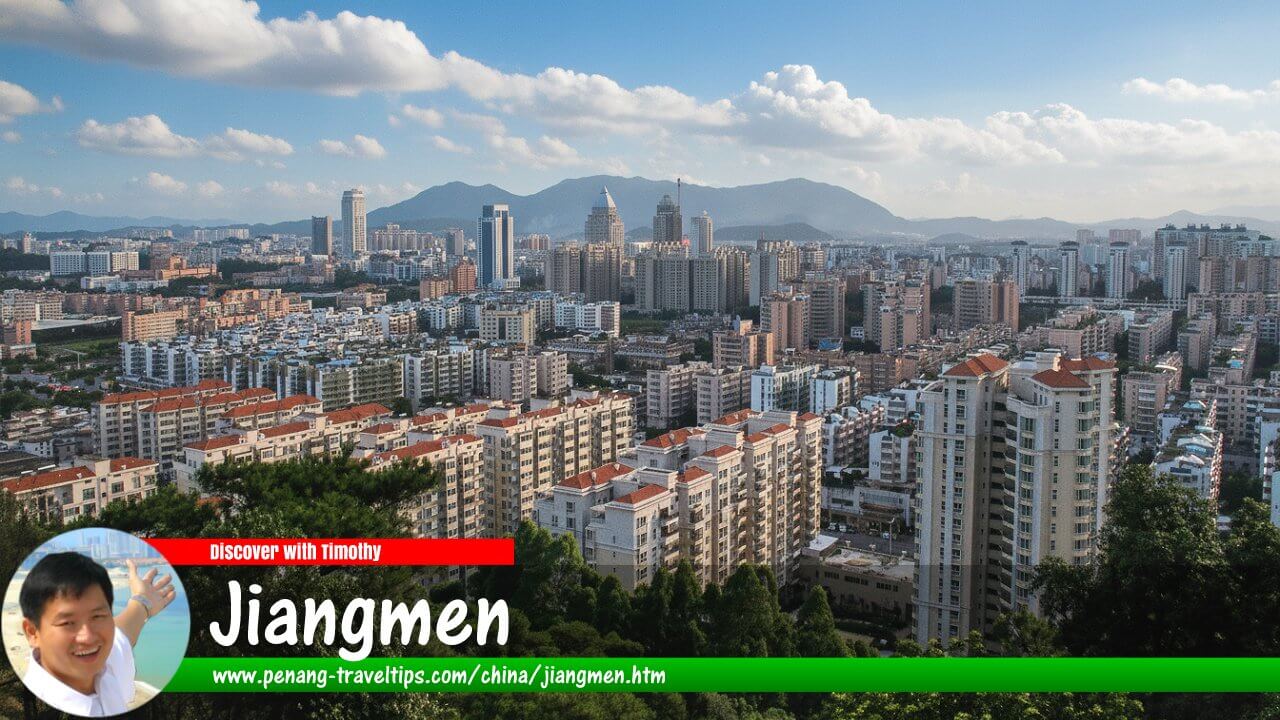 Jiangmen, China (Photo edited with AI on 16 June 2026)
Jiangmen (Chinese: 江门; pinyin: Jiāngmén) is a prefecture-level city in southern Guangdong Province, China. Located on the western side of the Pearl River Delta, Jiangmen is known for its rich overseas Chinese heritage, historic architecture, thriving manufacturing industries, and scenic river landscapes. The city serves as an important gateway between the economically dynamic Greater Bay Area and western Guangdong. Jiangmen is particularly famous as the ancestral home of millions of overseas Chinese whose descendants live throughout Southeast Asia, North America, Australia, and other parts of the world.1
The name "Jiangmen" literally means "River Gate." The city received this name because of its location at a strategic point where the Xijiang and Pengjiang rivers converge, forming a natural gateway for river traffic entering and leaving the Pearl River Delta. Historically, merchants and travelers passing through the waterways regarded the area as a gateway to the interior of Guangdong, and the name eventually became associated with the settlement itself.2
Quick Facts
- English Name: Jiangmen
- Chinese Name: 江门
- Pinyin: Jiāngmén
- Province: Guangdong
- Location: Western Pearl River Delta, Southern China
- Meaning of Name: River Gate
- Population: Approximately 4.8 million
- Area: About 9,500 square kilometres
- Climate: Humid Subtropical
- Nearest Airport: Zhuhai Jinwan Airport and Guangzhou Baiyun International Airport
- Main Railway Station: Jiangmen Railway Station
- Known For: Overseas Chinese heritage, Kaiping Diaolou, hot springs, manufacturing
- Major Rivers: Xijiang River and Pengjiang River
Geography
Jiangmen is situated in southwestern Guangdong Province on the western side of the Pearl River Delta. The city borders Foshan and Zhongshan to the east, Yangjiang to the west, Yunfu to the north, and the South China Sea to the south.1
The municipality covers approximately 9,500 square kilometres and includes the districts of Pengjiang, Jianghai, and Xinhui, as well as the county-level cities of Kaiping, Taishan, Enping, and Heshan. This diverse territory includes urban centers, agricultural plains, coastal areas, river networks, and mountainous regions.
Several important rivers flow through Jiangmen, including the Xijiang River, one of the major tributaries of the Pearl River system. These waterways have historically supported transportation, trade, agriculture, and settlement development.
The southern part of Jiangmen features a coastline facing the South China Sea. Numerous bays, estuaries, islands, and wetlands contribute to the region's ecological diversity and support fisheries and tourism activities.
Jiangmen experiences a humid subtropical climate characterized by hot, humid summers and mild winters. Average annual temperatures range from 21°C to 23°C. Rainfall is abundant throughout the year, particularly during the monsoon season between April and September.
The region's fertile soils, river systems, and favorable climate have supported agriculture for centuries and continue to contribute to the local economy today.
History
The area around Jiangmen has been inhabited for thousands of years. Archaeological evidence indicates that early settlements existed long before the region became formally incorporated into China's imperial administrative system. During the Qin and Han dynasties, the area gradually came under Chinese rule.2
Throughout the Tang and Song dynasties, the region developed as an agricultural and trading area. Its strategic position along important waterways facilitated commerce between inland Guangdong and coastal settlements.
During the Ming and Qing dynasties, Jiangmen grew into a significant commercial center. Maritime trade expanded, and merchants used local rivers to transport goods throughout southern China.
The nineteenth century brought dramatic changes as large numbers of residents emigrated overseas. Economic hardship, political instability, and opportunities abroad encouraged migration to Southeast Asia, North America, Australia, New Zealand, and other destinations. As a result, Jiangmen became one of China's most important centers of overseas Chinese migration.3
Many emigrants eventually returned with wealth and international influences. They invested in schools, hospitals, businesses, and distinctive buildings that blended Chinese and Western architectural styles. The famous diaolou watchtowers of Kaiping are among the most visible examples of this cultural exchange.
In the twentieth century, Jiangmen experienced industrialization and modernization. Following the establishment of the People's Republic of China in 1949, infrastructure development accelerated, and manufacturing became increasingly important.
Since China's economic reforms began in the late 1970s, Jiangmen has benefited from its location within the Pearl River Delta. Foreign investment, particularly from overseas Chinese communities, has contributed significantly to economic growth.
Today, Jiangmen remains a center of overseas Chinese culture and an important participant in the Guangdong–Hong Kong–Macau Greater Bay Area.
Economy and Products
Jiangmen possesses a diversified economy based on manufacturing, agriculture, tourism, logistics, energy production, and services. The city is one of Guangdong's important industrial centers.
Manufacturing industries include machinery, electronics, household appliances, motorcycles, automotive components, textiles, paper products, food processing, and metal products. Numerous domestic and international companies operate factories throughout the municipality.4
The city is also known for producing stainless steel products, electrical equipment, and industrial machinery. Industrial parks throughout Jiangmen attract investment from both Chinese and foreign enterprises.
Agriculture remains important in rural districts. Major products include rice, sugarcane, vegetables, fruits, tea, poultry, and seafood. The fertile river delta environment provides excellent conditions for cultivation.
Fishing and aquaculture contribute significantly to the economy, particularly in coastal areas. Fish, shrimp, oysters, and other seafood products are supplied to domestic and international markets.
Tourism has become an increasingly important sector. Visitors are drawn by UNESCO-listed heritage sites, hot spring resorts, historical villages, and cultural attractions related to overseas Chinese history.
Renewable energy and environmental industries have also expanded in recent years, reflecting broader trends within Guangdong Province.
How to Go There
By Air
Jiangmen does not currently have a major commercial airport within the urban center. Most visitors arrive through nearby airports.
Zhuhai Jinwan Airport is located approximately 90 kilometres from downtown Jiangmen. Airlines serving the airport include Air China, China Southern Airlines, China Eastern Airlines, Shenzhen Airlines, Hainan Airlines, Sichuan Airlines, and other domestic carriers. Flights connect Zhuhai with Beijing, Shanghai, Chengdu, Chongqing, Xi'an, Kunming, Harbin, and many other Chinese cities.5
Guangzhou Baiyun International Airport, approximately 120 kilometres away, serves hundreds of domestic and international destinations worldwide.
Shenzhen Bao'an International Airport is another convenient option located approximately 130 kilometres from Jiangmen.
By Train
Jiangmen Railway Station, located in Xinhui District, is the city's principal high-speed rail station. It forms part of the Guangzhou–Zhuhai Intercity Railway and other rail corridors connecting the city with Guangzhou, Zhuhai, Shenzhen, Hong Kong, and western Guangdong.6
Additional stations include Xinhui Railway Station, Kaiping South Railway Station, Taishan Railway Station, and Enping Railway Station.
By Long-Distance Bus
Jiangmen Bus Terminal, Xinhui Bus Station, and various regional bus terminals provide services to cities throughout Guangdong Province and neighboring regions.
By Road
An extensive network of expressways connects Jiangmen with Guangzhou, Foshan, Zhongshan, Zhuhai, Shenzhen, Yangjiang, and other cities. The Hong Kong–Zhuhai–Macao Bridge has further enhanced regional accessibility.
How to Travel Locally
Jiangmen offers several transportation options for residents and visitors.
- Public Buses: Comprehensive bus networks serve urban districts and suburban areas.
- Taxis: Metered taxis are readily available throughout the city.
- E-Hailing Services: Didi is the primary ride-hailing platform and functions similarly to Uber.
- Intercity Rail: Railway stations provide convenient travel between districts and neighboring cities.
- Bicycle Sharing: Shared bicycle systems are available in many urban areas.
Jiangmen does not currently operate a metro, subway, MRT, or LRT system. Traditional forms of transport such as trishaws, rickshaws, and tuk-tuks are generally not used. Most local transportation relies on buses, taxis, ride-hailing services, and private vehicles.
Tourist Attractions
Kaiping Diaolou and Villages
This UNESCO World Heritage Site consists of fortified watchtowers built by overseas Chinese families during the late nineteenth and early twentieth centuries. The structures combine Chinese and Western architectural influences and represent one of southern China's most unique cultural landscapes.7
Zili Village
One of the best-preserved villages within the Kaiping Diaolou area, Zili Village contains numerous historic towers surrounded by rice fields and traditional homes.
Li Garden
Constructed by a wealthy overseas Chinese family, Li Garden combines Chinese gardens, Western-style buildings, lakes, and bridges in an elegant setting.
Xinhui Bird Paradise
This ecological attraction is famous for its banyan trees and large populations of birds. It is one of the most celebrated bird-watching destinations in southern China.
Gudou Hot Spring Resort
Located in Xinhui District, this resort offers mineral-rich hot springs, spa facilities, recreational activities, and scenic mountain surroundings.
Mount Guifeng Scenic Area
This natural attraction features forests, hiking trails, temples, lakes, and panoramic views of the surrounding countryside.
Taishan Coastal Scenic Areas
Taishan's coastline includes beaches, islands, fishing villages, and marine recreation opportunities.
Chikan Ancient Town
This historic town preserves arcaded streets, colonial-era buildings, traditional shops, and architecture influenced by overseas Chinese communities.
Enping Hot Springs
Enping is renowned for its natural hot springs, attracting visitors seeking wellness tourism and relaxation.
Museum of Overseas Chinese
This museum explores the migration history of Jiangmen residents and their contributions to communities around the world.
Jiangmen, China on  the Map of Cities in China
References
- Encyclopaedia Britannica – Jiangmen
- Wikipedia – Jiangmen
- UNESCO World Heritage Centre – Kaiping Diaolou and Villages
- Invest Guangdong – Economic Information
- Wikipedia – Zhuhai Jinwan Airport
- Wikipedia – Jiangmen Railway Station
- UNESCO World Heritage Centre – Kaiping Diaolou and Villages
Page Details
This page was created/modified on 16 June 2026. Hi, my name is Timothy and created it from my research, for my own entertainment, knowledge and to satisfy my curiosity. I am providing the information to you in good faith and hope it is useful. I try to get the details as accurate as possible. I also try to update the page whenever I stumble on new details. So this and all my other pages are perpetual work in progress. If you discover any error, please politely inform me, pointing out where the error lies, and I will correct it as soon as possible. Your helpfulness will keep this page accurate, relevant and helpful to those who need the information.