
Jinhua, China
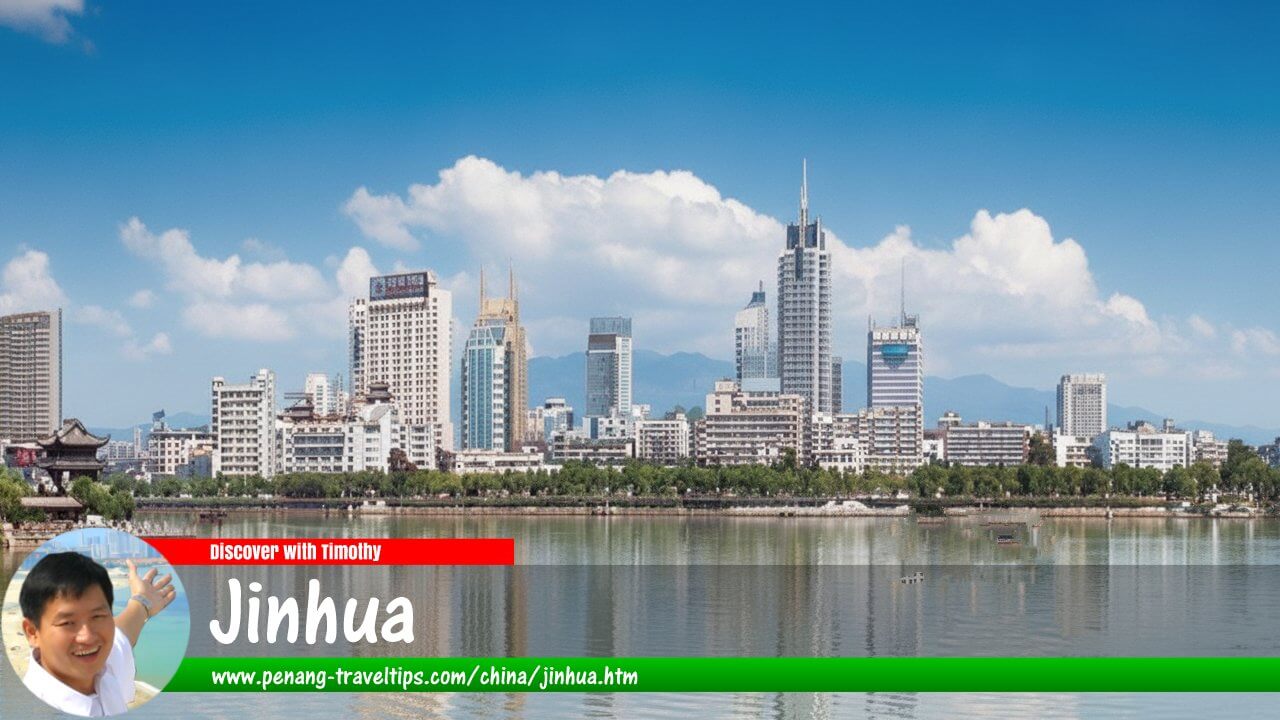 Jinhua, China (Photo edited with AI on 18 June 2026)
Jinhua (金华; Jīnhuá) is a prefecture-level city in central Zhejiang Province, China. Situated between the coastal cities of eastern Zhejiang and the inland regions of central China, Jinhua has long served as an important transportation, commercial, and cultural center. The city's name is written as 金华 in Chinese characters and romanized as Jīnhuá in pinyin. The name literally means “Golden Splendor” or “Golden Brilliance.” Historical records indicate that the name originated from the nearby Mount Jinhua, whose celestial and cultural significance was associated with brightness, prosperity, and good fortune. Today, Jinhua is widely known for its famous Jinhua ham, thriving manufacturing industries, rich historical heritage, and scenic landscapes.1
Quick Facts
- Chinese Name: 金华
- Pinyin: Jīnhuá
- Province: Zhejiang
- Location: Central Zhejiang Province, China
- Area: Approximately 10,942 square kilometres
- Population: About 7 million
- Known For: Jinhua Ham, commerce, manufacturing, historical sites
- Major River: Jinhua River
- Nearest Airport: Yiwu Airport
- Famous Counties: Yiwu, Dongyang, Yongkang, Lanxi
Geography
Jinhua is located in the heart of Zhejiang Province and occupies a strategic position within the province's transportation network. It lies approximately 180 kilometres southwest of Hangzhou and serves as a gateway between eastern China's coastal regions and the inland provinces. The municipality borders Shaoxing and Hangzhou to the north, Taizhou to the east, Lishui to the south, and Quzhou to the west.2
The terrain of Jinhua consists primarily of river valleys, plains, rolling hills, and mountain ranges. The central basin surrounding the urban area is fertile and well suited for agriculture, while mountainous areas occupy much of the surrounding landscape. The Jinhua River, part of the larger Qiantang River system, flows through the city and has historically supported settlement, transportation, and agriculture.
The climate is classified as humid subtropical, with four distinct seasons. Summers are warm and humid, while winters are generally cool and relatively mild. The region receives abundant rainfall throughout the year, contributing to fertile farmland and lush vegetation.
Several scenic mountains and nature reserves are located within Jinhua's jurisdiction. The area's natural beauty has inspired generations of poets, artists, and scholars and continues to attract visitors seeking outdoor recreation.
Languages and Dialects
Mandarin Chinese is the official language used in education, government administration, and commerce. However, a variety of local Chinese dialects are also spoken throughout Jinhua.
The dominant local speech belongs to the Wu Chinese language family, which includes the Jinhua dialect and related regional varieties. These dialects differ considerably from Mandarin in pronunciation, vocabulary, and grammar. Residents often use both Mandarin and local dialects in daily life.
Different counties and districts within the municipality possess distinctive linguistic characteristics. For example, the dialects spoken in Yiwu, Dongyang, Yongkang, and Lanxi each have unique features while remaining part of the broader Wu linguistic group.
Due to migration and economic development, Mandarin has become increasingly common among younger generations, though local dialects remain an important part of regional cultural identity.
History
Jinhua has a long history extending back more than two thousand years. Archaeological evidence suggests that human communities inhabited the area long before the establishment of formal administrative structures. The fertile valleys and river systems made the region attractive for early agricultural settlements.3
During the Qin Dynasty (221–206 BCE), the area was incorporated into China's unified imperial administration. Subsequent Han Dynasty governments expanded settlement and infrastructure, laying the foundations for future urban growth.
The city's modern name originated during the Tang Dynasty when the region became known as Jinhua. Historical accounts associate the name with Mount Jinhua and celestial observations linked to prosperity and cultural flourishing.
Throughout the Tang and Song dynasties, Jinhua developed into an important center of trade and education. Scholars from the region achieved success in the imperial examination system, contributing to the city's reputation as a place of learning and intellectual achievement.
During the Ming and Qing dynasties, agriculture, handicrafts, and commerce expanded significantly. Markets connected Jinhua with neighboring provinces, while local industries produced goods for domestic consumption and trade.
Jinhua also played an important role in the history of overseas Chinese migration. Many residents from counties such as Yiwu and Dongyang traveled abroad for trade and business, creating extensive commercial networks throughout Asia and beyond.
Following the establishment of the People's Republic of China in 1949, Jinhua experienced rapid industrialization and modernization. Economic reforms beginning in the late twentieth century accelerated growth, particularly in manufacturing, international trade, and private enterprise.
Today, Jinhua is one of Zhejiang Province's most dynamic economic centers, combining historical heritage with modern development.
Economy and Products
Jinhua possesses a diverse and highly developed economy. Manufacturing, commerce, logistics, agriculture, and tourism all contribute significantly to economic activity.
The city is internationally famous for Jinhua Ham, one of China's most renowned traditional food products. Produced using carefully cured pork and centuries-old techniques, Jinhua ham is widely used in Chinese cuisine and exported to various markets.4
One of the municipality's most important economic assets is Yiwu, a county-level city under Jinhua's administration. Yiwu is home to the Yiwu International Trade Market, one of the world's largest wholesale markets for small commodities. Buyers from around the globe visit Yiwu to source products ranging from household goods to seasonal decorations.
Manufacturing industries include machinery, hardware, textiles, electronics, automotive components, renewable energy equipment, and consumer products. Yongkang, another county-level city within Jinhua, is particularly famous for hardware manufacturing and metal products.
Agriculture remains important in rural areas. Major products include rice, tea, fruits, vegetables, bamboo, medicinal herbs, and livestock. The region's fertile land and favorable climate support a wide range of agricultural activities.
The tourism sector continues to grow as visitors explore ancient villages, temples, mountains, cultural heritage sites, and historical landmarks throughout the municipality.
How to Go There
By Air
The primary airport serving Jinhua is Yiwu Airport (YIW), located approximately 55 kilometres northeast of central Jinhua. The airport offers regular domestic flights to major Chinese cities including Beijing, Guangzhou, Shenzhen, Chengdu, Chongqing, Kunming, and Xi'an.
Airlines operating at Yiwu Airport include Air China, China Eastern Airlines, China Southern Airlines, Shenzhen Airlines, Xiamen Airlines, and several other domestic carriers.
Many international visitors also arrive through Hangzhou Xiaoshan International Airport, located about 120 kilometres from central Jinhua. This major international airport provides extensive domestic and international connections throughout Asia, Europe, and the Middle East.
By Rail
Jinhua is an important railway hub in eastern China.
- Jinhua Railway Station – Located within the urban area and serving conventional rail services.
- Jinhua South Railway Station – A major high-speed railway station connecting the city with Hangzhou, Shanghai, Beijing, Guangzhou, Shenzhen, and numerous other destinations.
- Yiwu Railway Station – One of the busiest high-speed railway stations in Zhejiang Province.
High-speed rail services allow travelers to reach Hangzhou in approximately one hour and Shanghai in less than two hours.
By Long-Distance Bus
Jinhua Passenger Transport Center and several regional bus terminals provide extensive services throughout Zhejiang Province and neighboring provinces. Frequent coaches connect Jinhua with Hangzhou, Ningbo, Shanghai, Wenzhou, and many other cities.
How to Travel Locally
Transportation within Jinhua is convenient and modern.
- Taxis: Widely available throughout the city and surrounding districts.
- E-Hailing Services: Didi Chuxing is the primary ride-hailing platform and operates extensively throughout Jinhua.
- Public Buses: A comprehensive bus network connects urban districts, railway stations, airports, and tourist attractions.
- Shared Bicycles: Bike-sharing systems are available in many urban areas.
- Private Vehicles: Well-developed roads and expressways make driving convenient.
Jinhua does not currently operate a subway, MRT, metro, LRT, tram, trishaw, rickshaw, or tuk-tuk system. Most residents and visitors rely on buses, taxis, ride-hailing services, bicycles, and private vehicles for transportation.
Tourist Attractions
1. Double Dragon Cave (Shuanglong Cave)
Located on Mount Jinhua, Double Dragon Cave is one of the city's most famous attractions. Visitors enter through a narrow waterway and explore impressive limestone formations, underground chambers, and scenic mountain landscapes.
2. Mount Jinhua Scenic Area
This mountain area contains temples, forests, caves, hiking trails, and cultural sites associated with local legends and religious traditions.
3. Hengdian World Studios
Located in Dongyang, Hengdian World Studios is the largest film and television production complex in China. Visitors can tour elaborate historical sets that recreate imperial palaces, ancient streets, and traditional architecture.
4. Yiwu International Trade Market
Although primarily a commercial center, the massive wholesale market has become a unique attraction where visitors can observe global trade in action.
5. Zhuge Bagua Village
This well-preserved ancient village is traditionally associated with descendants of the famous strategist Zhuge Liang. The settlement's layout is based on the Bagua principles of traditional Chinese cosmology.
6. Guodong Ancient Village
Known for its historic residences, ancestral halls, and traditional water management systems, this village offers insight into rural Zhejiang culture.
7. Fangyan Scenic Area
Located in Yongkang, Fangyan features dramatic cliffs, temples, caves, and panoramic views. It is an important destination for hiking and religious pilgrimage.
8. Lanxi Ancient City
Lanxi preserves traditional streets, historic buildings, and cultural landmarks that reflect centuries of commercial and social development.
9. Taiping Heavenly Kingdom Palace Site
This historical site commemorates events associated with the Taiping Rebellion and provides insight into one of the most significant periods of nineteenth-century Chinese history.
10. Niutoushan National Forest Park
This protected natural area offers forests, waterfalls, rivers, and hiking trails. It is popular among nature enthusiasts seeking outdoor recreation and scenic beauty.
Jinhua, China is  the Map of Cities in China
References
- Encyclopaedia Britannica – Jinhua
- Wikipedia – Jinhua
- Zhejiang Provincial Government
- Travel China Guide – Jinhua
- China Daily – Jinhua Reports
- UNESCO World Heritage Centre
Page Details
This page was created/modified on 18 June 2026. Hi, my name is Timothy and created it from my research, for my own entertainment, knowledge and to satisfy my curiosity. I am providing the information to you in good faith and hope it is useful. I try to get the details as accurate as possible. I also try to update the page whenever I stumble on new details. So this and all my other pages are perpetual work in progress. If you discover any error, please politely inform me, pointing out where the error lies, and I will correct it as soon as possible. Your helpfulness will keep this page accurate, relevant and helpful to those who need the information.