
Raeburn Park, Singapore
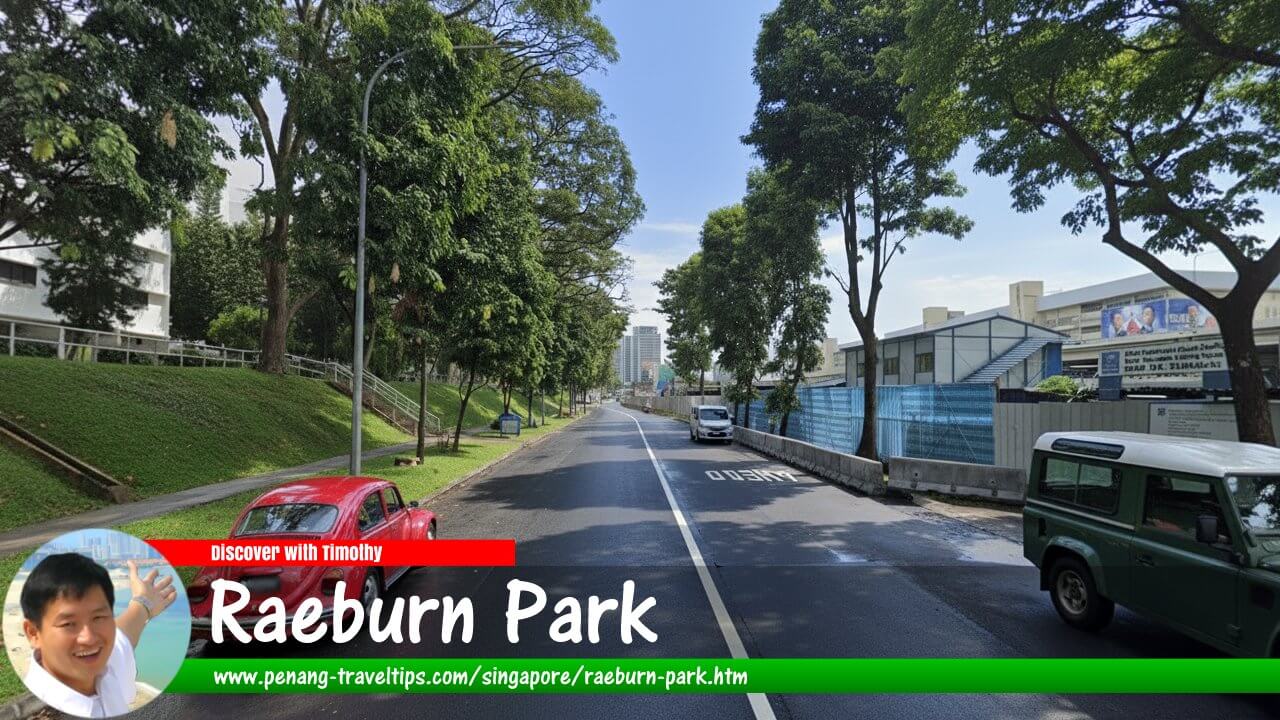 Raeburn Park, Singapore (AI-edited photograph on 26 December 2025)
Raeburn Park is a minor road in the southern part of Singapore, located within the Bukit Merah Planning Area. Stretching approximately 415 metres, the road today serves primarily residential and light institutional uses, while quietly preserving the name of a once-significant colonial-era plantation that shaped the area’s early landscape.
Quick Facts
- Road length: Approximately 415 metres
- Postal District: 2
- Planning Area: Bukit Merah
- Named: 1921
- Eastern connection: Spottiswoode Park Road
- Nearest MRT station: Tanjong Pagar (EW15)
Introduction and Urban Context
Raeburn Park lies just south of the Central Business District, occupying a transitional zone between the historic port areas of Tanjong Pagar and the older residential estates of Bukit Merah. Although modest in scale, the road is part of a wider network of streets whose names reflect Singapore’s nineteenth-century agricultural and colonial past.
Unlike streets named after people, Raeburn Park derives its name from a former nutmeg plantation, making it an example of how early land use patterns were commemorated long after plantations had disappeared.
Early History of the Area
Before modern urban development, much of southern Singapore consisted of plantations, estates, and rural holdings owned by European merchants and local elites. The land around present-day Raeburn Park was once occupied by spice and fruit plantations, taking advantage of fertile soil and proximity to the harbour.
These estates were gradually subdivided and redeveloped as Singapore expanded in the late nineteenth and early twentieth centuries. Roads such as Raeburn Park emerged during this process, formalising access routes through former plantation land1.
Naming of Raeburn Park
According to Singapore Street Names by Victor R. Savage and Brenda S.A. Yeoh, Raeburn Park was officially named in 19211. The name does not commemorate an individual directly but refers instead to the Raeburn nutmeg plantation.
This plantation belonged to Charles Scott (1802–1858), a lawyer and partner in Napier and Scotts, the first European legal firm of importance established in Singapore. The use of the plantation name rather than Scott’s personal name reflects a broader colonial naming practice that emphasised estates and landmarks.
The Raeburn Plantation and Estate
The Raeburn Spice Plantation was an extensive property that included a bungalow and approximately 31 acres of spice and fruit trees. Nutmeg was a highly prized commodity in the early nineteenth century, and plantations such as Raeburn played a role in Singapore’s early export economy.
According to Ng Yew Peng’s What’s in the Name?, the plantation was sold to G.F. Davidson around 1826 and later to the d’Almeida family in 1835, at which point it became known as Raeburn Estate2.
The d’Almeida Family Connection
The d’Almeida family were prominent landowners and professionals in early Singapore. One notable member, Dr Sir Jose d’Almeida Carvalho E. Silva (1784–1850), was later commemorated with D'Almeida Street, providing a direct cross-reference between plantation history and modern street names.
This connection highlights how Raeburn Park sits within a broader tapestry of roads named after estates, families, and figures influential during Singapore’s formative colonial years.
Character of the Street Today
In its present form, Raeburn Park is a quiet, low-traffic road with a primarily residential character. The street is lined with a mix of older walk-up apartments, newer private condominiums, and institutional buildings, reflecting successive waves of redevelopment.
Tree-lined sections and relatively wide pavements give parts of the road a calmer atmosphere compared to nearby arterial routes, making it attractive to residents seeking proximity to the city without constant traffic noise.
Surrounding Roads and Connectivity
Raeburn Park connects on its eastern end to Spottiswoode Park Road, which in turn links the area to Keppel Road and the Tanjong Pagar waterfront. Nearby roads such as Neil Road, Duxton Hill, and Everton Park place Raeburn Park within walking distance of heritage districts and dining enclaves.
This network of streets provides convenient access to both the Central Business District and the southern coastal areas.
Nearby Sights and Points of Interest
Within the vicinity of Raeburn Park are several notable attractions, including conserved shophouse districts, Spottiswoode Park, and the historic Tanjong Pagar area. Residents and visitors are also close to Chinatown, Duxton Plain Park, and the rail corridor.
The area’s layered history—ranging from plantation land to port activity and modern urban living—adds depth to what might otherwise appear to be a simple residential street.
Residential Property and Prices
Residential properties along and near Raeburn Park are predominantly private apartments and condominiums. As of late 2024 to early 2025, prices in this part of District 2 typically ranged from around SGD 2,000 to SGD 2,800 per square foot, depending on age, view, and proximity to the city.
Typical unit sizes range from approximately 500 to 1,400 sq ft (46–130 sq m). Purchase prices often fall between SGD 1.2 million for smaller units and over SGD 3.5 million for larger apartments.
Rental demand is strong due to the area’s central location, with monthly rents commonly ranging from SGD 3,500 to SGD 7,000, which is above the national average.
Public Transport Access
The nearest MRT station is Tanjong Pagar MRT Station (EW15) on the East–West Line, providing direct rail access to the Central Business District, Jurong, and Changi.
Several bus services operate along Spottiswoode Park Road, Neil Road, and Keppel Road, offering additional connectivity to HarbourFront, Outram, and Marina Bay.
Fun Fact
Although Raeburn Park is now surrounded by high-density urban development, its name preserves the memory of a nutmeg plantation that once covered more than 30 acres—an area vastly larger than the modern road itself1.
Map of Raeburn Park, Singapore
References
Page Details
This page was created on 26 December 2025. Hi, my name is Timothy and created it from my research, for my own entertainment, knowledge and to satisfy my curiosity. I am providing the information to you in good faith and hope it is useful. I try to get the details as accurate as possible. I also try to update the page whenever I stumble on new details. So this and all my other pages are perpetual work in progress. If you discover any error, please politely inform me, pointing out where the error lies, and I will correct it as soon as possible. Your helpfulness will keep this page accurate, relevant and helpful to those who need the information.Streets of Singapore Directory
My videos of Singapore
Want to share your Singapore travel experiences or get tips from fellow travellers?
Join the Singapore Travel Tips Facebook GroupMore information for visiting and living in Singapore
Here are some related articles to help you get to know Singapore better.- Cost of Living in Different Singapore Neighbourhoods (2025 Guide)
- EZ-Link Card
- Owning a Car in Singapore
- Singapore MRT Map & Guide 2025
- Singapore Postal Districts and Postcodes
- Singapore Tourist Pass
- Taking the Bus in Singapore: A Visitor's Guide
- Understanding CCR, RCR and OCR in Singapore real estate
 Latest Pages & Updates
Buy Me A Coffee
If you enjoy the information I provide and want to support the work I do, please buy me a coffee! I appreciate it immensely, thank you so much!
