
North-Eastern Islands Planning Area Travel Guide
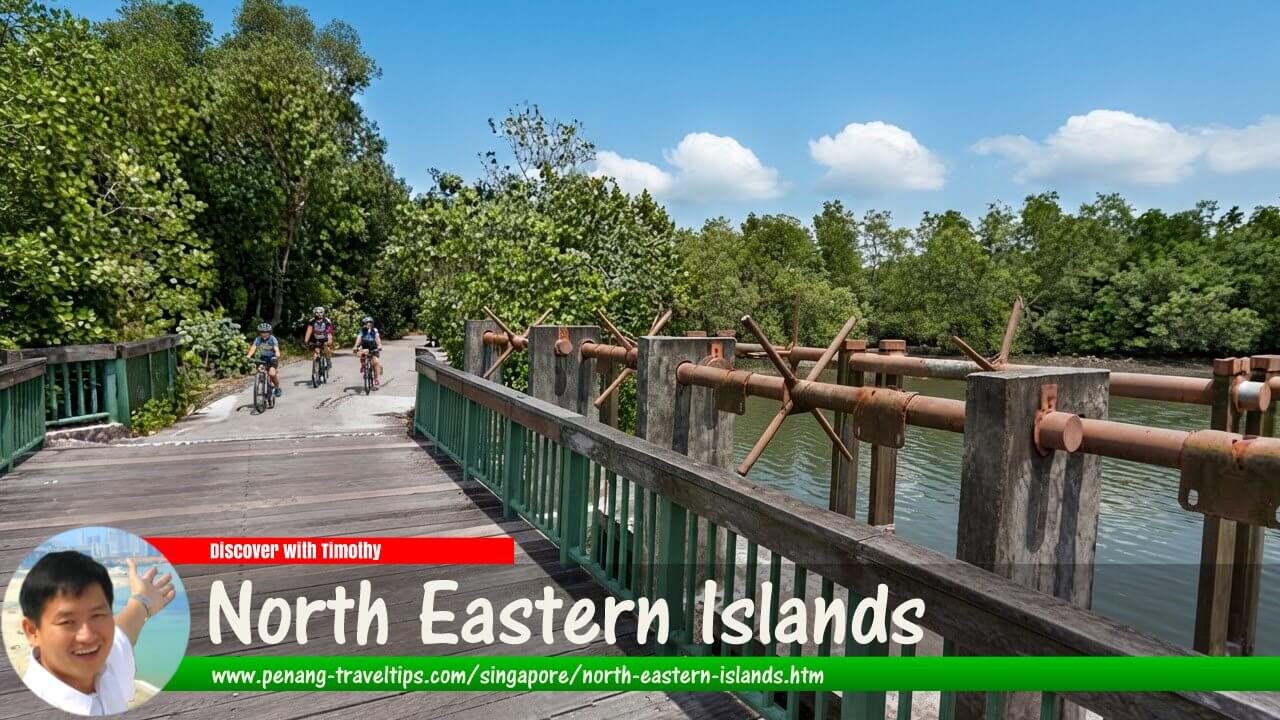 North Eastern Islands, Singapore (AI image created on 12 August 2026)
The North-Eastern Islands Planning Area (Simplified Chinese: 东北群岛, Traditional Chinese: 東北群島, Pinyin: Dōngběi Qúndǎo, Malay: Kepulauan Timur Laut, Tamil: வடகிழக்கு தீவுகள்) is one of the planning areas of Singapore, located outside the main island. As its name suggests, it encompasses the islands situated off the north-eastern coast of Singapore. These include Pulau Ubin, Pulau Tekong, and a number of smaller islets. Covering a combined area of about 42.8 square kilometres, the planning area had a very small resident population, recorded at just 40 people as of 20201.
History of the North-Eastern Islands
Historically, both Pulau Ubin and Pulau Tekong were inhabited fishing and farming communities. In the 19th and 20th centuries, Pulau Ubin developed a granite quarrying industry that supplied stone for early Singapore construction, while Pulau Tekong supported coconut and rubber plantations. Over the decades, mainland resettlement policies reduced their populations, and by the 1980s, most kampung (village) communities had been relocated.
Name and Pronunciation
The name “North-Eastern Islands” refers to their geographic position relative to mainland Singapore. The term is pronounced /nɔːrθ ˈiːstərn ˈaɪləndz/ in English. In Malay, the islands are known as Kepulauan Timur Laut, literally “northeast islands.”
Geography and Boundaries
This planning area covers Pulau Ubin to the northwest, Pulau Tekong to the east, and surrounding islets including Pulau Sekudu and Pulau Ketam. It lies across the Straits of Johor, near the Malaysian state of Johor’s southern coast. The islands are accessible only by boat, with Pulau Ubin being reachable by bumboat from Changi Point Ferry Terminal.
Transport and Accessibility
Unlike mainland planning areas, the North-Eastern Islands are not connected to the MRT network or major expressways. Transport options include:
- Pulau Ubin: Accessible via bumboats from Changi Point Ferry Terminal.
- Pulau Tekong: Restricted to Singapore Armed Forces (SAF) ferries for National Service training purposes; no public access is allowed.
Movement on Pulau Ubin is largely by bicycle, walking, or van transport. Pulau Tekong is off-limits to civilians due to its use as a military training base.
Land Use and Development
Pulau Ubin has been conserved as a nature and heritage site, retaining its kampung charm, rustic tracks, and biodiversity-rich areas such as Chek Jawa Wetlands. Pulau Tekong, on the other hand, is primarily reserved for Singapore’s National Service training facilities. The smaller islets remain undeveloped and serve as ecological and marine habitats.
Residential and Population
As of 2020, the North-Eastern Islands collectively had only about 40 residents, mainly on Pulau Ubin. These are long-term villagers who chose to remain even after government resettlement initiatives. Their presence preserves the island’s unique cultural atmosphere. Pulau Tekong has no permanent civilian residents, being used exclusively for military purposes.
Recreation and Attractions
Pulau Ubin is the main recreational destination in the North-Eastern Islands. Popular attractions include:
- Chek Jawa Wetlands – a unique coastal ecosystem where six habitats meet, including mangroves, sandy beaches, and seagrass lagoons.
- Pulau Ubin Town – the rustic village area with provision shops, bicycle rentals, and seafood restaurants.
- Ubin Quarry and Pekan Quarry – scenic former granite quarries now filled with water and surrounded by wildlife.
- Outdoor Activities – hiking, bird-watching, kayaking, and cycling trails are popular among visitors seeking an escape from urban Singapore.
Biodiversity
Pulau Ubin and its surrounding islets are biodiversity hotspots, home to hornbills, wild boar, mousedeer, otters, and various migratory birds. The government has identified the area as important for nature conservation, complementing Singapore’s City in Nature vision.
Where to Stay
The North-Eastern Islands Planning Area is very different from most of Singapore's other planning areas when it comes to accommodation. The planning area consists primarily of offshore islands, with Pulau Ubin being the main island accessible to ordinary visitors. There are no conventional hotels or mainstream tourist resorts currently operating on Pulau Ubin.
This is important to understand before planning an overnight visit. Some hotel-booking websites still carry listings for the former Celestial Resort Pulau Ubin, but the resort is no longer operating. Its former site is now occupied by the Ubin Living Lab, an NParks facility used for research, education and community activities. It should therefore not be regarded as a hotel or tourist resort.
For visitors who genuinely want to stay overnight on Pulau Ubin, the practical option is camping. NParks currently provides three designated campsites: Jelutong Campsite, Mamam Campsite and Endut Senin Campsite. Camping permits are required, and visitors must bring their own camping equipment. Tourists and other visitors without a Singpass account can apply for a camping permit using the application process provided by NParks.
Jelutong Campsite is the most convenient of the three for visitors who want access to food and other basic services. It is close to the main village and therefore within reach of the island's bicycle rental shops, provision stores and restaurants. For a first-time visitor camping on Pulau Ubin, this is probably the most practical campsite.
Mamam Campsite is more secluded and is better suited to visitors who want a quieter outdoor experience. It is on the northeastern side of Pulau Ubin and is considerably farther from the main village. Anyone staying here should be prepared to be self-sufficient and should not assume that food or drinks will be available nearby.
Endut Senin Campsite is located near the Ubin Living Lab and offers another option for campers who want to experience the island's natural environment. It is also away from the main village and therefore requires greater preparation than Jelutong Campsite.
All three campsites provide only basic facilities. Visitors should think of this as camping in a rustic nature reserve rather than staying at a holiday resort. There are basic toilet facilities and campfire pits, but campers should bring the equipment, food and other supplies they need for their stay.
For visitors who do not want to camp, I strongly recommend staying on mainland Singapore and visiting Pulau Ubin as a day trip. Accommodation is available in nearby Changi, Pasir Ris and other parts of eastern Singapore. This is a much easier option for visitors who want a comfortable bed, air-conditioning and normal hotel facilities.
For most travellers, a day trip is actually the better choice. You can take a bumboat from Changi Point Ferry Terminal to Pulau Ubin in the morning, spend the day cycling, hiking and exploring Chek Jawa, have lunch on the island, and return to the mainland before evening.
If you do intend to camp, plan carefully. The last part of the journey is by boat, and Pulau Ubin retains a much more rustic environment than mainland Singapore. The island does not have the same level of infrastructure, shops and services that visitors would normally expect elsewhere in the city.
What to Eat
Food is available on Pulau Ubin, but visitors should have realistic expectations. You will not find the extensive choice of restaurants, cafés, hawker centres and convenience stores that is normal on mainland Singapore. Nevertheless, the island does have several long-established restaurants and small provision shops, particularly around the village near Ubin Jetty.
NParks currently lists four restaurants operating on Pulau Ubin. These include Encik Hassan's shop near the jetty, Cheong Lian Yuen, Sin Nam Huat and Season Live Seafood Restaurant. The restaurants provide a mixture of Malay food, seafood and traditional drinks and are an important part of the island's rustic village character.
Encik Hassan's shop, beside Ubin Jetty, is particularly interesting because it has been part of the island's food scene for more than 30 years. NParks notes that it has recently resumed operation on weekends and serves homemade Malay dishes such as mee rebus, mee siam and nasi lemak.
Cheong Lian Yuen, also close to the jetty, is a seafood restaurant with a small alfresco dining area. It is one of the more convenient places to eat because visitors encounter it soon after arriving on the island.
Sin Nam Huat, opposite the old Wayang stage, is another traditional restaurant. Run by two sisters, it serves seafood as well as traditional kopi and teh. The walls feature photographs relating to Pulau Ubin's history, making the restaurant part of the island experience rather than simply a place to eat.
Season Live Seafood Restaurant is further along the road towards the Ubin Volunteer Hub. It has an alfresco dining area with views towards Ubin Jetty and mainland Singapore, making it particularly attractive for visitors who want a relaxed meal in the island's rustic surroundings.
There are also provision shops and drink stalls around Ubin Village. These sell bottled drinks, snacks, ice cream, chendol and ice kacang, while seasonal fruit such as durian, rambutan, mangosteen and chempedak may also be available depending on the time of year.
One of the pleasures of visiting Pulau Ubin is that the food experience is very different from the polished restaurant scene found elsewhere in Singapore. The restaurants are simple, informal and closely connected with the island's remaining kampong community.
However, visitors should not rely entirely on the island's restaurants for their food supply. Opening hours can vary, and the choice becomes considerably more limited once you leave the village area. If you are cycling or hiking to Chek Jawa, Puaka Hill or one of the more remote parts of the island, take sufficient drinking water and snacks with you.
Where to Eat
There are only a handful of places that can sensibly be recommended as established eating destinations on Pulau Ubin. That is not a weakness in this case; it is an important part of understanding what visiting the island is like.
- Encik Hassan's shop – Located immediately beside Ubin Jetty, this long-established shop is one of the most convenient places to eat after arriving on the island. It serves homemade Malay dishes including mee rebus, mee siam and nasi lemak. NParks notes that it has recently resumed operating on weekends.
- Cheong Lian Yuen – Located close to Ubin Jetty, this small restaurant specialises in seafood and has an alfresco dining area. It is a convenient choice for visitors who want a proper meal without travelling far from the village.
- Sin Nam Huat – Situated opposite the Wayang stage, this traditional restaurant serves seafood as well as kopi and teh. The photographs of Pulau Ubin's past displayed inside make it an interesting stop for visitors interested in the island's history.
- Season Live Seafood Restaurant – Located along the road towards the Ubin Volunteer Hub, this seafood restaurant has an alfresco dining area facing the jetty and mainland Singapore. Its setting makes it particularly suitable for a leisurely lunch.
- Ubin Village drink stalls and provision shops – These small shops are useful for bottled drinks, snacks, ice cream and traditional desserts such as chendol and ice kacang. Seasonal tropical fruit may also be available.
- Ah Ma Drink Stall – Located near Jelutong Bridge, this traditional drink stall is operated by a local Ubin family and sells drinks and fruit. It is particularly interesting for visitors who want to encounter one of the island's remaining traditional village businesses.
For visitors making a normal day trip, I would recommend eating lunch in the village area rather than assuming you will find food wherever you happen to be when you become hungry. The greatest concentration of food is around Ubin Jetty, so it makes sense to plan your meal around this area.
If you are camping at Mamam or Endut Senin, be considerably more self-sufficient. Those campsites are farther from the village, and visitors should not assume that a restaurant or shop will be conveniently available when they need one.
Campers are permitted to cook at the designated campfire areas, and NParks specifically advises campers that they can bring their own food and cook at the campsite. This is another reason why visitors staying overnight should bring sufficient provisions with them rather than depending on the island's restaurants.
As for halal food, visitors should exercise the same caution they would anywhere else when halal certification is important to them. Pulau Ubin has Malay food available, including the dishes sold by Encik Hassan's shop, but visitors who require formally certified halal food should check the current status of individual food providers rather than assuming that every Malay or seafood establishment is halal-certified.
For visitors with particularly strict dietary requirements, the safest approach is to purchase suitable food on the mainland before taking the bumboat to Pulau Ubin. This is especially important if you intend to spend the whole day exploring the more remote parts of the island.
Visiting North-Eastern Islands
The North-Eastern Islands Planning Area is unlike almost every other planning area in Singapore. Rather than being a conventional urban district, it encompasses offshore islands and areas of considerable natural and historical significance. Pulau Ubin is by far the most accessible and visitor-oriented of these islands.
Pulau Ubin retains one of the last surviving examples of Singapore's traditional kampong landscape. Wooden houses, forest tracks, former farms, old quarries and small family-run businesses remain scattered across the island. NParks estimates that only about 38 villagers continue to live on Pulau Ubin, making this a very different environment from the densely populated mainland.
The island's main attractions include Chek Jawa Wetlands, Puaka Hill, the Ubin Fruit Orchard, Butterfly Hill, Ketam Quarry and the island's network of cycling and walking trails. Visitors can rent bicycles near the jetty, which is generally the most convenient way to explore the island.
Chek Jawa Wetlands is one of the principal reasons people visit Pulau Ubin. The area contains several different coastal ecosystems in one location, including mangroves, coastal forest and intertidal habitats. Visitors can follow the boardwalks and raised walkways and explore the Nature Gallery and viewing areas.
Puaka Hill provides one of the island's better viewpoints. The summit overlooks the former granite quarry and provides a striking view of Pulau Ubin's rugged landscape, a reminder of the island's quarrying history.
The island is also interesting because of what has disappeared. Granite quarrying was once an important industry on Pulau Ubin, but the last operational quarry closed in 1999. Commercial crop cultivation and rubber tapping also ceased during the 1980s. As these industries disappeared, the island's population declined substantially.
Today, the remaining kampong landscape is deliberately being retained as part of Singapore's natural and cultural heritage. The result is an island where visitors can still encounter traditional houses, small provision shops, bicycle rental businesses and family-run eateries within a landscape of forest, wetlands and abandoned quarries.
Visitors should also remember that Pulau Ubin is not simply an outdoor theme park. It remains a living island. Residents still live there, and some of the businesses are family-run operations that have existed for decades. Visitors should therefore behave respectfully around homes and private property.
The journey itself is part of the experience. Pulau Ubin is reached by bumboat from Changi Point Ferry Terminal. NParks advises visitors to confirm fares before travelling and notes that the regular bumboat operating hours are generally from 6am to 7pm. Visitors intending to travel outside normal operating hours need to make prior arrangements with the boat operators.
Because of this, visitors should avoid treating Pulau Ubin like a destination that can be visited spontaneously late at night. If you are planning a day trip, arrive early enough to have plenty of time on the island and allow sufficient time to return to Changi before the end of the regular boat operating period.
For most visitors, I would recommend allowing at least half a day for Pulau Ubin, although a full day is much better if you want to cycle to Chek Jawa, visit the quarries and explore the island at a leisurely pace.
An overnight visit is possible, but it is really intended for visitors who enjoy camping and outdoor recreation. It is not a substitute for a hotel stay. There are no conventional tourist rooms, no normal hotel breakfast service and no expectation of the conveniences available on mainland Singapore.
That distinction is important because it is precisely what makes North-Eastern Islands interesting. This is one of the few places in Singapore where the visitor experience is deliberately rustic. You come here for the kampong atmosphere, forests, wetlands, cycling trails, wildlife and sense of escape from the city — not for shopping malls, luxury hotels or a wide choice of restaurants.
If you are visiting as part of a wider Singapore trip, I would therefore recommend treating Pulau Ubin as a day excursion into Singapore's natural and cultural past. Have breakfast before leaving the mainland, take the bumboat to Ubin, rent a bicycle, explore the island, stop for a traditional lunch near the village, continue to Chek Jawa or Puaka Hill, and return to Changi in the late afternoon.
For those who want to experience the island at night, camping provides an entirely different experience. Bring your own tent, food, drinking water and other necessities, obtain the required permit, and be prepared for a genuinely basic outdoor stay. The reward is the opportunity to experience Pulau Ubin after the day-trippers have left and the island becomes much quieter.
In short, North-Eastern Islands is not a planning area where visitors should expect conventional tourism infrastructure. There are no mainstream hotels, but there are designated campsites. There is no hawker centre, but there are several village restaurants. There are no supermarkets, but there are small provision shops. And there is no shortage of things to see if you are prepared to explore.
That is precisely the story the travel guide should tell. Rather than trying to make North-Eastern Islands sound like another urban Singapore neighbourhood, visitors should be encouraged to embrace what makes it different: Pulau Ubin is a rare surviving piece of Singapore's kampong landscape, and its limited accommodation and food infrastructure are part of the experience.
Accommodation and Food References
- National Parks Board – Visit Pulau Ubin: Food Options, Transport and Visitor Information
- National Parks Board – Camping on Pulau Ubin
- National Parks Board – Nature-Based Recreation on Pulau Ubin
- National Parks Board – Ubin Living Lab
- National Parks Board – Biodiversity and Heritage of Pulau Ubin
- National Parks Board – Pulau Ubin Permits and Camping Information
- Urban Redevelopment Authority – Master Plan 2025 Written Statement and Planning Area Map
Fun Facts
Pulau Ubin’s name means “Granite Island” in Malay (Pulau = island, ubin from “jubin,” meaning floor tile). It references the island’s history of granite quarrying. Pulau Tekong, meanwhile, means “an island of mangroves” in Malay, although its name is often mistakenly thought to mean “island of mosquitoes.”
Map of North-Eastern Islands, Singapore
Sights in North-Eastern Islands
- Chek Jawa (GPS: 1.40872, 103.99121)

Quick Facts
- Total Area: 42.8 sq km
- Population: ~40 (2020)
- Postal District: Not applicable (islands outside standard postal districts)
- Main Islands: Pulau Ubin, Pulau Tekong, Pulau Sekudu, Pulau Ketam
- Main Use: Nature conservation (Ubin), military training (Tekong)
- Main Attractions: Chek Jawa Wetlands, Ubin Quarry, cycling trails
- Accessibility: By boat only
References
- Singapore Department of Statistics – Population Data
- National Parks Board – Pulau Ubin
- NLB Infopedia – Pulau Ubin & Pulau Tekong
Page Details
This page was created on 8 September 2025. Hi, my name is Timothy and created it from my research, for my own entertainment, knowledge and to satisfy my curiosity. I am providing the information to you in good faith and hope it is useful. I try to get the details as accurate as possible. I also try to update the page whenever I stumble on new details. So this and all my other pages are perpetual work in progress. If you discover any error, please politely inform me, pointing out where the error lies, and I will correct it as soon as possible. Your helpfulness will keep this page accurate, relevant and helpful to those who need the information.My videos of Singapore
Want to share your Singapore travel experiences or get tips from fellow travellers?
Join the Singapore Travel Tips Facebook GroupMore information for visiting and living in Singapore
Here are some related articles to help you get to know Singapore better.- Cost of Living in Different Singapore Neighbourhoods (2025 Guide)
- EZ-Link Card
- Owning a Car in Singapore
- Singapore MRT Map & Guide 2025
- Singapore Postal Districts and Postcodes
- Singapore Tourist Pass
- Taking the Bus in Singapore: A Visitor's Guide
- Understanding CCR, RCR and OCR in Singapore real estate
 Latest Pages & Updates
Buy Me A Coffee
If you enjoy the information I provide and want to support the work I do, please buy me a coffee! I appreciate it immensely, thank you so much!
