
Christian Institute Building, Singapore
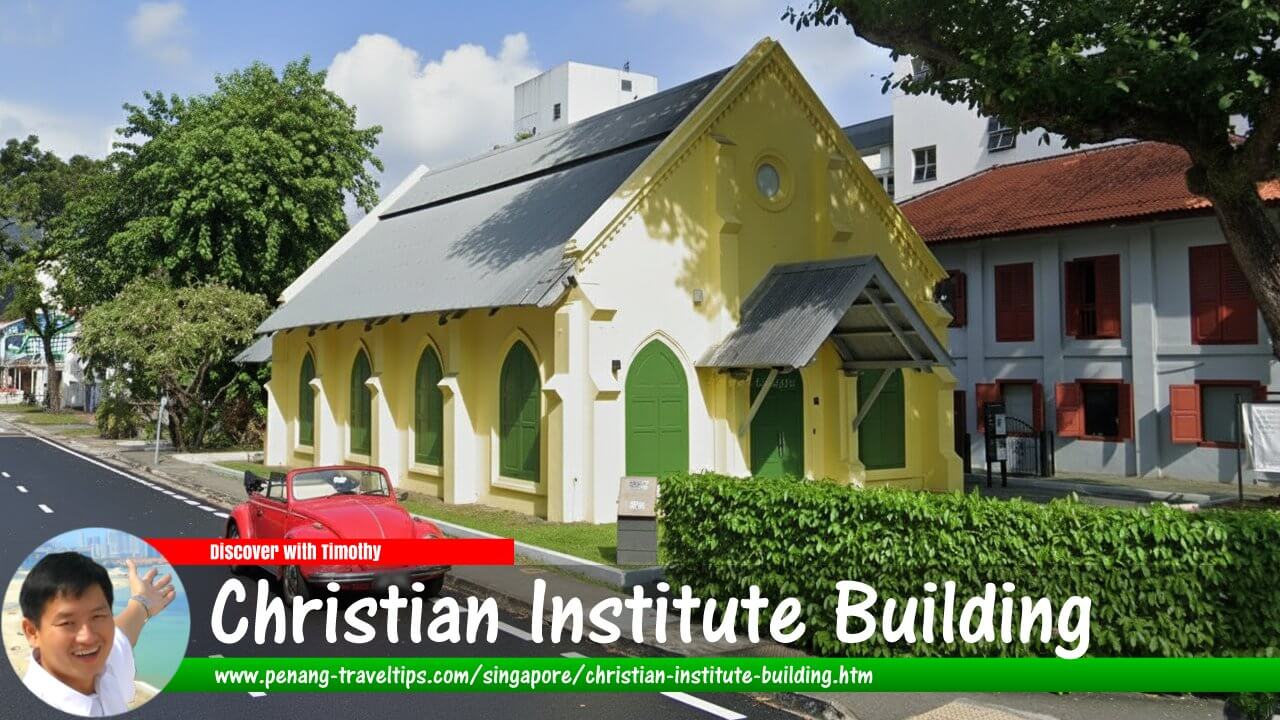 Christian Institute Building (AI generated on 6 May 2026)
The Christian Institute Building is one of the most recognizable historic landmarks situated within the vibrant Bras Basah.Bugis heritage precinct of Singapore. Located at 155 Middle Road, this architectural gem stands as a testament to the city-state’s colonial past and its evolution into a modern cultural hub. Characterized by its distinctive red-brick accents and quaint chapel-like silhouette, the building has served diverse roles over the last century—from a religious mission house and a girls’ school to a dedicated sculpture gallery and its current iteration as a center for photography and film.1
Origins and Early Missionary History
The history of the 155 Middle Road site begins in the late 19th century, during a period of significant missionary expansion in British Malaya. In 1891, the Methodist Episcopal Mission, led by pioneers such as Dr. William Shellabear and Reverend William Oldham, established the Christian Institute. The primary objective of the institute was to provide a space for religious education and community outreach, particularly targeting the local youth and migrant populations residing in the bustling city center.2
The building’s design reflects the "English Gothic" style common among religious structures of that era, featuring pointed arches and a modest nave. It quickly became a focal point for the Straits Chinese community. For many years, it housed the Straits Chinese Methodist Church (now known as the Kampong Kapor Methodist Church) before the congregation grew too large for the space and moved to its current location at Kampong Kapor in 1930.1
Educational Legacy
Beyond its religious functions, the Christian Institute Building played a pivotal role in Singapore’s educational history. In its early decades, the premises served as the first home for the Anglo-Chinese School (ACS) during its expansion years and, perhaps more notably, provided the foundation for the Fairfield Girls' School. Founded by Miss Sophia Blackmore, the school operated out of this location, offering education to young women at a time when such opportunities were scarce. The echoes of these early classrooms contribute to the building’s enduring sense of social purpose.3
Transition through the 20th Century
Following the departure of the church congregation and the schools, the building underwent several decades of varied usage. During the mid-20th century, the site was utilized for commercial and storage purposes, reflecting the changing urban landscape of Middle Road. Despite the rapid modernization of the surrounding area, the structural integrity of the building remained largely intact, though its aesthetic prominence faded temporarily behind the rise of newer concrete developments.2
The Sculpture Square Era (1999–2014)
In the late 1990s, a significant revitalization effort was undertaken to preserve the building and repurpose it for the burgeoning arts scene in Singapore. In 1999, the site was officially launched as Sculpture Square. This was a landmark moment for the local arts community, as it became the first space in the country dedicated specifically to the exhibition and promotion of three-dimensional art.4
For fifteen years, Sculpture Square occupied two main structures on the site: the original Chapel (the Christian Institute Building) and the adjacent Gallery (a former automotive workshop). The venue hosted countless local and international artists, fostering a unique dialogue between contemporary art and historic architecture. The high ceilings and natural light of the Chapel provided an ethereal backdrop for sculptures and installations, making it one of the most beloved galleries in the city.4
Current Usage: Objectifs (May 2026)
As of May 2026, the building continues its legacy as a cornerstone of the arts. It is currently the headquarters of Objectifs - Centre for Photography & Film. Objectifs is an independent non-profit institution that moved to 155 Middle Road in 2015. The center provides a platform for visual storytellers, offering a range of exhibitions, screenings, and workshops that focus on lens-based media.5
The interior of the historic Chapel has been carefully maintained to serve as a professional gallery space, while the surrounding courtyard often features public art displays. In recent years, the center has expanded its influence by integrating digital media and documentary film programs, ensuring that the 135-year-old building remains relevant in the 21st century. Visitors today can walk through the same doors that 19th-century students and worshippers once used, now to view contemporary film festivals or photography biennials.5
Quick Facts
- Common Name: Christian Institute Building / 155 Middle Road
- Original Year Built: 1891
- Architectural Style: Gothic Revival / Eclectic Colonial
- Original Purpose: Methodist Mission and Educational Centre
- Former Tenants: Straits Chinese Methodist Church, Fairfield Girls' School, Sculpture Square
- Current Tenant: Objectifs - Centre for Photography & Film (as of May 2026)
- Location: 155 Middle Road, Singapore 188977
Transportation and Access
Located in the heart of the city, the building is highly accessible via public transport. The nearest Singapore MRT stations are:
- Bencoolen MRT Station (DT21): Located on the Downtown Line, providing the closest access point.
- Bras Basah MRT Station (CC02): Located on the Circle Line, just a short walk away through the arts district.
- Bugis MRT Station (EW12 / DT14): Serving both the East-West Line and the Downtown Line, offering convenient access from many parts of the island.
Fun Fact: A School for 10 Cents
A fascinating piece of trivia regarding this building involves its time as a school. When the Methodist mission first began its educational work here, the "fees" for some of the underprivileged students were reportedly as low as ten cents a month. This was part of the mission's commitment to making education accessible to the local community, regardless of their financial status. Today, while the fees for photography workshops are a bit higher, the building maintains that spirit of community accessibility through its many free public exhibitions.3
Christian Institute Building is  on the Map of Middle Road, Singapore
The Christian Institute Building is  on the Map of Waterloo Road, Singapore
References
- "155 Middle Road," Roots.sg, National Heritage Board. https://www.roots.gov.sg/places/places-landing/Places/landmarks/bras-basah-bugis-trail/155-middle-road
- "Methodist Church in Singapore," Singapore Infopedia, National Library Board. https://eresources.nlb.gov.sg/infopedia/articles/SIP_835_2004-12-30.html
- "Fairfield Methodist School (Primary)," School History, Fairfield Methodist. https://www.fairfieldmethodistpri.moe.edu.sg/about-us/our-history/
- "Sculpture Square," ArtHop Singapore. https://arthop.co/venues/sculpture-square
- "About Objectifs," Objectifs - Centre for Photography & Film. https://www.objectifs.com.sg/about/
Page Details
This page was created on 6 May 2026. Hi, my name is Timothy and created it from my research, for my own entertainment, knowledge and to satisfy my curiosity. I am providing the information to you in good faith and hope it is useful. I try to get the details as accurate as possible. I also try to update the page whenever I stumble on new details. So this and all my other pages are perpetual work in progress. If you discover any error, please politely inform me, pointing out where the error lies, and I will correct it as soon as possible. Your helpfulness will keep this page accurate, relevant and helpful to those who need the information.My videos of Singapore
Want to share your Singapore travel experiences or get tips from fellow travellers?
Join the Singapore Travel Tips Facebook GroupMore information for visiting and living in Singapore
Here are some related articles to help you get to know Singapore better.- Cost of Living in Different Singapore Neighbourhoods (2025 Guide)
- EZ-Link Card
- Owning a Car in Singapore
- Singapore MRT Map & Guide 2025
- Singapore Postal Districts and Postcodes
- Singapore Tourist Pass
- Taking the Bus in Singapore: A Visitor's Guide
- Understanding CCR, RCR and OCR in Singapore real estate
 Latest Pages & Updates
Buy Me A Coffee
If you enjoy the information I provide and want to support the work I do, please buy me a coffee! I appreciate it immensely, thank you so much!
