
Kuala Lumpur-Kuala Selangor Expressway (E25, LATAR)
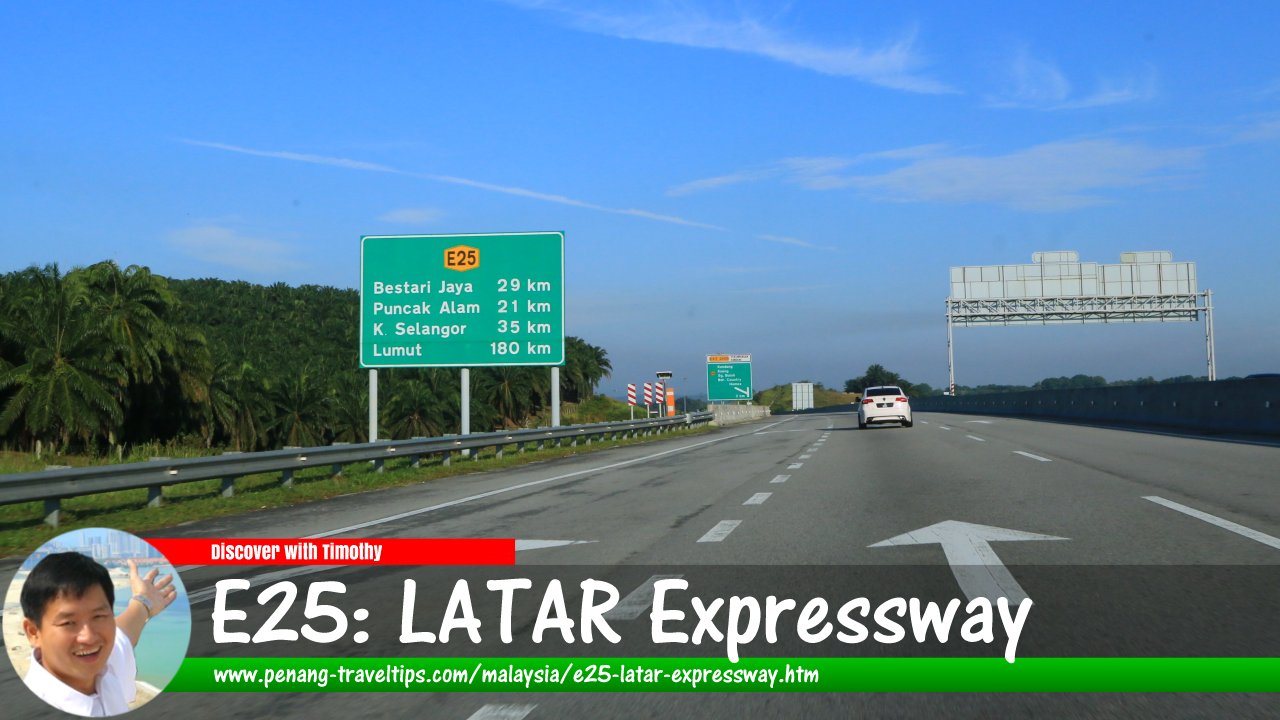 Kuala Lumpur-Kuala Selangor Expressway (LATAR, E25) (7 July, 2016)
Kuala Lumpur–Kuala Selangor Expressway, more commonly known by its acronym LATAR Expressway, is a controlled-access toll expressway in Selangor that provides a direct connection between the northwestern outskirts of the Klang Valley and Kuala Selangor. Officially designated as Expressway E25, the expressway begins at the Templer Interchange near Rawang and extends westwards to Ijok, where it connects with Federal Route 54 leading to Kuala Selangor. Since its opening in 2011, LATAR has significantly reduced travel times between Kuala Lumpur, Rawang, Puncak Alam, Bestari Jaya and Kuala Selangor while supporting residential, industrial and agricultural development across northwestern Selangor.1
Quick Facts
- Official name: Kuala Lumpur–Kuala Selangor Expressway
- Common name: LATAR Expressway
- Expressway code: E25
- Length: Approximately 33 km
- Location: Selangor
- Route: Templer Interchange (Rawang) to Ijok
- Operational since: 23 June 2011
- Operator: LATAR Expressway Sdn Bhd
- Lane configuration: Dual two-lane carriageway (2 lanes in each direction)
- Number of interchanges: 7 principal interchanges
- Toll system: Closed toll system using electronic payment
- Passenger car toll: RM2.50 end-to-end (Class 1, as of June 2026)
Overview
The Kuala Lumpur–Kuala Selangor Expressway derives its acronym LATAR from its Malay name, Lebuhraya Kuala Lumpur–Kuala Selangor. Although the expressway does not begin within Kuala Lumpur itself, it was conceived as a strategic route providing motorists from the Klang Valley with a faster journey towards Kuala Selangor by bypassing heavily congested sections of Federal Route 54. The expressway forms part of Selangor's expanding network of urban and suburban highways, complementing other major expressways serving the northern part of the Klang Valley.2
Before LATAR was built, motorists travelling between Kuala Lumpur and Kuala Selangor relied primarily on Federal Route 54, which passes through Rawang, Bestari Jaya and numerous small towns. As residential growth accelerated in Rawang, Puncak Alam and surrounding districts, increasing traffic congestion made journey times unpredictable. The construction of LATAR provided an alternative route that bypasses town centres and offers uninterrupted travel on a modern expressway.3
Map of E25: Kuala Lumpur-Kuala Selangor Expressway (LATAR)
Route Description
The expressway begins at the Templer Interchange, where it connects with the North–South Expressway (E1) near Rawang. From there, it travels westwards through predominantly rural and suburban landscapes before terminating at Ijok. Beyond its western terminus, motorists continue towards Kuala Selangor using Federal Route 54.
Along its route, LATAR serves rapidly developing townships including Kundang, Kuang, Puncak Alam and Bestari Jaya. The expressway has helped improve accessibility to new housing developments, universities, industrial estates and logistics facilities that have emerged across northwestern Selangor over the past two decades.2
Engineering Features
The Kuala Lumpur–Kuala Selangor Expressway is approximately 33 kilometres long and consists primarily of a dual two-lane carriageway, providing two traffic lanes in each direction separated by a central median. The expressway was designed with provisions for future widening should traffic volumes continue to increase.
Like most modern Malaysian expressways, LATAR is built to controlled-access standards. Entry and exit are only possible via designated interchanges, eliminating at-grade intersections and traffic lights. The route includes numerous bridges, drainage structures and grade-separated crossings that allow uninterrupted traffic flow while maintaining connections for local roads and agricultural access.3
Interchanges
The expressway features seven principal interchanges that provide access to surrounding communities and strategic development areas.
- Templer Interchange (North–South Expressway)
- Kundang Interchange
- Kuang Interchange
- Puncak Alam Interchange
- Bestari Jaya Interchange
- Ijok East Interchange
- Ijok West Terminus
Among these, the most significant is the eastern Templer Interchange, where LATAR connects directly with the North–South Expressway (E1). This connection enables motorists travelling from Kuala Lumpur, Ipoh and other parts of Peninsular Malaysia to reach Kuala Selangor without travelling through Rawang town.4
Toll Collection
LATAR is a toll expressway operated under a concession agreement by LATAR Expressway Sdn Bhd. It employs a closed toll system, with motorists paying according to the distance travelled. Electronic toll collection is available through RFID, Touch 'n Go cards and SmartTAG.
As of June 2026, the toll for a Class 1 passenger vehicle travelling the entire length of the expressway is RM2.50, making it one of the more affordable toll expressways in the Klang Valley. Individual toll charges vary depending on entry and exit points.5
Traffic and Economic Importance
Although shorter than many of Malaysia's major expressways, LATAR plays an important regional role by improving accessibility between northern Klang Valley communities and western Selangor. The expressway has reduced journey times for commuters while facilitating the movement of commercial vehicles serving agricultural estates, ports, industrial parks and distribution centres.
The highway has also encouraged residential development in areas such as Kundang, Kuang and Puncak Alam. Improved transport infrastructure has attracted new housing projects, educational institutions and commercial developments, transforming previously rural districts into growing suburban communities.6
Safety Features
LATAR incorporates the safety features expected of a modern Malaysian expressway, including concrete median barriers, guardrails, emergency telephones at selected locations, reflective road markings, overhead directional signage and adequate lighting at major interchanges. Closed-circuit television cameras and traffic monitoring systems assist operators in responding quickly to incidents.
Regular maintenance programmes include pavement resurfacing, vegetation control, drainage cleaning and bridge inspections to ensure that the expressway continues operating safely and efficiently throughout the year.2
Future Prospects
Population growth throughout northern Selangor is expected to increase demand for LATAR in the coming decades. Areas such as Puncak Alam, Bestari Jaya and Ijok continue to experience residential and industrial expansion, resulting in steadily increasing traffic volumes. The expressway was planned with sufficient corridor width to allow future widening should traffic conditions require additional capacity.
Further integration with surrounding highways and local road improvements will continue enhancing regional connectivity. Together with the North–South Expressway, Guthrie Corridor Expressway and other major roads in Selangor, LATAR forms an important component of the state's transport infrastructure, supporting economic development while providing motorists with a reliable alternative to older federal roads.6
References
- LATAR Expressway – Official Website
- Malaysian Highway Authority (LLM)
- Wikipedia – Kuala Lumpur–Kuala Selangor Expressway
- Road Network Information – Road Transport Department Malaysia
- Touch 'n Go – Toll Rate Information
- Selangor State Government
Page Details
This page was created on 30 June 2026. Hi, my name is Timothy and created it from my research, for my own entertainment, knowledge and to satisfy my curiosity. I am providing the information to you in good faith and hope it is useful. I try to get the details as accurate as possible. I also try to update the page whenever I stumble on new details. So this and all my other pages are perpetual work in progress. If you discover any error, please politely inform me, pointing out where the error lies, and I will correct it as soon as possible. Your helpfulness will keep this page accurate, relevant and helpful to those who need the information.Back to Discover Malaysia mainpage; List of Expressways in Malaysia; see also Highways in Malaysia
My Videos of Malaysia
 Latest Pages & Updates
Buy Me A Coffee
If you enjoy the information I provide and want to support the work I do, please buy me a coffee! I appreciate it immensely, thank you so much!
