
Wellington Museum (Apsley House)
Wellington Museum provides the public a glimpse into the interior of an English aristocratic town house of its period. The house was originally built between 1771 and 1778 by Robert Adam for Lord Apsley, the Lord Chancellor. It was purchased by Richard Wellesley, 1st Marquess Wellesley, the elder brother of Sir Arthur Wellesley in 1807. However financial difficulties forced Richard to sell the house to Arthur, who had been made the Duke of Wellington, and who was in need of a house to be his London base.
The Duke of Wellington engaged architect Benjamin Dean Wyatt to give Apsley House a makeover. He added two bays westward, built the Waterloo Gallery to display his collection of paintings, and faced the red bricks with the finer quality Bath stone.
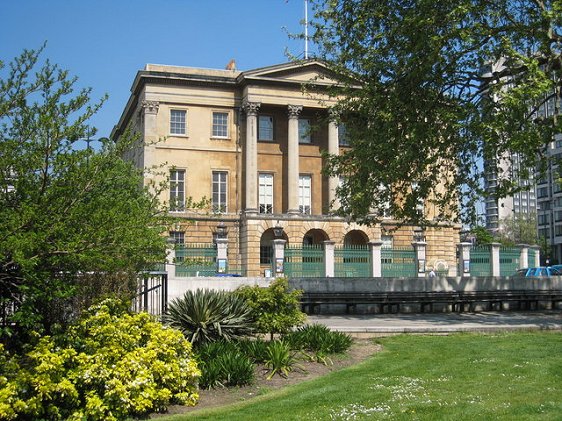 Another view of Apsley House
Source: https://commons.wikimedia.org/wiki/File:Apsley_House_-_geograph.org.uk_-_792981.jpg
Author: Rod Allday

The Duke of Wellington also re-did the interior, according to his own interpretation of French style. One of the most important rooms in the house is the Waterloo Gallery, which celebrates the Duke's famous victory over Napoleon at the Battle of Waterloo. Every 18 June, a special banquet is held there to commemorate the date.
Apsley House was given to the nation in 1947 by Gerald Wellesley, the 7th Duke of Wellington, with the condition (Wellington Museum Act 1947) that the family has a right to occupy some parts of the house, for as long as there is a Duke of Wellington. The family quarters are on the north side of the house, on the second floor.
Visiting Wellington Museum (Apsley House)
Take the Piccadilly Line to the Hyde Park Corner Station and walk a short distance from there.The Wellington Museum at Apsley House is located at 149 Piccadilly, Hyde Park Corner, London W1J 7NT. It is usually closed on Mondays and Tuesdays. On other days, it is open from 11:00 am to 5:00 pm. Entrance fee is £6.30 for adults, £3.80 for children. Joint ticket for visiting the Wellington Arch is also available, at £7.90 for adults and £4.70 for children.
List of Museums in London
Want to share your London travel experiences or get tips from fellow travellers?
Join the London Travel Tips Facebook GroupMore information for visiting London
Here are some related articles to help you get to know London better.- Cost of Living in London: Discover the true cost of living in London, including housing, transport, groceries, and more - plus tips for budgeting in one of the world's most expensive cities.
- Driving in London: Planning to drive in London? Learn about roads, car rentals, parking, tolls, and key tips for tourists and visitors from outside the capital.
- Driving Tips for Visiting London: Thinking of driving to London? Discover the best times to travel, congestion tips, parking apps, breakdown help, and petrol advice for a smoother journey.
- Evolution of London's Streets: Discover the fascinating history of how London's streets developed from ancient footpaths to today's complex network of roads across the capital.
- History of Immigration to London: Discover the rich history of immigration to London, from Huguenots to Bangladeshis, and how diverse communities have shaped the city's vibrant identity.
- How Big Is London Compared to Other World Cities?
- How London's Streets Measure Up: A Global Comparison of Road Widths
- How Streets of London are Named: Discover how London streets get their names, who decides them, and how historic, political, and public influences shape street naming in the capital.
- How the Grosvenor Family Came to Own Much of Mayfair, Belgravia and Pimlico: Explore how the Grosvenor family came to own much of Mayfair, Belgravia, and Pimlico, and learn about their historical connection (or lack thereof) with the British royal family and government.
- Living and working in London
- London's Quiet Collapse: How Living Standards Fell as Costs Skyrockted (1975-2025): Explore how London residents endured rising costs and falling living standards from 1975 to 2025 - from rocketing rents to wage stagnation and inflation.
- Marvel of the London Underground: Discover the history, challenges, and triumphs of the London Underground - the world's first underground railway and a vital transport lifeline for the UK capital since 1863.
- Moving to London: Expat Tips for Settling in Westminster: Essential advice for expats moving to London's Westminster: neighborhood insights, cost of living, transportation, housing, healthcare, schools, and tips to help you feel at home in the heart of the city.
- Places in London that aren't pronounced the way they're spelled
- Shopping in London: Discover London's diverse shopping scene
- Taking the bus in London: This is your complete guide to taking the bus when in London.
- The Anglican Faith: A Visitor's Guide to the Church of England: Learn about the Anglican faith and its deep ties to London's landmarks like Westminster Abbey and St Paul's Cathedral.
- Top 10 London Streets Every Visitor Must See: Discover London through its most iconic thoroughfares - 10 streets every visitor must experience. From historic Abbey Road to vibrant Camden High Street, explore culture, shopping, and hidden gems.
- Why are most roads in Central London so narrow? Learn why there are so few multi-lane roads and elevated highways in the heart of the city.
 Latest Pages & Updates
Buy Me A Coffee
If you enjoy the information I provide and want to support the work I do, please buy me a coffee! I appreciate it immensely, thank you so much!
