
Tower Bridge, London
Tower Bridge was designed and built in the second half of the 19th century, at a time when the Port of London was one of the busiest ports in the world. Commercial development in the East End of London called for a new river crossing downstream from London Bridge.
A traditional fixed bridge could not be built there as it would block access to the port facilies located further upstream, between London Bridge and the present Tower Bridge. A committee was formed in 1876 to find a solution to this problem. A competition was held to find a suitable design. It attracted over 50 designs. The design submitted by Horace Jones, the City Architect (and apparently, one of the judges), was the one selected. Needless to say, the choice created much controversy.
The design called for a combined bascule and suspension bridge. Jones' engineer, Sir John Wolfe Barry devised the idea of a bascule bridge 800 feet (244 m) in length with two towers each 213 feet (65 m) high, built on piers. The central span is 200 feet (61 m), and is split between two equal bascules or leaves which could be raised to an angle of 83 degrees to allow boats to pass through. Each of the bascule weighs over 1,000 tons. They are counterbalanced to minimize the force required to raise them, and to ensure raising can be done in five minutes.
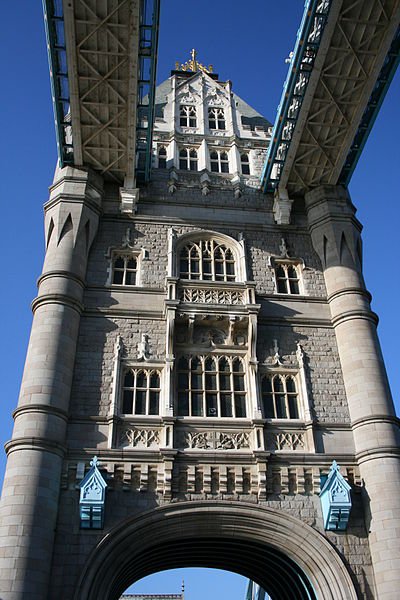 Tower Bridge, London
Source: https://commons.wikimedia.org/wiki/File:006SFEC_TOWER_BRIDGE-200705.JPG
Author: Steve F-E-Cameron

The two side-spans are suspension bridges, each 270 feet (82 m) long, with the suspension rods anchored both at the abutments and through rods contained within the bridge's upper walkways. The pedestrian walkways are 143 feet (44 m) above the river at high tide.
Construction of the Tower Bridge started in 1886 and took eight years under five major contractors – Sir John Jackson (foundations), Baron Armstrong (hydraulics), William Webster, Sir H.H. Bartlett, and Sir William Arrol. 432 construction workers were employed.
Two massive piers containing over 70,000 tons of concrete, were sunk into the Thames river bed to support the construction. Over 11,000 tons of steel provided the framework for the towers and walkways. This was then clad in Cornish granite and Portland stone, to protect the underlying steelwork as well as to give the bridge a pleasing appearance. The total cost of construction amounted to £1,184,000.
The Tower Bridge was officially opened on 30 June 1894 by the Prince of Wales, the future King Edward VII, and his wife, Alexandra of Denmark. It replaced the Tower Subway 400m to the west, which was the world's first underground tube railway built in 1870. Until the Tower Bridge was built, the Tower Subway was the shortest way to cross the Thames from Tower Hill to Tooley Street in Southwark.
How to reach the Tower Bridge
The nearest London Underground station is the Tower Hill station.List of Bridges in London and Bridges in the United Kingdom
Want to share your London travel experiences or get tips from fellow travellers?
Join the London Travel Tips Facebook GroupMore information for visiting London
Here are some related articles to help you get to know London better.- Cost of Living in London: Discover the true cost of living in London, including housing, transport, groceries, and more - plus tips for budgeting in one of the world's most expensive cities.
- Driving in London: Planning to drive in London? Learn about roads, car rentals, parking, tolls, and key tips for tourists and visitors from outside the capital.
- Driving Tips for Visiting London: Thinking of driving to London? Discover the best times to travel, congestion tips, parking apps, breakdown help, and petrol advice for a smoother journey.
- Evolution of London's Streets: Discover the fascinating history of how London's streets developed from ancient footpaths to today's complex network of roads across the capital.
- History of Immigration to London: Discover the rich history of immigration to London, from Huguenots to Bangladeshis, and how diverse communities have shaped the city's vibrant identity.
- How Big Is London Compared to Other World Cities?
- How London's Streets Measure Up: A Global Comparison of Road Widths
- How Streets of London are Named: Discover how London streets get their names, who decides them, and how historic, political, and public influences shape street naming in the capital.
- How the Grosvenor Family Came to Own Much of Mayfair, Belgravia and Pimlico: Explore how the Grosvenor family came to own much of Mayfair, Belgravia, and Pimlico, and learn about their historical connection (or lack thereof) with the British royal family and government.
- Living and working in London
- London's Quiet Collapse: How Living Standards Fell as Costs Skyrockted (1975-2025): Explore how London residents endured rising costs and falling living standards from 1975 to 2025 - from rocketing rents to wage stagnation and inflation.
- Marvel of the London Underground: Discover the history, challenges, and triumphs of the London Underground - the world's first underground railway and a vital transport lifeline for the UK capital since 1863.
- Moving to London: Expat Tips for Settling in Westminster: Essential advice for expats moving to London's Westminster: neighborhood insights, cost of living, transportation, housing, healthcare, schools, and tips to help you feel at home in the heart of the city.
- Places in London that aren't pronounced the way they're spelled
- Shopping in London: Discover London's diverse shopping scene
- Taking the bus in London: This is your complete guide to taking the bus when in London.
- The Anglican Faith: A Visitor's Guide to the Church of England: Learn about the Anglican faith and its deep ties to London's landmarks like Westminster Abbey and St Paul's Cathedral.
- Top 10 London Streets Every Visitor Must See: Discover London through its most iconic thoroughfares - 10 streets every visitor must experience. From historic Abbey Road to vibrant Camden High Street, explore culture, shopping, and hidden gems.
- Why are most roads in Central London so narrow? Learn why there are so few multi-lane roads and elevated highways in the heart of the city.
 Latest Pages & Updates
Buy Me A Coffee
If you enjoy the information I provide and want to support the work I do, please buy me a coffee! I appreciate it immensely, thank you so much!
