
National Gallery, London
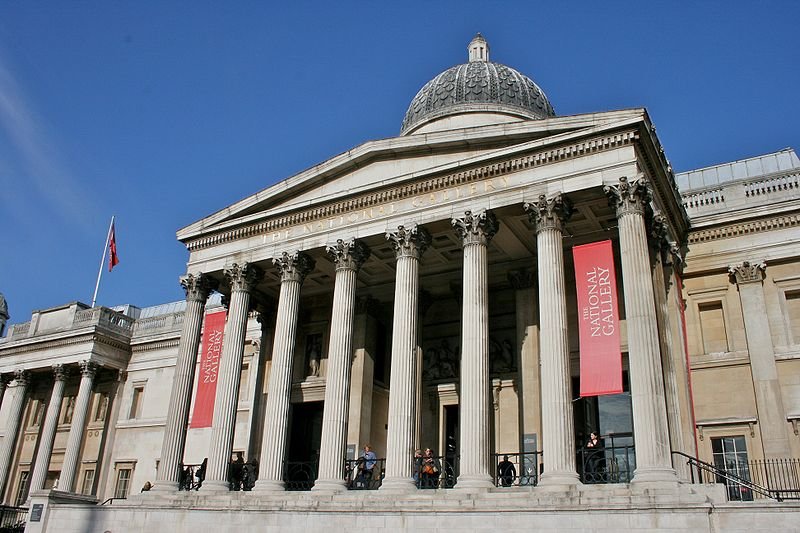 The National Gallery, London
Source: https://commons.wikimedia.org/wiki/File:National_Gallery,_London.jpg
Author: Mike Peel

The National Gallery (GPS: 51.50872, -0.12838) in London is located on the north side of Trafalgar Square, London. It began when the British government bought 36 paintings from banker John Julius Angerstain in 1824. From that minuscule collection, the National Gallery today houses over 2,300 paintings dating from the mid-13th century to 1900. Two thirds of the collection comes from donation. The collect is small compared to national galleries of continental Europe, however, it has important works with a broad historical representation, covering Early Renaissance to Post-Impressionism.
The present structure at Trafalgar Square was built in 1832-8. However only the facade is recognisable from the original, with much of the inside having been renovated and expanded. This is the third building to house the National Gallery, and despite the many expansions, is still inadequate.
Britain was a late start in establishing a national art collection accessible to the public. It was not so much a lack of opportunity, but a lack of will. When the substantial private collection of Sir Robert Walpole was put up for sale in 1777, the government passed over the opportunity. In the end, the collection was bought in its entirely by Catherine the Great, and now is housed within the State Hermitage Museum in St Petersburg. London was without a state-owned national gallery in a central location until after the Napoleonic Wars.
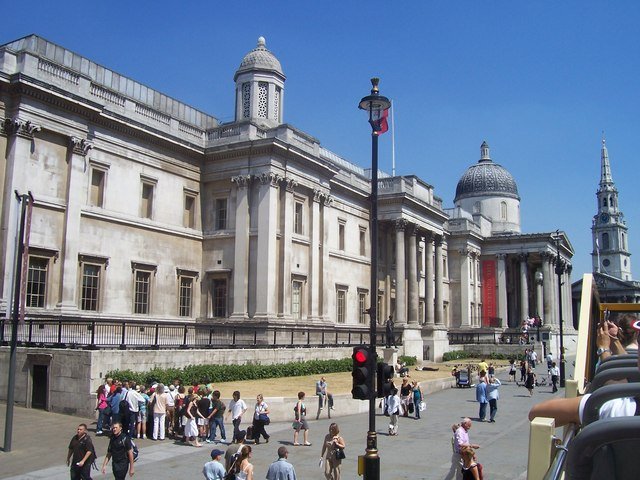 Side view, National Gallery
Source: https://commons.wikimedia.org/wiki/File:London_,_Westminster_-_The_National_Gallery_-_geograph.org.uk_-_1225070.jpg
Author: Lewis Clarke

The National Gallery finally was established when the House of Commons voted to buy the collection of John Julius Angerstin, who had died the previous year, in 1824. The gallery opened to the public on 10 May, 1824, in Angerstein's former townhouse, on No. 100 Pall Mall. In 1826, Sir George Beaumont donated his collection while in 1828, Reverend William Holwell Carr bequested 34 paintings. In no time No. 100 Pall Mall was soon overcrowded with paintings, and its diminutive size compared to the substantial Louvre in Paris was a cause of national embarrassment.
The site at Trafalgar Square made creating an impressive gallery a challenging task. It cannot be extended in further than one room, as there was a workhouse and a barracks immediately behind. The architect whose design was chosen, William Wilkins, also had to comply to several stipulations, among them, he has to used columns from the demolished Carlton House, and sculptures which were intended for John Nash's Marble Arch. As a result, the National Gallery opened to much public ridicule.
Alterations were made in the immediate years of the 19th century, going into the 20th and now the 21st century. In the recent years, the main entrance was refurnished and reopened in September 2005. There will certainly be more renovation going into the future, with no timetable announced at the moment.
Getting there
Location: Trafalgar Square WC2N 5DNTake the London Underground to the Charing Cross Station or Leicester Square Station and walk a short distance from there.
Buses: Nos. 19, 24, 6, 9, 11 & 13
Entrance fee: no charge, but donation box available
Guided Tours: Free guided tours available daily at 11:30am and 2:30pm, and also at 6:30pm on Wednesdays.
What to see
There are three main entrances: the Trafalgar Square entrance, the Sainsbury wing entrance and the Educational Centre entrance. Inside, the National Gallery comprises 4 wings namely the Sainsbury Wing, North Wing, West Wing and East Wing.National Gallery is  on the map of Art Galleries in London
List of Art Galleries in London
Want to share your London travel experiences or get tips from fellow travellers?
Join the London Travel Tips Facebook GroupMore information for visiting London
Here are some related articles to help you get to know London better.- Cost of Living in London: Discover the true cost of living in London, including housing, transport, groceries, and more - plus tips for budgeting in one of the world's most expensive cities.
- Driving in London: Planning to drive in London? Learn about roads, car rentals, parking, tolls, and key tips for tourists and visitors from outside the capital.
- Driving Tips for Visiting London: Thinking of driving to London? Discover the best times to travel, congestion tips, parking apps, breakdown help, and petrol advice for a smoother journey.
- Evolution of London's Streets: Discover the fascinating history of how London's streets developed from ancient footpaths to today's complex network of roads across the capital.
- History of Immigration to London: Discover the rich history of immigration to London, from Huguenots to Bangladeshis, and how diverse communities have shaped the city's vibrant identity.
- How Big Is London Compared to Other World Cities?
- How London's Streets Measure Up: A Global Comparison of Road Widths
- How Streets of London are Named: Discover how London streets get their names, who decides them, and how historic, political, and public influences shape street naming in the capital.
- How the Grosvenor Family Came to Own Much of Mayfair, Belgravia and Pimlico: Explore how the Grosvenor family came to own much of Mayfair, Belgravia, and Pimlico, and learn about their historical connection (or lack thereof) with the British royal family and government.
- Living and working in London
- London's Quiet Collapse: How Living Standards Fell as Costs Skyrockted (1975-2025): Explore how London residents endured rising costs and falling living standards from 1975 to 2025 - from rocketing rents to wage stagnation and inflation.
- Marvel of the London Underground: Discover the history, challenges, and triumphs of the London Underground - the world's first underground railway and a vital transport lifeline for the UK capital since 1863.
- Moving to London: Expat Tips for Settling in Westminster: Essential advice for expats moving to London's Westminster: neighborhood insights, cost of living, transportation, housing, healthcare, schools, and tips to help you feel at home in the heart of the city.
- Places in London that aren't pronounced the way they're spelled
- Shopping in London: Discover London's diverse shopping scene
- Taking the bus in London: This is your complete guide to taking the bus when in London.
- The Anglican Faith: A Visitor's Guide to the Church of England: Learn about the Anglican faith and its deep ties to London's landmarks like Westminster Abbey and St Paul's Cathedral.
- Top 10 London Streets Every Visitor Must See: Discover London through its most iconic thoroughfares - 10 streets every visitor must experience. From historic Abbey Road to vibrant Camden High Street, explore culture, shopping, and hidden gems.
- Why are most roads in Central London so narrow? Learn why there are so few multi-lane roads and elevated highways in the heart of the city.
 Latest Pages & Updates
Buy Me A Coffee
If you enjoy the information I provide and want to support the work I do, please buy me a coffee! I appreciate it immensely, thank you so much!
