
Royal Borough of Greenwich, London
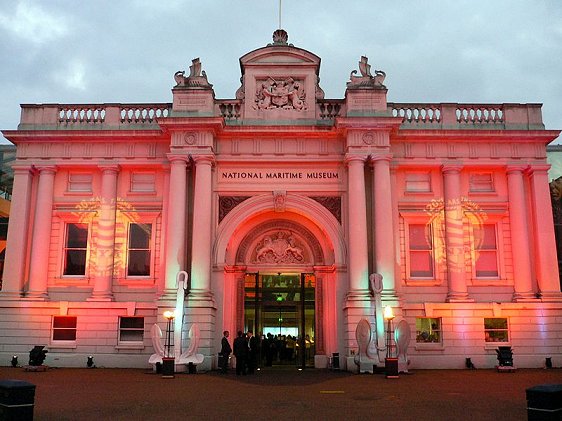 National Maritime Museum, Greenwich, London
Source: https://commons.wikimedia.org/wiki/File:National_Maritime_Museum_Greenwich_2.jpg
Author: Sue Wallace

Greenwich is a historic town on the southeastern part of London. Previously a distinct town, today it is part of the urban sprawn of Greater London. It sits on the south bank of the River Thames in the Royal Borough of Greenwich, and is best known for its role in the fields of navigation and astronomy. This led to the Greenwich Meridien being agreed as the Prime Meridian of the World in 1884. This recognition led to Maritime Greenwich being inscribed as a World Heritage Site of the United Kingdom.
The Royal Observatory (previously Royal Greenwich Observatory) is located in Greenwich and the Prime Meridian passes through the building. At one time, Greenwich Mean Time was based on the time observations made at the Royal Observatory, before being superseded by Coordinated Universal Time. Although Greenwich no longer hosts a working astronomical observatory, a ball still drops daily to mark the exact moment of 1 pm (13:00). There is a museum of astronomical and navigational tools, particularly John Harrison's marine chronometers.
The observatory is situated in Greenwich Park, which used to be the grounds of the Royal Palace of Placentia. At the bottom of the park is the National Maritime Museum which also includes the Queen's House, designed by Inigo Jones.
The landmark of maritime Greenwich is the Old Royal Naval College, designed by Sir Christopher Wren. It is open daily to visitors, free of charge. Several of the buildings are let to The University of Greenwich and one, the King Charles block, to Trinity College of Music. Guided tours are available daily 7 days a week.
Greenwich also has the only museum in the world dedicated to fans, the Fan Museum, in a Georgian townhouse at 10–12 Croom's Hill. On the corner of the junction with Nevada Street is Greenwich Theatre, formerly Crowder's Music Hall - one of two Greenwich theatres, the other being Greenwich Playhouse.
The Cutty Sark (a clipper ship) has been preserved in a dry dock by the river. A major fire in May 2007 destroyed a part of the ship, although much had already been removed for restoration. Its future has yet to be decided. Nearby for many years was also displayed Gipsy Moth IV, the 54ft yacht sailed by Sir Francis Chichester in his single-handed, 226-day circumnavigation of the globe during 1966–67. In 2004, Gypsy Moth IV was removed from Greenwich, and after restoration work completed a second circumnavigation in May 2007. On the riverside in front of the north-west corner of the Hospital is an obelisk erected in memory of Arctic explorer Joseph René Bellot.
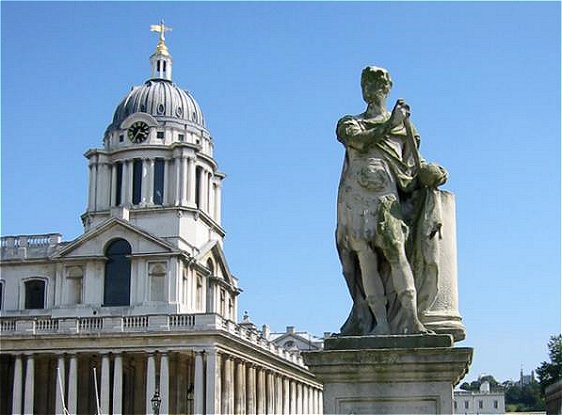 Statue of King George II at the Statue of King George II at the Royal Naval College, Greenwich
Source: https://commons.wikimedia.org/wiki/File:Royal-naval-college-gw.jpg
Author: MykReeve

Near the remains of the Cutty Sark, a circular building contains the entrance to the Greenwich foot tunnel. This connects Greenwich to the Isle of Dogs on the northern side of the River Thames. The north exit of the tunnel is at Island Gardens, from where the famous view of Greenwich Hospital painted by Canaletto can be seen.
The O2 (formerly the Millennium Dome) was built on a disused site on the Greenwich Peninsula, next to the North Greenwich tube station and three miles east from the Greenwich town centre. The Greenwich Millennium Village is a new urban regeneration development south of the Dome.
East Greenwich has a small park, East Greenwich Pleasaunce, formerly the burial ground of Greenwich Hospital. The town centre features Greenwich Market, a covered market popular with tourists on weekends. The owners, Greenwich Hospital, is considering developing the site while retaining the Market.
In 1997, maritime Greenwich was inscribed by Unesco as a World Heritage Sites. In conjunction with this honour, Asteroid 2830 was named "Greenwich".
Getting there
Greenwich is located about 11km (7 miles) southeast of Trafalgar Square, on the south bank of the River Thames.Nearest National Rail Station: Greenwich
Docklands Light Railway: Take train to Island Gardens station, then walk through the tunnel to Greenwich Buses: No. 188
River Boats: Take ferry boat from Westminster Millennium Pier. Journey takes about 1 hour 10 minutes.
Want to share your London travel experiences or get tips from fellow travellers?
Join the London Travel Tips Facebook GroupMore information for visiting London
Here are some related articles to help you get to know London better.- Cost of Living in London: Discover the true cost of living in London, including housing, transport, groceries, and more - plus tips for budgeting in one of the world's most expensive cities.
- Driving in London: Planning to drive in London? Learn about roads, car rentals, parking, tolls, and key tips for tourists and visitors from outside the capital.
- Driving Tips for Visiting London: Thinking of driving to London? Discover the best times to travel, congestion tips, parking apps, breakdown help, and petrol advice for a smoother journey.
- Evolution of London's Streets: Discover the fascinating history of how London's streets developed from ancient footpaths to today's complex network of roads across the capital.
- History of Immigration to London: Discover the rich history of immigration to London, from Huguenots to Bangladeshis, and how diverse communities have shaped the city's vibrant identity.
- How Big Is London Compared to Other World Cities?
- How London's Streets Measure Up: A Global Comparison of Road Widths
- How Streets of London are Named: Discover how London streets get their names, who decides them, and how historic, political, and public influences shape street naming in the capital.
- How the Grosvenor Family Came to Own Much of Mayfair, Belgravia and Pimlico: Explore how the Grosvenor family came to own much of Mayfair, Belgravia, and Pimlico, and learn about their historical connection (or lack thereof) with the British royal family and government.
- Living and working in London
- London's Quiet Collapse: How Living Standards Fell as Costs Skyrockted (1975-2025): Explore how London residents endured rising costs and falling living standards from 1975 to 2025 - from rocketing rents to wage stagnation and inflation.
- Marvel of the London Underground: Discover the history, challenges, and triumphs of the London Underground - the world's first underground railway and a vital transport lifeline for the UK capital since 1863.
- Moving to London: Expat Tips for Settling in Westminster: Essential advice for expats moving to London's Westminster: neighborhood insights, cost of living, transportation, housing, healthcare, schools, and tips to help you feel at home in the heart of the city.
- Places in London that aren't pronounced the way they're spelled
- Shopping in London: Discover London's diverse shopping scene
- Taking the bus in London: This is your complete guide to taking the bus when in London.
- The Anglican Faith: A Visitor's Guide to the Church of England: Learn about the Anglican faith and its deep ties to London's landmarks like Westminster Abbey and St Paul's Cathedral.
- Top 10 London Streets Every Visitor Must See: Discover London through its most iconic thoroughfares - 10 streets every visitor must experience. From historic Abbey Road to vibrant Camden High Street, explore culture, shopping, and hidden gems.
- Why are most roads in Central London so narrow? Learn why there are so few multi-lane roads and elevated highways in the heart of the city.
 Latest Pages & Updates
Buy Me A Coffee
If you enjoy the information I provide and want to support the work I do, please buy me a coffee! I appreciate it immensely, thank you so much!
