
The London Borough of Enfield
Located in North London, the London Borough of Enfield is a diverse and historic borough offering a unique mix of urban and green landscapes.
Introduction and Location
The London Borough of Enfield lies in the far north of Greater London, forming part of Outer London. It shares borders with the London Boroughs of Barnet to the west, Haringey to the south, and Waltham Forest to the southeast. To the north, it touches the county of Hertfordshire, making it a key transition zone between London and the Home Counties.
The town centre of Enfield, known as Enfield Town, is a major commercial hub in the borough and lies approximately 10.1 miles (16.3 km) north of Charing Cross, traditionally considered the central point of London.
History and Establishment
The London Borough of Enfield was officially formed in 1965 by the merger of the former Municipal Boroughs of Enfield, Southgate, and Edmonton under the London Government Act 19631. The borough has deep historic roots, with Enfield Town mentioned in the Domesday Book of 1086 as "Enefelde."
Size and Population
Enfield covers an area of 82.20 square kilometres (31.74 square miles), making it one of the larger London boroughs in terms of land area2.
As of the most recent estimates, the borough has a population of approximately 333,600 residents3. The borough is ethnically diverse:
- White: 38.8%
- Black (African, Caribbean, or Black British): 18.1%
- Asian (primarily Turkish, Bangladeshi, and Indian): 14.7%
- Mixed and Other: 28.4%
Name Origin
The name "Enfield" is thought to derive from the Anglo-Saxon term "Eanafeld," meaning "open land belonging to a man called Ēana."4 The presence of the River Lea and its fertile valley would have made it an attractive settlement in early medieval times.
Population Density
Enfield's population density stands at approximately 4,058 people per square kilometre. This is relatively low compared to inner London boroughs, some of which exceed 10,000 residents per square kilometre. Enfield's blend of suburban housing and green belt land contributes to this lower density5.
Property Prices and Rental Rates
As of 2025, the average residential property price in Enfield is approximately £470,000, with average monthly rental prices for a two-bedroom flat hovering around £1,6006. These prices are lower than the London average, making Enfield an attractive option for families and commuters seeking more space and affordability.
London Underground Stations in Enfield
While much of Enfield is served by National Rail rather than the Tube, there is one London Underground line that reaches into the borough:
- Oakwood – Piccadilly Line
- Southgate – Piccadilly Line
- Arnos Grove – Piccadilly Line (partially within the borough)
Other Rail Services
Enfield is well-served by National Rail and London Overground services. Key stations include:
- Enfield Town – London Overground (Liverpool Street Line)
- Enfield Chase – Great Northern (Moorgate Line)
- Southbury – London Overground
- Edmonton Green – London Overground and Greater Anglia
- Winchmore Hill – Great Northern
- Gordon Hill – Great Northern
- Turkey Street, Theobalds Grove – London Overground
Fun Fact
Enfield is credited with the creation of the world’s first ATM (Automated Teller Machine), installed at a Barclays Bank branch in Enfield Town in 1967. The machine was unveiled by actor Reg Varney of *On the Buses* fame7.
Quick Facts
- Official Name: London Borough of Enfield
- Established: 1965
- Location: Northernmost borough of London
- Area: 82.20 km² (31.74 sq mi)
- Population: Approx. 333,600
- Ethnic Composition: 38.8% White, 18.1% Black, 14.7% Asian, 28.4% Mixed/Other
- Population Density: 4,058/km² (Lower than London average)
- Average Property Price: £470,000
- Average Rent (2-bed): £1,600/month
- Town Centre: Enfield Town (10.1 miles from Charing Cross)
- London Underground Stations: Oakwood, Southgate (Piccadilly Line)
- Other Rail Stations: Enfield Town, Enfield Chase, Edmonton Green, etc.
- Fun Fact: Site of the world’s first ATM in 1967
References
- London Government Act 1963
- Greater London Authority GIS Dataset
- Enfield Council - Statistics
- British History Online - Enfield
- London Datastore - Borough Profiles
- Rightmove - Enfield Property Prices
- Barclays – History of the ATM
Map of Enfield, London
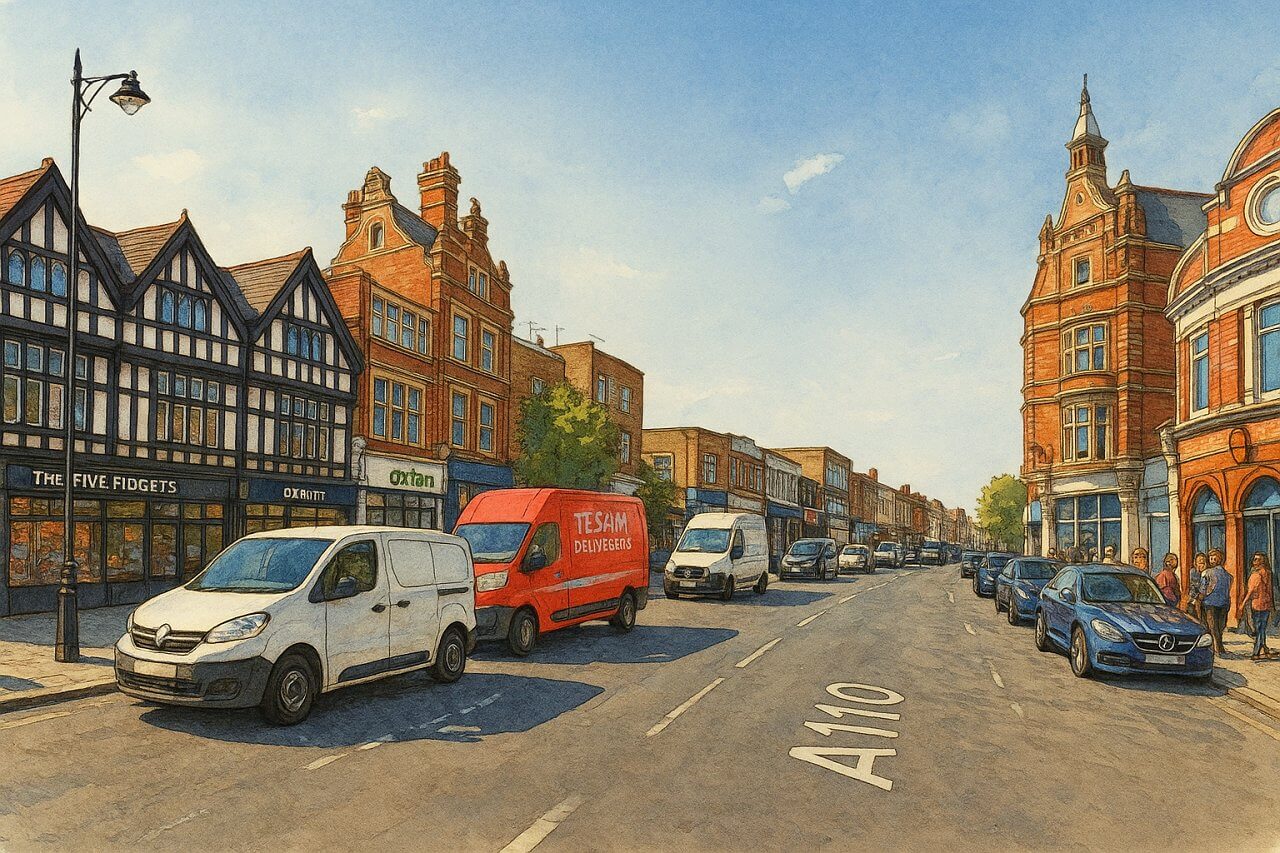
Painting of Enfield, London (View image in full size)

Page Details
This page was created on 30 April 2025. Hi, my name is Timothy and created it from my research, for my own entertainment, knowledge and to satisfy my curiosity. I am providing the information to you in good faith and hope it is useful. I try to get the details as accurate as possible. I also try to update the page whenever I stumble on new details. So this and all my other pages are perpetual work in progress. If you discover any error, please politely inform me, pointing out where the error lies, and I will correct it as soon as possible. Your helpfulness will keep this page accurate, relevant and helpful to those who need the information.List of Boroughs of London, Map of London Boroughs
Want to share your London travel experiences or get tips from fellow travellers?
Join the London Travel Tips Facebook GroupMore information for visiting London
Here are some related articles to help you get to know London better.- Cost of Living in London: Discover the true cost of living in London, including housing, transport, groceries, and more - plus tips for budgeting in one of the world's most expensive cities.
- Driving in London: Planning to drive in London? Learn about roads, car rentals, parking, tolls, and key tips for tourists and visitors from outside the capital.
- Driving Tips for Visiting London: Thinking of driving to London? Discover the best times to travel, congestion tips, parking apps, breakdown help, and petrol advice for a smoother journey.
- Evolution of London's Streets: Discover the fascinating history of how London's streets developed from ancient footpaths to today's complex network of roads across the capital.
- History of Immigration to London: Discover the rich history of immigration to London, from Huguenots to Bangladeshis, and how diverse communities have shaped the city's vibrant identity.
- How Big Is London Compared to Other World Cities?
- How London's Streets Measure Up: A Global Comparison of Road Widths
- How Streets of London are Named: Discover how London streets get their names, who decides them, and how historic, political, and public influences shape street naming in the capital.
- How the Grosvenor Family Came to Own Much of Mayfair, Belgravia and Pimlico: Explore how the Grosvenor family came to own much of Mayfair, Belgravia, and Pimlico, and learn about their historical connection (or lack thereof) with the British royal family and government.
- Living and working in London
- London's Quiet Collapse: How Living Standards Fell as Costs Skyrockted (1975-2025): Explore how London residents endured rising costs and falling living standards from 1975 to 2025 - from rocketing rents to wage stagnation and inflation.
- Marvel of the London Underground: Discover the history, challenges, and triumphs of the London Underground - the world's first underground railway and a vital transport lifeline for the UK capital since 1863.
- Moving to London: Expat Tips for Settling in Westminster: Essential advice for expats moving to London's Westminster: neighborhood insights, cost of living, transportation, housing, healthcare, schools, and tips to help you feel at home in the heart of the city.
- Places in London that aren't pronounced the way they're spelled
- Shopping in London: Discover London's diverse shopping scene
- Taking the bus in London: This is your complete guide to taking the bus when in London.
- The Anglican Faith: A Visitor's Guide to the Church of England: Learn about the Anglican faith and its deep ties to London's landmarks like Westminster Abbey and St Paul's Cathedral.
- Top 10 London Streets Every Visitor Must See: Discover London through its most iconic thoroughfares - 10 streets every visitor must experience. From historic Abbey Road to vibrant Camden High Street, explore culture, shopping, and hidden gems.
- Why are most roads in Central London so narrow? Learn why there are so few multi-lane roads and elevated highways in the heart of the city.
 Latest Pages & Updates
Buy Me A Coffee
If you enjoy the information I provide and want to support the work I do, please buy me a coffee! I appreciate it immensely, thank you so much!
