
Why Do All the Buildings in Belgravia Look the Same?
Ever explored Belgravia and noticed that the grand buildings there share a consistent look, and you possibly wondered if they were all built by the same developer? Well, let me explain!
A Vision of Elegant Uniformity
Belgravia, one of London’s most prestigious and architecturally consistent districts, owes its elegant and unified appearance to a carefully managed 19th-century development plan. Although the buildings may look like they came from a single blueprint or developer, the truth is more nuanced — but no less fascinating.
The Grosvenor Estate and the Marquess of Westminster
Much of Belgravia was developed under the ownership of the Grosvenor Estate, controlled in the early 1800s by Richard Grosvenor, 2nd Marquess of Westminster. The family owned vast tracts of land in central London, including what would become Belgravia, and they embarked on a massive building programme during the 1820s and 1830s.
Rather than build everything directly, the Grosvenors issued long leases to developers, surveyors, and builders, under the condition that they adhered to strict architectural guidelines that preserved the aesthetic vision of the estate. This is the main reason why Belgravia has such a cohesive and harmonious look today.
The Role of Thomas Cubitt
The most influential builder in the early development of Belgravia was Thomas Cubitt (1788–1855), a master builder and developer whose company was responsible for much of the original construction around Belgrave Square, Eaton Square, and Chester Square. His work helped define Belgravia’s hallmark style — grand stucco-fronted terraces, uniform façades, and classical proportions.
Cubitt’s standards were so high that he set the benchmark for all future building in the area. Even those developments not directly built by Cubitt often emulated his designs to stay in line with the Grosvenor covenants.
Other Architects and Builders
While Cubitt's influence looms large, he wasn’t the only builder active in Belgravia. Other architects, including George Basevi (designer of Wilton Crescent), Thomas Cundy II (the Grosvenor Estate’s surveyor), and Philip Hardwick also played roles in shaping the area. Each brought their own interpretation of Regency and early Victorian classical styles — but always within the estate’s unified design framework.
Why the Buildings All Look Alike
The visual consistency of Belgravia can be credited to a few key factors:
- Estate-wide building covenants enforced architectural uniformity.
- Thomas Cubitt’s influential designs set a widely copied template.
- Regency and early Victorian tastes favoured classical symmetry and elegance.
- Purposeful urban planning treated Belgravia as a cohesive whole, not a piecemeal project.
Fun Fact: Marshland Turned Millionaires' Row
Before its transformation into one of London’s most exclusive neighbourhoods, the land that is now Belgravia was once known as the Five Fields — a semi-rural area of marshland and footpads, considered unsafe after dark. Thanks to 19th-century drainage and vision from the Grosvenors, it evolved into a model of urban elegance. Today, it is among the most expensive postcodes in Britain.
Legacy and Preservation
To this day, the Grosvenor Estate remains a major landowner in Belgravia, and they continue to oversee preservation and restoration efforts. Modern building work is tightly controlled to ensure that the district’s historic character — and that distinctive, consistent look — remains intact.
Quick Facts
- Belgravia was developed primarily in the 1820s–1850s by the Grosvenor Estate.
- Thomas Cubitt was the leading builder, responsible for much of the early architecture.
- Strict estate guidelines enforced a unified appearance across different builders and architects.
- Architectural style is largely Regency and early Victorian — white stucco, porticos, and classical detailing.
- Belgravia was once marshland known as Five Fields before becoming a wealthy enclave.
- Today, it’s one of London’s most exclusive neighbourhoods, with property prices reflecting its grandeur and history.
Who Were the Grosvenors, and How Did They Acquire This Land?
If you're wondering why so many streets and squares in this area bear names like Grosvenor, Belgrave, Eaton, or Wilton, it's because much of this land once belonged to the powerful Grosvenor family. To find out how they came to own vast swathes of Mayfair, Belgravia, and Pimlico — and whether they had any ties to the government or the royal family — read our in-depth article here.
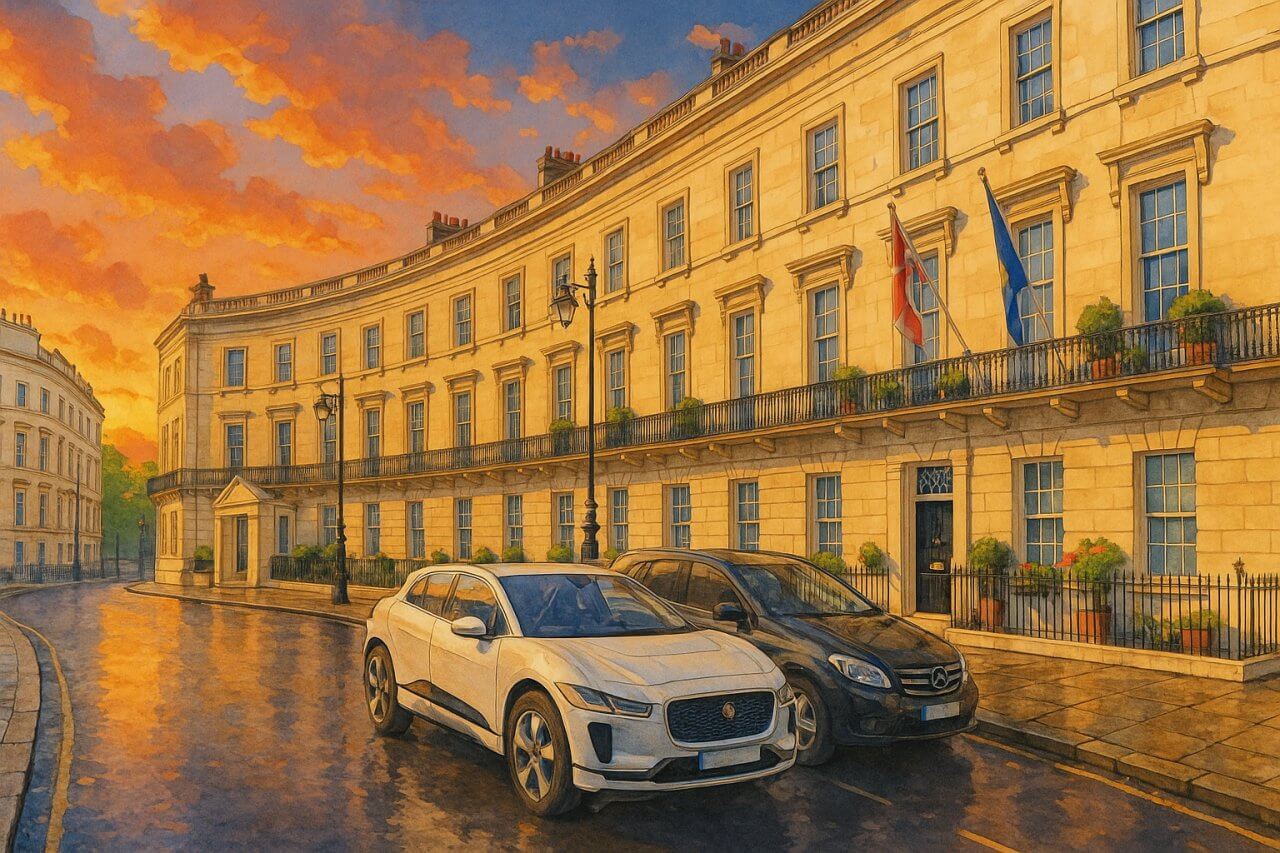
Painting of Wilton Terrace in Belgravia at sunset (View image in full size)

Page Details
This page was created/modified on 20 May 2025. Hi, my name is Timothy and created it from my research, for my own entertainment, knowledge and to satisfy my curiosity. I am providing the information to you in good faith and hope it is useful. I try to get the details as accurate as possible. I also try to update the page whenever I stumble on new details. So this and all my other pages are perpetual work in progress. If you discover any error, please politely inform me, pointing out where the error lies, and I will correct it as soon as possible. Your helpfulness will keep this page accurate, relevant and helpful to those who need the information.Want to share your London travel experiences or get tips from fellow travellers?
Join the London Travel Tips Facebook GroupMore information for visiting London
Here are some related articles to help you get to know London better.- Cost of Living in London: Discover the true cost of living in London, including housing, transport, groceries, and more - plus tips for budgeting in one of the world's most expensive cities.
- Driving in London: Planning to drive in London? Learn about roads, car rentals, parking, tolls, and key tips for tourists and visitors from outside the capital.
- Driving Tips for Visiting London: Thinking of driving to London? Discover the best times to travel, congestion tips, parking apps, breakdown help, and petrol advice for a smoother journey.
- Evolution of London's Streets: Discover the fascinating history of how London's streets developed from ancient footpaths to today's complex network of roads across the capital.
- History of Immigration to London: Discover the rich history of immigration to London, from Huguenots to Bangladeshis, and how diverse communities have shaped the city's vibrant identity.
- How Big Is London Compared to Other World Cities?
- How London's Streets Measure Up: A Global Comparison of Road Widths
- How Streets of London are Named: Discover how London streets get their names, who decides them, and how historic, political, and public influences shape street naming in the capital.
- How the Grosvenor Family Came to Own Much of Mayfair, Belgravia and Pimlico: Explore how the Grosvenor family came to own much of Mayfair, Belgravia, and Pimlico, and learn about their historical connection (or lack thereof) with the British royal family and government.
- Living and working in London
- London's Quiet Collapse: How Living Standards Fell as Costs Skyrockted (1975-2025): Explore how London residents endured rising costs and falling living standards from 1975 to 2025 - from rocketing rents to wage stagnation and inflation.
- Marvel of the London Underground: Discover the history, challenges, and triumphs of the London Underground - the world's first underground railway and a vital transport lifeline for the UK capital since 1863.
- Moving to London: Expat Tips for Settling in Westminster: Essential advice for expats moving to London's Westminster: neighborhood insights, cost of living, transportation, housing, healthcare, schools, and tips to help you feel at home in the heart of the city.
- Places in London that aren't pronounced the way they're spelled
- Shopping in London: Discover London's diverse shopping scene
- Taking the bus in London: This is your complete guide to taking the bus when in London.
- The Anglican Faith: A Visitor's Guide to the Church of England: Learn about the Anglican faith and its deep ties to London's landmarks like Westminster Abbey and St Paul's Cathedral.
- Top 10 London Streets Every Visitor Must See: Discover London through its most iconic thoroughfares - 10 streets every visitor must experience. From historic Abbey Road to vibrant Camden High Street, explore culture, shopping, and hidden gems.
- Why are most roads in Central London so narrow? Learn why there are so few multi-lane roads and elevated highways in the heart of the city.
 Latest Pages & Updates
Buy Me A Coffee
If you enjoy the information I provide and want to support the work I do, please buy me a coffee! I appreciate it immensely, thank you so much!
