
Karlsplatz, Munich
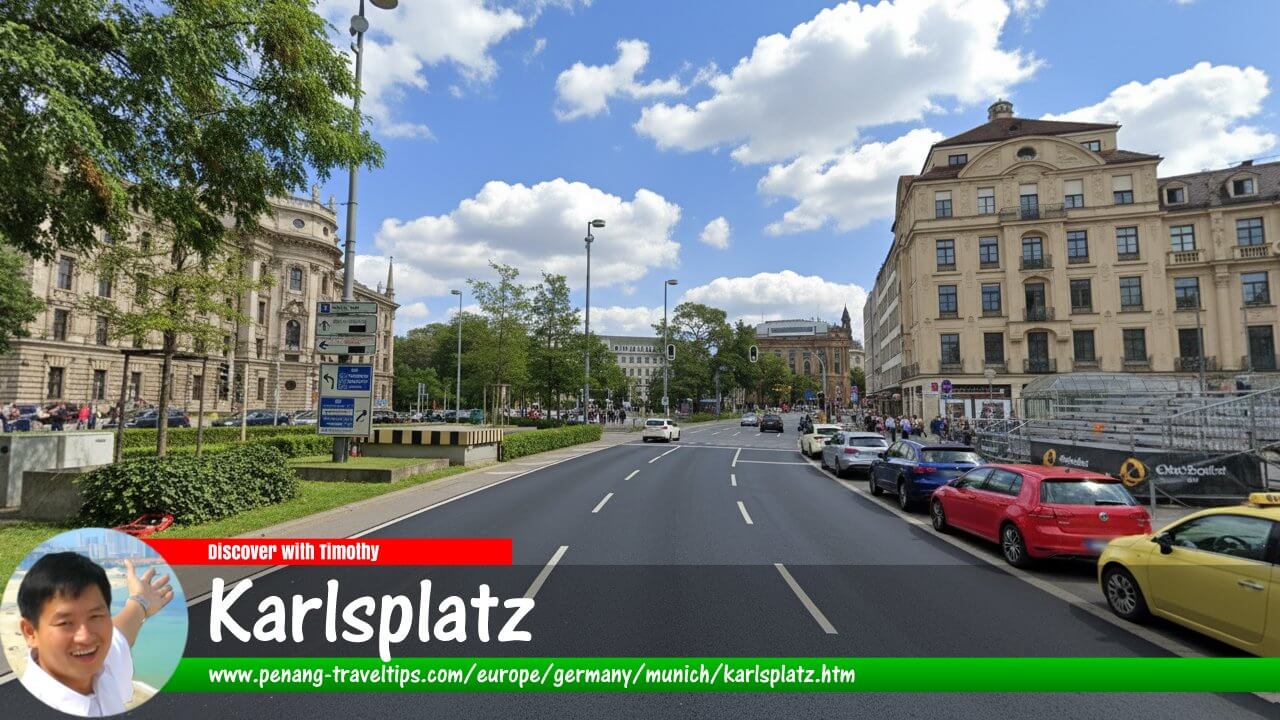 Karlsplatz, Munich (AI Generated on 16 February 2026)
Karlsplatz is a short but strategically important street in central Munich, forming a north–south connection between Lenbachplatz and Sonnenstraße. Measuring approximately 200 metres in length, the street is defined by a central tram alignment flanked by traffic lanes on both sides, illustrating Munich’s long-standing integration of surface public transport within its urban fabric. 1
Quick Facts
- Location: Maxvorstadt, Munich, Germany
- Length: approx. 200 metres
- Street type: Inner-city connector street with tram alignment
- Connects: Lenbachplatz (north) to Sonnenstraße (south)
- Nearest metro station: Karlsplatz (Stachus)
Street Character & Layout
Karlsplatz functions primarily as a transport-oriented urban corridor rather than a destination street. Its defining feature is the tramline running along its centre, with road traffic flowing on both sides. This layout creates a strong linear axis that prioritises movement and connectivity while maintaining visual openness within a dense part of the city. 2
The street environment is characterised by wide sightlines, consistent building heights, and a clear hierarchy of movement. Pedestrians tend to use Karlsplatz as a transition space, moving between nearby squares, transit hubs, and surrounding streets rather than lingering along the roadway itself. 2
Surrounding Streets & Urban Context
To the north, Karlsplatz connects directly with Lenbachplatz, continuing the tram corridor toward the western edge of Munich’s historic centre. To the south, it feeds into Sonnenstraße, part of the city’s inner ring road system that traces the former line of Munich’s medieval fortifications. Nearby streets include Elisenstraße, Bayerstraße, and several smaller connectors serving Maxvorstadt and the old town fringe. 3
This positioning places Karlsplatz at a key junction between Maxvorstadt’s cultural and academic quarter and the commercial core surrounding Stachus, making it an essential link within Munich’s central circulation network. 3
Historical Development
The area around Karlsplatz developed significantly during the late 18th and 19th centuries as Munich expanded beyond its medieval walls. Sonnenstraße, at the southern end of the street, follows the line of former defensive structures that were dismantled to allow for broader boulevards and improved circulation. Karlsplatz emerged as part of this transformation, serving new traffic and transport demands. 4
With the introduction and expansion of Munich’s tram network in the late 19th century, the street became firmly established as a surface transport corridor. Post-war reconstruction after World War II preserved this role, favouring functional clarity and movement efficiency over dense ornamentation. 5
Name, Origin & Pronunciation
The name “Karlsplatz” refers to King Karl Theodor of Bavaria, who ruled in the late 18th century and played a key role in shaping Munich’s urban development. The square and its associated streets were named in his honour during a period of Enlightenment-inspired city planning. 6
In common English pronunciation, the name is rendered as “KARLS-plahts.” In the International Phonetic Alphabet (IPA), it is written as /ˈkaʁlsˌplats/, with the German r articulated in the back of the throat and a crisp ts sound at the end. 6
Nearby Sights & Points of Interest
Although Karlsplatz itself is relatively short, it sits within immediate reach of some of Munich’s most important landmarks and public spaces:
- Karlsplatz (Stachus): One of Munich’s busiest squares and a major transport interchange. 7
- Sonnenstraße: A wide boulevard marking the edge of the historic old town. 4
- Lenbachplatz: A neighbouring street known for its tram alignment and proximity to cultural institutions. 1
- Maxvorstadt: Munich’s museum and university district, located just to the north. 3
Real Estate & Property Market
Karlsplatz lies at the boundary between Maxvorstadt and Munich’s historic centre, placing it within a highly desirable and expensive real estate zone. As of early 2026, average residential sale prices in the surrounding area range from approximately €9,500 to €13,000 per square metre, depending on building age, condition, and exact location. 8
Residential properties directly on Karlsplatz are limited and typically located within mixed-use buildings. A compact apartment of around 60 sq m (approximately 646 sq ft) may sell for €600,000 to €800,000, while larger units of 100 sq m (about 1,076 sq ft) can exceed €1.2 million. Rental prices are similarly elevated, reflecting strong demand for central locations with excellent transport access. 8
Compared with Munich’s outer districts, the area commands a notable premium due to its centrality, historic context, and proximity to major employment and cultural hubs. 8
Public Transport & Accessibility
The nearest U-Bahn station is Karlsplatz (Stachus), served by lines U4 and U5, offering rapid east–west connections across the city. The station is also one of Munich’s most important S-Bahn hubs. Multiple tram lines run directly along Karlsplatz, reinforcing its role as a surface transport spine within the city centre. 7
Bus services operate along Sonnenstraße and nearby arterial roads, providing additional links to districts beyond the U-Bahn and tram network. 7
Fun Fact
Despite its short length, Karlsplatz carries a disproportionately high volume of daily tram passengers, making it one of the most intensively used surface transport segments in central Munich. 5
Karlsplatz is  on the Map of Streets in Munich, Germany
References
- München Wiki: Karlsplatz
- City of Munich – Official Website
- Historisches Lexikon Bayerns
- Munich Official Tourism Portal
- Süddeutsche Zeitung – Munich History
- Haus der Bayerischen Geschichte
- Wikipedia: Karlsplatz (Munich)
- Immowelt: Property Prices in Maxvorstadt
Page Details
This page was created on 16 February 2026. Hi, my name is Timothy and created it from my research, for my own entertainment, knowledge and to satisfy my curiosity. I am providing the information to you in good faith and hope it is useful. I try to get the details as accurate as possible. I also try to update the page whenever I stumble on new details. So this and all my other pages are perpetual work in progress. If you discover any error, please politely inform me, pointing out where the error lies, and I will correct it as soon as possible. Your helpfulness will keep this page accurate, relevant and helpful to those who need the information. Latest Pages & Updates
Buy Me A Coffee
If you enjoy the information I provide and want to support the work I do, please buy me a coffee! I appreciate it immensely, thank you so much!
