
Lenbachplatz, Munich
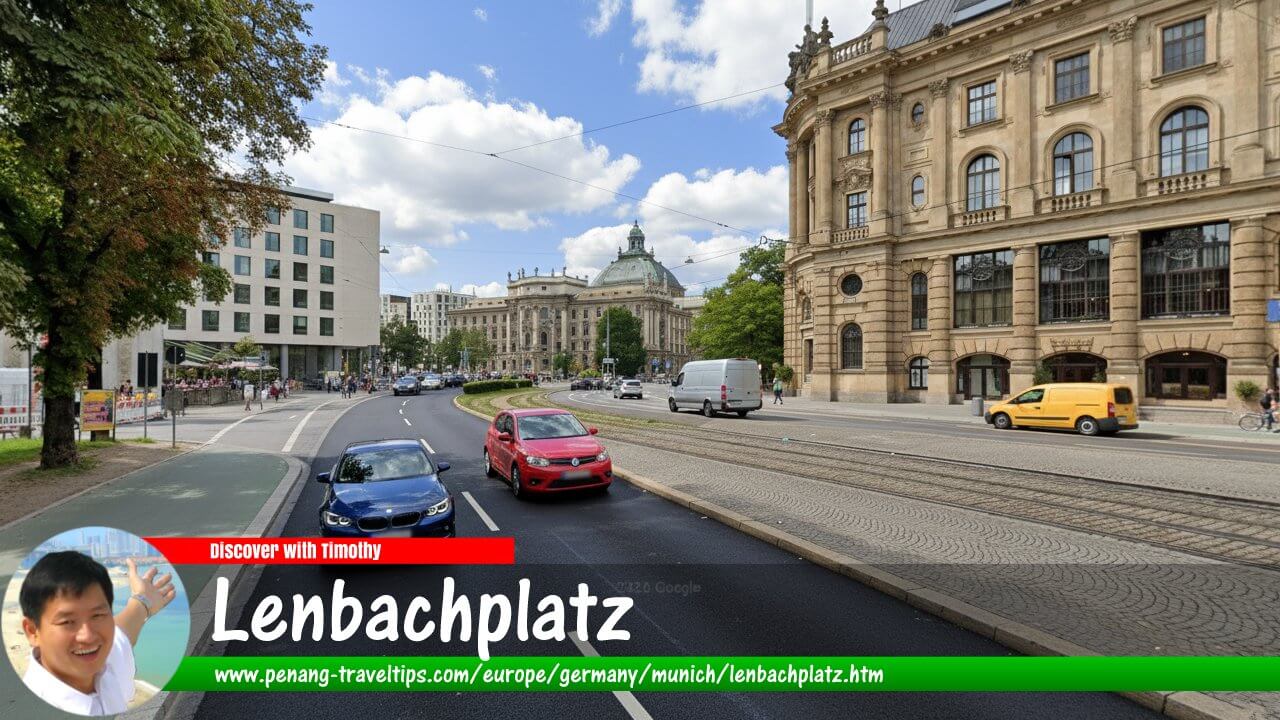 Lenbachplatz, Munich (AI Generated on 16 February 2026)
Lenbachplatz is a centrally located street in Munich, forming part of the Altstadt-Lehel district and acting as an important east–west connector between Elisenstraße and Maximiliansplatz. At approximately 215 metres in length, the street is distinctive for its unusual layout, with traffic lanes flanking the tram tracks running through Lenbachplatz, reflecting the close integration of surface public transport and urban space in this part of the city. 1
Quick Facts
- Location: Altstadt-Lehel, Munich, Germany
- Length: approx. 215 metres
- Street type: Inner-city street with tram alignment
- Connects: Elisenstraße (west) to Maximiliansplatz (east)
- Nearest metro station: Karlsplatz (Stachus)
Street Character & Layout
Lenbachplatz stands out within Munich’s city centre due to its functional yet visually striking layout. Rather than forming a conventional street, it is divided into two carriageways that run parallel on either side of the central tram tracks and tram stop serving Lenbachplatz. This configuration creates a linear urban space that blends public transport, administration, and historic architecture into a single corridor. 2
The atmosphere along Lenbachplatz is more transitional than residential. Pedestrian movement is steady, especially during commuting hours, while vehicular traffic serves mainly as a distributor between the central ring roads and the old town. Despite this functional role, the street retains a dignified appearance, framed by mature trees, institutional buildings, and carefully controlled urban proportions. 2
Surrounding Streets & Urban Context
To the west, Lenbachplatz connects directly with Elisenstraße, one of the main east–west routes skirting Munich’s historic centre. To the east, it opens onto Maximiliansplatz, a large square that acts as a buffer between the old town and the western districts. Nearby streets include Maxburgstraße, Ottostraße, and Pacellistraße, situating Lenbachplatz within a zone shaped by transport corridors and former institutional land use. 3
This positioning places Lenbachplatz at a threshold between Munich’s dense medieval core and its more open 19th-century urban extensions, offering a clear example of how the city evolved beyond its original walls. 3
Historical Development
Lenbachplatz emerged during the 19th century, a period of rapid urban expansion and modernisation in Munich. The area was developed in response to growing transport needs, particularly as tramways became a key element of surface mobility in the expanding city centre. The alignment of tram tracks through Lenbachplatz reflects this phase of infrastructure-led urban planning. 4
Over time, the surrounding area became associated with administrative and institutional functions rather than dense residential development. Much of the historic fabric suffered damage during World War II, but post-war reconstruction preserved the essential layout of the street and its relationship with surface transport routes. Today’s Lenbachplatz remains a testament to Munich’s pragmatic approach to rebuilding while respecting historical urban structure. 5
Name, Origin & Pronunciation
The name “Lenbachplatz” honours Franz von Lenbach, one of Munich’s most celebrated painters of the 19th century. Lenbach was closely associated with the city’s artistic life, and several landmarks nearby also bear his name, reinforcing the cultural significance of the area. 6
In common English spelling, the name is pronounced “LEN-bakh-plahts.” In the International Phonetic Alphabet (IPA), it is rendered as /ˈlɛnbaxˌplats/, with the German ch producing a soft fricative sound rather than a hard “k.” 6
Nearby Sights & Points of Interest
While Lenbachplatz itself is primarily a functional urban space, it is surrounded by notable cultural and civic landmarks within easy walking distance:
- Maximiliansplatz: A landscaped square marking the edge of Munich’s historic centre. 7
- Lenbachhaus: The former residence of Franz von Lenbach, now an art museum located nearby. 6
- Karlsplatz (Stachus): One of Munich’s busiest squares and transport hubs. 8
- Old Town (Altstadt): Easily accessible via adjacent streets leading toward Marienplatz. 3
Real Estate & Property Market
Lenbachplatz lies within Altstadt-Lehel, Munich’s most prestigious and expensive real estate district. As of early 2026, residential property prices in this area typically range between €10,500 and €14,000 per square metre, depending on building age, condition, and proximity to major squares. 9
Residential units near Lenbachplatz are relatively limited and often located within mixed-use or institutional buildings. A typical apartment of around 65 sq m (approximately 700 sq ft) may command prices between €700,000 and €950,000. Larger apartments of 110 sq m (about 1,184 sq ft) can exceed €1.5 million. Rental prices reflect similar premiums, driven by centrality and excellent public transport access. 9
Compared with Munich’s outer districts, Altstadt-Lehel consistently commands a substantial price premium due to its historic character, limited supply, and exceptional connectivity. 9
Public Transport & Accessibility
The nearest U-Bahn station is Karlsplatz (Stachus), served by lines U4 and U5, providing fast east–west connections across Munich. The station is also a major S-Bahn interchange, while several tram lines pass directly through Lenbachplatz, making the area exceptionally well connected by surface and underground transport. 8
Bus stops are located along Elisenstraße and around Karlsplatz, offering additional surface transport links to surrounding districts and key city landmarks. 8
Fun Fact
Lenbachplatz is one of the few places in Munich where a public street directly flanks active tram tracks in the city centre, offering a rare glimpse of how surface public transport was woven into urban life rather than hidden underground. 4
Lenbachplatz is  on the Map of Streets in Munich, Germany
References
- München Wiki: Lenbachplatz
- City of Munich – Official Website
- Historisches Lexikon Bayerns
- German Railways – Station Information
- Süddeutsche Zeitung – Munich History
- Lenbachhaus – Official Website
- Wikipedia: Maximiliansplatz
- Wikipedia: Karlsplatz (Stachus)
- Immowelt: Property Prices in Altstadt-Lehel
Page Details
This page was created on 16 February 2026. Hi, my name is Timothy and created it from my research, for my own entertainment, knowledge and to satisfy my curiosity. I am providing the information to you in good faith and hope it is useful. I try to get the details as accurate as possible. I also try to update the page whenever I stumble on new details. So this and all my other pages are perpetual work in progress. If you discover any error, please politely inform me, pointing out where the error lies, and I will correct it as soon as possible. Your helpfulness will keep this page accurate, relevant and helpful to those who need the information. Latest Pages & Updates
Buy Me A Coffee
If you enjoy the information I provide and want to support the work I do, please buy me a coffee! I appreciate it immensely, thank you so much!
