
Germany Travel Guide
 Go Back
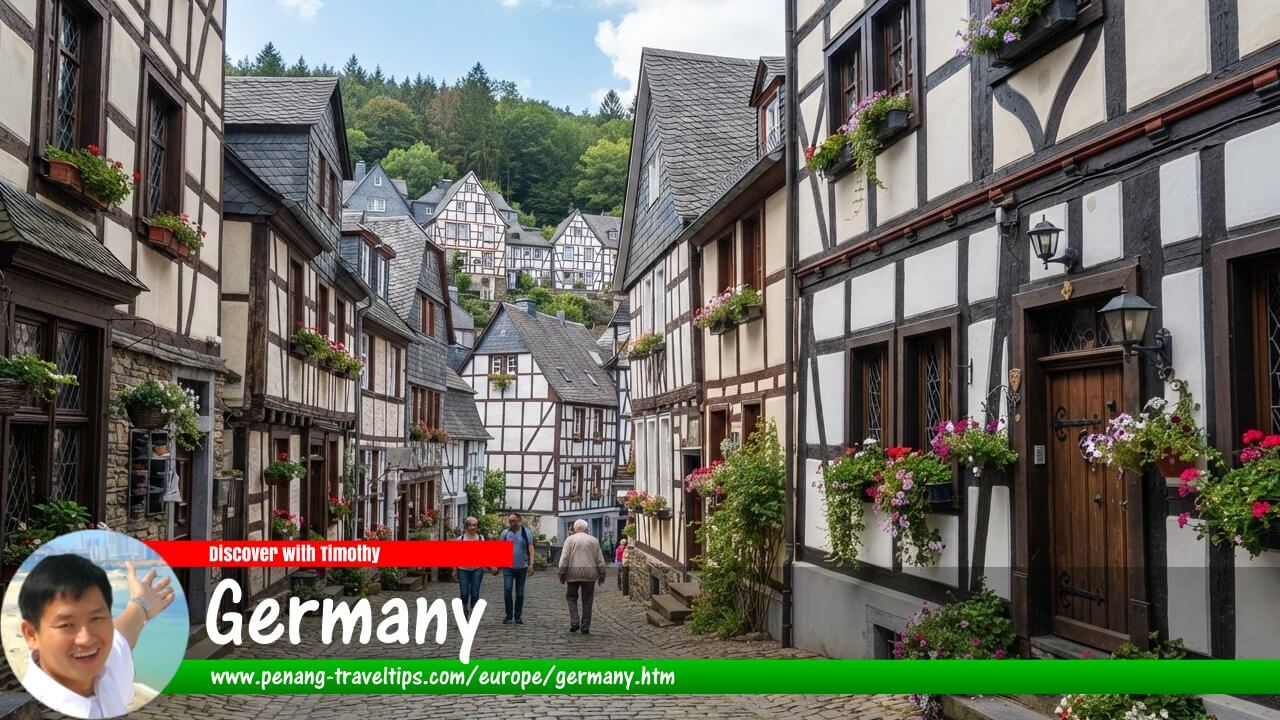 Germany Travel Guide (AI Image generated on 27 August 2026)
Also available: Panduan Melawat Jerman
Germany Travel Guide
Germany is one of Europe's most diverse travel destinations, combining historic cities, medieval towns, magnificent castles, scenic countryside, forests, rivers and modern cultural centres. From Berlin and Munich to the Rhine Valley, the Black Forest and the Bavarian Alps, the country offers a wide range of experiences for travellers.
Germany is also a convenient country to explore by train, with an extensive railway network connecting major cities and many smaller towns. Its central position in Europe makes it particularly easy to combine with neighbouring countries such as France, Switzerland, Austria, the Czech Republic, Poland, the Netherlands and Belgium.
About Germany
Germany, officially the Federal Republic of Germany, is a country in Central Europe. It is the most populous country in the European Union and one of Europe's major economic, cultural and political centres.
The country has a population of more than 80 million people and is divided into 16 federal states, known as Länder. Each state has its own character, traditions and attractions.
Germany's capital and largest city is Berlin. Other major cities include Hamburg, Munich, Cologne, Frankfurt, Stuttgart, Düsseldorf, Leipzig, Dresden and Nuremberg.
Where Is Germany?
Germany occupies a central position in Europe. It borders nine countries: Denmark to the north; Poland and the Czech Republic to the east; Austria and Switzerland to the south; and France, Luxembourg, Belgium and the Netherlands to the west.
Its northern coastline faces the North Sea and the Baltic Sea.
This location has made Germany an important crossroads between northern, western, eastern and southern Europe for centuries.
Geography of Germany
Germany has a varied landscape. The north is relatively flat, while the centre contains rolling hills, forests and river valleys. The south rises towards the Alps.
Some of the country's best-known geographical features include the Rhine, Danube and Elbe rivers, the Black Forest, the Bavarian Alps and the North Sea and Baltic Sea coasts.
The German Alps
The German Alps occupy the southernmost part of Bavaria near the Austrian border. This region is known for dramatic mountains, alpine lakes, traditional villages and winter sports.
The highest mountain in Germany is Zugspitze, which rises to 2,962 metres above sea level. It is located near the resort town of Garmisch-Partenkirchen.
Major Rivers
Germany has many important rivers that have shaped its history and supported trade and settlement.
- Rhine: one of Europe's most important rivers, flowing through the west of Germany.
- Danube: rises in southern Germany before flowing through several countries towards the Black Sea.
- Elbe: flows through Dresden and Hamburg before reaching the North Sea.
- Weser: flows through central and northern Germany.
- Main: passes through Frankfurt and joins the Rhine.
Black Forest
The Black Forest, or Schwarzwald, is a mountainous and heavily forested region in southwestern Germany. It is famous for its scenery, traditional villages, hiking trails, spas and cuckoo clocks.
The region is also associated with Black Forest cake, although the exact origins and traditional preparation of the dessert are more complex than its name suggests.
German States
Germany consists of 16 federal states. Some are large regions such as Bavaria and Lower Saxony, while others are city-states such as Berlin, Hamburg and Bremen.
For travellers, the distinction is useful because many attractions and traditions are strongly associated with individual states.
Bavaria
Bavaria is Germany's largest federal state by area and one of its most popular tourist regions. Munich, Neuschwanstein Castle, Nuremberg, the Bavarian Alps and many traditional villages are located here.
Bavaria is particularly associated with traditional German culture, alpine scenery, beer gardens and Oktoberfest.
North Rhine-Westphalia
North Rhine-Westphalia is Germany's most populous federal state. Cologne, Düsseldorf, Bonn and Aachen are among its best-known cities.
The region combines industrial heritage with historic towns, museums, cathedrals and vibrant urban culture.
Baden-Württemberg
Baden-Württemberg lies in southwestern Germany and includes Stuttgart, Heidelberg and much of the Black Forest.
The state is known for its castles, forests, thermal spas, vineyards and automobile industry.
Saxony
Saxony is located in eastern Germany. Dresden and Leipzig are its best-known cities.
Dresden is particularly famous for its historic architecture and art collections, while Leipzig has developed a reputation as a lively cultural and creative centre.
Hesse
Hesse is home to Frankfurt, one of Europe's major financial centres, as well as Wiesbaden and the historic university town of Marburg.
The state also contains forests, spa towns and picturesque areas along the Rhine and Main rivers.
Berlin
Berlin is the capital of Germany and one of Europe's most historically significant cities.
The city was divided during the Cold War by the Berlin Wall, and its reunification has left a fascinating mixture of historic buildings, modern architecture, museums and former Cold War sites.
Major attractions include the Brandenburg Gate, Reichstag Building, Museum Island, Berlin Cathedral, East Side Gallery and the Memorial to the Murdered Jews of Europe.
Munich
Munich is the capital of Bavaria and one of Germany's most popular tourist destinations.
The city is known for Marienplatz, Frauenkirche, the Munich Residenz, English Garden and its many museums. Munich is also the gateway to the Bavarian Alps and several famous castles.
Hamburg
Hamburg is a major port city in northern Germany. The city has a long maritime history and is built around the River Elbe.
Its attractions include the Speicherstadt warehouse district, Elbphilharmonie concert hall, Miniatur Wunderland and the harbour.
Cologne
Cologne is one of Germany's oldest major cities and is dominated by its magnificent Gothic cathedral, Kölner Dom.
The city lies on the Rhine and is also known for its Roman heritage, museums, historic old town and distinctive local beer culture.
Frankfurt
Frankfurt is Germany's principal financial centre and an important international transport hub.
The city has a distinctive skyline of modern skyscrapers alongside the reconstructed historic centre around Römerberg.
Heidelberg
Heidelberg is one of Germany's most picturesque historic cities. Its old town lies along the Neckar River beneath Heidelberg Castle.
The city is also home to Germany's oldest university and has long attracted writers, artists and scholars.
Dresden
Dresden is the capital of Saxony and is known for its impressive Baroque and Renaissance architecture.
The Zwinger, Semperoper, Dresden Castle and Frauenkirche are among its principal attractions.
Nuremberg
Nuremberg has a long history dating back to the Middle Ages and played an important role during the Nazi period and the Second World War.
Visitors can explore the medieval old town as well as sites connected with the Nuremberg Trials and the history of Nazi Germany.
Germany's Historic Towns
Germany has many smaller towns with well-preserved historic centres. These are often among the most charming places to visit because they provide an experience very different from the country's large cities.
Half-timbered houses, medieval walls, market squares, churches and castles are common features.
Rothenburg ob der Tauber
Rothenburg ob der Tauber is one of Germany's best-known medieval towns. Its preserved walls, towers, narrow streets and half-timbered houses make it particularly popular with visitors.
The town lies along the Romantic Road, a scenic tourist route through southern Germany.
The Romantic Road
The Romantic Road is a popular tourist route through Bavaria connecting historic towns, villages and castles.
The route is particularly attractive for travellers who want to experience medieval architecture and rural scenery rather than concentrating only on Germany's major cities.
Neuschwanstein Castle
Neuschwanstein Castle is one of Germany's most recognisable landmarks. It stands dramatically on a hill above the village of Hohenschwangau in Bavaria.
The castle was commissioned by King Ludwig II of Bavaria and has become one of Europe's most photographed castles.
Rhine Valley
The Rhine Valley is famous for castles, vineyards, historic towns and dramatic scenery along the river.
The section of the Middle Rhine between Bingen and Koblenz is particularly well known and is recognised as a UNESCO World Heritage Site.
Moselle Valley
The Moselle Valley is another attractive wine-growing region. Vineyards cover the steep hillsides above the winding Moselle River.
Trier, Cochem and Bernkastel-Kues are among the destinations that can be included in a journey through the region.
Germany's Castles
Germany has thousands of castles, palaces and fortified residences. Some are imposing medieval fortresses, while others are elegant Baroque or Renaissance palaces.
Among the most famous are Neuschwanstein, Hohenzollern Castle, Heidelberg Castle, Wartburg Castle and Eltz Castle.
Germany's UNESCO World Heritage Sites
Germany has numerous UNESCO World Heritage Sites representing its cultural and natural heritage. These include historic city centres, cathedrals, industrial sites, castles, archaeological sites and natural landscapes.
Examples include Cologne Cathedral, Museum Island in Berlin, the Wartburg, the Upper Middle Rhine Valley and the Bauhaus sites in Weimar and Dessau.
German Culture
German culture has been shaped by centuries of regional traditions as well as major developments in music, literature, philosophy, science, architecture and industry.
The country has produced influential figures such as Johann Wolfgang von Goethe, Friedrich Schiller, Johann Sebastian Bach, Ludwig van Beethoven and Albert Einstein.
German Food
German cuisine varies considerably from region to region. Sausages, breads, potatoes, cabbage, pork and pastries feature prominently, but German food is much more diverse than these familiar stereotypes suggest.
Each region has its own specialities, and travelling through Germany provides an opportunity to experience these differences.
German Sausages
Sausages, known collectively as Wurst, are an important part of German food culture. Different regions have their own varieties and ways of serving them.
Among the best known are Bratwurst, Currywurst, Weisswurst and Nürnberger Rostbratwurst.
German Bread
Germany has an exceptionally varied bread culture, with numerous types of rye, wheat and mixed-grain bread.
Bakeries are found throughout the country and are an easy way for travellers to experience everyday German food.
German Beer
Beer has a long cultural tradition in Germany, with different regions producing their own styles.
Bavaria is particularly famous for its beer culture, while Cologne and Düsseldorf have distinctive local beer traditions.
Christmas Markets
German Christmas markets are among the country's most popular seasonal attractions. Town squares are decorated with lights and stalls selling handicrafts, decorations, food and hot drinks.
Nuremberg, Dresden, Cologne and many towns in Bavaria and Saxony are particularly well known for their Christmas markets.
Oktoberfest
Oktoberfest is held annually in Munich and is one of the world's largest public festivals.
Despite its name, much of the festival takes place in September. Visitors can experience Bavarian food, music, traditional clothing and large beer tents.
Germany's History
Germany's history is long and complex. The territory that now forms Germany was once divided among numerous kingdoms, principalities and free cities.
The modern German state was unified in 1871 under the German Empire. The country subsequently experienced the First World War, the Weimar Republic, Nazi dictatorship and the Second World War.
After 1945, Germany was divided into West Germany and East Germany. Berlin was also divided. German reunification took place in 1990.
Roman Germany
Parts of present-day western and southern Germany were incorporated into the Roman Empire. Roman remains can still be found in cities such as Cologne and Trier.
Trier in particular contains important Roman monuments, including the Porta Nigra.
The Holy Roman Empire
During the Middle Ages, much of present-day Germany formed part of the Holy Roman Empire, a political entity that included numerous territories in Central Europe.
The empire lasted for centuries and helped shape the political and cultural development of the region.
German Unification
Germany was unified as a nation-state in 1871 under the leadership of Prussia and Otto von Bismarck.
Berlin became the capital of the German Empire, beginning a new period in the country's political and economic development.
World War I
Germany was one of the principal powers involved in the First World War. Its defeat in 1918 brought an end to the German Empire and led to the establishment of the Weimar Republic.
Nazi Germany and World War II
Adolf Hitler and the Nazi Party came to power in 1933. The Nazi dictatorship led Germany into the Second World War and carried out the Holocaust and other crimes on an enormous scale.
Germany's major cities and infrastructure suffered extensive destruction during the war.
Germany After 1945
After the Second World War, Germany was divided into occupation zones and eventually became two countries: the Federal Republic of Germany in the west and the German Democratic Republic in the east.
Berlin was similarly divided, with the Berlin Wall becoming the most powerful symbol of the Cold War.
German Reunification
The Berlin Wall fell on 9 November 1989. Germany was formally reunified on 3 October 1990.
Today, the former East and West Germany form a single federal republic, although the historical division continues to influence some aspects of regional identity and development.
Part 2: Major Cities and Places to Visit in Germany
Germany offers a remarkable variety of destinations, from historic capitals and medieval towns to river valleys, forests, castles and alpine resorts. The best places to visit depend largely on your interests and the season in which you travel.
Berlin
Berlin is the capital of Germany and the country's principal centre for politics, culture and history. The city has undergone enormous changes since German reunification, yet reminders of its divided past remain throughout the city.
The Brandenburg Gate is perhaps Berlin's best-known landmark. Nearby are the Reichstag, the Holocaust Memorial, the Tiergarten and the famous boulevard Unter den Linden.
Museum Island, located in the River Spree, contains several important museums and is a UNESCO World Heritage Site. The island is an excellent destination for visitors interested in archaeology, ancient civilisations and European art.
Berlin Wall
The Berlin Wall divided East and West Berlin from 1961 until 1989. Although most of the wall has disappeared, several sections and memorial sites remain.
The East Side Gallery is a particularly popular section. Artists from around the world painted murals on the remaining stretch of wall after its fall.
Munich
Munich is the capital of Bavaria and one of Germany's most popular cities. It combines historic architecture with a lively modern cultural scene.
The central Marienplatz is dominated by the Neues Rathaus, whose famous Glockenspiel attracts visitors throughout the day.
Other attractions include the Frauenkirche, Munich Residenz, English Garden and Deutsches Museum.
Oktoberfest in Munich
Munich hosts Oktoberfest, one of the world's largest public festivals. Despite its name, the festival traditionally begins in September and ends in early October.
Visitors can experience Bavarian food, music, traditional costumes and enormous festival tents. The event is extremely popular, so accommodation should be booked well in advance.
Hamburg
Hamburg is Germany's major port city and has a distinctly maritime character. The River Elbe and its harbour have played a central role in the city's development.
The historic Speicherstadt, with its red-brick warehouses and canals, is one of Hamburg's most distinctive areas. Nearby, the Elbphilharmonie has become a modern architectural landmark.
Hamburg is also home to Miniatur Wunderland, one of the world's largest model railway exhibitions.
Cologne
Cologne is situated on the Rhine and is famous for its magnificent Gothic cathedral, the Kölner Dom.
The cathedral stands beside Cologne's main railway station, making it one of the easiest major German attractions to reach by train.
Cologne also has Roman archaeological remains, museums, a historic old town and a distinctive local beer known as Kölsch.
Frankfurt
Frankfurt am Main is Germany's principal financial centre and one of Europe's major business cities.
The city is known for its modern skyline, earning it the nickname Mainhattan. At the same time, the historic Römerberg area has been reconstructed with traditional architecture.
Frankfurt is also one of Germany's most important international transportation hubs.
Heidelberg
Heidelberg is one of Germany's most romantic and picturesque cities. Its old town stretches along the Neckar River beneath the ruins of Heidelberg Castle.
The city is home to Heidelberg University, founded in 1386 and one of Europe's oldest universities.
The Philosophers' Walk offers an attractive view across the river towards the old town and castle.
Dresden
Dresden, the capital of Saxony, is known for its magnificent Baroque architecture and extensive art collections.
The historic centre contains the Frauenkirche, Zwinger Palace, Dresden Castle and Semperoper. Many of the buildings were reconstructed after extensive destruction during the Second World War.
Leipzig
Leipzig has a long history as a centre of music, trade and learning. Johann Sebastian Bach worked in the city, and visitors can explore several sites connected with his life.
Today Leipzig has a youthful atmosphere, with art galleries, independent businesses and a growing creative scene.
Nuremberg
Nuremberg combines a beautifully restored medieval old town with important sites connected with twentieth-century German history.
The Imperial Castle overlooks the old town, while the Documentation Centre and former Nazi Party Rally Grounds provide context on the city's role during the Nazi era.
The Nuremberg Trials, held after the Second World War, were also conducted here.
Stuttgart
Stuttgart is the capital of Baden-Württemberg and is closely associated with the automobile industry.
The Mercedes-Benz Museum and Porsche Museum are major attractions for automobile enthusiasts. The surrounding region also contains vineyards, castles and historic towns.
Düsseldorf
Düsseldorf is an important business and fashion centre in western Germany. The city lies along the Rhine and is known for its elegant shopping boulevard, Königsallee.
The Altstadt, or old town, contains numerous restaurants, bars and traditional breweries and is sometimes described as the city's longest bar.
Bonn
Bonn served as the capital of West Germany from 1949 until reunification. It is situated along the Rhine and has a strong connection with music because it was the birthplace of Ludwig van Beethoven.
The Beethoven House is an important attraction for visitors interested in the composer.
Bremen
Bremen is one of Germany's historic Hanseatic cities. Its market square contains the Town Hall and the famous statue of the Bremen Town Musicians.
The historic centre provides a compact introduction to the city's medieval trading heritage.
Rothenburg ob der Tauber
Rothenburg ob der Tauber is one of Germany's best-preserved medieval towns and a highlight of the Romantic Road.
Its fortified walls, towers, cobbled streets and half-timbered houses create an atmosphere that attracts visitors throughout the year.
Bamberg
Bamberg is a historic town in Bavaria with a well-preserved medieval and Baroque centre. Its old town is a UNESCO World Heritage Site.
The city is particularly famous for its distinctive smoked beer, known as Rauchbier.
Würzburg
Würzburg is situated at the northern end of the Romantic Road. Its most famous landmark is the Würzburg Residence, an elaborate Baroque palace.
The city is also an important centre of Franconian wine production.
Regensburg
Regensburg lies on the Danube and has one of Germany's best-preserved medieval city centres.
The old town and Stadtamhof are UNESCO World Heritage Sites. The city's stone bridge and Gothic cathedral are among its most notable landmarks.
Trier
Trier is one of Germany's oldest cities and contains an exceptional collection of Roman monuments.
The Porta Nigra, Roman baths, amphitheatre and Roman bridge demonstrate the importance of the city during the Roman period.
Aachen
Aachen lies near Germany's borders with Belgium and the Netherlands. Its cathedral was built around the palace of Charlemagne and became the first German site to be inscribed on the UNESCO World Heritage List.
The city has also been associated with European history for centuries.
Black Forest
The Black Forest is one of Germany's most scenic regions. Dense forests, rolling hills, waterfalls, lakes and traditional villages make it popular with hikers and nature lovers.
Freiburg is a convenient base for exploring the southern Black Forest.
Freiburg
Freiburg im Breisgau is a university city on the western edge of the Black Forest. Its historic centre is known for the Freiburg Minster and the small waterways known as Bächle that run through many streets.
The city is also close to the French and Swiss borders.
Baden-Baden
Baden-Baden is a historic spa town on the edge of the Black Forest. Its thermal springs attracted visitors long before modern tourism developed.
The town is particularly suitable for travellers looking for relaxation, spas and elegant nineteenth-century architecture.
Rhine Valley
The Rhine Valley between Bingen and Koblenz is one of Germany's most scenic landscapes. Vineyards cover steep hillsides while castles and fortresses overlook the river.
A river cruise is one of the most enjoyable ways to experience this region.
Lorelei
The Lorelei is a famous rock overlooking a narrow section of the Rhine. It has inspired numerous poems, songs and legends.
River cruises commonly pass this landmark as they travel through the Upper Middle Rhine Valley.
Cologne to Koblenz by Rhine
The stretch of the Rhine between Cologne and Koblenz can be explored by train, car or river cruise. The section south of Koblenz is particularly famous for castles and vineyards.
Travellers with limited time can take a shorter cruise between towns such as Boppard, St Goar and Bacharach.
Neuschwanstein and Hohenschwangau
The area around Hohenschwangau in Bavaria contains several castles associated with King Ludwig II.
Neuschwanstein is the most famous, while nearby Hohenschwangau Castle was the childhood home of Ludwig II.
Garmisch-Partenkirchen
Garmisch-Partenkirchen is one of Germany's best-known alpine resorts. It is located beneath the Zugspitze and offers hiking, skiing and mountain scenery.
The town hosted the 1936 Winter Olympics and remains an important base for exploring the Bavarian Alps.
Zugspitze
Zugspitze is Germany's highest mountain at 2,962 metres. Visitors can reach the summit using cable cars or mountain railways.
From the summit, there are panoramic views across the Alps and towards Austria.
Berchtesgaden
Berchtesgaden lies in the southeastern corner of Bavaria near the Austrian border. The surrounding mountains, lakes and forests make it a popular destination for outdoor activities.
Königssee, a remarkably clear alpine lake, is one of the area's principal attractions.
Königssee
Königssee is surrounded by steep mountain slopes within Berchtesgaden National Park. Boat trips provide one of the best ways to experience the lake.
The landscape is particularly impressive when viewed from the water.
North Sea Coast
Germany's North Sea coast offers a very different travel experience from the Alps and historic cities. Islands, tidal flats, beaches and coastal villages dominate the landscape.
The Wadden Sea is particularly important for its wildlife and natural environment and is recognised as a UNESCO World Heritage Site.
Baltic Sea Coast
The Baltic Sea coast contains sandy beaches, seaside resorts and historic port towns. Lübeck, Kiel and Rostock are among the better-known destinations in the region.
The Baltic islands of Rügen and Usedom are popular summer destinations.
Rügen
Rügen is Germany's largest island. It is known for its beaches, chalk cliffs, forests and seaside resorts.
The chalk cliffs of Jasmund National Park are among the island's most distinctive natural landmarks.
Wartburg Castle
Wartburg Castle stands above Eisenach in central Germany. It is one of the country's most important historic castles and a UNESCO World Heritage Site.
Martin Luther stayed at the castle in the early sixteenth century and translated the New Testament into German while living there.
Sanssouci Palace
Sanssouci Palace in Potsdam was built for Frederick the Great of Prussia. The palace and its extensive gardens form one of Germany's finest examples of eighteenth-century royal architecture.
Potsdam is close enough to Berlin to make an easy day trip.
Potsdam
Potsdam is surrounded by lakes and forests and contains numerous palaces and gardens associated with the Prussian royal family.
Besides Sanssouci, visitors can explore the New Palace and Cecilienhof Palace.
German Scenic Routes
Germany has several established scenic routes designed for road trips. They connect castles, historic towns, wine regions and natural landscapes.
Among the best known are the Romantic Road, Castle Road, German Alpine Road, German Wine Route and Fairy-Tale Road.
Fairy-Tale Road
The German Fairy-Tale Road links towns and landscapes associated with the Brothers Grimm and traditional German fairy tales.
The route passes through forests, medieval towns and castles and is particularly attractive for families.
German Wine Route
The German Wine Route passes through the Palatinate wine-growing region in southwestern Germany.
Vineyards, small villages and wine festivals make this a pleasant destination during the warmer months.
German Alpine Road
The German Alpine Road runs through southern Bavaria near the Austrian border. The route passes mountains, lakes, villages and castles.
It is particularly suitable for travellers who enjoy scenic driving and outdoor activities.
Part 3: When to Visit Germany and How to Get There
Germany can be visited throughout the year, with each season offering a different experience. Summer is popular for sightseeing and outdoor activities, spring and autumn are pleasant for exploring cities and countryside, while winter brings Christmas markets, snow-covered landscapes and opportunities for skiing.
Best Time to Visit Germany
For most travellers, May to September is the most convenient period to visit Germany. The weather is generally milder, daylight hours are long and many outdoor attractions are open.
However, these months also include the main tourist season. Hotels and popular attractions can be more expensive and crowded, particularly in major cities and during festivals.
Visiting Germany in Spring
March to May brings gradually warmer weather and longer days. Spring is a pleasant time for sightseeing because many destinations are less crowded than during the peak summer months.
April and May can be particularly attractive for visiting parks, gardens and historic towns. However, weather can change quickly, so travellers should bring clothing suitable for both cool and warmer conditions.
Visiting Germany in Summer
June to August is the busiest tourist season. Temperatures are generally comfortable for sightseeing, although occasional heatwaves can occur.
Summer is an excellent season for hiking in the Alps, exploring the Rhine Valley, visiting castles and enjoying Germany's many outdoor festivals.
Popular destinations such as Berlin, Munich, the Rhine Valley and Neuschwanstein Castle can become very busy, so advance booking is advisable.
Visiting Germany in Autumn
September to November brings cooler weather and autumn colours. September can still feel like summer in many parts of Germany, while October usually brings more distinctly autumnal conditions.
Autumn is an especially attractive season for visiting wine regions, forests and historic towns.
Visiting Germany in Winter
December to February is the coldest period of the year. Days are shorter and snow is possible, particularly in the mountains.
December is especially popular because of Germany's famous Christmas markets. January and February are quieter in many cities but are good months for winter sports in Bavaria and the German Alps.
Christmas in Germany
Christmas is one of the most atmospheric times to visit Germany. Town and city centres are decorated with lights and seasonal markets sell handicrafts, decorations, food and hot drinks.
Christmas markets usually begin in late November or early December and continue until just before Christmas, although exact dates vary by location.
Oktoberfest Season
Munich's Oktoberfest normally takes place from late September into early October. It attracts millions of visitors and is one of the busiest periods for accommodation in Munich.
If you intend to visit Munich during the festival, hotel and transport arrangements should be made considerably in advance.
Weather in Germany
Germany has a temperate climate, but weather varies from north to south and from lowlands to mountainous regions.
The north tends to have stronger maritime influences, while southern Germany has greater continental and alpine influences. Mountain areas can be considerably colder than cities at lower elevations.
Summer Temperatures
Summer daytime temperatures commonly range from the high teens to the mid-20s Celsius, although hotter periods can occur.
Rain showers and thunderstorms are possible even during summer, so a lightweight waterproof jacket can be useful.
Winter Temperatures
Winter temperatures vary considerably. Cities such as Berlin, Hamburg and Cologne can experience temperatures around freezing, while mountainous Bavaria can be much colder.
Snow is possible throughout the country, but it is more reliable in the higher elevations of the Alps.
What to Pack
Because German weather can change quickly, layered clothing is generally the most practical choice.
- Light jacket or sweater for spring and autumn.
- Waterproof jacket or compact umbrella.
- Comfortable walking shoes.
- Warm coat, gloves and hat for winter.
- Sun protection for summer.
- Suitable hiking footwear if visiting mountainous areas.
How to Get to Germany from Malaysia
Travellers from Malaysia generally arrive in Germany by air. Germany has several major international airports, with Frankfurt Airport and Munich Airport serving as the country's principal long-haul gateways.
Berlin, Düsseldorf and Hamburg also have international airports and can be convenient depending on your itinerary.
Flying from Malaysia
Travellers from Malaysia can reach Germany through direct or connecting flights, depending on the airline and current flight schedule.
Kuala Lumpur International Airport is the principal international departure point for travellers from Malaysia. Connections through major Asian or Middle Eastern aviation hubs provide additional options.
Flight schedules change over time, so compare current routes and fares before booking.
Frankfurt Airport
Frankfurt Airport is one of Europe's busiest airports and an important gateway to Germany.
Frankfurt is particularly convenient if your itinerary includes the Rhine Valley, western Germany or cities such as Cologne and Heidelberg. The airport also has excellent rail connections for onward travel.
Munich Airport
Munich Airport is an important gateway to Bavaria and southern Germany.
It is particularly convenient for travellers heading to Munich, Neuschwanstein Castle, the Bavarian Alps and destinations in southern Bavaria.
Berlin Brandenburg Airport
Berlin Brandenburg Airport serves the German capital. It is located southeast of central Berlin and is connected to the city by regional trains and public transport.
It is the most convenient international gateway for visitors whose itinerary is concentrated on Berlin and eastern Germany.
Hamburg Airport
Hamburg Airport serves northern Germany's major port city. It is useful for itineraries covering Hamburg, the North Sea coast and parts of northern Germany.
Entering Germany from Another European Country
Germany shares land borders with nine countries, making overland travel particularly easy.
High-speed and regional trains connect Germany with neighbouring countries, while long-distance buses and roads provide additional options.
Arriving by Train
Germany is connected by international rail services to countries including France, Belgium, the Netherlands, Switzerland, Austria, Denmark, Poland and the Czech Republic.
High-speed services make cities such as Paris, Amsterdam, Brussels, Zurich and Vienna accessible by train.
Arriving from France
High-speed trains connect Paris with several German cities, including Frankfurt and other major destinations. This makes it relatively easy to combine a trip to France with Germany.
Arriving from Switzerland
Switzerland and Germany are connected by frequent rail services. Zurich, Basel and other Swiss cities have direct train connections to destinations in Germany.
Arriving from Austria
Germany and Austria have extensive rail connections. Munich is particularly well connected with Austrian cities such as Salzburg and Vienna.
Arriving from the Netherlands
Germany can be reached easily from the Netherlands by train. Amsterdam, Utrecht and other Dutch cities have connections to German destinations.
Arriving from Belgium
Brussels is connected to Germany by high-speed and international rail services, making a Belgium-Germany itinerary practical.
Arriving from the Czech Republic
Prague is connected by rail to Dresden and Berlin, making the Czech Republic a natural addition to a Germany itinerary.
Arriving from Poland
Germany and Poland are linked by rail and road. Berlin is particularly well positioned for travellers arriving from western Poland.
Arriving from Denmark
Denmark is connected to northern Germany by rail and road. Hamburg is a convenient starting point for travellers arriving from Scandinavia.
Arriving by Long-Distance Bus
Long-distance buses connect Germany with many European cities and can be cheaper than trains. However, journey times are generally longer.
Bus travel can be useful for budget-conscious travellers, particularly when train fares are high or when travelling between destinations not directly connected by rail.
Getting Around Germany
Germany has an extensive public transport network. Trains, buses, trams, U-Bahn and S-Bahn services make it possible to travel around the country without renting a car.
For a first visit, trains are often the most convenient way to connect major cities.
Travelling by Train
Germany's railway network connects major cities and many smaller towns. Long-distance trains include Intercity Express (ICE), Intercity (IC) and EuroCity (EC) services.
ICE trains are the fastest option and are particularly useful for longer journeys between major cities.
ICE High-Speed Trains
ICE trains connect cities such as Berlin, Hamburg, Frankfurt, Cologne, Munich and Stuttgart. Some international ICE services also cross into neighbouring countries.
They offer comfortable seating and are generally an excellent option for long-distance travel.
Regional Trains
Regional trains connect smaller cities and towns. They are slower than ICE services but can be useful for reaching destinations outside the major intercity network.
Regional trains are also important for exploring rural areas and scenic regions.
Germany's Regional Transport
German cities generally have integrated local transport systems consisting of combinations of buses, trams, U-Bahn and S-Bahn trains.
Tickets and fare systems vary by region, so check the local transport authority before travelling.
Berlin Public Transport
Berlin has an extensive network of U-Bahn, S-Bahn, trams and buses. The system covers most areas visited by tourists.
A public transport ticket can often be used across several forms of transport within the relevant fare zone and validity period.
Munich Public Transport
Munich's transport network includes U-Bahn, S-Bahn, trams and buses. It is particularly useful for reaching attractions outside the city centre.
The S-Bahn also connects Munich with the airport and surrounding towns.
Hamburg Public Transport
Hamburg has an extensive U-Bahn and S-Bahn network as well as buses. Public transport makes it easy to reach the harbour, city centre and surrounding districts.
Driving in Germany
Renting a car can be useful if your itinerary includes rural villages, castles and scenic routes that are not easily accessible by public transport.
It is less necessary in major cities, where parking can be expensive and public transport is generally more convenient.
The Autobahn
Germany is famous for the Autobahn, its network of federal motorways. Some sections have no general speed limit, although many sections have posted limits.
Drivers should always follow the posted speed limits and local traffic regulations.
Driving in German Cities
Driving in central Berlin, Munich, Cologne and other large cities can be inconvenient because of traffic, parking costs and restricted areas.
If you are renting a car, consider collecting it after leaving the city centre rather than using it throughout your stay.
Road Trips in Germany
Germany is particularly well suited to road trips through the countryside. The Romantic Road, German Alpine Road, Castle Road and German Wine Route are examples of scenic routes that can be explored by car.
A road trip provides greater flexibility for stopping at small towns, viewpoints and rural attractions.
Travelling by Bicycle
Cycling is popular in Germany, and many cities and rural regions have dedicated cycling routes.
Long-distance cycling trails follow major rivers such as the Rhine and Danube, providing an enjoyable way to experience the countryside at a slower pace.
Walking in German Cities
Many historic centres are best explored on foot. Berlin, Munich, Cologne, Heidelberg, Dresden and numerous smaller towns have pedestrian-friendly areas.
Comfortable shoes are therefore one of the most useful items to pack for a trip to Germany.
Choosing Your Transport
For a city-based holiday, public transport is usually the simplest option. For a journey through rural Bavaria, the Black Forest or the Romantic Road, renting a car can provide greater flexibility.
A combination of trains and occasional car rental is often an efficient compromise.
Part 4: Where to Stay and What to Eat in Germany
Germany offers accommodation ranging from international luxury hotels and historic properties to family-run guesthouses, hostels, holiday apartments and countryside inns. Food is equally diverse, with each region having its own traditional dishes and specialities.
Where to Stay in Germany
The best place to stay depends on your itinerary. Major cities are convenient bases for sightseeing and public transport, while smaller towns and rural areas offer a more relaxed experience.
For a first visit, it is usually more practical to stay close to a railway station or within easy walking distance of the historic centre. This can save considerable time when moving around.
Hotels in Germany
Germany has hotels in every price category, from international luxury properties to simple budget hotels. Standards are generally high, although room sizes and facilities vary considerably.
Hotels in central locations are normally more expensive than those on the outskirts, but the extra convenience can be worthwhile if you are visiting for only a few days.
Luxury Hotels
Germany has numerous five-star hotels, particularly in Berlin, Munich, Frankfurt, Hamburg, Cologne and other major cities.
Historic luxury hotels can also be found in spa towns such as Baden-Baden and in scenic destinations throughout Bavaria and the Rhine Valley.
Budget Hotels
Budget hotels provide a practical option for travellers who intend to spend most of their time sightseeing. Some are located near railway stations or airports, while others are found in suburban areas.
When comparing prices, check whether breakfast, city taxes, parking and other charges are included.
Hostels
Youth hostels and independent hostels are available in many German cities. They are particularly popular with younger travellers and backpackers, but some also offer private rooms suitable for couples and families.
Guesthouses
Family-run guesthouses, known by names such as Gasthaus, Gasthof or Pension, are common in smaller towns and rural areas.
Staying in one can provide a more local experience and may include a traditional German breakfast.
Farm Stays
In rural Germany, some farms offer accommodation to visitors. These can be particularly enjoyable for families with children and travellers looking for a quieter holiday.
Holiday Apartments
Holiday apartments are widely available, particularly in resort areas and larger cities. They can be useful for families or groups who want access to a kitchen and additional living space.
Before booking, check whether cleaning fees, tourist taxes and other charges are included in the advertised price.
Staying in Historic Towns
Spending a night in a medieval or historic town can be more rewarding than visiting only as a day trip. Rothenburg ob der Tauber, Bamberg, Heidelberg and Regensburg are examples of places where staying overnight allows visitors to experience the town after the day-trip crowds have departed.
Staying in the Rhine Valley
The Rhine Valley has hotels and guesthouses in small towns overlooking the river and vineyards. Staying in towns such as Bacharach, Boppard or St Goar can be a pleasant alternative to basing yourself in a large city.
Staying in Bavaria
Bavaria offers everything from city hotels in Munich to traditional guesthouses in alpine villages.
If visiting Neuschwanstein Castle and the surrounding mountains, staying near Füssen or Hohenschwangau can reduce the amount of travelling required.
Staying in the Black Forest
The Black Forest has many small hotels, guesthouses, spa resorts and holiday apartments. Freiburg is useful as an urban base, while smaller towns provide a more rural experience.
Booking Accommodation
Accommodation should be booked well ahead during major festivals, Christmas markets and other peak periods. Munich is particularly busy during Oktoberfest.
During the summer, popular alpine and lakeside destinations can also fill quickly.
Tourist Tax
Some German cities and tourist resorts charge a local visitor or accommodation tax. The amount and method of collection vary by location.
Check whether the tax is included in the quoted room price or is payable separately when you arrive.
German Breakfast
A traditional German breakfast often includes bread or rolls, butter, cheese, cold meats, jam and eggs. Hotels commonly offer a buffet with a wider selection.
German bakeries are also excellent places to buy fresh rolls, pastries and coffee for a simple breakfast.
German Bread
Bread is an important part of everyday German food culture. Germany has an enormous variety of breads and bread rolls made with wheat, rye, mixed grains and other ingredients.
Trying different breads from local bakeries is one of the simplest ways to experience German food beyond the familiar sausages.
Brötchen
Brötchen are small bread rolls commonly eaten for breakfast or as the basis of sandwiches. They come in many varieties and may contain different grains and seeds.
Pretzels
Pretzels, known in German as Brezeln, are especially associated with Bavaria and southern Germany.
They are commonly eaten as a snack and are often served with butter or alongside other traditional foods.
Wurst
Wurst is the German word for sausage, and Germany has an extraordinary variety of sausages.
Different regions have their own recipes and traditions, so a sausage eaten in Bavaria may be quite different from one found in northern Germany.
Bratwurst
Bratwurst is a general term for various German sausages traditionally prepared by grilling or frying. Different regions have their own versions.
It is commonly served with bread, mustard, potatoes or sauerkraut.
Currywurst
Currywurst is particularly associated with Berlin. It consists of cooked sausage served with a tomato-based sauce flavoured with curry.
It is commonly sold as an inexpensive casual meal or snack.
Weisswurst
Weisswurst is a pale sausage strongly associated with Bavaria, particularly Munich. It is traditionally made from veal and pork and seasoned with herbs and spices.
It is commonly served with sweet mustard and pretzels.
Nürnberger Rostbratwurst
Nürnberger Rostbratwurst is a small sausage associated with Nuremberg. It is traditionally grilled and often served in groups with sauerkraut, potato salad or bread.
Sauerkraut
Sauerkraut is fermented cabbage and is one of the foods most commonly associated with German cuisine.
It is often served as an accompaniment to meat and sausages, although regional preparation varies.
Schnitzel
Schnitzel is a breaded and fried cutlet. Although Wiener Schnitzel is specifically associated with Austria, schnitzel is also widely eaten in Germany in various forms.
Sauerbraten
Sauerbraten is a traditional German pot roast in which meat is marinated before being slow-cooked. It is particularly associated with regional home cooking.
It is commonly accompanied by potatoes, dumplings, red cabbage or other vegetables.
Rouladen
Rouladen consists of thin slices of beef rolled around a filling that may include onions, bacon and pickles. The rolls are braised and generally served with gravy.
Schweinshaxe
Schweinshaxe is roasted pork knuckle, particularly associated with Bavaria. The outside is traditionally roasted until crisp while the meat remains tender.
It is commonly served with potatoes, dumplings, sauerkraut or other vegetables.
Maultaschen
Maultaschen are filled pasta parcels associated with Swabia in southwestern Germany.
The filling can contain meat, spinach, onions and other ingredients. They can be served in broth, pan-fried or accompanied by a sauce.
Käsespätzle
Käsespätzle consists of soft egg noodles layered with cheese and often topped with fried onions.
It is particularly associated with southern Germany and neighbouring Alpine regions.
German Potato Dishes
Potatoes feature prominently in German cuisine and appear in many forms, including boiled potatoes, potato salads, dumplings, fried potatoes and mashed potatoes.
German Dumplings
Knödel or Klöße are dumplings commonly served with meat dishes and gravy. They may be made from potatoes, bread or other ingredients.
Different names and recipes are used in different parts of Germany.
German Cakes and Desserts
Germany has a rich tradition of cakes, pastries and desserts. Many are associated with particular regions and are commonly served with coffee.
Black Forest Cake
Black Forest cake, known in German as Schwarzwälder Kirschtorte, is traditionally made with layers of chocolate sponge, cherries, cream and kirsch.
Despite its worldwide popularity, the authentic version follows specific traditional characteristics.
Apfelstrudel
Apfelstrudel is strongly associated with Austria but is also widely enjoyed in Germany. It consists of thin pastry filled with apples and commonly served warm with cream, ice cream or vanilla sauce.
Stollen
Stollen is a traditional fruit bread associated particularly with Dresden. It is especially popular during the Christmas season.
Christstollen contains dried fruit and other ingredients and is traditionally covered with powdered sugar.
Lebkuchen
Lebkuchen is a type of spiced German gingerbread or honey cake. It is especially associated with Christmas markets and the city of Nuremberg.
German Christmas Food
Christmas markets offer a wide variety of seasonal foods. Sausages, roasted nuts, gingerbread, grilled foods and sweet pastries are commonly available.
Visitors can enjoy the markets even without buying alcoholic drinks, as hot chocolate, fruit drinks and other non-alcoholic beverages are also available.
German Coffee Culture
Coffee and cake, or Kaffee und Kuchen, is a traditional German afternoon custom. Cafés and bakeries provide an easy opportunity to experience this part of German culture.
German Beer Culture
Beer has a long tradition in Germany, with regional breweries producing many different styles. Beer gardens are particularly associated with Bavaria.
Visitors who do not drink alcohol can generally find non-alcoholic beer, soft drinks, mineral water and other alternatives.
Wine in Germany
Germany is also an important wine-producing country. The Rhine, Moselle and other river valleys contain extensive vineyards.
Riesling is one of Germany's best-known grape varieties, particularly associated with the Moselle, Rhine and other northern wine-growing regions.
Regional German Cuisine
German cuisine should not be treated as a single uniform tradition. Bavarian food differs from Swabian, Rhineland, Saxon, northern German and Franconian cuisine.
Travelling between regions therefore provides an opportunity to discover a surprisingly wide variety of dishes.
Food for Vegetarians
Vegetarian food is widely available in German cities, particularly in restaurants serving international, modern European and health-oriented cuisine.
Traditional restaurants may have fewer vegetarian choices, but the situation has changed considerably in recent years.
Food for Vegans
Vegan restaurants and vegan choices can be found particularly easily in Berlin and other large cities. Smaller towns may have fewer dedicated options.
Halal Food in Germany
Germany has a substantial Muslim population, and halal food is available in many cities. Turkish, Middle Eastern and other restaurants often provide halal meat.
Availability is greatest in large cities such as Berlin, Cologne, Frankfurt, Hamburg and Munich. In smaller towns and rural areas, halal options may be limited.
Halal Restaurants for Malaysian Travellers
Malaysian Muslim travellers should check whether meat is halal and whether the restaurant uses alcohol or non-halal ingredients in its sauces and cooking.
Turkish and Middle Eastern restaurants can be useful options, while vegetarian and seafood dishes provide alternatives when halal meat is unavailable.
Muslim-Friendly Travel in Germany
Germany has mosques and Islamic centres in most major cities. Larger cities generally provide easier access to halal restaurants, prayer facilities and Muslim communities.
Travellers planning an itinerary through rural areas should make arrangements for meals and prayer facilities in advance.
German Dining Hours
Lunch is generally eaten around midday and dinner in the early evening, although restaurants in large cities often accommodate later dining.
Smaller restaurants may have more limited opening hours, and some may close between lunch and dinner service.
Sunday Dining
Restaurants and cafés may remain open on Sundays even when many shops are closed. However, opening hours vary considerably between establishments.
Paying at Restaurants
In many German restaurants, the bill is paid directly to the server. If you wish to pay by card, tell the server when requesting the bill.
Tips are normally given for good service. Rather than simply leaving money on the table, it is common to tell the server the total amount you wish to pay when making the payment.
Tap Water
Tap water in Germany is generally safe to drink. Travellers can normally refill a reusable bottle at their accommodation or other appropriate drinking-water facilities.
Supermarkets
Supermarkets are useful for travellers who want to reduce food costs or prepare their own meals. Germany has several major supermarket chains, as well as discount supermarkets.
Local bakeries, markets and delicatessens are also worth exploring for regional products.
German Markets
Traditional markets can be found in many cities and towns. They sell fresh produce, meat, cheese, bread, flowers and regional specialities.
Markets are particularly useful for travellers who want to experience everyday German life rather than only visiting tourist attractions.
Food Allergies
Travellers with food allergies should carry information about their allergies in German. Ingredient information is increasingly available, particularly in larger restaurants and supermarkets.
However, communication can be more difficult in small establishments, so advance preparation is advisable.
Eating on a Budget
Travellers can keep food costs down by using bakeries, supermarkets, takeaway restaurants and casual eateries.
Many German cities also have Turkish, Middle Eastern and Asian restaurants offering relatively affordable meals.
Traditional German Restaurants
Traditional restaurants, often called Gasthäuser or Gasthöfe, are particularly common in Bavaria, the Rhineland and rural areas.
These establishments are good places to sample regional dishes in a traditional setting.
What to Expect from German Food
Visitors should expect hearty regional dishes, substantial portions and a strong tradition of bread, meat, potatoes and seasonal produce. At the same time, Germany's modern food scene is highly diverse.
International cuisine is particularly common in the larger cities, reflecting Germany's multicultural population.
Part 5: Practical Travel Information for Germany
Germany is generally straightforward to travel around, especially for visitors who are comfortable using trains and public transport. A little preparation, however, can make your trip considerably easier, particularly when dealing with tickets, payments, opening hours and local customs.
Language in Germany
German is the official language of Germany. English is widely understood, particularly in major cities, tourist attractions, hotels and among younger people.
Nevertheless, learning a few basic German expressions is useful and is generally appreciated by local residents.
Useful German Expressions
- Hallo — Hello
- Guten Morgen — Good morning
- Guten Tag — Good day
- Guten Abend — Good evening
- Bitte — Please / You're welcome
- Danke — Thank you
- Entschuldigung — Excuse me / Sorry
- Ja — Yes
- Nein — No
- Sprechen Sie Englisch? — Do you speak English?
- Wie viel kostet das? — How much does that cost?
- Wo ist der Bahnhof? — Where is the railway station?
German Currency
Germany uses the euro (€), which is divided into 100 cents.
Euro banknotes and coins are used throughout the country. Germany is part of the euro area, so travellers visiting several European countries can often use the same currency throughout their trip.
Using Cash in Germany
Although card and contactless payments are increasingly common, cash is still useful in Germany. Some small restaurants, bakeries, cafés, market stalls and other businesses may accept only cash or may have minimum amounts for card payments.
It is therefore sensible to carry a modest amount of euros even if you normally pay by card.
Credit and Debit Cards
Visa and Mastercard are widely accepted, particularly in hotels, department stores, supermarkets and larger restaurants.
American Express may be less widely accepted. Travellers should also check with their bank regarding overseas transaction fees.
Contactless Payment
Contactless card payments and mobile payment services are increasingly common in Germany. However, acceptance is not universal, so carrying a physical payment card and some cash remains advisable.
ATMs in Germany
ATMs are widely available in cities and towns. Bank-operated ATMs are generally preferable to independent machines because the latter may charge additional fees.
When withdrawing money, check the exchange rate and any fees displayed on the screen before confirming the transaction.
Credit Card and ATM Security
As with any major tourist destination, travellers should protect their PIN and remain aware of their surroundings when using ATMs.
It is also sensible to carry more than one means of payment in case a card is lost, blocked or not accepted.
Electrical Plugs in Germany
Germany uses the Type F electrical socket, with a standard voltage of 230 volts and a frequency of 50 Hz.
Travellers from Malaysia will generally need a suitable plug adapter because Malaysian electrical plugs are different.
Internet and Mobile Connectivity
Germany has extensive mobile and Wi-Fi coverage. Hotels, cafés, restaurants, airports and railway stations commonly provide Wi-Fi.
Travellers from outside the European Union should check their mobile provider's roaming charges before using mobile data.
Using a SIM Card or eSIM
Travellers can use a German or European SIM card or eSIM if their phone supports it. This can be useful for navigation, train information, translation and communication.
Make sure your phone is unlocked before purchasing a local SIM card.
Time Zone in Germany
Germany uses Central European Time (CET), which is UTC+1 during standard time. During daylight saving time, it uses Central European Summer Time (CEST), which is UTC+2.
Travellers from Malaysia should take the time difference into account when planning flights and communicating with people at home.
Public Holidays in Germany
Germany has several national public holidays, while some holidays are observed only in particular federal states.
Public holidays can affect the opening hours of shops, offices, attractions and public services. Easter, Christmas and New Year's Day are particularly important periods to take into account.
Shops in Germany
Shops generally have more restricted opening hours than travellers from some countries may be accustomed to. Most shops are closed on Sundays, although exceptions include some shops at major railway stations and airports.
Supermarkets and shops can also have different opening hours depending on the state and location.
Sunday in Germany
Sunday is traditionally a quieter day in Germany. Many shops are closed, although restaurants, cafés, tourist attractions and some transport services continue to operate.
If you need groceries or other essentials, it is wise to buy them on Saturday rather than assuming shops will be open on Sunday.
Public Transport Tickets
German cities and regions have their own public transport fare systems. Tickets may be available from vending machines, transport apps, stations or directly from drivers, depending on the system.
Always check whether a ticket needs to be validated before boarding or travelling.
Train Tickets
Long-distance train tickets can be purchased online, through railway apps, at ticket machines or at railway stations.
Advance-purchase tickets can sometimes be considerably cheaper than flexible tickets, but they may have restrictions on which train you can use.
Reserved Seats on Trains
On many German long-distance trains, a seat reservation is optional rather than automatically included with the ticket.
During busy periods, reserving a seat can be worthwhile, particularly if you are travelling as a family or group.
Missed Trains
Travellers using flexible tickets generally have more freedom if their plans change. Discounted tickets may be tied to a particular train.
Read the conditions of your ticket carefully before purchasing.
Train Delays
German trains can experience delays, particularly during periods of bad weather, engineering works or operational disruption.
If you have a tight connection, allow sufficient time between trains rather than planning an itinerary around very short transfer times.
Railway Stations
Major German railway stations can be large and busy. Allow extra time if you need to find your platform, purchase food or luggage or change between trains.
Electronic departure boards normally show the platform and current status of each train.
Luggage on Trains
Travellers are generally responsible for carrying and storing their own luggage on German trains.
Large suitcases should be placed in designated luggage areas where available, while smaller bags can normally be kept near your seat.
Driving Licence
Visitors who intend to drive in Germany should carry a valid driving licence and the documents required for their rental vehicle and nationality.
Travellers from countries whose licences are not in German or in a format readily understood internationally may need an International Driving Permit. Check the current requirements before travelling.
Road Rules
Germany drives on the right-hand side of the road.
Seat belts are compulsory, and strict rules apply to drink-driving, mobile phone use while driving and other road offences.
Speed Limits
Speed limits vary according to the type of road and location. Urban roads commonly have lower limits, while motorways can have higher limits or, on some sections, no general mandatory maximum speed.
Drivers should always follow the posted speed limit because restrictions can change along the same road.
Pedestrian Crossings
Drivers are expected to respect pedestrian crossings. Pedestrians should nevertheless make sure traffic has stopped before crossing.
Cycling in Germany
Cycling is an important part of everyday transport in many German cities. Dedicated cycle lanes are common, although their design and availability vary from city to city.
Pedestrians should avoid walking in marked cycle lanes, while cyclists should follow traffic signals and road regulations.
Smoking in Germany
Smoking is restricted in many indoor public places and workplaces. Regulations vary between states and establishments, while designated smoking areas may be provided.
Alcohol in Public
Alcohol is culturally common in Germany, and regulations concerning drinking in public vary according to the location and local rules.
Travellers should behave responsibly and observe any restrictions displayed at stations, public transport facilities or other public places.
Tipping in Germany
Tipping is customary when receiving good service, particularly in restaurants, cafés, taxis and other service businesses.
A tip of around 5% to 10% is common for satisfactory to good restaurant service, although there is no single mandatory percentage.
Restaurant Etiquette
German dining tends to be relatively straightforward. In traditional restaurants, you may be seated at a communal table if there is no clearly reserved seating.
When entering a restaurant, check whether you should wait to be seated or choose a table yourself.
Drinking Water
Tap water in Germany is generally safe to drink. Travellers can carry a reusable bottle and refill it where drinking water is available.
Toilets in Germany
Public toilets are available at railway stations, motorway service areas, shopping centres, museums and other tourist facilities. Some charge a small fee.
Keep a few coins available, particularly when travelling by train or using motorway facilities.
Emergency Numbers
Germany uses 112 for emergency medical services and the fire brigade. 110 is the emergency number for the police.
The European emergency number 112 can be called free of charge from telephones and mobile phones.
Healthcare in Germany
Germany has a high-quality healthcare system and numerous hospitals, pharmacies and medical practices.
Travellers should obtain appropriate travel insurance before leaving home, particularly if their trip involves outdoor activities, skiing or other potentially hazardous activities.
Pharmacies
Pharmacies in Germany are called Apotheke. They are identified by a distinctive red A symbol.
Pharmacies can provide advice and sell many common medicines, although some medicines require a prescription.
Travel Insurance
Travel insurance is strongly recommended for international visitors. A suitable policy can provide coverage for medical treatment, emergency evacuation, trip cancellation, lost luggage and other unexpected expenses.
Safety in Germany
Germany is generally a safe destination for tourists. Nevertheless, visitors should take normal precautions against pickpocketing, particularly in crowded railway stations, public transport and busy tourist areas.
Keep valuables secure and avoid displaying large amounts of cash.
Pickpocketing
Pickpocketing can occur in crowded places such as railway stations, public transport, major tourist attractions and festivals.
Use a secure bag, keep important documents close to you and be particularly alert when boarding or leaving crowded trains.
Scams
Travellers should be cautious of unsolicited approaches, unofficial ticket sellers and requests for money or personal information.
When buying tickets or services, use official websites, machines or recognised vendors whenever possible.
Solo Travel
Germany is suitable for solo travel. Major cities have extensive public transport and a wide range of accommodation.
As elsewhere, solo travellers should take greater care at night and keep friends or family informed of their general itinerary.
Travelling with Children
Germany is generally family-friendly, with museums, zoos, castles, parks and outdoor attractions suitable for children.
Rail travel can also be convenient for families because major cities are well connected without the need to drive.
Accessibility
Many modern German transport facilities and public buildings provide accessibility features, although older historic buildings may have limitations.
Travellers with mobility requirements should check individual attractions and accommodation before booking.
Photography
Photography is generally permitted at outdoor attractions, but some museums and historic sites restrict photography or prohibit flash photography.
Always observe signs and instructions from staff.
German Cultural Etiquette
German society generally values punctuality, order and respect for personal space.
Being on time for appointments, tours and reservations is therefore appreciated. Queueing and following posted instructions are also important aspects of everyday etiquette.
Punctuality
Arriving on time is considered courteous in Germany. If you are meeting someone or joining a scheduled tour, avoid arriving significantly late.
Personal Space
Germans generally maintain a reasonable amount of personal space when interacting with strangers. Avoid unnecessarily touching people or standing extremely close when speaking.
Quiet Hours
Many residential areas observe periods of quiet, particularly at night and on Sundays. Visitors staying in apartments or residential neighbourhoods should avoid loud music and unnecessary noise.
Recycling
Germany has an extensive recycling system. Different types of waste may need to be placed in separate bins.
Visitors staying in apartments should follow the instructions provided by their accommodation regarding waste disposal.
Deposit System for Bottles
Germany has a deposit system known as Pfand for many beverage containers. A refundable deposit is included in the purchase price and can be recovered by returning eligible bottles or cans to a collection machine.
Travel Tips for Germany
- Carry a small amount of cash even if you normally pay by card.
- Book accommodation early for Oktoberfest and major Christmas markets.
- Consider trains instead of driving between major cities.
- Reserve seats on busy long-distance trains if you want guaranteed seating.
- Check Sunday opening hours before planning shopping.
- Wear comfortable shoes because many historic centres are best explored on foot.
- Carry a reusable water bottle.
- Keep valuables secure in crowded railway stations and tourist areas.
- Learn a few basic German expressions.
- Check current transport schedules and ticket conditions before travelling.
Planning a Trip to Germany
A first trip to Germany can combine one or two major cities with a scenic region. For example, Berlin can be combined with Dresden, while Munich can be paired with Neuschwanstein Castle and the Bavarian Alps.
Travellers with more time can create a broader itinerary covering Berlin, the Rhine Valley, Bavaria, the Black Forest and northern Germany.
Germany for First-Time Visitors
First-time visitors should avoid trying to see the entire country in a single trip. Germany is larger and more geographically diverse than it may appear on a map.
Choosing two or three regions allows more time to appreciate the destinations instead of spending most of the holiday travelling between them.
Part 6: Culture, History and Experiences in Germany
Germany has played a central role in European history, science, music, philosophy and the arts. Travelling through the country provides an opportunity to experience this heritage through its historic cities, castles, museums, churches, festivals and cultural traditions.
German History
Germany's history stretches from ancient Germanic tribes and the Roman frontier through the medieval Holy Roman Empire, the rise of Prussia, German unification, two world wars, the division of Germany and reunification in 1990.
This complex history is reflected in monuments and museums throughout the country. Visitors will encounter both celebrated achievements and difficult chapters of German history.
The Roman Era
The Romans established settlements and military bases along the Rhine and Danube. Cities such as Trier, Cologne and Mainz have important Roman remains.
The Upper Germanic-Raetian Limes marks part of the former frontier of the Roman Empire and is recognised as a UNESCO World Heritage Site.
The Middle Ages
During the Middle Ages, the German lands consisted of numerous kingdoms, principalities, bishoprics, free cities and other territories.
Many of Germany's medieval castles, churches and old towns date from this period.
The Holy Roman Empire
The Holy Roman Empire existed for centuries across a large part of Central Europe. It was not a modern nation-state but a complex political structure consisting of numerous territories.
Many historic German cities developed their importance during this period.
The Reformation
Germany was one of the principal centres of the Protestant Reformation in the sixteenth century.
Martin Luther's actions in Wittenberg and his translation of the Bible into German had a profound influence on religion, language and European history.
Martin Luther
Martin Luther was a German theologian whose criticism of aspects of the Catholic Church helped initiate the Protestant Reformation.
Important sites associated with Luther include Wittenberg, Eisenach and Eisleben.
German Unification
Before 1871, the German-speaking lands consisted of numerous states. Under the leadership of Prussia and Otto von Bismarck, these states were brought together to form the German Empire in 1871.
Berlin became the political centre of the newly unified Germany.
Otto von Bismarck
Otto von Bismarck was the Prussian statesman who played a decisive role in the unification of Germany. He became the first Chancellor of the German Empire.
Germany in the Twentieth Century
Germany experienced dramatic political and social changes during the twentieth century. The First World War, the Weimar Republic, the Nazi dictatorship, the Second World War and the subsequent division of the country profoundly shaped modern Germany.
Many museums and memorials address this history directly and encourage visitors to understand its consequences.
Nazi Germany
The period of Nazi rule from 1933 to 1945 is one of the darkest chapters of German history. Adolf Hitler's dictatorship led to war, persecution and the Holocaust.
Germany has established numerous memorials, museums and documentation centres to preserve the historical record and educate future generations.
Holocaust Memorials
Berlin's Memorial to the Murdered Jews of Europe, commonly known as the Holocaust Memorial, commemorates the Jewish victims of the Holocaust.
Other memorial sites and former concentration camps throughout Germany provide further historical context.
Concentration Camp Memorials
Former concentration camps such as Dachau and Sachsenhausen are now memorial and educational sites.
Visitors should approach these places respectfully. They are sites of remembrance rather than conventional tourist attractions.
Germany after the Second World War
After 1945, Germany was divided into occupation zones. In 1949, two German states emerged: the Federal Republic of Germany in the west and the German Democratic Republic in the east.
Berlin itself was also divided despite being located within East Germany.
East and West Germany
The division between East and West Germany lasted for more than four decades. The two states developed different political and economic systems while remaining culturally connected.
Reminders of this division can still be found in Berlin and other parts of eastern Germany.
The Berlin Wall
The Berlin Wall was constructed in 1961 to prevent movement from East Berlin to West Berlin. It became one of the most powerful symbols of the Cold War.
The wall fell on 9 November 1989, leading to rapid political change and eventually German reunification.
German Reunification
Germany was officially reunified on 3 October 1990. The date is now celebrated annually as German Unity Day.
Berlin became the capital of reunified Germany, replacing Bonn as the seat of the federal government.
German Castles
Germany has thousands of castles, palaces and fortified residences. They range from medieval hilltop fortresses to elaborate royal palaces.
Some are major tourist attractions, while others are hidden among forests and villages.
Neuschwanstein Castle
Neuschwanstein Castle is one of the world's most recognisable castles. It was commissioned by King Ludwig II of Bavaria and stands in a spectacular mountain setting.
The castle is extremely popular, particularly during summer. Visitors should check admission arrangements before arriving.
Heidelberg Castle
Heidelberg Castle overlooks the old town and Neckar River. Although partly ruined, it remains one of Germany's most atmospheric historic monuments.
The castle also contains the Heidelberg Tun, one of the world's most famous historic wine barrels.
Hohenzollern Castle
Hohenzollern Castle stands dramatically on a hilltop in Baden-Württemberg. It is associated with the Hohenzollern dynasty, which produced important Prussian and German rulers.
Wartburg Castle
Wartburg Castle near Eisenach is particularly important for its association with Martin Luther and the Reformation.
The castle is also recognised as a UNESCO World Heritage Site.
German Palaces
Germany's former royal and princely states left behind numerous palaces and gardens. These include Sanssouci in Potsdam, the Würzburg Residence and the Munich Residenz.
Many are now museums and cultural attractions.
German Churches and Cathedrals
Germany has an extraordinary collection of churches, abbeys and cathedrals representing Romanesque, Gothic, Renaissance, Baroque and later architectural styles.
Major examples include Cologne Cathedral, Aachen Cathedral, the Frauenkirche in Dresden and Ulm Minster.
Cologne Cathedral
Cologne Cathedral is one of Europe's great Gothic churches. Its twin towers dominate the city skyline.
The cathedral is a UNESCO World Heritage Site and remains an active place of worship.
Aachen Cathedral
Aachen Cathedral was built around Charlemagne's palace chapel and became an important centre of European religious and political history.
It was the first German site to be inscribed on the UNESCO World Heritage List.
Dresden Frauenkirche
The Frauenkirche in Dresden was destroyed during the Second World War and later reconstructed using surviving historical material wherever possible.
Its reconstruction became an important symbol of Dresden's recovery.
Ulm Minster
Ulm Minster is famous for having one of the world's tallest church towers. Visitors who climb the tower can enjoy extensive views across Ulm and the surrounding region.
German Museums
Germany has museums covering almost every field, including history, art, science, technology, archaeology, automobiles and music.
Major museums are concentrated in Berlin, Munich, Frankfurt, Hamburg, Dresden and other large cities.
Museum Island in Berlin
Museum Island contains several major museums, including the Pergamon Museum complex, Neues Museum, Altes Museum, Bode Museum and Alte Nationalgalerie.
The museum ensemble is recognised as a UNESCO World Heritage Site.
German Art
German art includes important contributions from the medieval period through the Renaissance, Baroque, Romanticism, modernism and contemporary art.
Major museums provide opportunities to see works by artists such as Albrecht Dürer, Caspar David Friedrich and other influential figures.
Albrecht Dürer
Albrecht Dürer was a leading German Renaissance artist, printmaker and mathematician. He was born in Nuremberg, where his former home is now a museum.
Caspar David Friedrich
Caspar David Friedrich was one of the most important German Romantic painters. His landscapes often depict solitary figures confronting dramatic natural scenery.
German Classical Music
Germany has made an enormous contribution to Western classical music. Composers associated with German-speaking lands include Johann Sebastian Bach, Ludwig van Beethoven, Johannes Brahms, Richard Wagner and Robert Schumann.
Johann Sebastian Bach
Johann Sebastian Bach spent important periods of his career in cities including Leipzig, Weimar and Köthen.
Leipzig remains particularly associated with Bach, and visitors can explore sites connected with his life and work.
Ludwig van Beethoven
Ludwig van Beethoven was born in Bonn in 1770. The Beethoven House in Bonn contains a museum dedicated to his life and work.
His music remains an important part of Germany's cultural heritage.
Richard Wagner
Richard Wagner was a major nineteenth-century German composer known particularly for his operas and music dramas.
Bayreuth is closely associated with Wagner and hosts the annual Bayreuth Festival devoted to his works.
German Literature
Germany has a distinguished literary tradition that includes Johann Wolfgang von Goethe, Friedrich Schiller, Heinrich Heine, Thomas Mann and many other writers.
Literary museums and historic homes can be found in cities and towns throughout the country.
Johann Wolfgang von Goethe
Johann Wolfgang von Goethe was one of Germany's most influential writers and thinkers. His former home in Weimar is an important cultural attraction.
Weimar itself is closely associated with Goethe and Schiller and is recognised for its outstanding cultural heritage.
The Brothers Grimm
Jacob and Wilhelm Grimm are famous for collecting and publishing German folk tales that became known throughout the world.
Their legacy is particularly celebrated along the German Fairy-Tale Road.
German Philosophy
Germany has produced influential philosophers including Immanuel Kant, Georg Wilhelm Friedrich Hegel, Friedrich Nietzsche and Martin Heidegger.
Their ideas have had a major influence on European philosophy and intellectual history.
German Architecture
Germany's architectural heritage ranges from Roman ruins and medieval castles to Baroque palaces, nineteenth-century monuments and modern buildings.
The country is also closely associated with the Bauhaus movement, which had a profound influence on modern architecture and design.
Bauhaus
The Bauhaus school was founded in Weimar in 1919 before moving to Dessau and later Berlin. Its emphasis on functional design and the integration of art, craft and architecture influenced design worldwide.
Important Bauhaus sites in Weimar and Dessau are recognised as UNESCO World Heritage Sites.
German Festivals
Germany hosts festivals throughout the year. These include traditional folk festivals, music festivals, Christmas markets, wine festivals and major cultural events.
Festival traditions differ considerably between regions.
Oktoberfest
Munich's Oktoberfest is Germany's best-known festival. It combines Bavarian food, music, traditional costumes and large festival tents.
Although beer is strongly associated with the event, visitors can also enjoy the rides, food and atmosphere without drinking alcohol.
Christmas Markets
Germany's Weihnachtsmärkte, or Christmas markets, are among the country's most popular seasonal attractions.
Markets in cities such as Nuremberg, Dresden, Cologne and Berlin each have their own character and traditions.
Nuremberg Christkindlesmarkt
The Nuremberg Christkindlesmarkt is one of Germany's oldest and most famous Christmas markets. It is particularly known for its traditional atmosphere and seasonal specialities.
Striezelmarkt in Dresden
Dresden's Striezelmarkt is another historic Christmas market. The city is particularly associated with Stollen, the traditional German Christmas fruit bread.
German Wine Festivals
Wine-growing regions hold numerous festivals during the warmer months. The Rhine, Moselle and Palatinate regions are particularly well known for these celebrations.
German Folk Traditions
Traditional costumes, regional music, seasonal festivals and local crafts remain important in parts of Germany, particularly Bavaria, the Black Forest and Alpine regions.
Visitors should remember that Germany does not have a single uniform folk culture. Traditions vary from one region to another.
Bavarian Culture
Bavaria has one of Germany's strongest regional identities. Traditional costumes such as Dirndl and Lederhosen, brass-band music, beer gardens and regional cuisine are particularly associated with Bavarian culture.
Beer Gardens
Biergärten, or beer gardens, are especially associated with Bavaria. They provide communal outdoor seating where people can socialise and enjoy food and drinks.
Many beer gardens also welcome visitors who prefer non-alcoholic beverages.
German Christmas Traditions
Many modern Christmas traditions have strong connections with German-speaking Europe. Christmas trees, Advent traditions, seasonal markets and decorative crafts are particularly prominent.
Travellers visiting Germany in December can experience these traditions throughout the country.
German Cars
Germany is one of the world's most important automobile-producing countries. Brands such as Mercedes-Benz, BMW, Porsche, Audi and Volkswagen have become internationally recognised.
Automobile museums in Stuttgart, Munich and other cities provide an insight into the development of the German motor industry.
Mercedes-Benz Museum
The Mercedes-Benz Museum in Stuttgart traces the history of the automobile and the Mercedes-Benz brand through an extensive collection of vehicles and exhibits.
Porsche Museum
The Porsche Museum in Stuttgart presents the history of Porsche and displays many significant sports and racing cars.
German Football
Football is Germany's most popular spectator sport. The country has a strong club football tradition as well as a highly successful national team.
Major cities such as Munich, Dortmund, Berlin and Hamburg have famous football clubs and large stadiums.
Football Stadiums
Watching a Bundesliga match can be an exciting cultural experience. German football is particularly known for its passionate supporters and large match-day crowds.
Visitors interested in attending a match should check fixture dates and ticket availability well in advance.
Hiking in Germany
Germany has an extensive network of hiking trails through forests, mountains, river valleys and countryside.
The Black Forest, Bavarian Alps, Harz Mountains and Rhine Valley are particularly attractive for hikers.
Cycling Holidays
Germany has numerous long-distance cycling routes. River trails along the Rhine, Danube, Moselle and Elbe are especially popular because they often combine relatively gentle terrain with scenic landscapes.
Winter Sports
The Bavarian Alps provide opportunities for skiing, snowboarding and other winter activities. Garmisch-Partenkirchen is one of the country's best-known winter sports destinations.
German Lakes
Germany has many lakes suitable for swimming, boating, hiking and relaxation. Bavaria and northern Germany contain particularly large concentrations of scenic lakes.
National Parks
Germany has numerous national parks protecting forests, wetlands, coastlines and other natural environments.
Examples include Berchtesgaden National Park, the Black Forest National Park, Saxon Switzerland National Park and Jasmund National Park.
Saxon Switzerland
Saxon Switzerland National Park near Dresden is famous for dramatic sandstone rock formations, forests and hiking trails.
The Bastei Bridge is one of the region's most photographed viewpoints.
Berchtesgaden National Park
Berchtesgaden National Park protects an alpine landscape of mountains, forests and lakes in southeastern Bavaria.
Königssee is one of its principal attractions.
German UNESCO World Heritage Sites
Germany has numerous UNESCO World Heritage Sites covering historic cities, industrial heritage, natural landscapes, castles, churches and cultural traditions.
These sites demonstrate the extraordinary diversity of Germany's heritage and provide useful focal points when planning a cultural itinerary.
Experiencing Germany
The most rewarding German journeys often combine major landmarks with smaller cultural experiences. A visit to Berlin might focus on history and museums, while a journey through Bavaria could combine castles, villages, food and alpine scenery.
Travellers should allow time to experience Germany at a slower pace rather than moving from one famous attraction to another.
Page Details
This page was created on 26 August 2026. Hi, my name is Timothy and created it from my research, for my own entertainment, knowledge and to satisfy my curiosity. I am providing the information to you in good faith and hope it is useful. I try to get the details as accurate as possible. I also try to update the page whenever I stumble on new details. So this and all my other pages are perpetual work in progress. If you discover any error, please politely inform me, pointing out where the error lies, and I will correct it as soon as possible. Your helpfulness will keep this page accurate, relevant and helpful to those who need the information.Buy Me A Coffee
If you enjoy the information I provide and want to support the work I do, please buy me a coffee! I appreciate it immensely, thank you so much!
