
Sanming, China
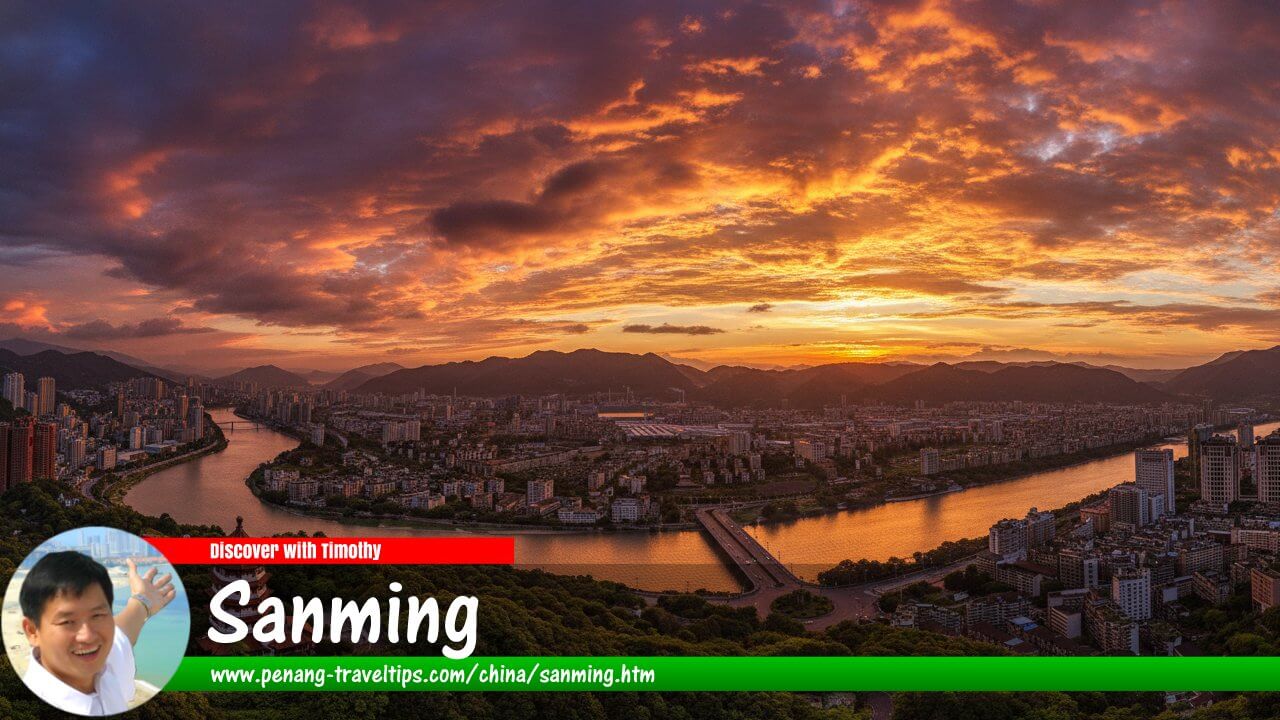 Sanming, China (Photo edited with AI on 15 June 2026)
Sanming (Chinese: 三明; pinyin: Sānmíng) is a prefecture-level city in western-central Fujian Province, China. Situated among the forested mountains of inland Fujian, Sanming is known for its abundant natural resources, extensive woodlands, rich Hakka cultural heritage, and spectacular karst landscapes. Unlike the coastal cities of Fujian, Sanming developed as an inland center of forestry, mining, agriculture, and industry. Today, it is recognized as one of China's important ecological cities, with vast forest coverage, scenic national parks, and a growing tourism sector.1
The name "Sanming" literally means "Three Brightnesses" or "Three Illuminations." The modern city was established in 1958 through the merger and reorganization of administrative areas around Sanyuan County and Mingxi County. The first character "San" (三) was taken from Sanyuan, while the second character "Ming" (明) came from Mingxi, creating the name "Sanming." Although the city itself is relatively modern as an administrative unit, the region has a history stretching back more than two thousand years.2
Quick Facts
- English Name: Sanming
- Chinese Name: 三明
- Pinyin: Sānmíng
- Province: Fujian
- Location: Inland Western-Central Fujian
- Established: 1958 (modern municipality)
- Climate: Humid Subtropical
- Main Railway Hub: Sanming North Railway Station
- Nearest Airport: Sanming Shaxian Airport
- Known For: Forests, Hakka culture, Danxia landscapes
- Major Industries: Forestry, mining, agriculture, manufacturing
- Forest Coverage: Among the highest in Fujian Province
Geography
Sanming occupies a large inland area in western-central Fujian Province and borders the prefecture-level cities of Fuzhou, Quanzhou, Putian, Nanping, Longyan, and Zhangzhou, as well as Jiangxi Province to the northwest. Covering more than 22,000 square kilometers, it is one of the largest municipalities in Fujian by land area.1
The city is characterized by rugged mountains, deep valleys, rivers, forests, and karst formations. Much of the municipality lies within the Wuyi Mountain system and associated uplands. Elevations vary considerably, creating a diverse natural environment that supports numerous plant and animal species.
Several important rivers flow through Sanming, including tributaries of the Min River system, which ultimately flows toward Fuzhou and the East China Sea. These waterways have historically supported agriculture, transportation, and settlement.
Sanming enjoys a humid subtropical climate with four distinct seasons. Summers are warm and humid, while winters are relatively mild compared with northern China. Annual rainfall is abundant, helping sustain the city's extensive forests and agricultural lands.
Forest coverage exceeds 75 percent in many parts of the municipality, making Sanming one of China's most environmentally significant urban regions. The abundance of forests has earned the city recognition as an important ecological conservation area and a national model for sustainable forestry management.
History
The region now occupied by Sanming has been inhabited since prehistoric times. Archaeological discoveries indicate that ancient communities lived in the valleys and river basins thousands of years ago. During the Qin and Han dynasties, the area gradually became incorporated into the imperial Chinese administrative system.2
Throughout the Tang and Song dynasties, the region developed as an agricultural frontier. Farmers cultivated rice, tea, and other crops in river valleys, while mountain communities engaged in forestry and mining activities. Trade routes connected the interior with Fujian's coastal ports.
Large-scale migration occurred during periods of warfare and political instability in northern China. Many migrants moved south into Fujian, including Hakka communities who settled in the mountainous interior. Their influence remains visible today in local architecture, customs, language, and traditions.
During the Ming and Qing dynasties, Sanming's counties became known for timber production, tea cultivation, bamboo products, and mineral resources. The forests supplied wood for construction and shipbuilding in coastal cities, while local mines produced iron and other minerals.
The modern city of Sanming emerged after the establishment of the People's Republic of China. In 1958, the municipal government was formally created to oversee the industrial development of the region. Rich deposits of coal, iron ore, and other resources encouraged rapid industrialization.
During the latter half of the twentieth century, Sanming became one of Fujian's principal industrial centers. State-owned enterprises expanded mining, metallurgy, machinery manufacturing, and chemical production. Railways and highways improved transportation links with other parts of China.
In recent decades, economic reforms have encouraged diversification. While industry remains important, environmental conservation, tourism, modern services, and sustainable forestry have become increasingly significant components of the local economy.
Today, Sanming is recognized for successfully balancing industrial development with ecological protection, preserving both its natural environment and cultural heritage.
Economy and Products
Sanming's economy is based on a combination of industry, forestry, agriculture, mining, manufacturing, and tourism. The city's abundant natural resources have historically formed the foundation of economic development.
Forestry remains one of the most important sectors. Timber, bamboo, forest products, and related industries contribute significantly to local employment and revenue. Sustainable forest management programs have helped maintain ecological stability while supporting economic growth.
Mining is another key industry. Deposits of coal, iron ore, limestone, and other minerals have supported the development of metallurgy, cement production, and manufacturing. Industrial zones throughout the municipality process raw materials into finished products.
Agriculture remains important in rural areas. Major products include rice, tea, bamboo shoots, mushrooms, fruits, vegetables, and livestock. The region's favorable climate and fertile valleys support diverse agricultural activities.
One of the city's most famous products is Shaxian snacks, a style of traditional Chinese cuisine originating in Shaxian County. Shaxian eateries can now be found throughout China and have become one of the country's most recognizable culinary brands.3
Tourism has grown rapidly as visitors are attracted by national parks, caves, mountains, historic towns, and Hakka cultural sites. Ecotourism and nature-based travel are increasingly important sources of income.
How to Go There
By Air
Sanming Shaxian Airport (SQJ) is located approximately 30 kilometers west of Sanming's urban center in Shaxian District. The airport serves domestic routes and provides convenient access to the city and surrounding counties.4
Airlines operating at the airport have included Air China, China Eastern Airlines, China Southern Airlines, XiamenAir, and several regional carriers. Flights connect Sanming with major cities such as Beijing, Shanghai, Guangzhou, Shenzhen, Chengdu, Chongqing, Kunming, and Xi'an, although routes may vary according to seasonal demand.
By Train
Sanming North Railway Station is located in Shaxian District and serves as the city's principal high-speed rail hub. It is situated on the Hefei–Fuzhou High-Speed Railway and provides connections to Fuzhou, Xiamen, Quanzhou, Hangzhou, Shanghai, Nanchang, Wuhan, Beijing, and other major cities.5
Sanming Railway Station, located closer to the urban center, serves conventional rail services and selected passenger routes.
By Long-Distance Bus
Sanming Long-Distance Bus Station and several district-level passenger terminals provide coach services throughout Fujian Province and neighboring regions. Frequent buses connect Sanming with Fuzhou, Xiamen, Quanzhou, Longyan, Nanping, and other cities.
How to Travel Locally
Sanming's transportation system includes urban buses, taxis, highways, and regional rail services.
- Public Buses: Comprehensive bus routes connect major districts, railway stations, airports, and tourist attractions.
- Taxis: Metered taxis are widely available throughout urban areas.
- E-Hailing Services: Didi is the primary ride-hailing platform and functions similarly to Uber.
- Intercity Coaches: Frequent coach services connect counties and neighboring cities.
- Private Vehicles: Car rentals and private transport services are available.
- Rail Services: Local railway connections provide additional transportation options within the region.
Sanming does not currently operate a subway, metro, MRT, or LRT system. Traditional forms of transportation such as trishaws, rickshaws, and tuk-tuks are generally not part of the city's transportation network.
Tourist Attractions
Taining Scenic Area
Taining Scenic Area is Sanming's most famous attraction and a UNESCO Global Geopark. It is known for its spectacular Danxia landforms, red sandstone cliffs, winding rivers, and dramatic natural scenery.6
Dajin Lake
Located within the Taining Scenic Area, Dajin Lake features striking rock formations, narrow gorges, caves, and scenic boat cruises. It is considered one of Fujian's most beautiful natural attractions.
Taining Ancient Town
This well-preserved historic town contains traditional residences, ancestral halls, temples, and streets dating from the Ming and Qing dynasties.
Yuhua Cave
Often regarded as one of Fujian's finest limestone caves, Yuhua Cave contains spectacular stalactites, stalagmites, underground chambers, and colorful mineral formations.
Geshiyan Temple
Built into a cliffside setting, this historic Buddhist temple offers impressive architecture and scenic mountain views.
Shaxian Ancient County Town
Shaxian is famous for its culinary heritage and traditional architecture. Visitors can sample authentic Shaxian snacks while exploring historical sites.
Junzi Peak
This mountain destination attracts hikers and nature enthusiasts with its forested slopes, scenic viewpoints, and diverse wildlife.
Jinrao Mountain
One of the highest peaks in the region, Jinrao Mountain offers hiking trails, alpine scenery, and panoramic views across inland Fujian.
Longqi Mountain Nature Reserve
This protected area preserves forests, rare plant species, waterfalls, and wildlife, making it a popular destination for ecotourism.
Confucian Temple of Taining
The historic temple reflects the region's long educational tradition and contains valuable examples of traditional Chinese architecture.
Sanming, China is  the Map of Cities in China
References
- Encyclopaedia Britannica – Sanming
- Wikipedia – Sanming
- Wikipedia – Shaxian Delicacies
- Wikipedia – Sanming Shaxian Airport
- Wikipedia – Sanming North Railway Station
- UNESCO Global Geoparks – Taining Geopark
Page Details
This page was created/modified on 14 June 2026. Hi, my name is Timothy and created it from my research, for my own entertainment, knowledge and to satisfy my curiosity. I am providing the information to you in good faith and hope it is useful. I try to get the details as accurate as possible. I also try to update the page whenever I stumble on new details. So this and all my other pages are perpetual work in progress. If you discover any error, please politely inform me, pointing out where the error lies, and I will correct it as soon as possible. Your helpfulness will keep this page accurate, relevant and helpful to those who need the information.