
Quanzhou, China
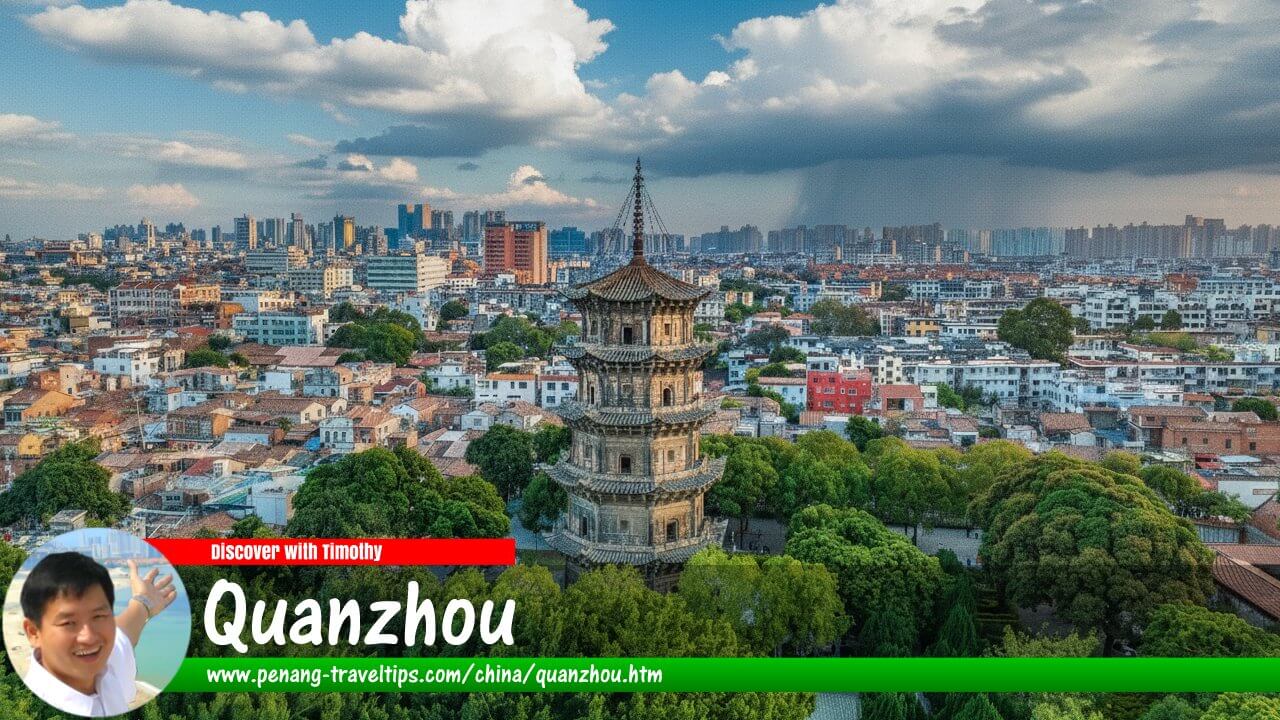 Quanzhou, China (Photo edited with AI on 15 June 2026)
Quanzhou (Chinese: 泉州; pinyin: Quánzhōu) is a major prefecture-level city in Fujian Province on the southeastern coast of China. Situated along the Taiwan Strait, Quanzhou is one of China's most historically significant maritime cities and was once among the world's busiest ports. The city is renowned for its role in international trade during the Song and Yuan dynasties, its multicultural heritage, and its remarkable collection of religious and historical monuments. In 2021, Quanzhou was inscribed as a UNESCO World Heritage Site for its importance as a center of the Maritime Silk Road.1
The name "Quanzhou" literally means "Prefecture of Springs." The first character, "Quan" (泉), means "spring" or "water source," while "Zhou" (州) refers to a traditional administrative prefecture. The name reflects the abundance of natural springs and waterways found in the region. Historical records indicate that the city received this name during the early Tang Dynasty when it became an important administrative center in southeastern China.2
Quick Facts
- English Name: Quanzhou
- Chinese Name: 泉州
- Pinyin: Quánzhōu
- Province: Fujian
- Location: Southeastern China, Taiwan Strait Coast
- UNESCO Status: Maritime Emporium of the World in Song-Yuan China
- Nickname: Starting Point of the Maritime Silk Road
- Climate: Humid Subtropical
- Main Airport: Quanzhou Jinjiang International Airport
- Main Language: Mandarin and Hokkien (Minnan)
- Major Industries: Manufacturing, footwear, textiles, petrochemicals, trade
- Known For: Maritime history, temples, overseas Chinese heritage
Geography
Quanzhou is located on the southeastern coast of Fujian Province, approximately midway between Fuzhou and Xiamen. The city faces the Taiwan Strait and occupies a strategic position that has historically facilitated maritime trade with Southeast Asia, East Asia, the Middle East, and beyond.1
The municipality encompasses a varied landscape of coastal plains, river valleys, hills, offshore islands, and mountainous regions. Several rivers flow through the area before entering Quanzhou Bay, creating fertile agricultural lands that have supported settlement and economic activity for centuries.
Quanzhou experiences a humid subtropical climate characterized by warm winters, hot summers, and abundant rainfall. Monsoon influences and proximity to the sea moderate temperatures throughout much of the year. The region's favorable climate has contributed to agricultural production and population growth since ancient times.
The city's coastline includes numerous harbors and natural anchorages, which played a crucial role in its rise as one of the world's leading trading ports during the medieval period.
History
The history of Quanzhou dates back more than 1,700 years. The area was initially settled by indigenous peoples before becoming integrated into successive Chinese dynasties. During the Three Kingdoms period and the Jin Dynasty, the region gradually developed as a local administrative center.2
Quanzhou gained prominence during the Tang Dynasty when maritime trade expanded dramatically along China's southeastern coast. Merchants from Arabia, Persia, India, Southeast Asia, and other regions began visiting the port, bringing goods, technologies, and cultural influences.
The city reached its greatest prosperity during the Song Dynasty (960–1279). At that time, Quanzhou became one of the largest and busiest ports in the world. Ships carried silk, ceramics, tea, lacquerware, and other Chinese products to distant markets, while foreign merchants imported spices, precious stones, textiles, and exotic goods.1
The famous Venetian traveler Marco Polo described Quanzhou, known to Europeans as "Zayton," as one of the world's greatest ports. Contemporary Arab and Persian accounts similarly praised the city's commercial importance and cosmopolitan atmosphere.3
During the Yuan Dynasty, Quanzhou continued to flourish as an international trading hub. Diverse communities of Muslims, Christians, Hindus, and other groups established places of worship and cultural institutions within the city. This multicultural legacy remains visible in Quanzhou's architecture and archaeological sites today.
The city's importance gradually declined during the Ming Dynasty due to changing trade policies, maritime restrictions, and the silting of harbor channels. Nevertheless, Quanzhou remained an important regional center and continued to maintain connections with overseas Chinese communities throughout Southeast Asia.
In the nineteenth and twentieth centuries, Quanzhou's economy diversified through manufacturing, agriculture, and commerce. Following China's economic reforms beginning in the late 1970s, the city experienced rapid industrialization and urban development.
Today, Quanzhou is recognized not only for its economic achievements but also for its exceptional historical heritage. In 2021, UNESCO inscribed "Quanzhou: Emporium of the World in Song-Yuan China" on the World Heritage List, acknowledging the city's crucial role in global maritime trade.1
Economy and Products
Quanzhou is one of Fujian Province's most prosperous cities and consistently ranks among China's leading manufacturing centers. The local economy is driven by industry, trade, logistics, technology, and private enterprise.
The city is particularly famous for its footwear and sportswear industries. Numerous well-known Chinese brands originated in Quanzhou, making it one of the country's most important centers for shoe manufacturing and apparel production.
Other major industries include textiles, petrochemicals, machinery, electronics, building materials, food processing, and logistics. The city's strategic location and port facilities facilitate domestic and international trade.
Agricultural products from the surrounding region include rice, fruits, vegetables, tea, and seafood. Fishing remains an important economic activity along the coast.
Traditional crafts associated with Quanzhou include stone carving, wood carving, porcelain production, and religious sculpture. Dehua County, which falls under Quanzhou's administration, is internationally renowned for its high-quality white porcelain, often known as "Blanc de Chine."4
Tourism has become increasingly important due to the city's UNESCO World Heritage status, historical sites, and cultural festivals.
How to Go There
By Air
Quanzhou Jinjiang International Airport (JJN) is located in Jinjiang, approximately 12 kilometers south of central Quanzhou. The airport serves domestic routes throughout China and selected international destinations.5
Airlines operating at the airport include Air China, China Eastern Airlines, China Southern Airlines, XiamenAir, Shenzhen Airlines, Sichuan Airlines, and Spring Airlines. Frequent domestic flights connect Quanzhou with Beijing, Shanghai, Guangzhou, Shenzhen, Chengdu, Chongqing, Kunming, and many other cities. International and regional services operate to destinations in East and Southeast Asia.
By Train
Quanzhou Railway Station is located in Fengze District north of the city center. It serves high-speed rail services connecting Quanzhou with Fuzhou, Xiamen, Shenzhen, Guangzhou, Hangzhou, Shanghai, and Beijing.6
Quanzhou East Railway Station and several other regional stations provide additional rail connections within Fujian Province and neighboring regions.
By Long-Distance Bus
The city is served by major long-distance bus terminals including Quanzhou Central Bus Station and Quanzhou Passenger Transport Center Station. These terminals provide services to destinations throughout Fujian Province and neighboring provinces.
How to Travel Locally
Quanzhou offers a range of transportation options suitable for both residents and visitors.
- Public Buses: Extensive bus routes connect major districts, attractions, and transportation hubs.
- Taxis: Metered taxis are readily available throughout the city.
- E-Hailing Services: Didi is widely used and functions similarly to Uber.
- Shared Bicycles: App-based bicycle-sharing systems are common in urban areas.
- Private Vehicles: Rental cars and chauffeur services are available.
- Airport Shuttle Services: Buses and taxis connect the airport with the city center.
Quanzhou currently does not operate a metro, MRT, LRT, or subway system. Traditional forms of transport such as trishaws, rickshaws, and tuk-tuks are generally not used in the city.
Tourist Attractions
Kaiyuan Temple
Kaiyuan Temple is Quanzhou's most famous Buddhist temple and one of the largest and oldest temples in Fujian Province. Founded during the Tang Dynasty, it is renowned for its twin stone pagodas, exquisite architecture, and cultural significance.1
Qingjing Mosque
Built in 1009 during the Song Dynasty, Qingjing Mosque is one of the oldest Islamic structures in China. It reflects strong Middle Eastern architectural influences and symbolizes Quanzhou's historic connections with Muslim traders.
Quanzhou Maritime Museum
This museum showcases the city's maritime heritage through ship models, archaeological artifacts, trade records, and exhibits relating to the Maritime Silk Road.
Tianhou Temple
Dedicated to Mazu, the goddess of the sea, Tianhou Temple has long been an important place of worship for sailors and merchants engaged in maritime trade.
Luoyang Bridge
Constructed during the Northern Song Dynasty, Luoyang Bridge is one of China's oldest large stone bridges and represents a remarkable achievement in medieval engineering.
Qingyuan Mountain
This scenic mountain area features hiking trails, temples, historic carvings, and panoramic views of the surrounding countryside. The famous giant stone statue of Laozi is one of its highlights.
Dehua Porcelain Sites
Dehua County is famous for producing some of China's finest white porcelain. Visitors can tour museums, workshops, and historical kiln sites associated with this celebrated ceramic tradition.
West Street
One of Quanzhou's oldest streets, West Street contains traditional architecture, shops, restaurants, temples, and cultural landmarks that reflect the city's historic character.
Chongwu Ancient City
Located on the coast, this well-preserved Ming Dynasty fortified town is known for its defensive walls, stone sculptures, and maritime history.
Quanzhou Confucian Temple
One of the largest Confucian temples in southeastern China, this complex contains historic halls, courtyards, and cultural relics associated with traditional Chinese education and philosophy.
Quanzhou, China is  the Map of Cities in China
References
- UNESCO World Heritage Centre – Quanzhou: Emporium of the World in Song-Yuan China
- Wikipedia – Quanzhou
- Encyclopaedia Britannica – Quanzhou
- Encyclopaedia Britannica – Dehua Ware
- Wikipedia – Quanzhou Jinjiang International Airport
- Wikipedia – Quanzhou Railway Station
Page Details
This page was created/modified on 14 June 2026. Hi, my name is Timothy and created it from my research, for my own entertainment, knowledge and to satisfy my curiosity. I am providing the information to you in good faith and hope it is useful. I try to get the details as accurate as possible. I also try to update the page whenever I stumble on new details. So this and all my other pages are perpetual work in progress. If you discover any error, please politely inform me, pointing out where the error lies, and I will correct it as soon as possible. Your helpfulness will keep this page accurate, relevant and helpful to those who need the information.