
Ningde, China
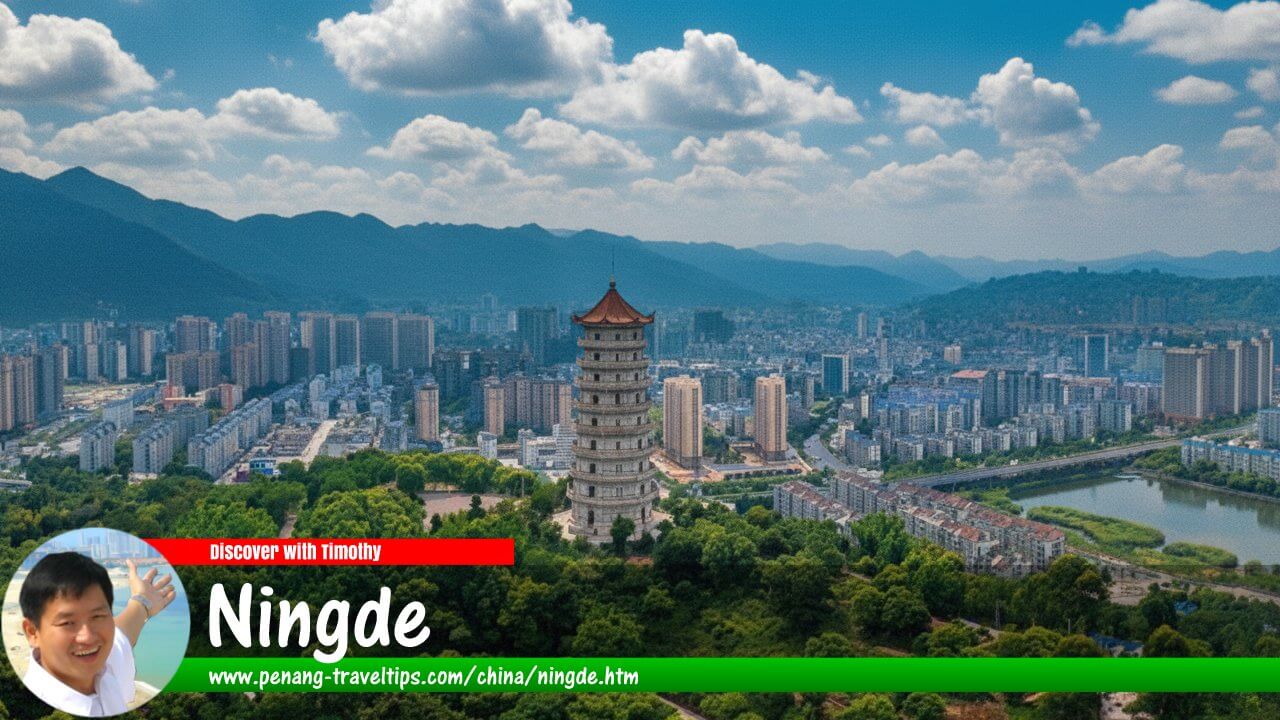 Ningde, China (Photo edited with AI on 15 June 2026)
Ningde (Chinese: 宁德; pinyin: Níngdé) is a prefecture-level city in northeastern Fujian Province, China. Situated along the coast of the East China Sea and backed by mountainous terrain, Ningde is one of Fujian's most important centers for fisheries, aquaculture, tea production, and emerging high-technology industries. Although historically less well known than coastal cities such as Fuzhou, Xiamen, and Quanzhou, Ningde has become increasingly significant in recent decades due to its economic growth, natural beauty, and strategic location. The city is also renowned for its picturesque coastal scenery, traditional villages, and diverse ethnic cultures, particularly those of the She people, one of China's officially recognized ethnic minorities.1
The name "Ningde" literally means "Peaceful Virtue" or "Tranquil Morality." The first character, "Ning" (宁), means peace, tranquility, or stability, while "De" (德) means virtue or moral character. The name was adopted during the Tang Dynasty when Ningde County was established as an administrative unit. It reflected the traditional Chinese aspiration for a peaceful and prosperous society governed by moral principles. Over time, the name became associated with the wider region and remains in use today.2
Quick Facts
- English Name: Ningde
- Chinese Name: 宁德
- Pinyin: Níngdé
- Province: Fujian
- Location: Northeastern Fujian, China
- Coastline: Along the East China Sea
- Climate: Humid Subtropical
- Main Railway Station: Ningde Railway Station
- Nearest Major Airport: Fuzhou Changle International Airport
- Known For: Tea, fisheries, aquaculture, mountains, ethnic culture
- Major Industries: Aquaculture, manufacturing, batteries, energy, agriculture
- Ethnic Minority: She People
Geography
Ningde is located in the northeastern part of Fujian Province and borders Fuzhou to the south, Nanping to the west, Zhejiang Province to the north, and the East China Sea to the east. Covering a vast area of mountains, rivers, islands, and coastline, Ningde is one of the most geographically diverse regions in Fujian.1
The city's terrain is dominated by mountains and hills, with many areas rising sharply from the coast. The eastern coastline stretches for hundreds of kilometers and contains numerous bays, peninsulas, islands, and natural harbors. This coastal geography has supported fishing and maritime trade for centuries.
Among the most notable geographical features is Sandu'ao (Sandu Bay), one of China's deepest natural harbors. The bay provides excellent conditions for shipping, aquaculture, and port development.
Ningde experiences a humid subtropical climate characterized by warm winters, hot summers, and abundant rainfall. Monsoon influences bring significant precipitation throughout the year, while the coastal location helps moderate temperature extremes. The region occasionally experiences typhoons during the summer and autumn months.
The municipality also contains extensive forests, rivers, waterfalls, wetlands, and nature reserves. These landscapes support rich biodiversity and provide important ecological resources.
History
The history of Ningde extends back more than two thousand years. Archaeological discoveries suggest that the area was inhabited long before the establishment of formal Chinese administrative control. During the Qin and Han dynasties, the region became increasingly integrated into the Chinese state.2
During the Tang Dynasty, Ningde County was officially established, giving rise to the modern name. The region developed gradually as agriculture expanded and trade routes connected inland settlements with coastal ports.
Throughout the Song Dynasty, maritime trade contributed significantly to local prosperity. Fishing communities flourished along the coast, while inland areas cultivated rice, tea, and other agricultural products.
The region also became home to significant populations of the She people, whose traditions, language, costumes, and festivals remain an important part of Ningde's cultural identity today.3
During the Ming and Qing dynasties, Ningde's coastal communities participated in regional trade networks linking Fujian with Taiwan, Southeast Asia, and other parts of East Asia. Many residents emigrated overseas and established communities abroad while maintaining ties with their hometowns.
In the twentieth century, modernization brought improved transportation, education, and industrial development. Following economic reforms beginning in the late 1970s, Ningde experienced rapid growth, benefiting from investment, infrastructure projects, and expanding domestic markets.
The city gained international recognition in the twenty-first century as a major center for advanced manufacturing, particularly lithium-ion battery production. This transformation has made Ningde one of China's fastest-growing economic regions.
Economy and Products
Ningde's economy combines traditional industries with modern manufacturing and technology. Historically, fishing, agriculture, forestry, and tea cultivation formed the foundation of local prosperity.
Aquaculture remains one of the city's most important industries. Coastal waters support the cultivation of fish, shrimp, oysters, seaweed, kelp, and other marine products. Ningde is frequently ranked among China's leading seafood-producing regions.
Tea production is another major economic activity. The mountainous interior provides ideal conditions for tea cultivation, and local varieties are widely consumed throughout China.
Agricultural products include rice, vegetables, fruits, bamboo, mushrooms, and medicinal herbs. Forestry also contributes significantly to the local economy.
In recent years, Ningde has become internationally known for advanced battery manufacturing. Contemporary Amperex Technology Co. Limited (CATL), one of the world's largest producers of lithium-ion batteries for electric vehicles and energy storage systems, is headquartered in Ningde.4
Other important industries include shipbuilding, renewable energy, machinery manufacturing, electronics, chemicals, logistics, and port operations. The city's strategic coastal location continues to support economic development.
How to Go There
By Air
Ningde does not currently have a major commercial airport serving the city center. Most visitors arrive via Fuzhou Changle International Airport (FOC), located approximately 100 kilometers south of central Ningde. The airport is connected to Ningde by expressways, buses, and high-speed rail services.5
Airlines serving Fuzhou include Air China, China Eastern Airlines, China Southern Airlines, XiamenAir, Hainan Airlines, Shenzhen Airlines, Sichuan Airlines, and various international carriers. Flights connect the region with Beijing, Shanghai, Guangzhou, Shenzhen, Chengdu, Chongqing, Kunming, Hong Kong, Singapore, Bangkok, Tokyo, and numerous other destinations.
By Train
Ningde Railway Station is located in Jiaocheng District, the city's urban center. It forms part of the Hangzhou–Shenzhen Railway and offers high-speed rail services to Fuzhou, Xiamen, Quanzhou, Wenzhou, Hangzhou, Shanghai, Shenzhen, Guangzhou, and other major cities.6
Additional railway stations throughout the municipality serve regional routes and nearby counties.
By Long-Distance Bus
Ningde Passenger Transport Center and other bus terminals provide regular services to destinations throughout Fujian Province and neighboring provinces including Zhejiang, Jiangxi, and Guangdong.
How to Travel Locally
Ningde has a modern transportation system that allows convenient travel throughout the city and surrounding areas.
- Public Buses: Extensive bus routes connect districts, railway stations, bus terminals, and tourist attractions.
- Taxis: Metered taxis operate throughout the urban area.
- E-Hailing Services: Didi is widely available and functions similarly to Uber.
- Shared Bicycles: App-based bicycle-sharing services are common in urban districts.
- Intercity Coaches: Frequent services connect counties and neighboring cities.
- Ferries: Ferry services operate to selected islands and coastal communities.
Ningde does not currently have a subway, MRT, metro, or LRT system. Traditional transportation methods such as trishaws, rickshaws, and tuk-tuks are generally not used in the city.
Tourist Attractions
Taimu Mountain Scenic Area
Taimu Mountain is Ningde's most famous tourist destination. Known for its granite peaks, unusual rock formations, caves, temples, and panoramic views, it is often called the "Immortal Mountain on the Sea."7
Sandu Bay
One of China's deepest natural harbors, Sandu Bay is renowned for its coastal scenery, fishing villages, aquaculture farms, and maritime culture.
Xiapu Mudflats
Xiapu is internationally famous among photographers for its dramatic tidal flats, fishing nets, bamboo structures, and changing light conditions. The area is considered one of China's premier photography destinations.
Ji鲤 Creek (Yuanyang Creek Scenic Area)
This scenic area features clear streams, waterfalls, forests, suspension bridges, and walking trails through beautiful natural landscapes.
Baishuiyang Scenic Area
Located within the UNESCO-listed Mount Wuyi-related landscape region, Baishuiyang is famous for its broad, shallow riverbed that forms a natural water park.
Fuan Ancient Town
Fuan preserves historic streets, traditional architecture, temples, and cultural sites reflecting centuries of local history.
She Ethnic Culture Villages
Several villages showcase the traditions, costumes, music, festivals, and handicrafts of the She ethnic minority.
Mount Jiufeng
This mountain area offers hiking trails, forests, temples, and scenic viewpoints overlooking the surrounding countryside.
Dongbi Village
Located near Xiapu, Dongbi Village is famous for sunset views over the sea and has become a popular destination for photographers.
Ruiyun Temple
This historic Buddhist temple is known for its religious significance, traditional architecture, and tranquil mountain setting.
Ningde, China is  the Map of Cities in China
References
- Encyclopaedia Britannica – Ningde
- Wikipedia – Ningde
- Wikipedia – She People
- CATL – Company Overview
- Wikipedia – Fuzhou Changle International Airport
- Wikipedia – Ningde Railway Station
- UNESCO Tentative Lists and Fujian Scenic Resources
Page Details
This page was created/modified on 14 June 2026. Hi, my name is Timothy and created it from my research, for my own entertainment, knowledge and to satisfy my curiosity. I am providing the information to you in good faith and hope it is useful. I try to get the details as accurate as possible. I also try to update the page whenever I stumble on new details. So this and all my other pages are perpetual work in progress. If you discover any error, please politely inform me, pointing out where the error lies, and I will correct it as soon as possible. Your helpfulness will keep this page accurate, relevant and helpful to those who need the information.