
Xiamen, China
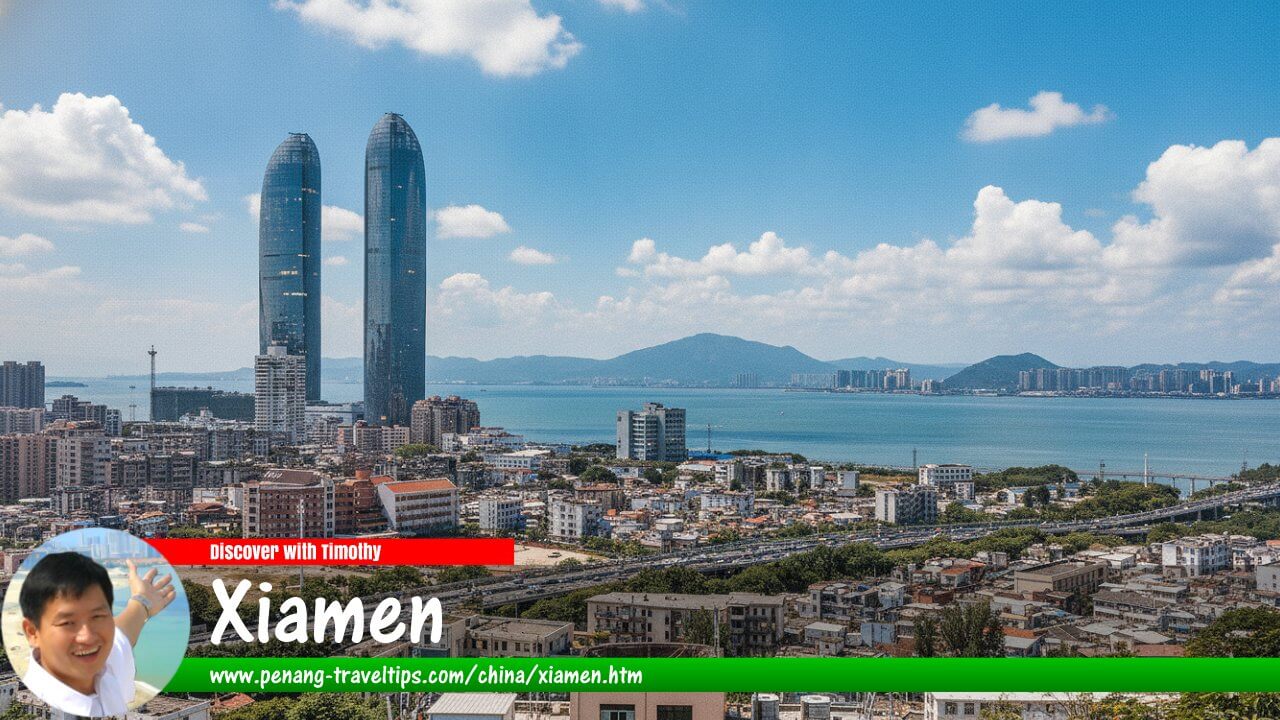 Xiamen, China (Photo edited with AI on 14 June 2026)
Xiamen (Chinese: 厦门; pinyin: Xiàmén), historically known to many Westerners as Amoy, is a major coastal city in Fujian Province in southeastern China. Located on the shores of the Taiwan Strait, the city is renowned for its beautiful seaside scenery, important commercial port, rich cultural heritage, and modern urban development. Often called the “Garden on the Sea,” Xiamen combines natural beauty with a thriving economy and is one of China's most attractive and livable cities.1
The name "Xiamen" literally means "Mansion Gate" or "Grand Gate." The city was originally written using different Chinese characters that reflected its position near the mouth of a harbor. During the Ming Dynasty, the present characters 厦门 were adopted, conveying the idea of a gateway to China. The local Hokkien pronunciation gave rise to the name "Amoy," which became widely used by European traders and sailors.2
Quick Facts
- English Name: Xiamen
- Chinese Name: 厦门
- Pinyin: Xiàmén
- Province: Fujian
- Location: Southeastern China, Taiwan Strait
- Historical Western Name: Amoy
- Climate: Humid subtropical
- Known For: Port city, Gulangyu Island, Xiamen University, Special Economic Zone
- Main Airport: Xiamen Gaoqi International Airport
- Main Language: Mandarin and Hokkien (Minnan)
- Major Industries: Electronics, shipping, tourism, trade, manufacturing
Geography
Xiamen is situated on the southeastern coast of Fujian Province, facing Taiwan across the Taiwan Strait. The city consists of Xiamen Island, Gulangyu Island, and extensive mainland districts including Jimei, Haicang, Tong'an, Xiang'an, and Siming. Its strategic location has made it an important maritime center for centuries.1
The urban core developed primarily on Xiamen Island, which is connected to the mainland by bridges, causeways, tunnels, and rail links. The city occupies a natural harbor formed near the estuary of the Jiulong River, providing sheltered waters that have supported maritime trade for generations.1
Xiamen experiences a humid subtropical climate characterized by warm winters, hot summers, and abundant rainfall. The city enjoys a long coastline, numerous beaches, and scenic hills. Palm-lined roads, parks, and waterfront promenades contribute to its reputation as one of China's most pleasant coastal cities.
History
The area that is now Xiamen has been inhabited for many centuries. During the Song and Yuan dynasties, the island was known as Jiahe Island and was primarily noted as a fishing community and trading settlement. Its strategic location also attracted pirates who operated along the southeastern coast of China.1
In 1387, during the Ming Dynasty, fortifications were constructed to combat piracy, and the name Xiamen came into official use. The city grew in military and commercial importance because of its location near important sea routes.1
During the seventeenth century, Xiamen became associated with Zheng Chenggong, better known in the West as Koxinga. He used the city as a base for resistance against the Qing Dynasty and maintained close connections with Taiwan. The city subsequently became an important naval center under Qing rule.1
Foreign trade expanded significantly after European merchants arrived in the region. Following the First Opium War, Xiamen became one of the first treaty ports opened to international commerce under the Treaty of Nanjing in 1842. Foreign settlements emerged, particularly on nearby Gulangyu Island, where consulates, churches, schools, and residences were established.1
In the nineteenth century, Xiamen became one of China's principal tea-exporting ports. It also served as a major departure point for emigrants traveling to Southeast Asia, many of whom later maintained strong economic and cultural ties with their hometown.1
The city was occupied by Japanese forces from 1938 to 1945 during the Second World War. After the establishment of the People's Republic of China in 1949, Xiamen's development was initially constrained by cross-strait tensions. However, major infrastructure projects were undertaken, including rail connections and industrial development.1
A turning point came in 1980 when Xiamen was designated one of China's Special Economic Zones. This status encouraged foreign investment, particularly from overseas Chinese communities, and transformed the city into a modern center of manufacturing, trade, finance, and tourism.1
Economy and Products
Xiamen possesses one of the most dynamic economies in southeastern China. As a Special Economic Zone, it has attracted substantial domestic and foreign investment over the past several decades. The city's economy benefits from its strategic coastal location, modern infrastructure, and extensive international connections.
The Port of Xiamen ranks among China's important seaports and serves as a major gateway for international trade. The harbor handles containerized cargo, bulk goods, and passenger traffic, linking Fujian Province with markets throughout Asia and beyond.
Manufacturing plays a significant role in the local economy. Major industries include electronics, information technology, machinery, petrochemicals, shipbuilding, and precision equipment. Numerous multinational corporations have established facilities in and around the city.
Tourism is another major economic pillar. Visitors are attracted by the city's beaches, islands, cultural landmarks, and pleasant climate. Educational institutions such as Xiamen University also contribute to the local economy through research, innovation, and international exchanges.1
Traditional products associated with Xiamen and southern Fujian include tea, seafood, preserved foods, handicrafts, and various Minnan-style culinary specialties. The city is particularly known for its seafood restaurants and local Hokkien cuisine.
How to Get to Xiamen
By Air
Xiamen is served by Xiamen Gaoqi International Airport (XMN), located approximately 10 kilometers north of the city center on Xiamen Island. The airport serves as the primary hub for XiamenAir and handles both domestic and international flights. Airlines operating at the airport include XiamenAir, Air China, China Southern Airlines, China Eastern Airlines, Spring Airlines, and several international carriers.3
Domestic flights connect Xiamen with major Chinese cities such as Beijing, Shanghai, Guangzhou, Shenzhen, Chengdu, Chongqing, and Kunming. International services operate to destinations across East Asia, Southeast Asia, and other regions.3
By Train
Xiamen Railway Station is located in Siming District near the city center. It serves both conventional and high-speed rail services, providing convenient connections to Fuzhou, Quanzhou, Zhangzhou, Longyan, Hangzhou, Shanghai, and many other Chinese cities.4
Xiamen North Railway Station, located in Jimei District, is another major rail hub serving many high-speed train routes. Travelers arriving from northern and central China frequently use this station.
By Long-Distance Bus
Xiamen has several long-distance bus terminals, including Fanghu Bus Station and Hubin Long-Distance Bus Station. These facilities provide services to cities and towns throughout Fujian Province as well as neighboring provinces.
Getting Around Xiamen
Xiamen has a modern and efficient transportation system that makes travel within the city relatively easy.
- Metro: Xiamen Metro operates several lines connecting major districts, railway stations, airports, and commercial areas.
- BRT: The Bus Rapid Transit system provides fast and affordable transportation across the city.
- Public Buses: Extensive bus routes cover virtually all urban and suburban areas.
- Taxis: Metered taxis are widely available throughout the city.
- E-Hailing Services: Didi is the dominant ride-hailing platform and functions similarly to Uber.
- Ferries: Frequent ferry services operate between Xiamen Island and Gulangyu Island.
- Bicycles and E-Bikes: Shared bicycles and electric bikes are common and convenient for short journeys.
Traditional transport methods such as trishaws, rickshaws, or tuk-tuks are not a significant part of modern transportation in Xiamen.
Tourist Attractions
Gulangyu Island
A UNESCO World Heritage Site, Gulangyu Island is famous for its colonial-era architecture, pedestrian-friendly streets, museums, gardens, and musical heritage. The island is one of China's most popular tourist destinations.1
Xiamen University
Founded in 1921 by overseas Chinese philanthropist Tan Kah Kee, Xiamen University is widely regarded as one of China's most beautiful university campuses, featuring traditional Chinese architecture and scenic waterfront views.1
Nanputuo Temple
This famous Buddhist temple dates back more than a thousand years and is located at the foot of Wulaofeng Mountain. It remains an active religious center and a popular sightseeing destination.
Zhongshan Road Pedestrian Street
One of Xiamen's most famous shopping streets, Zhongshan Road combines historic architecture with modern retail stores, restaurants, and local snack vendors.
Jimei School Village
Established by Tan Kah Kee, Jimei features distinctive educational buildings, memorial halls, and gardens that reflect a blend of Chinese and Western architectural influences.
Hulishan Fortress
This coastal defense fort was built during the Qing Dynasty and contains historic military installations, including one of the world's largest surviving nineteenth-century coastal cannons.
Baicheng Beach
Located near Xiamen University, Baicheng Beach is a popular recreational area offering sandy shores, ocean views, and walking paths.
Wanshi Botanical Garden
This extensive botanical garden contains thousands of plant species, themed landscapes, and scenic mountain surroundings.
Shapowei Art Zone
Once a traditional fishing harbor, Shapowei has evolved into a creative district filled with galleries, cafes, cultural spaces, and artistic installations.
Xiamen International Conference and Exhibition Center
This modern waterfront complex hosts major conferences, exhibitions, and events while offering attractive coastal scenery.
Xiamen on  the Map of Cities in China
References
- Encyclopaedia Britannica – Xiamen
- Wikipedia (Spanish) – Xiamen Etymology and History
- Wikipedia – Xiamen Gaoqi International Airport
- Wikipedia – Xiamen Railway Station
Page Details
This page was created/modified on 14 June 2026. Hi, my name is Timothy and created it from my research, for my own entertainment, knowledge and to satisfy my curiosity. I am providing the information to you in good faith and hope it is useful. I try to get the details as accurate as possible. I also try to update the page whenever I stumble on new details. So this and all my other pages are perpetual work in progress. If you discover any error, please politely inform me, pointing out where the error lies, and I will correct it as soon as possible. Your helpfulness will keep this page accurate, relevant and helpful to those who need the information.