
State Route P110, Seberang Perai
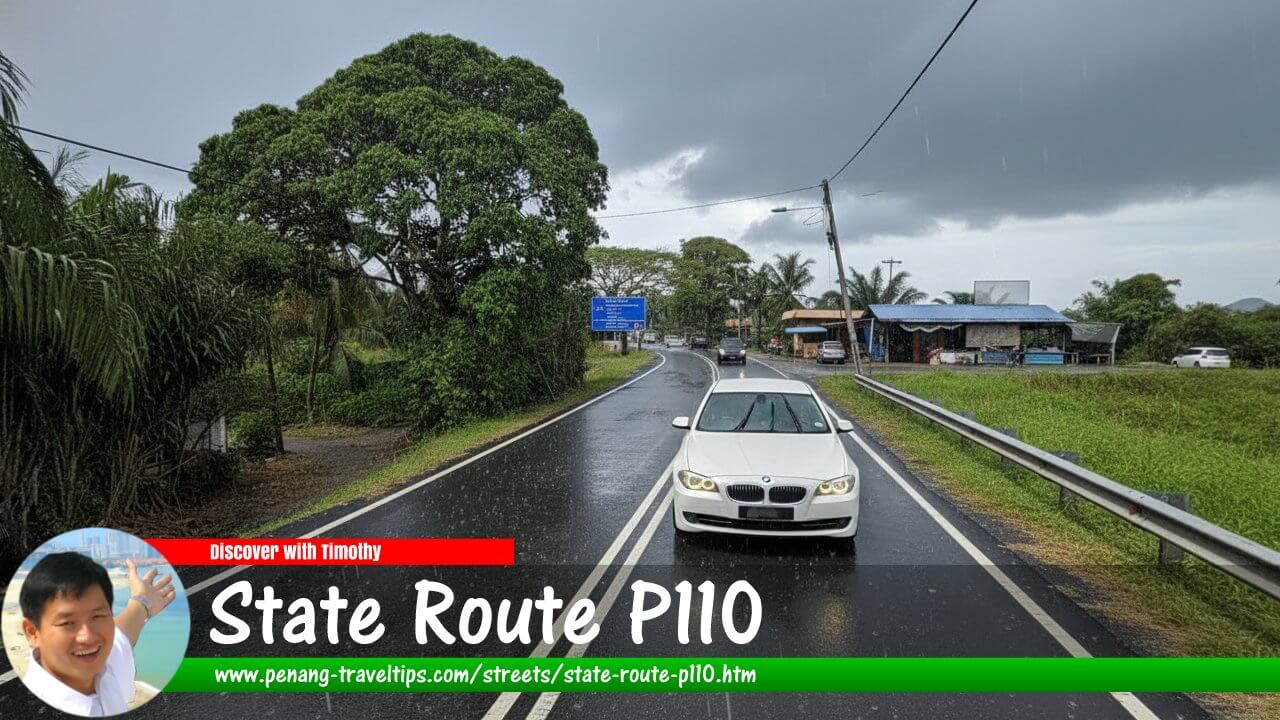 State Route P110, Seberang Perai (AI-edited photograph on 4 January 2026)
State Route P110 is an important rural connector road in the northeastern part of Seberang Perai, Penang. With an approximate length of 16 kilometres, the route provides a continuous link from a T-junction with Jalan Kedah in the northwest to Kampung Baru in the southeast. It plays a vital role in connecting a chain of Malay villages, supporting daily mobility, local commerce, and community interaction across this largely rural landscape.1
Quick Facts
- Route number: State Route P110
- Location: Northeastern Seberang Perai, Penang
- Approximate length: 16 km
- Road type: Rural state connector
- Northwest terminus: T-junction with Jalan Kedah
- Southeast terminus: Kampung Baru
- Local name (western stretch): Jalan Paya Keladi
- Villages served: Permatang Tinggi C, Lahar Tiang, Paya Keladi, Permatang Langsat, Pinang Tunggal, Ekor Kucing, Kampung Baru
Overview of State Route P110
State Route P110 forms part of Penang’s extensive state road network, which is designed to ensure accessibility for rural and semi-rural communities. Unlike federal highways that prioritise long-distance travel, P110 focuses on local and regional connectivity, linking villages, agricultural areas, and minor junctions within northeastern Seberang Perai.2
The route’s alignment reflects historical settlement patterns, following established village corridors and natural land divisions that have shaped movement in the area for generations.2
Geographical Context
P110 runs through a predominantly rural environment characterised by kampung housing, small farms, and patches of undeveloped land. The surrounding landscape is typical of northeastern Seberang Perai, where agriculture and village life remain closely intertwined.3
This rural setting influences both the design and usage of the road, with moderate traffic volumes, frequent access points, and a strong emphasis on serving local needs rather than through traffic.3
Northwestern Terminus at Jalan Kedah
The northwestern end of State Route P110 begins at a T-junction with Jalan Kedah, one of the older and more significant north–south routes in Seberang Perai. This junction provides an important gateway, allowing residents from villages along P110 to access larger transport corridors.4
From this point, P110 heads southeast, transitioning quickly from a more developed roadside environment into quieter rural surroundings.4
Jalan Paya Keladi Segment
The western stretch of State Route P110 is locally known as Jalan Paya Keladi. This name is widely used by residents and reflects the road’s close association with the Paya Keladi village area.1
Along this segment, the road supports daily village activities, including commuting, school travel, and the movement of agricultural produce. Small roadside structures and community landmarks reinforce its role as a local main street rather than a purely functional roadway.5
Villages Served Along the Route
One of the defining characteristics of State Route P110 is the number of villages it serves along its length. These include Permatang Tinggi C, Lahar Tiang, Paya Keladi, Permatang Langsat, Pinang Tunggal, Ekor Kucing, and Kampung Baru.1
The road acts as a shared artery for these communities, facilitating social interaction, access to services, and participation in the local economy.5
Role in Rural Mobility
State Route P110 plays a crucial role in rural mobility by linking villages that might otherwise be isolated or dependent on indirect routes. For many residents, it is the primary means of reaching schools, markets, mosques, and healthcare facilities.6
The road’s continuity across multiple settlements allows for efficient travel without the need to divert onto larger, busier highways.6
Traffic Characteristics
Traffic along P110 is typically composed of motorcycles, private cars, and light goods vehicles. These reflect the everyday needs of villagers and small-scale agricultural activities rather than heavy industrial transport.6
Peak traffic periods usually align with school hours and work commutes, while quieter conditions prevail during mid-day and late evening hours.6
Southeastern Terminus at Kampung Baru
At its southeastern end, State Route P110 terminates at Kampung Baru. This endpoint marks the conclusion of the route’s role as a linear connector across northeastern Seberang Perai.4
The terminus integrates with local village roads, ensuring continued accessibility within the surrounding rural hinterland.4
Importance to Community Life
Beyond transportation, P110 functions as a social and cultural corridor. Roads in rural Penang often serve as informal public spaces where daily interactions occur, reinforcing community bonds and shared identity.3
The continued use of local names such as Jalan Paya Keladi highlights the strong relationship between the road and the communities it serves.3
Maintenance and Future Outlook
As a state-maintained road, P110 is subject to regular upkeep focused on road surface quality, drainage, and safety. Maintenance works are generally modest in scale, reflecting the route’s rural character and traffic levels.7
Future improvements are likely to prioritise safety and accessibility while preserving the road’s function as a village connector rather than transforming it into a high-capacity corridor.7
Conclusion
State Route P110 is a vital rural connector in northeastern Seberang Perai, stretching from Jalan Kedah to Kampung Baru over approximately 16 kilometres. Serving numerous Malay villages and known locally as Jalan Paya Keladi along its western stretch, the road reflects the close relationship between infrastructure and community life.1
Through its role in mobility, social interaction, and local economic activity, P110 continues to support the everyday lives of the communities it connects, making it an essential component of Penang’s state road network.1
State Route P110 on the Map of Roads in Penang
References
- State Roads in Penang – Wikipedia
- Roads in Malaysia – Wikipedia
- Seberang Perai – Wikipedia
- Penang State Government
- Public Works Department of Malaysia
- Malaysia Open Data Portal
- Penang Public Works Department
Page Details
This page was created on 4 January 2026. Hi, my name is Timothy and created it from my research, for my own entertainment, knowledge and to satisfy my curiosity. I am providing the information to you in good faith and hope it is useful. I try to get the details as accurate as possible. I also try to update the page whenever I stumble on new details. So this and all my other pages are perpetual work in progress. If you discover any error, please politely inform me, pointing out where the error lies, and I will correct it as soon as possible. Your helpfulness will keep this page accurate, relevant and helpful to those who need the information.Want to share your Penang travel experiences or get tips from fellow travellers?
Join the Penang Travel Tips Facebook GroupUseful guides for visiting Penang
My Videos of Penang
 Latest Pages & Updates
Buy Me A Coffee
If you enjoy the information I provide and want to support the work I do, please buy me a coffee! I appreciate it immensely, thank you so much!
