
Lebuh Andaman, Andaman Island, Penang
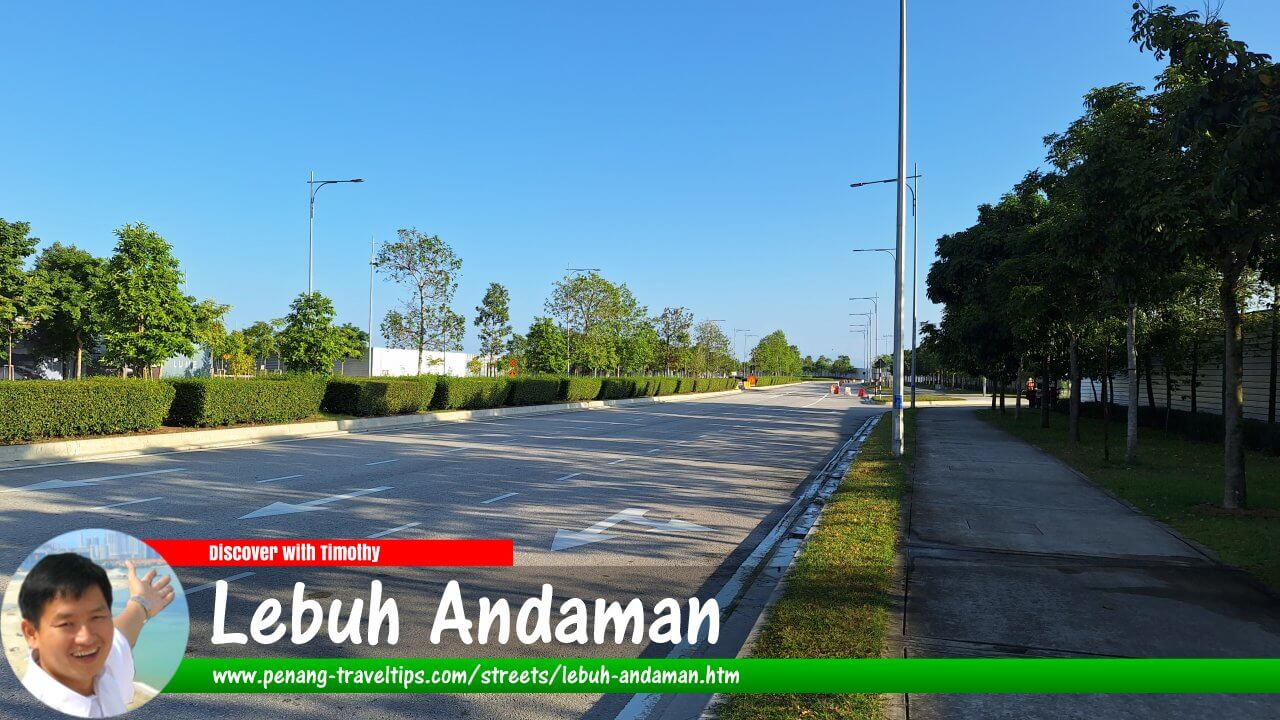 Lebuh Andaman, Andaman Island, Penang (13 January 2026)
Lebuh Andaman is the principal arterial road of the first phase of the Andaman Island development in Penang. Designed as a six-lane dual carriageway, it serves as the main north–south spine that presently connects the Straits Quay Bridge in the north to the Gurney Bridge in the south. As the backbone of the island’s initial transport network, Lebuh Andaman plays a critical role in defining access, circulation, and urban structure for this ambitious reclaimed island project.1
Quick Facts
- Road name: Lebuh Andaman
- Location: Andaman Island, Penang
- Road type: Main arterial road
- Configuration: Six-lane dual carriageway
- Northern terminus: Straits Quay Bridge
- Southern terminus: Gurney Bridge
- Junctions: T-junction with Lengkok Andaman
- Role: Primary connector and urban spine
- Development phase: First phase of Andaman Island
Introduction to Lebuh Andaman
Lebuh Andaman is conceived as the central corridor of Andaman Island’s transport network. Unlike smaller internal roads that serve specific developments, this road is meant to carry the bulk of traffic entering, leaving, and circulating within the island. Its scale, width, and alignment demonstrate its importance as a strategic infrastructure component that supports both current construction activities and future urban life.1
As Andaman Island is developed in phases, Lebuh Andaman stands out as the first fully realised major road that establishes the character of the new district. It represents a transition from Penang’s traditional street patterns to a modern, planned boulevard style that prioritises capacity, efficiency, and urban form.2
Role within Andaman Island
Andaman Island is envisioned as a large-scale waterfront city built on reclaimed land. Lebuh Andaman functions as its main axis, organising movement and shaping the arrangement of future plots, developments, and public spaces. All major internal roads, including Lengkok Andaman, relate to it directly or indirectly, making it the structural backbone of the island’s layout.3
This centrality means that Lebuh Andaman is not merely a traffic corridor, but also an urban organising element. The placement of major developments along its length reflects its importance as a prestigious address and a highly accessible location.3
Connection between Straits Quay Bridge and Gurney Bridge
One of the most significant aspects of Lebuh Andaman is its direct linkage between the Straits Quay Bridge in the north and the Gurney Bridge in the south. These two bridges connect Andaman Island to the established parts of Penang Island, making Lebuh Andaman the primary route that integrates the new island with the existing urban fabric.4
This alignment allows traffic from northern coastal areas to flow smoothly into the island and onward to Gurney Drive and other central districts. Similarly, it enables residents and visitors on Andaman Island to access major destinations on the mainland side with minimal detours.4
Six-Lane Dual Carriageway Design
Lebuh Andaman is constructed as a six-lane dual carriageway, typically consisting of three lanes in each direction separated by a median. This configuration reflects its function as a high-capacity arterial road capable of handling significant traffic volumes generated by dense urban development.5
Such a wide cross-section ensures smoother traffic flow, reduces congestion risks, and provides flexibility for future traffic management strategies. It also accommodates different vehicle types, including private cars, service vehicles, and potential public transport services.5
Safety and Efficiency
The divided carriageway design enhances safety by separating opposing traffic flows. The multiple lanes provide space for overtaking, merging, and turning movements, reducing conflict points that often occur on narrower roads.6
Efficiency is also improved, as the road can sustain higher traffic volumes without immediate congestion, a critical feature for a rapidly developing urban district.6
T-Junction with Lengkok Andaman
Lengkok Andaman forms a T-junction with Lebuh Andaman, highlighting the hierarchical relationship between the two roads. While Lebuh Andaman functions as the primary artery, Lengkok Andaman serves as an important secondary distributor that channels traffic to specific development zones.7
This junction exemplifies the planned nature of Andaman Island’s road network, where each road is assigned a clear role within a structured hierarchy. Such organisation helps to manage traffic efficiently and reduce unnecessary congestion on the main artery.7
Urban Boulevard Character
Beyond its functional role, Lebuh Andaman is intended to function as an urban boulevard. Its width, alignment, and visual openness give it a monumental quality that sets the tone for Andaman Island as a modern, prestigious district.8
As developments rise along its sides, the road is expected to become a vibrant urban corridor framed by high-rise buildings, landscaped areas, and active frontages, reinforcing its status as the island’s main address.8
Support for Economic and Residential Growth
Lebuh Andaman is crucial for supporting both economic activity and residential life on the island. Efficient road access encourages investment by ensuring that commercial and mixed-use developments are well connected to the wider city.9
For residents, the road provides direct and convenient routes to shopping, workplaces, recreational areas, and transport links, making daily commuting more manageable and predictable.9
Symbol of Modern Infrastructure
Compared to older roads in Penang that evolved organically over decades, Lebuh Andaman represents a new generation of infrastructure built with foresight. Its scale and design reflect contemporary urban planning principles that emphasise capacity, clarity, and integration with large-scale developments.10
This makes it a physical symbol of Penang’s ongoing transformation and its ambition to create world-class urban environments.10
Future Traffic Patterns
As Andaman Island becomes more populated and active, Lebuh Andaman will experience increasing traffic demand. Its six-lane configuration is intended to absorb this growth without compromising efficiency or safety.11
The road’s design allows for future adaptations, such as dedicated lanes for public transport or improved junction treatments, ensuring long-term relevance and flexibility.11
Relationship with the Waterfront Setting
Situated on a reclaimed island, Lebuh Andaman benefits from its proximity to the sea and waterfront developments. This unique setting gives the road a distinctive character compared to inland arterial roads, blending infrastructure with scenic and lifestyle-oriented surroundings.12
The integration of transport infrastructure with a coastal environment underscores Andaman Island’s identity as both a functional urban area and a leisure-oriented destination.12
Conclusion
Lebuh Andaman stands as the most important road of Andaman Island’s first phase. By connecting the Straits Quay Bridge in the north to the Gurney Bridge in the south, and by forming a T-junction with Lengkok Andaman, it establishes the core framework for movement and accessibility on the island.1
With its six-lane dual carriageway design, urban boulevard character, and strategic positioning, Lebuh Andaman is not only a transport corridor but also a defining feature of Andaman Island’s identity as a modern and forward-looking district within Penang.11
Lebuh Andaman on the Map of Roads in Penang
References
- Andaman Island (Penang) – Wikipedia
- Urban Planning – Wikipedia
- Official Portal of the Penang State Government
- Gurney Drive, Penang – Wikipedia
- Public Works Department of Malaysia
Page Details
This page was created on 13 January 2026. Hi, my name is Timothy and created it from my research, for my own entertainment, knowledge and to satisfy my curiosity. I am providing the information to you in good faith and hope it is useful. I try to get the details as accurate as possible. I also try to update the page whenever I stumble on new details. So this and all my other pages are perpetual work in progress. If you discover any error, please politely inform me, pointing out where the error lies, and I will correct it as soon as possible. Your helpfulness will keep this page accurate, relevant and helpful to those who need the information.Want to share your Penang travel experiences or get tips from fellow travellers?
Join the Penang Travel Tips Facebook GroupUseful guides for visiting Penang
My Videos of Penang
 Latest Pages & Updates
Buy Me A Coffee
If you enjoy the information I provide and want to support the work I do, please buy me a coffee! I appreciate it immensely, thank you so much!
