
Jalan Transkrian, Nibong Tebal
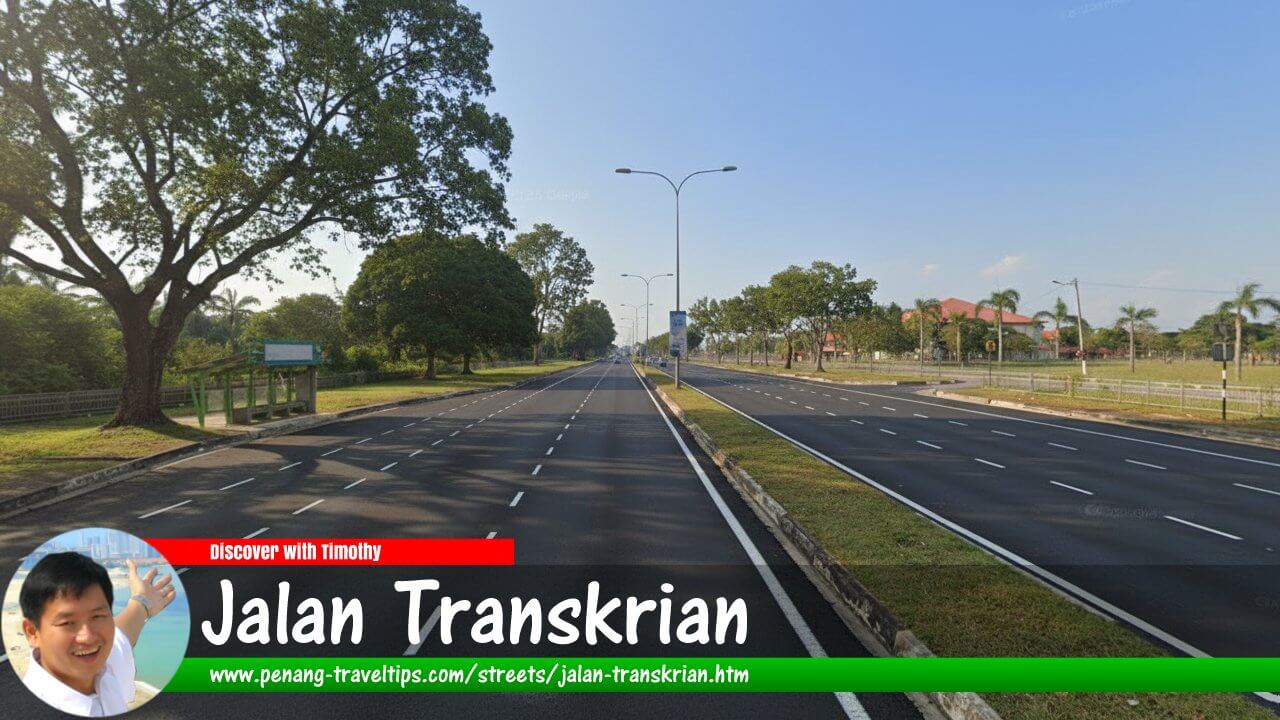 Jalan Transkrian, Nibong Tebal (AI-edited photograph on 31 December 2025)
Jalan Transkrian is one of the most significant arterial roads serving the southern part of Seberang Perai, Penang. Located in the Nibong Tebal area, the road is a major dual-carriageway with two lanes in each direction separated by a central divider, reflecting its role as an important inter-state connector. Officially designated as Federal Route 283, Jalan Transkrian links Jalan Nibong Tebal with the town of Parit Buntar in the neighbouring state of Perak, crossing the state boundary before terminating at the Parit Buntar Roundabout. Its scale and design distinguish it clearly from village roads in the area, positioning it as a key transport corridor for both local and through traffic.1
Quick Facts
- Road name: Jalan Transkrian
- Route number: Federal Route 283
- Location: Nibong Tebal, Seberang Perai, Penang
- Road type: Major dual-carriageway
- Lanes: Two lanes per direction with a central divider
- Main connections: Jalan Nibong Tebal and Parit Buntar Roundabout
- State connection: Penang to Perak
Strategic Location and Alignment
Jalan Transkrian occupies a strategically important position at the southern edge of Penang, where Seberang Perai meets the state of Perak. Beginning from Jalan Nibong Tebal, the road extends southwards and south-eastwards, passing through semi-urban and agricultural landscapes before crossing the state border. This alignment allows it to function as a direct and efficient link between Nibong Tebal and Parit Buntar, two important population and commercial centres in their respective states.2
The road’s endpoint at the Parit Buntar Roundabout marks a key junction within the Perak road network. From this roundabout, traffic can disperse towards other major routes serving northern Perak, reinforcing Jalan Transkrian’s role as a gateway between Penang and Perak.2
Role as Federal Route 283
As Federal Route 283, Jalan Transkrian is part of Malaysia’s federally maintained road system. Federal roads are designed to support higher traffic volumes and inter-regional connectivity, and Jalan Transkrian exemplifies these characteristics through its dual-carriageway design and relatively high capacity.3
This federal designation reflects the road’s importance beyond local travel. While it serves residents of Nibong Tebal, it also accommodates long-distance movement between Penang and Perak, including daily commuters, commercial vehicles, and inter-town travellers who prefer an alternative to expressways.3
Physical Characteristics and Design
One of the defining features of Jalan Transkrian is its dual-carriageway configuration. With two lanes in each direction separated by a central divider, the road is built to support smoother traffic flow and enhanced safety compared to single-carriageway roads. This design reduces the risk of head-on collisions and allows for higher operating speeds appropriate to a major arterial route.4
The presence of a median divider also enables better traffic management, particularly at junctions and access points. Road markings, signage, and lighting along Jalan Transkrian reflect its status as a major road, ensuring clarity and safety for drivers, especially during night-time or adverse weather conditions.4
Connection Between Penang and Perak
Jalan Transkrian plays a crucial role in linking Penang with northern Perak. For many road users, it represents one of the most direct surface-road connections between Nibong Tebal and Parit Buntar. This inter-state connection supports not only daily commuting but also economic interaction between the two regions.1
The road’s cross-border function is particularly important for residents living near the state boundary, who may work, study, or conduct business across state lines. By providing a high-capacity link, Jalan Transkrian reduces travel time and improves accessibility between communities in Penang and Perak.2
Economic and Commercial Importance
The economic significance of Jalan Transkrian extends beyond its role as a commuter route. The road facilitates the movement of goods between industrial, agricultural, and commercial areas in southern Seberang Perai and northern Perak. Light commercial vehicles and lorries frequently use the road to transport products, reflecting its importance to regional supply chains.5
Its proximity to Nibong Tebal also supports local businesses by improving access for customers and suppliers. The improved connectivity provided by a major road like Jalan Transkrian enhances the attractiveness of the surrounding area for investment and development.5
Traffic Patterns and Usage
Traffic along Jalan Transkrian is generally heavier than on village or local roads in the area. Peak periods typically coincide with morning and evening commuting hours, when vehicles travel between Penang and Perak for work or education. Outside these periods, traffic remains steady due to commercial and inter-town travel.4
The dual-carriageway design helps accommodate these traffic volumes efficiently. While congestion can occur near junctions or during peak times, the road’s capacity allows it to function reliably as a major corridor under most conditions.4
Relationship with Jalan Nibong Tebal
At its northern end, Jalan Transkrian connects directly to Jalan Nibong Tebal, a key route serving the town and surrounding areas. This connection integrates Jalan Transkrian into the local road network, enabling seamless movement between town streets and a major inter-state road.1
For residents of Nibong Tebal, this means convenient access to Parit Buntar and other parts of Perak without the need to travel long distances to reach expressway interchanges. This directness enhances the everyday usability of the road.2
Surrounding Environment
Despite its scale, Jalan Transkrian passes through a mix of environments. Sections closer to Nibong Tebal feature urban and semi-urban development, while other stretches are bordered by agricultural land and open spaces. This contrast highlights the road’s role in bridging developed town areas with more rural surroundings.2
The transition between these environments also illustrates broader patterns of development in southern Seberang Perai, where improved road infrastructure has supported gradual urban expansion while maintaining connections to traditional agricultural zones.5
Importance in the Regional Road Network
Within the wider road network of northern Peninsular Malaysia, Jalan Transkrian serves as an important secondary corridor complementing larger highways and expressways. While long-distance travellers may rely on expressways for speed, Jalan Transkrian offers a practical alternative for regional travel and access to intermediate destinations.3
This layered approach to road infrastructure ensures resilience and flexibility within the transport system. Roads like Jalan Transkrian absorb local and regional traffic that might otherwise overload expressways, contributing to balanced network performance.3
Everyday Experience and Identity
For many users, Jalan Transkrian is a familiar and dependable route associated with daily routines and regional movement. Its wide carriageways, central divider, and clear alignment give it a distinct identity compared to smaller roads in Nibong Tebal, reinforcing its status as a major road.4
Over time, Jalan Transkrian has become recognised not just as a physical connection but as a symbol of inter-state linkage between Penang and Perak. Its continued function as Federal Route 283 underscores its enduring importance in supporting mobility, commerce, and regional integration in northern Peninsular Malaysia.5
Jalan Transkrian on the Map of Roads in Penang
References
- Nibong Tebal – Wikipedia
- Parit Buntar – Wikipedia
- Federal roads in Malaysia – Wikipedia
- Dual carriageway – Wikipedia
- Public Works Department of Malaysia
Page Details
This page was created on 31 December 2025. Hi, my name is Timothy and created it from my research, for my own entertainment, knowledge and to satisfy my curiosity. I am providing the information to you in good faith and hope it is useful. I try to get the details as accurate as possible. I also try to update the page whenever I stumble on new details. So this and all my other pages are perpetual work in progress. If you discover any error, please politely inform me, pointing out where the error lies, and I will correct it as soon as possible. Your helpfulness will keep this page accurate, relevant and helpful to those who need the information.Want to share your Penang travel experiences or get tips from fellow travellers?
Join the Penang Travel Tips Facebook GroupUseful guides for visiting Penang
My Videos of Penang
 Latest Pages & Updates
Buy Me A Coffee
If you enjoy the information I provide and want to support the work I do, please buy me a coffee! I appreciate it immensely, thank you so much!
