
Nakhoda Intan
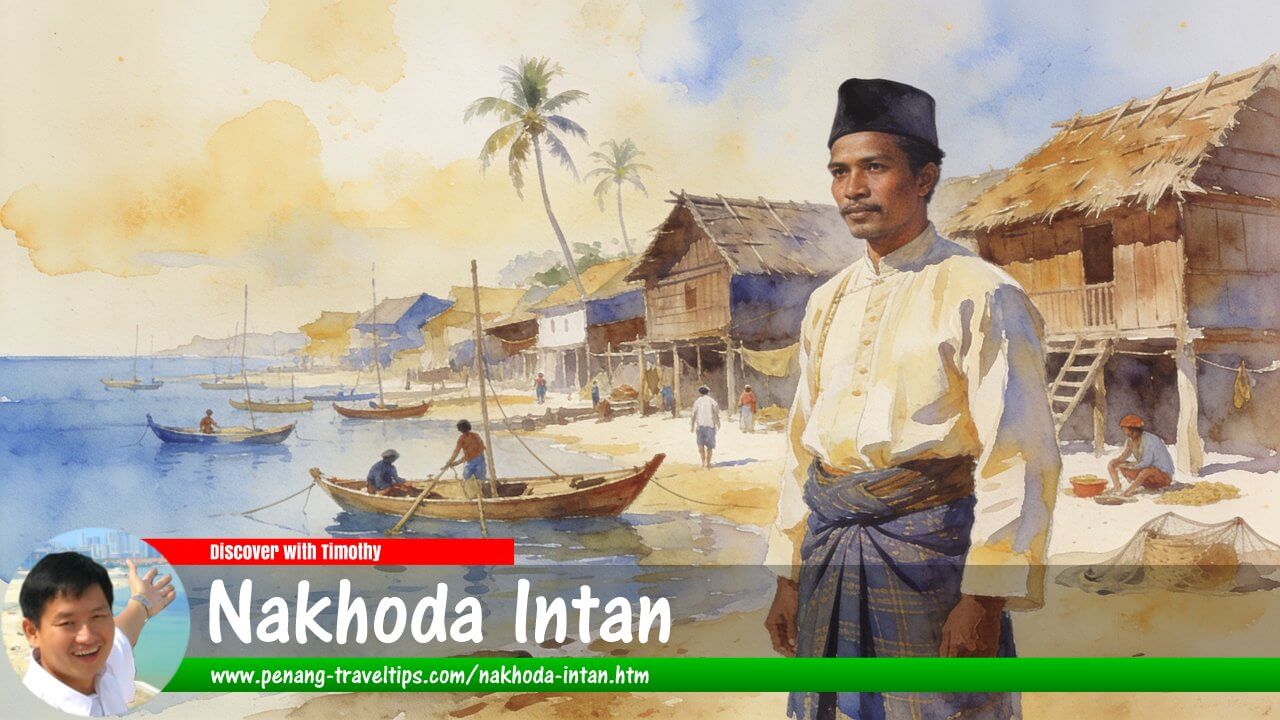 Nakhoda Intan (AI-edited photograph on 7 September 2026)
Also available: Nakhoda Intan (Edisi Melayu)
Haji Mohammad Salleh, better known as Nakhoda Intan or Nakhoda Nan Intan, was a Minangkabau pioneer associated with the early settlement of Batu Uban on Penang Island. He is traditionally credited with establishing the settlement and founding the mosque that became Masjid Jamek Batu Uban in 1734, more than five decades before the arrival of Francis Light.
Nakhoda Intan occupies an important place in the early history of Penang because his story demonstrates that the island already had established Malay-Muslim communities before the British founded George Town in 1786. His life was also part of a much wider movement of people, ideas, trade and religion across the Straits of Malacca, particularly between the Minangkabau heartland of Sumatra, Kedah and the Malay Peninsula.
Although historical sources differ in some details concerning his name, origins and date of arrival, Haji Mohammad Salleh is consistently associated with Batu Uban and the establishment of its early Muslim community. His legacy survives through the historic mosque, the old settlement and the traditions of the local community.
Quick Facts
Name: Haji Mohammad Salleh
Better known as: Nakhoda Intan / Nakhoda Nan Intan
Other recorded name: Maharaja Nan Intan, in local genealogical traditions
Origin: Minangkabau, Sumatra
Place associated with him: Batu Uban, Penang Island
Period: 18th century
Settlement associated with him: Batu Uban
Historic mosque: Masjid Jamek Batu Uban
Mosque date: 1734
Historical significance: Early Malay-Muslim settlement and Islamic centre on Penang Island
Who Was Nakhoda Intan?
Nakhoda Intan was a Minangkabau leader who is associated with one of the earliest known Malay settlements on Penang Island. Historical accounts identify him as Haji Mohammad Salleh, although his personal name appears in several forms in different sources.
Local genealogical traditions give his name as Maharaja Nan Intan, son of Tengku Patih Nan Sebatang. Other historical writings refer to him as Raja Nan Intan or Nakhoda Nan Intan. The title Nakhoda, meaning a shipmaster or boat captain, reflects the maritime environment in which he and other early Minangkabau migrants operated.
He is generally described as a Minangkabau from the interior of West Sumatra. Some accounts place his origins at Kampung Buadi or Bodi in the Payakumbuh area, within the historical Minangkabau region associated with Pagaruyung.
His association with the Minangkabau ruling tradition is also mentioned in historical and genealogical accounts. This suggests that he was not simply a migrant settler but a person of some standing within the society from which he came.
Minangkabau Migration Across the Straits of Malacca
The story of Nakhoda Intan needs to be understood within the wider history of Minangkabau migration. For centuries, people from the highlands of West Sumatra travelled throughout the Malay world in search of opportunities, establishing settlements and commercial and religious networks.
The Straits of Malacca provided a natural maritime highway linking Sumatra with Kedah, Perak, Penang and other parts of the Malay Peninsula. The movement of Minangkabau people across the straits was therefore not unusual.
By the 18th century, Minangkabau communities had become established in various parts of the Malay Peninsula. Some migrants were traders, while others became religious teachers, community leaders, farmers or political figures.
Nakhoda Intan's journey to Penang forms part of this broader history of merantau, the Minangkabau tradition of travelling away from one's homeland. His settlement at Batu Uban eventually became one of the important Malay-Muslim communities on Penang Island.
Arrival in Penang
The precise date of Nakhoda Intan's arrival on Penang Island is uncertain. Historical research indicates that the settlement of Batu Uban may have begun sometime between 1710 and 1734, while 1734 is firmly associated with the establishment of the mosque.
According to local tradition, Nakhoda Intan travelled to Penang with two other vessels. The other vessels are associated with Nakhoda Bayan at Bayan Lepas and Nakhoda Kecil at Jelutong. The three nakhodas are traditionally described as relatives or members of the same extended family.
This tradition is significant because it links several early Malay settlements around the island. Rather than arriving as an isolated individual, Nakhoda Intan appears in local history as part of a wider network of Minangkabau migrants who established themselves at different points around Penang.
Historical research also indicates that the early settlers sought permission from the Sultan of Kedah before establishing settlements on the island. At the time, Penang was within the political and economic sphere of Kedah.
The Founding of Batu Uban
Nakhoda Intan is traditionally regarded as the founder of the early settlement at Batu Uban. The location was well suited to settlement because it provided access to the sea and was connected to other coastal communities.
The first community developed around the coast and the mosque. Fishing was an important activity, while agriculture and small-scale trade also contributed to the livelihood of the inhabitants.
Over time, Batu Uban became more than a fishing village. Its location on the eastern coast of Penang allowed it to participate in the maritime networks linking the island with Kedah, Sumatra and other parts of the Malay world.
The settlement therefore provides important evidence that the history of Penang Island predates the British occupation. When Francis Light arrived in 1786, he was entering a landscape that already contained Malay villages, agricultural areas, trading activity and Muslim institutions.
Masjid Jamek Batu Uban
Nakhoda Intan's most visible legacy is Masjid Jamek Batu Uban, traditionally dated to 1734.
Historical research states that Nakhoda Intan initially established a small surau for the local community. In 1734, the structure was enlarged into a mosque. The mosque that exists today has subsequently been repaired and modified, but it remains on the historic site associated with the original settlement.
The mosque is particularly significant because it predates the establishment of George Town by more than 50 years. It is therefore one of the most important physical reminders of the Malay-Muslim history of Penang before British rule.
The Penang Heritage Trust has described the Batu Uban mosque, built in 1734, as the earliest mosque on Penang Island and one of the earliest surviving mosques in Malaysia. It is also associated with the wider history of Nakhoda Intan, Dato' Jenaton and Nakhoda Kecil, all of whom were connected with the early Minangkabau community of Penang.
An Early Islamic Centre
Batu Uban developed as an important centre of Muslim life on the island. Nakhoda Intan was remembered as a religiously learned person, and the mosque served not only as a place of worship but also as a centre of religious instruction and community life.
People from other parts of the region were attracted to Batu Uban because of its religious activities. Its position near the sea also made it accessible to travellers and traders moving through the Straits of Malacca.
This combination of maritime activity and religious scholarship was characteristic of many Malay-Muslim settlements throughout the region. Mosques frequently served multiple functions, acting as places of worship, education, community administration and meeting places for travellers.
Batu Uban as an Early Port
Batu Uban is also remembered as an early port and trading settlement. Before George Town became the principal port of Penang under British rule, coastal settlements such as Batu Uban provided places where boats could land and people could exchange goods.
The settlement's position facing the Straits of Malacca connected it naturally with Sumatra and the Malay Peninsula. Small vessels could move between Batu Uban, Kedah and other coastal settlements.
This maritime character is reflected in the title Nakhoda associated with Haji Mohammad Salleh. The early history of Batu Uban was closely connected to the sea, and its inhabitants included people involved in fishing, trade and maritime travel.
The Freshwater Well
One of the traditional features associated with the Batu Uban mosque is a freshwater well near the historic mosque site.
The well is particularly noteworthy because the mosque was originally located close to the shoreline. Before later reclamation changed the coastline, the sea was much closer to the mosque than it is today.
Local tradition associates the well with Nakhoda Intan and the establishment of the early settlement. The availability of fresh water would have been especially important to a community living close to the sea.
The survival of the well is another reminder of the practical considerations that shaped the location of the original settlement. Water, access to the sea and suitable land were all important factors in determining where the early community could establish itself.
Relationship with Kedah
Nakhoda Intan's history is closely connected with the Sultanate of Kedah. Before British rule, Kedah exercised political influence over Penang Island, and early settlers traditionally sought permission from the Kedah sultan before establishing communities there.
This relationship is important because it places Batu Uban within the political geography of the northern Malay Peninsula before 1786.
The settlement also maintained close connections with communities on the mainland. Historical accounts mention Nakhoda Intan's marriage to a woman from Seberang Perai known as Cik Aishah or Cik Tunggal. Such family connections helped strengthen the links between Batu Uban and the mainland.
Nakhoda Intan and Dato' Jenaton
Another important Minangkabau figure associated with the early history of Batu Uban is Dato' Jenaton. The two men are closely linked in accounts of the development of early Malay settlements on Penang Island.
Dato' Jenaton is generally associated with the settlement of the area now occupied by Minden and parts of Gelugor. He is said to have arrived in Penang later than Nakhoda Intan and to have received permission to establish a settlement from the Sultan of Kedah.
Their activities helped create a wider Minangkabau settlement zone extending inland from the coast. Batu Uban therefore became part of a larger network of Malay communities stretching through what are now Batu Uban, Gelugor and surrounding areas.
Nakhoda Kecil
Nakhoda Intan is also associated with Nakhoda Kecil, who is identified in some sources as his younger brother. Nakhoda Kecil became associated with Jelutong and the area towards Tanjong.
Historical research suggests that by 1734 the area influenced or administered by Haji Mohammad Salleh had extended towards Tanjong, while Nakhoda Kecil was responsible for the area further north.
This arrangement helps explain why the early Minangkabau settlements around the eastern side of Penang were interconnected. The communities were not isolated villages but formed part of a wider network under local leaders with family and commercial relationships.
Penang Before Francis Light
The story of Nakhoda Intan is particularly important in understanding Penang's history before 1786.
Francis Light established George Town after the British East India Company obtained control of Penang from the Sultan of Kedah. This event transformed the island into a major British trading centre.
However, the island was not uninhabited before Light's arrival. Malay communities had already established settlements along the eastern and southern coast, while fishing, agriculture, trade and Islamic religious activities were already taking place.
Batu Uban is one of the strongest surviving examples of this earlier history. The existence of a mosque dating from 1734 demonstrates that an established Muslim community existed on the island more than half a century before George Town was founded.
Nakhoda Intan therefore belongs to the pre-colonial history of Penang rather than the colonial history that began with the British occupation.
The Meaning of Batu Uban
The name Batu Uban is generally translated as "grey-haired rock" or "white-haired rock". Local tradition connects the name with a large rock offshore that was covered with grass or vegetation resembling grey or white hair when viewed from a distance.
The rock was once an identifiable landmark for people approaching the coast. Changes to the shoreline and later land reclamation have altered the relationship between the historic settlement and the sea, and the original offshore landmark is no longer as prominent as it once was.
The name nevertheless survived and became attached to the village, mosque and wider locality.
His Burial Place
Nakhoda Intan is traditionally believed to have been buried near Masjid Jamek Batu Uban. His grave has long been associated with the historic mosque and remains part of the heritage landscape of the settlement.
Local traditions have regarded the grave as a keramat, reflecting the respect accorded to Nakhoda Intan as a religious leader and founder of the community.
There are, however, some uncertainties surrounding the identification and condition of individual graves around the mosque. Historical accounts and local genealogical traditions do not always agree on every detail. These differences are best understood as part of the evolving oral and documentary history of Batu Uban.
Family and Descendants
Information about Nakhoda Intan's family comes largely from genealogical traditions and local historical accounts. These sources indicate that he maintained family connections with Minangkabau communities in Sumatra as well as with people in Kedah and Seberang Perai.
His marriage to Cik Aishah, also known as Cik Tunggal, is one example of the close links that developed between the island and mainland communities. Such marriages were an important means through which social and commercial networks were maintained across the Straits.
Descendants of Nakhoda Intan have continued to be associated with the Batu Uban community, helping preserve the memory of his role in the settlement's early history.
Nakhoda Intan and the Wider Malay World
The significance of Nakhoda Intan extends beyond Penang itself. His story illustrates how the Malay world functioned as a connected cultural and maritime region.
He originated from the Minangkabau heartland of Sumatra, crossed the Straits of Malacca, established himself in Kedah's sphere of influence and founded a Muslim settlement on Penang Island.
His story demonstrates that the Straits of Malacca was not simply a geographical divide between Sumatra and the Malay Peninsula. It was also a route along which people, goods, religious ideas, languages, customs and family connections moved for centuries.
Batu Uban became one of the places where these different currents came together.
Distinguishing Nakhoda Intan from Haji Brunei
The name Haji Mohammad Salleh should not be confused with other historical figures who bore similar names.
In particular, Haji Brunei was another important early Malay settler on Penang Island. He was associated with Brunei and with the settlement of Jelutong and Bayan Lepas during the period following the establishment of British Penang.
Nakhoda Intan, by contrast, was a Minangkabau figure associated with Batu Uban and the period before Francis Light's arrival. Keeping the two figures separate is important when discussing the chronology of Penang's early Malay settlements.
Historical Significance
Nakhoda Intan's greatest historical significance lies in the evidence he provides for the existence of a Malay-Muslim society on Penang Island before British rule.
His association with Batu Uban demonstrates that Penang was already connected to the wider Malay world. The settlement had its own leadership, religious institution, maritime connections and relationships with neighbouring communities.
The 1734 date associated with Masjid Jamek Batu Uban is particularly important. It places an established Islamic institution on Penang Island more than 50 years before the founding of George Town.
This does not diminish the importance of Francis Light in the later development of Penang. Rather, it provides a more complete understanding of the island's history by recognising the communities and institutions that existed before British rule.
Legacy in Batu Uban
The legacy of Nakhoda Intan remains visible in Batu Uban today. The historic mosque continues to serve the Muslim community, while the old settlement remains an important part of Penang's Malay heritage.
The mosque, burial ground and surviving traditional community form a historic landscape that connects the modern urban environment with the island's 18th-century past.
Although Batu Uban has been surrounded by extensive urban development, its historical identity has not disappeared. The name of Nakhoda Intan remains closely associated with the locality and with the story of Penang's earliest Malay-Muslim communities.
Conclusion
Haji Mohammad Salleh, better known as Nakhoda Intan or Nakhoda Nan Intan, was an important Minangkabau pioneer associated with the early settlement of Batu Uban on Penang Island.
Coming from the Minangkabau region of Sumatra, he represents the long-standing connections across the Straits of Malacca that linked Sumatra with Kedah and the Malay Peninsula. His settlement at Batu Uban developed into an important Malay-Muslim community, supported by fishing, agriculture, trade and religious activities.
His most enduring legacy is Masjid Jamek Batu Uban, traditionally dated to 1734. The mosque remains one of the most important physical reminders of Penang's pre-British history and demonstrates that an established Muslim community existed on the island long before George Town was founded in 1786.
The story of Nakhoda Intan is therefore not simply the story of one migrant or community leader. It is part of the larger history of Malay migration, Minangkabau culture, Islamic scholarship, maritime trade and the political relationship between Penang and Kedah.
Today, Batu Uban's mosque, old settlement and associated burial places preserve an important chapter of that history. Together, they ensure that Nakhoda Intan remains one of the key figures for understanding the Malay history of Penang before the British era.
References
- Universiti Sains Malaysia – Nakhoda Nan Intan, Batu Uban dan Islam di Pulau Pinang
- Universiti Sains Malaysia – Batu Uban: Petempatan Awal Orang Pulau Pinang
- Penang Heritage Trust – Batu Uban in Pulau Pinang: Past, Place and Presence
- Sistem Maklumat Masjid Malaysia – Masjid Jamek Batu Uban
- Universiti Sains Malaysia – Kolokium Kebangsaan Melayu Pulau Pinang
Nakhoda Intan is  on the Map of
Page Details
This page was created on 7 September 2026. Hi, my name is Timothy and created it from my research, for my own entertainment, knowledge and to satisfy my curiosity. I am providing the information to you in good faith and hope it is useful. I try to get the details as accurate as possible. I also try to update the page whenever I stumble on new details. So this and all my other pages are perpetual work in progress. If you discover any error, please politely inform me, pointing out where the error lies, and I will correct it as soon as possible. Your helpfulness will keep this page accurate, relevant and helpful to those who need the information.Want to share your Penang travel experiences or get tips from fellow travellers?
Join the Penang Travel Tips Facebook GroupUseful guides for visiting Penang
My Videos of Penang
 Latest Pages & Updates
Buy Me A Coffee
If you enjoy the information I provide and want to support the work I do, please buy me a coffee! I appreciate it immensely, thank you so much!
