
Penang Riots of 1867: Guns, Barricades and the Politics of Secret Societies
Overview: This article examines the causes, chronology, principal actors, and consequences of the Penang Riots of 1867. It draws on colonial reports, contemporary newspaper accounts, and oral histories to reconstruct how a prosperous port town became a battleground for rival Chinese secret societies.
Prologue — A City on the Brink
In the summer of 1867 George Town, Penang, was a busy free port where the world’s trade routes met. Merchants, coolies, and sailors filled the quays; opium, tin and rice changed hands on Beach Street; temples, clan houses and society halls anchored Chinese neighbourhoods. Beneath this busy surface, however, sat deep social fissures. Chinese migrants were divided by dialect, kinship and region; in the absence of full social and legal protections, many turned to voluntary associations and secret societies for protection and employment. Over the decades two networks came to dominate the island’s Chinese political landscape: the Hai San (海山, Hǎishān) and the Ghee Hin (義興, Yìxìng). Allied with one faction was the temple-centred Tua Pek Kong Society — also identified in Penang as Kean Teik Tong (大伯公会 / 建德堂, Dàbógōng Huì / Jiàn Dé Táng) — a body that mixed religious patronage with mutual aid and the capacity for mass mobilisation.
When long-standing disputes over gambling farms, labour recruitment, and local influence finally boiled over in July 1867, George Town experienced a week of intense urban fighting. Barricades rose in its lanes, musket fire echoed off shopfronts, and the British colonial government— accustomed to laissez-faire administration of “native” affairs— suddenly faced a crisis too large to ignore. The Penang Riots were not simply a local disorder; they were a symptom of how migration, economic competition and weak intermediary governance could combust into violence.
Chapter 1 — Penang in the 1860s: A Melting Pot under Pressure
By the 1860s Penang had matured into a cosmopolitan entrepôt. Its free-port status attracted merchants from China, India and the Malay world; seamen and coolies arrived in steady numbers; plantations, tin trade, and retail commerce expanded. The island’s Chinese community grew rapidly and became politically and economically central. But it was internally diverse: Hokkien, Cantonese, Hakka, Teochew, and other dialect groups lived side-by-side yet often in separate social spheres. Where formal institutions were weak or absent, voluntary societies — including temples, clan associations and kongsi (公司) — provided dispute resolution, employment networks and social welfare.
Secret societies filled both philanthropic and coercive roles. They raised funds for festivals and funerals, mediated disputes, and organised labour. Equally, they policed neighbourhoods, enforced internal discipline, and competed for revenue streams — gambling leases, opium selling rights, coolie recruitment and protection fees. For British administrators, the societies posed a recurrent problem: legal prohibition and official anxiety coexisted with an administrative practice that often preferred informal accommodation over intervention, until disturbances threatened public order.
Chapter 2 — The Secret Societies: Hai San and Ghee Hin
The Hai San (海山, Hǎishān) and the Ghee Hin (義興, Yìxìng) were more than street gangs: they were organised bodies with rituals, hierarchies and networks that spanned the Straits region. The Hai San drew strength from Hakka and some Hokkien groups linked to tin-mining communities (notably in Perak), while the Ghee Hin — initially Cantonese-dominated but increasingly multi-dialect by mid-century — maintained lodges across Malaya and Singapore. Both could call upon armed men, coordinate logistics, and enforce collective decisions.
Crucially, the societies were embedded in ordinary civic life. Temples such as the Tua Pek Kong shrines and the kongsi halls functioned as social centres. The Tua Pek Kong Society (大伯公会, Dàbógōng Huì) — sometimes referred to by its temple name Kean Teik Tong (建德堂, Jiàn Dé Táng) — combined religious authority with mutual aid and, when required, the capacity to mobilise men for defence or confrontation. Membership provided protection, a path to employment, and a powerful social network; it also obliged men to follow society decisions in moments of conflict.
Chapter 3 — Tensions Build: 1860–1867
Rivalries escalated slowly. Competition over gambling operations and opium leases produced repeated quarrels: a dispute in one street could lead to revenge acts elsewhere. Labour recruitment — the movement, employment and control of coolies — was a particularly contentious and lucrative area. Societies that supplied labourers to plantations and mines earned commissions and influence; control of these flows meant both cash and patronage. Over the 1860s, both Hai San-allied groups (including the Tua Pek Kong Society) and the Ghee Hin sought to expand their reach and protect their revenue. Minor clashes, threats, and tit-for-tat attacks accumulated into a broader atmosphere of anticipation and readiness for confrontation.
British officials, with a small police force and constrained resources, attempted ad hoc mediation and warnings but rarely imposed structural solutions. Informal understandings and local bargaining had worked while disputes remained limited; when violence threatened the public peace, colonial policy switched temporarily to coercion—but only after the damage had been done.
Chapter 4 — The Spark Ignites
Contemporary accounts offer competing explanations for the immediate trigger of the riots. Colonial reports point to a gambling dispute and an ensuing street quarrel; oral tradition remembers slights during processions and the symbolic placement of banners as catalysts. Whatever the proximate cause, the result was swift. On the morning of the outbreak, confrontations in George Town’s Chinese quarters became armed fights. A shot was fired — its exact origin still debated — and within hours multiple skirmishes dotted the town. Reinforcements were rushed in by society runners; barricades were being erected before dusk.
The outbreak was not an isolated incident but the product of months, if not years, of preparation: rumours of stockpiled arms, secret alliances negotiated outside the public eye, and readiness among young society members to defend honour and livelihood. The first day proved that the city’s streets could be converted into defensive districts practically overnight.
Chapter 5 — Day One: Barricades Rise
The hallmark of the riots was the speed with which ordinary streets were turned into defensive lines. Shop shutters were pulled down and chained; carts and barrels were overturned to make impromptu walls; timber and nails turned carpenters’ shops into armories. Key lanes — those that provided access to temples, kongsi halls and marketplaces — became contested chokepoints. The Tua Pek Kong Society’s temple precinct and adjacent lanes were quickly fortified by its adherents; the Ghee Hin likewise secured approaches leading toward the port and certain inner streets.
Weapons were varied: blades and cleavers remained common, but the arrival and deployment of firearms — shotguns, muskets, and pistols — changed the character of the fighting. The soundscape of day one was a terrifying mix of shouted commands in Hokkien, Cantonese and Malay; hammering as barricades were made; and gunfire that echoed through narrow alleys. Civilians closed their doors or fled. The small colonial police presence could do little beyond recording the unfolding disaster and requesting reinforcements.
Chapter 6 — A Week of Urban Warfare
The initial barricades hardened into lines of siege across the following days. Fighting was not continuous in a single place but shifted as both sides tested defences, probed weak points, and tried to secure supply routes. Food, ammunition and fresh fighters arrived by small boats, through back alleys and via sympathetic households. Night attacks aimed to dislodge entrenched men; daytime skirmishes attempted to widen control. Looting, arson and reprisals blurred the lines between combatant and non-combatant suffering.
For residents it was a week of terror and endurance. Some households sheltered neighbours; others bartered food for protection. Medical care was rudimentary: wounded men were tended in temple halls, private homes, and makeshift infirmaries. The disruption to commerce and shipping alarmed merchants and the chamber of commerce, who pressed the colonial authorities for decisive action to prevent further damage to trade and the island’s reputation.
Chapter 7 — Reinforcements and Escalation
The contest was not limited to the island alone. Both Ghee Hin and Hai San networks mobilised allies from the mainland and other ports. Experienced fighters from tin-mining districts—many veterans of the Larut conflicts—brought tactical experience and firearms. Small boats carried men under cover of night to landing points. The arrival of outside reinforcements internationalised the struggle: it was no longer a local quarrel but a conflict drawing resources and loyalties from across the Malay Peninsula.
As numbers swelled, leadership and coordination became more important. Society leaders attempted to direct operations from temple halls and kongsi lodges; young men carried messages and scouted enemy positions. With both sides better organised, the fighting became more systematic and lethal.
Chapter 8 — The British Response
For several days the British civil and police authorities were reactive rather than pre-emptive. A small colonial police force and volunteer detachments attempted relief efforts and patrols, but they were hampered by barricades and the risk of ambush. Eventually troops and additional policing resources were committed, and the government took firmer measures to break the stalemate.
Arrests, night patrols and the institution of curfews formed part of the colonial response. Intelligence officers and informants were employed to map society networks; magistrates prepared cases for prosecution. The scale of the violence— and the threat it posed to public commerce and order— forced a policy shift from toleration and selective mediation toward stricter regulation and suppression of secret-society activity.
Chapter 9 — Civilians in the Crossfire
Ordinary Penangites bore a heavy burden. Shopkeepers who had lived and traded alongside neighbours for decades found their businesses looted or burned. Families hid in cellars and storerooms; some fled to more remote parts of the island or across the Straits. Religious life continued where it could— temples became refuge points, and clergy and elders often negotiated local truces to protect civilians.
Oral histories preserve vivid memories of this time: households sheltering wounded men, the barter of rice and tobacco for safe passage, and the quiet courage of shopkeepers who reopened once the shooting stopped. These testimonies underline that while the riot is often framed in political or legal terms, its human effects were intimate and long-lasting.
Chapter 10 — Turning Points and the Collapse of Resistance
Every siege has turning points: a breach of a key barricade, the capture or flight of leaders, or the exhaustion of supplies. In Penang these moments occurred as British forces and local notables began to combine pressure on strongholds and as exhaustion set in among fighters. Some prominent leaders were arrested or fled; reinforcements could no longer be guaranteed; and increasingly cautious merchant classes demanded a return to law and normal commerce.
With these dynamics the momentum shifted. The well-fortified positions of both sides were incrementally weakened; deserters increased; negotiations—often brokered through neutral community elders— grew more feasible. By the end of the sequence of clashes, both sides had paid a high price in lives and resources.
Chapter 11 — Aftermath, Trials and Repercussions
When the shooting ceased, the island faced the practical tasks of burial, medical care and repair. The colonial administration moved to reassert control: trials were held, sentences administered, and several society leaders were punished by imprisonment, exile, or fines. The government also used the riots to justify more intrusive surveillance of Chinese associations and to pass stronger measures— both statutory and administrative— to control societies and limit their capacity for armed action.
Merchants demanded more robust policing to reassure traders and shipping interests that Penang was again safe for commerce. The chamber of commerce pressed for infrastructural and administrative improvements, arguing that stability was essential to the island’s prosperity. At the same time, the cost to intra-community trust was profound: revenge narratives and personal grievances persisted and shaped local memory.
Chapter 12 — Memory, Meaning and Long-Term Impact
Historians now view the Penang Riots of 1867 as a watershed. They showed how informal, tightly-knit community organisations could quickly generate comparable military power when economic and political incentives aligned. The riots also catalysed colonial reform in the way Chinese associations were policed, registered and regulated. Secret societies did not vanish overnight, but their public presence and overt military capacity were diminished as the colonial state strengthened its instruments of control.
Memory of the riots took multiple forms. Official reports emphasized lawlessness and the need for stronger policing. Chinese oral histories, by contrast, sometimes framed society actions as community defence or as responses to economic predation. Both sets of narratives survive: in archives, magistrate reports and newspaper accounts; and in family stories, temple records and local lore.
Epilogue — Penang’s Streets Today
The physical traces of the 1867 riots have largely disappeared: shopfronts rebuilt, lanes repaved, and new generations moving through the same streets. Yet the events linger in institutional memory— in how the colonial government reformed policing and society laws— and in popular culture and family histories. The riots remind us that port cities are fragile balances of commerce, migration and governance, and that when the systems which mediate social life falter, ordinary places can become sites of extraordinary violence.
If you have family stories, photographs or objects connected to the Penang Riots of 1867, they are an important part of how we collectively remember this episode. Please consider sharing them with local archives or with community history projects—these personal testimonies often illuminate corners of the past that official records leave blank.
Suggested further viewing and reading: For related material see resources on Chung Keng Quee (鄭景貴, Zhèng Jǐngguì), Chung Thye Phin (鄭大平, Zhèng Dàpíng), the Larut tin-mining conflicts, the Hai San (海山, Hǎishān), the Ghee Hin (義興, Yìxìng), the Tiandihui (天地會, Tiāndìhuì) and the history of the Tua Pek Kong Society / Kean Teik Tong (大伯公会 / 建德堂, Dàbógōng Huì / Jiàn Dé Táng). Links to video essays on these subjects appear in the Learn Penang Hokkien channel description.
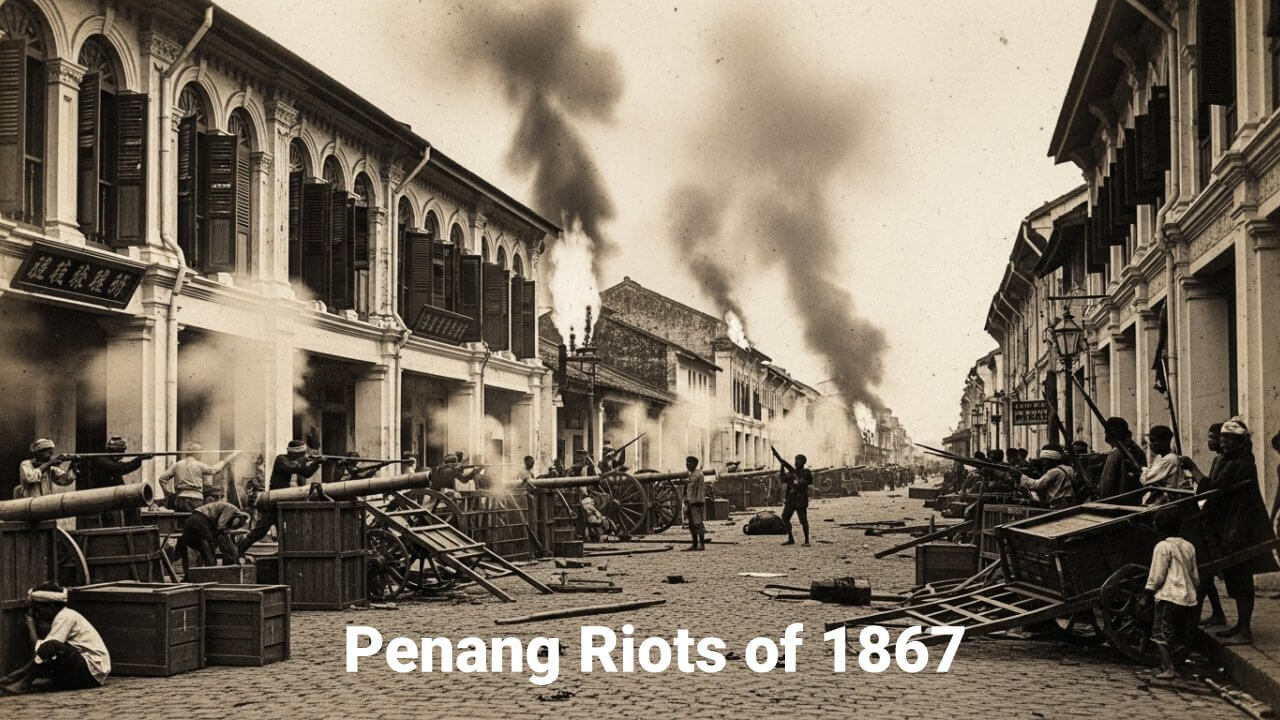 Penang Riots of 1867 (AI Generated Image)
