
Gertak Sanggul
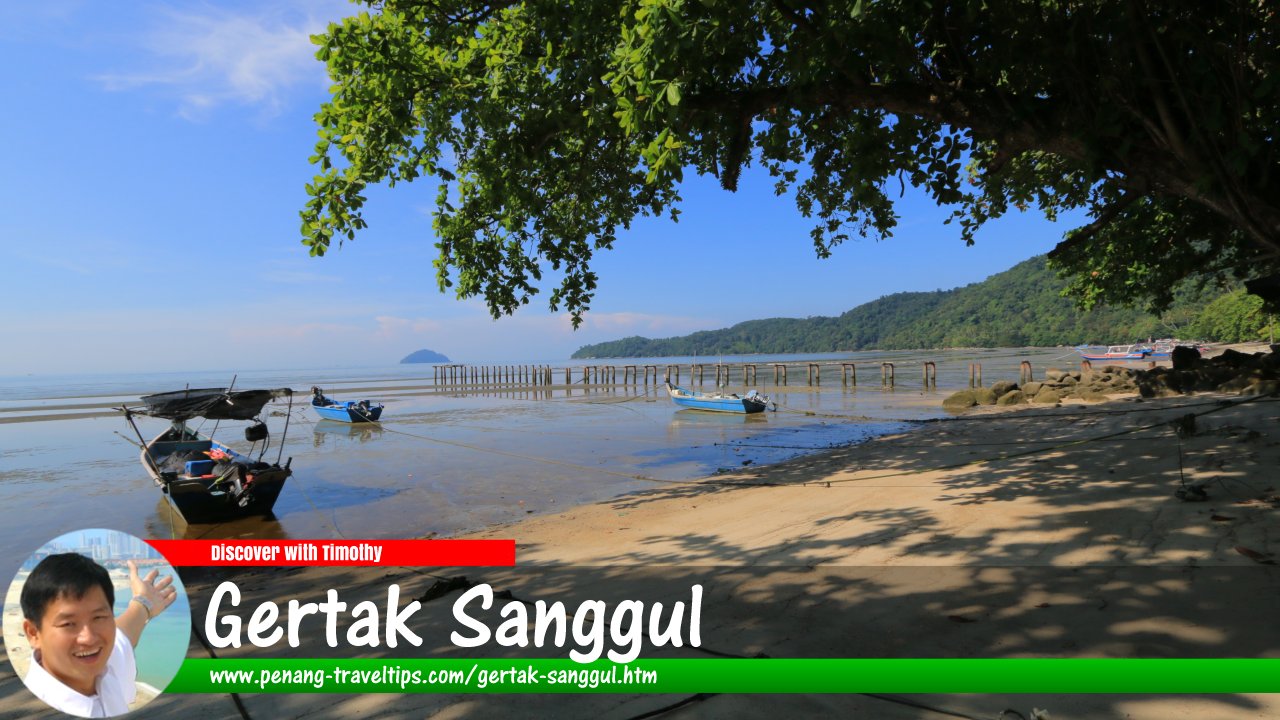 Gertak Sanggul, Penang (16 October 2019)

Also available: Gertak Sanggul (Edisi BM)
Gertak Sanggul is a fishing village on the southwestern coast of Penang Island, Malaysia. Located near the island's southwestern extremity, it is known for its traditional coastal character, fishing boats, sandy shoreline, seafood eateries and views of Pulau Kendi offshore. Although residential development has gradually reached the surrounding countryside, Gertak Sanggul retains a village atmosphere shaped by fishing, agriculture and the daily life of its coastal community.1
Quick Facts
- Name: Gertak Sanggul
- Malay name: Kampung Gertak Sanggul
- Location: Southwestern coast of Penang Island, Penang, Malaysia
- GPS coordinates: 5.28156, 100.19025
- Character: Coastal fishing village with surrounding rural and residential areas
- Main road: Jalan Gertak Sanggul
- Nearby settlements: Teluk Kumbar, Pulau Betong and other villages in southwestern Penang
- Nearby island: Pulau Kendi
- Local activities: Fishing, coastal walks, photography and seafood dining
- Nearby beaches: Gertak Sanggul Beach, Pantai Ombak Damai and Pantai Tanjung Asam in the wider coastal area
- Public transport: Rapid Penang services have served the southwestern coastal corridor; check current routes and timetables before travelling
- Approximate distance to Komtar: 21.6 km by road, using the supplied reference point
- Approximate distance to Penang International Airport: 7.2 km by road, using the supplied reference point
Geography and Location
Gertak Sanggul lies along the southwestern coastline of Penang Island, within the rural and semi-rural landscape of the island's southwest district. It is reached from the main road network through Teluk Kumbar and lies south of the Bayan Lepas urban and industrial area. Compared with the heavily developed eastern and northern parts of Penang Island, this section of the coast has traditionally retained more village settlements, agricultural land, wooded slopes and stretches of shoreline.
The village faces the sea, with fishing boats and small landing areas forming part of the coastal landscape. Coconut palms, roadside vegetation and low-rise village houses contribute to its rural appearance. The surrounding terrain includes hills and undulating land, while the coastline alternates between sandy stretches, rocky sections and small coastal inlets.
Gertak Sanggul is also associated with the wider fishing-village belt of southwestern Penang, which includes Teluk Kumbar and Pulau Betong. Fishing remains an important part of the area's identity, although residents also work in other sectors, including manufacturing, retail, services and employment in the Bayan Lepas industrial area.
Because Gertak Sanggul lies towards the southwestern end of the island, reaching it from George Town involves travelling through a substantial part of Penang Island. The journey passes through increasingly suburban and rural surroundings as the road approaches the coastal villages.
History of Gertak Sanggul
A Traditional Coastal Settlement
Gertak Sanggul developed as a village in the southwestern coastal region of Penang Island. Like neighbouring settlements such as Teluk Kumbar and Pulau Betong, its location encouraged a close relationship between the community and the sea. Fishing provided an important source of food and income, while agriculture and small-scale animal husbandry were also part of the surrounding rural economy.
Traditional village settlements in southwestern Penang developed over generations, before the expansion of the Bayan Lepas industrial area and the growth of modern housing estates transformed much of the island. Families established homes near the coast and along the roads linking villages with markets, schools and other facilities.
Fishing continues to contribute to Gertak Sanggul's identity. Boats operating from the coast supply fish and other seafood, while the village's roadside eateries and seafood restaurants reflect the area's relationship with the fishing industry. The economic life of the community, however, has diversified as employment opportunities elsewhere on the island have expanded.
From Rural Village to a Developing Coastal Area
For much of its history, Gertak Sanggul was characterised by clusters of village houses, fishing-related activities and surrounding agricultural land. Access was primarily by road, and the settlement was distant from the main commercial districts of George Town.
Over time, improved road access and the growth of the Bayan Lepas employment corridor made the southwestern coast more accessible to residents and visitors. Residential development gradually reached the wider Gertak Sanggul area, including low-rise housing and newer residential projects. Nevertheless, the village's coastal setting and traditional fishing activities remain central to its character.
Development has brought changes to the rural landscape, with new homes and other buildings appearing along parts of Jalan Gertak Sanggul. The relationship between development, village life, coastal access and the environment remains an important consideration for the future of the area.
Origin of the Name Gertak Sanggul
The name Gertak Sanggul is made up of two Malay words. Gertak can refer to a raised crossing or small bridge, a meaning related to the word titi, which is used for a small bridge or footbridge. Sanggul refers to a woman's hair arranged in a bun or coil.
The precise historical reason for combining these words in the place name is not firmly established. A popular local story links the name to women whose hair buns supposedly came undone while travelling along uneven roads during the Japanese occupation of Penang in the Second World War. This explanation is best treated as local folklore rather than a verified account of the name's origin.
The village also has a Chinese name, commonly written as 美湖 and romanised in Mandarin as Měihú. Penang Hokkien place-name records give a dialect form transcribed as Boey Or and associate it with the characters 尾湖, interpreted as “last lake”. The written forms and interpretations found in different sources are not entirely consistent, so the Chinese name should be understood in the context of the language and local tradition being used.2
Gertak Sanggul Beach
The shoreline at Gertak Sanggul is one of the village's most recognisable features. The beach provides views of the open sea, fishing boats and the distant outline of Pulau Kendi. Coconut trees and coastal vegetation contribute to the village's rural appearance, making the area suitable for a quiet stroll, photography or observing daily life along the shore.
The beach is not a developed resort beach with extensive visitor facilities. Conditions can vary along the shoreline, and visitors should be prepared for uneven ground, exposed rocks, fishing equipment and areas used by local residents. The presence of a sandy beach does not necessarily mean that the water is suitable for swimming.
Water safety is important. Water quality may vary with weather, tides, drainage and nearby activities. Do not assume the sea is safe for swimming simply because it looks clear. Check for current official advisories and avoid entering the water if there is a warning, visible pollution, an unpleasant smell, or other signs of contamination. Visitors should also respect working fishing areas and keep clear of boats, nets and landing points.
Views of Pulau Kendi
Pulau Kendi is a small island off the southwestern coast of Penang Island and can be seen from the Gertak Sanggul area in suitable weather. Its low, rocky profile may appear partly submerged when viewed from the shore, with the sea obscuring the lower parts of the island. The island is uninhabited and is known for its natural coastline and interest to anglers and boat visitors.3
The island's offshore position gives it a sense of remoteness compared with the more developed coastal areas of Penang. Its surrounding waters are also relevant to local fishing activities. Visitors should not assume that a public ferry or scheduled passenger boat operates to Pulau Kendi.
Boat Trips to Pulau Kendi
Private boat trips may be arranged through local operators when arrangements are available. Whether a trip can proceed depends on the boat operator, weather, sea conditions, passenger numbers and any applicable safety or access requirements. Visitors should confirm the arrangements directly before travelling to Gertak Sanggul with the intention of taking a boat trip.
For a group excursion, establish the total price, departure and return times, passenger capacity, safety equipment and the precise destination before confirming the booking. Sea conditions can change quickly, and operators may postpone or cancel trips when conditions are unsuitable. Visitors should follow the boat operator's safety instructions and avoid landing on rocky shorelines in rough seas.
Nearby Coastal Attractions
Pantai Ombak Damai
Pantai Ombak Damai is one of the coastal locations in the wider Gertak Sanggul area. Its shoreline and coastal vegetation provide a setting for photography and seaside visits. Facilities and access conditions can differ from one section of the coast to another, so visitors should check the location and access arrangements before setting out.
Pantai Tanjung Asam
Pantai Tanjung Asam is another coastal spot associated with this part of southwestern Penang. Like other beaches in the area, its appeal lies in the natural scenery, sea views and relatively rural surroundings. Visitors should take care around rocks, changing tides and slippery surfaces, and should not assume that every part of the coastline is suitable for swimming.
Teluk Kumbar
Teluk Kumbar is a neighbouring coastal settlement and a useful reference point for reaching Gertak Sanggul. It has residential areas, local shops, food outlets and connections to the wider road network. The two places share a history of coastal settlement and fishing, although each has its own village centre and local facilities.
Pulau Betong
Pulau Betong is another fishing village along the southwestern coast of Penang Island. It has a strong association with coastal fishing and provides further insight into the traditional maritime communities of this part of the island. Gertak Sanggul, Pulau Betong and Teluk Kumbar form part of a broader coastal landscape in which fishing, village life and newer development exist side by side.
Fishing and the Local Economy
Fishing is one of the activities most closely associated with Gertak Sanggul. The coastal setting allows local fishermen to launch boats, work at sea and bring their catch ashore. The timing of fishing trips depends on weather, tides, fishing grounds and working conditions, so activity along the shore may vary considerably from one visit to another.
Fishing also supports related businesses, including seafood retailers and eateries. The availability and selection of fish depend on the daily catch, seasonal conditions and the needs of local customers. Visitors should not assume that every restaurant obtains all its seafood directly from boats landing at the village.
Fishing communities along southwestern Penang have also faced challenges, including competition over fishing grounds and the effects of larger fishing vessels. In 2021, the Consumers' Association of Penang raised concerns about trawlers operating near Pulau Betong and Gertak Sanggul, reporting that coastal fishermen's livelihoods were being affected.4 Such issues illustrate the importance of managing marine resources and protecting the livelihoods of small-scale fishing communities.
Food and Seafood in Gertak Sanggul
Seafood is one of the main reasons people visit Gertak Sanggul. The village and surrounding coastal roads have eateries and seafood restaurants where visitors can enjoy fish and other dishes in a setting away from the busy city centre. Some establishments have views of the sea or are situated close to the village's coastal landscape.
Depending on the restaurant and the day's supply, menus may include fish, prawns, crabs, shellfish and other seafood prepared in Chinese or Malaysian styles. Grilled fish, fried seafood and dishes served with rice are common options in coastal dining areas around Penang, although menus and availability differ from one restaurant to another.
For the best experience, check the opening hours of a chosen restaurant before setting off. Some establishments operate mainly during lunch or dinner periods, while others may be closed on particular days. Fresh seafood availability can change according to the day's catch and weather conditions.
Visitors should also remember that Gertak Sanggul is a working village. Restaurant parking, access roads and the spaces around fishing facilities may be limited. Park only in permitted areas and avoid blocking access for local residents or fishing operations.
How to Get to Gertak Sanggul
By Car
Driving is one of the most convenient ways to reach Gertak Sanggul, particularly for visitors coming from George Town or other parts of Penang Island. From the Bayan Lepas area, follow the main road towards Teluk Kumbar and continue onto Jalan Gertak Sanggul. The road leads through residential and rural surroundings before reaching the coastal village.
From George Town, the journey generally involves travelling south along the island's main road network towards Bayan Lepas, then continuing towards Teluk Kumbar and Gertak Sanggul. The precise route depends on the starting point and current traffic conditions. Navigation applications can help with turn-by-turn directions, but visitors should confirm that the destination pin refers to the village or beach they intend to visit.
The final section of the journey is along local roads that serve residents, businesses and fishing activities. Drivers should reduce speed near houses, junctions and areas where pedestrians or motorcycles may enter the road. The road network is not designed solely for tourism, so visitors should be considerate of local traffic and parking needs.
Distances from Gertak Sanggul
Using the junction of Jalan Gertak Sanggul and Penang State Route P235 as the reference point, the approximate road distances to selected destinations are:
- Komtar, George Town: 21.6 km
- Penang Bridge access: 15.2 km
- Second Penang Bridge access: 11.2 km
- Penang International Airport: 7.2 km
These figures are approximate road distances and not straight-line measurements. The actual distance depends on the exact starting point and route taken. Journey times vary with traffic, especially around Bayan Lepas and the approaches to the bridges during commuting periods.
By Bus
Gertak Sanggul has historically been associated with the end of a bus route serving the southwestern coast, where buses turned around before returning towards the more urban parts of Penang Island. Public transport routes and terminal points have changed over time, however, so visitors should not rely on an old route number or assume that a particular service still terminates at the village.
Rapid Penang buses serve parts of the Bayan Lepas and southwestern coastal corridor. Before travelling, check the operator's current route map, timetable and stopping points to determine whether a bus reaches Gertak Sanggul itself or requires a transfer and additional walk. Services may be less frequent than on the main urban routes.
If the available bus service does not reach the intended beach or village destination, a taxi or e-hailing service from a larger nearby settlement may be necessary. Check the return journey as well as the outbound journey, particularly if visiting in the evening, when transport options may be more limited.
By Taxi or E-hailing
Taxis and e-hailing services offer a practical alternative for visitors without a car. They can be used to travel from the airport, Bayan Lepas, George Town or nearby settlements to Gertak Sanggul. Availability and fares depend on the time of day and driver supply.
Because Gertak Sanggul is farther from the main urban centres than many of Penang's tourist attractions, visitors should consider the return trip before travelling. In areas where drivers are less readily available, it may be useful to arrange a return pick-up in advance, where the service permits it.
Getting Around Gertak Sanggul
The village is best explored at a relaxed pace. Short walks around the coastal area can provide views of fishing boats, the shoreline and everyday village activity. However, Gertak Sanggul is spread along local roads rather than organised as a pedestrian tourist precinct, so walking between distant points may involve roads without continuous footpaths.
Visitors should be cautious when walking along the road, especially where vehicles, motorcycles and fishing-related traffic share narrow sections. Wear suitable footwear for beaches and uneven ground, and avoid walking across private property or entering areas used for boat storage and fishing operations without permission.
A car is useful for visiting other coastal locations in the wider area, including Teluk Kumbar and Pulau Betong. However, the roads can be narrow in places, and parking near popular beaches or seafood restaurants may be limited during busy periods.
Where to Stay in Gertak Sanggul
Gertak Sanggul is primarily a fishing village rather than a major hotel destination. Accommodation in the immediate area may include selected holiday rentals, homestays or privately operated units, depending on current availability. Visitors should confirm the exact address, facilities, booking conditions and legal status of any short-term rental before making a reservation.
Staying locally may suit travellers who want to spend time along the southwestern coast, enjoy seafood meals or explore the nearby villages. However, visitors should not assume that the village has the same range of hotels, shops and late-night services as George Town or Batu Ferringhi.
For a wider choice of accommodation, travellers can consider the Bayan Lepas area or other parts of southern Penang Island. These locations offer access to a broader range of shops, services and transport options while remaining within driving distance of Gertak Sanggul. Visitors without a car should check public transport connections and the cost of travelling to and from the village before booking.
Weather and Best Time to Visit
Gertak Sanggul has a tropical climate, with warm temperatures and humidity throughout the year. Conditions along the coast can change with the monsoon seasons, rainfall, wind and sea state. A sunny morning does not guarantee calm conditions for the rest of the day, particularly for anyone planning a boat trip.
For coastal walks and photography, daytime visits allow better visibility of the shoreline and Pulau Kendi. Early morning can be a good time to observe fishing-related activity, while late afternoon may offer attractive light over the sea. Visitors should check the weather forecast and avoid exposed coastal areas during thunderstorms or rough conditions.
There is no single season that guarantees ideal conditions for every activity. For boating and fishing-related excursions, follow the advice of local operators and do not go to sea when conditions are considered unsafe.
Responsible Visiting and Environmental Considerations
Gertak Sanggul is both a place of interest for visitors and a working coastal community. The beach, fishing boats, village roads and seafood businesses are part of local life. Visitors can help preserve the character of the area by taking their rubbish away, avoiding damage to vegetation and respecting the privacy of residents.
Do not leave plastic packaging, food waste, fishing line or other rubbish on the beach. Waste can be carried into the sea and harm marine life. Visitors should also avoid disturbing wildlife or collecting marine organisms and shells where this may be prohibited or damaging to the local environment.
Water quality should be treated as a practical consideration rather than assumed from appearance alone. The earlier reputation of the area for pollution does not establish the current condition of every section of the coast. Conversely, the presence of visitors or restaurants does not prove that the water is suitable for swimming. Check current official advice and avoid contact with the water when pollution is suspected.
When visiting fishing areas, keep a safe distance from boats, nets and equipment. These are working facilities, and blocking access can interfere with the livelihoods of local fishermen. For boat trips to Pulau Kendi, use a responsible operator and follow all safety instructions.
Gertak Sanggul as a Coastal Destination
Gertak Sanggul offers a different perspective on Penang Island from the heritage streets of George Town and the resort coastline of Batu Ferringhi. Its appeal lies in its fishing-village atmosphere, coastal scenery, seafood dining and views of Pulau Kendi. The surrounding rural landscape also provides a reminder that parts of Penang Island retain a close relationship with fishing and village life despite the growth of urban development elsewhere.
The village can be visited as a short coastal excursion or combined with a drive through the southwestern settlements of Teluk Kumbar and Pulau Betong. Visitors should plan transport in advance, confirm restaurant or boat-trip arrangements, and take care around the sea and working fishing areas.
For those interested in Penang beyond its better-known urban attractions, Gertak Sanggul provides an opportunity to experience a quieter part of the island while recognising the importance of protecting the coastal environment and the community that lives and works there.
Updates on Gertak Sanggul
15 September, 2018
The Star reported that residents of Gertak Sanggul are upset that a one-kilometer stretch of the beach is being polluted with raw piggery waste. Details
 Map of Gertak Sanggul, Penang
 Sights in Gertak Sanggul
- Gertak Sanggul Pillbox (GPS: 5.28796, 100.22544)

Residential Properties in Gertak Sanggul
- Baymont Residence (GPS: 5.28843, 100.21898)

Eateries in Gertak Sanggul
- Hai Boey Seafood (GPS: 5.28164, 100.21179)

- Khun Thai (GPS: 5.28187, 100.21956)

- Ombak Damai (GPS: 5.28263, 100.21665)

Roads in Gertak Sanggul
Rivers in Gertak Sanggul
Places in Gertak Sanggul
- Pekan Gertak Sanggul (GPS: 5.2854, 100.22286)

- Pasir Belanda (GPS: 5.2854, 100.22286)

- Tanjung Asam (GPS: 5.28164, 100.21179)

References
- Gertak Sanggul, Penang – Penang Travel Tips. Locality overview, location and background information about the village.
- Place Names in Penang Hokkien – Penang Travel Tips. Penang Hokkien forms of local place names, including Gertak Sanggul.
- Penang Global Tourism: 8 Eco-Friendly Gems in Penang You Need to Know About. Information on Gertak Sanggul's coastal scenery, nearby beaches and boat trips to Pulau Kendi.
- Consumers' Association of Penang: Trawler Intrusions Affect the Income of Coastal Fishermen at Pulau Betong and Gertak Sanggul. Report published in March 2021 on fishing-ground concerns affecting local fishermen.
- Penang Global Tourism: Fishing Villages on Penang Island. Background on the fishing villages along the southern and southeastern coasts of Penang Island.
- Jalan Gertak Sanggul – Penang Travel Tips. Information about the road connecting the coastal village with the wider road network.
Page Details
This page was created on 22 October 2026. Hi, my name is Timothy and created it from my research, for my own entertainment, knowledge and to satisfy my curiosity. I am providing the information to you in good faith and hope it is useful. I try to get the details as accurate as possible. I also try to update the page whenever I stumble on new details. So this and all my other pages are perpetual work in progress. If you discover any error, please politely inform me, pointing out where the error lies, and I will correct it as soon as possible. Your helpfulness will keep this page accurate, relevant and helpful to those who need the information.Want to share your Penang travel experiences or get tips from fellow travellers?
Join the Penang Travel Tips Facebook GroupUseful guides for visiting Penang
My Videos of Penang
Latest Pages & Updates
Buy Me A Coffee
If you enjoy the information I provide and want to support the work I do, please buy me a coffee! I appreciate it immensely, thank you so much!
