
Rindermarkt, Munich
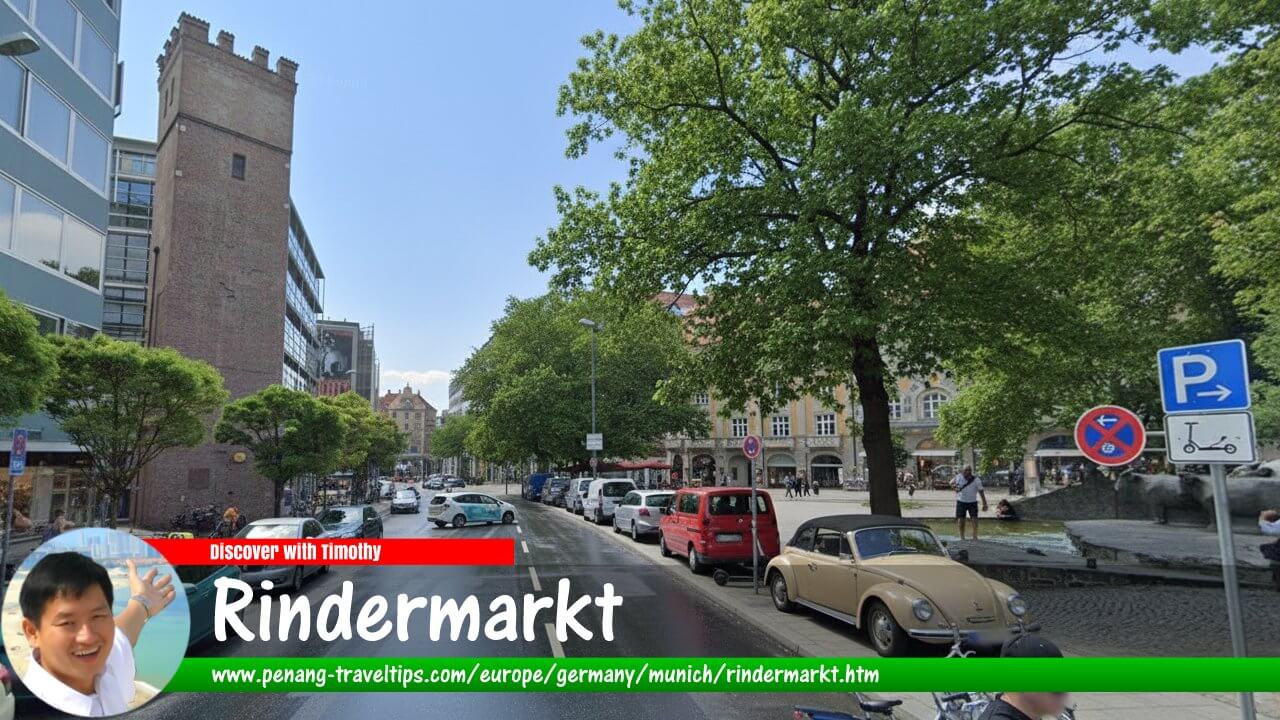 Rindermarkt, Munich (AI Generated on 23 January 2026)
The Rindermarkt is a historic street and square in Munich’s Altstadt-Lehel district that gently slopes from Oberanger in the southwest to the city’s iconic Marienplatz in the northeast, offering a scenic pedestrian experience surrounded by centuries-old sights, shops and cafés. 20
Quick Facts
- Location: Altstadt-Lehel, Munich, Germany
- Length: approx. 160 meters
- Type: Pedestrian street & square
- Connects: Oberanger to Marienplatz
- Nearest metro station: Marienplatz
What Rindermarkt Is Like
Rindermarkt isn’t just a street — it’s more like a cozy square extending from Munich’s historic shopping zones, creating a calm yet vibrant link between major thoroughfares deep in the city’s walkable core. While modest in length, its position just off Munich’s retail heart makes it a pleasant stop for strolling visitors and locals alike. 6
Today, Rindermarkt serves as a peaceful pedestrian zone filled with boutique stores, traditional businesses, cafés and historic façades. Elements such as the central fountain and the Ruffinihaus give this space a unique character that balances old-town charm with contemporary urban life. 3
Surrounding Streets & Neighbourhood
Rindermarkt sits in Munich’s historic Altstadt and is closely connected with other notable streets. To the northeast is Marienplatz, the city’s central square. Close by are Rosenstraße, Sendlinger Straße and Fürstenfelder Straße, forming a tight network of pedestrian zones that make up Munich’s core commercial and cultural heart. 2225
History & Origins
One of Munich’s oldest streets, Rindermarkt originated in the Middle Ages and was used as a cattle market — its name literally means “cattle market.” The street once formed a part of the route connecting Marienplatz with the former Inner Sendlinger Tor city gate, and further on to what is now Sendlinger Straße. 20
During the Second World War, many buildings around Rindermarkt were damaged, and in the post-war reconstruction the square was expanded toward Oberanger, though the northern side still follows much of the original medieval street alignment. 22
Name & Pronunciation
The name “Rindermarkt” comes from German, literally meaning “cattle market.” In everyday English-friendly pronunciation, it’s often rendered as “**RIN-der-markt**.” In the International Phonetic Alphabet, that becomes /ˈʁɪndɐˌmaʁkt/. 20
Interesting Sights Nearby
Rindermarkt is home to a number of historic landmarks that make it a worthwhile stop on any Munich visit:
- St. Peter’s Church (Alter Peter): Munich’s oldest parish church — its tower defines the northern edge of Rindermarkt with views over the Old Town. 22
- Rindermarktbrunnen (Fountain): Created in 1964 by sculptor Josef Henselmann, this fountain features bronze cattle and a shepherd as a reminder of the street’s historic function. 21
- Löwenturm (Lion Tower): A 15th-century tower with frescoes, thought to be part of the old fortifications. 3
- Ruffinihaus: A richly decorated early 20th-century building ensemble that adds architectural flair to the square. 3
Real Estate Around Rindermarkt
Rindermarkt lies within Munich’s Altstadt-Lehel — one of the most prestigious and expensive residential districts in the city. Properties here tend to be highly sought after due to their central location, historic charm and proximity to cultural amenities. As of early 2026, apartments and houses in this district often range from roughly €900,000 up to several million euros, reflecting its status as Munich’s most expensive neighborhood. 1
For perspective, a 50 m² (~538 sq ft) historic apartment here might cost well over €900,000 for purchase, while larger units above 100 m² (~1,076 sq ft) often fetch prices deep into the multi-million euro range. Rentals in Altstadt-Lehel typically command premium monthly rates relative to the broader Munich average, with central locations trending significantly higher. 1
Compared to the wider city of Munich, which itself has one of the highest property markets in Germany — with average asking prices well above the national average — Altstadt-Lehel remains at the top end due to its scarcity and prestige. 13
Public Transport & Access
The nearest major public transport access point is Marienplatz Station, served by the S-Bahn lines S1–S8 and U-Bahn lines U3 and U6, providing one of the city’s busiest hubs for both regional and local travel. 1
Bus services also stop around Marienplatz, including routes such as 52, 58 and others, offering surface connections that make Rindermarkt easily reachable from different parts of Munich. 1
Fun Facts
Despite its relatively short 160-meter length, Rindermarkt packs a rich slice of Munich’s history into one small corner — from medieval livestock trade to refined patrician residences, and now to a relaxing public space where residents and tourists alike pause by the fountain or browse elegant shops. 20
Rindermarkt on the Map of Streets in Munich, Germany
References
- Investropa: Munich housing prices in Altstadt-Lehel (2026)
- Wikipedia: Rindermarkt, Munich
- muenchen.de: Rindermarkt sights and description
- Wikipedia: Munich Marienplatz station
- Wikipedia: Marienplatz
Page Details
This page was created on 23 January 2026. Hi, my name is Timothy and created it from my research, for my own entertainment, knowledge and to satisfy my curiosity. I am providing the information to you in good faith and hope it is useful. I try to get the details as accurate as possible. I also try to update the page whenever I stumble on new details. So this and all my other pages are perpetual work in progress. If you discover any error, please politely inform me, pointing out where the error lies, and I will correct it as soon as possible. Your helpfulness will keep this page accurate, relevant and helpful to those who need the information. Latest Pages & Updates
Buy Me A Coffee
If you enjoy the information I provide and want to support the work I do, please buy me a coffee! I appreciate it immensely, thank you so much!
