
Munich's Mass Transit: History and Modern Public Transport Network
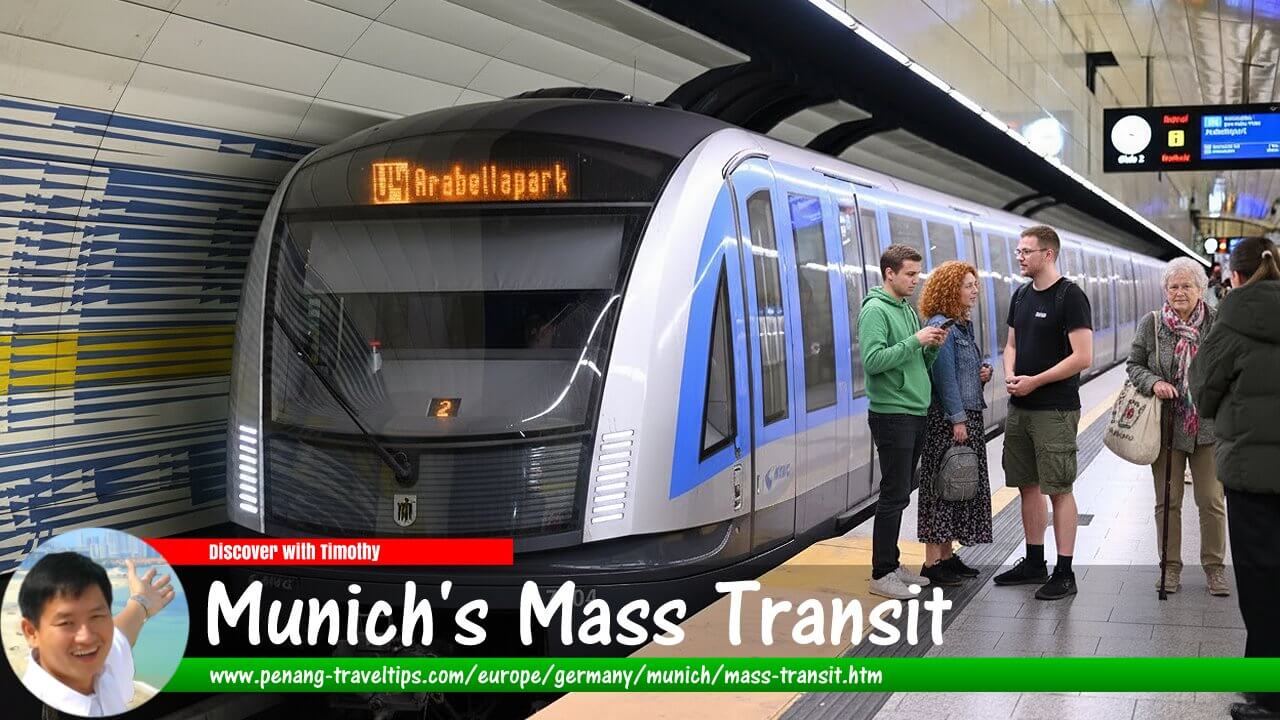 Munich's Mass Transit: History and Modern Public Transport Network (AI Generated on 24 January 2026 based on 4300streetcar, CC BY 4.0, via Wikimedia Commons)
_May_2025_1.jpg)
Munich has one of the most comprehensive and efficient public transport systems in Europe, combining suburban rail, metro, tram, and bus networks under a unified transport authority. This integrated system serves both residents and visitors across the city and surrounding regions, offering frequent, reliable, and well-connected services that make cars optional for many daily journeys.1
Quick Facts
S-Bahn established: 1972
U-Bahn opened: 1971
Number of S-Bahn lines: 8
Number of U-Bahn lines: 8
Tram lines: Approx. 13
Major operator: MVG & MVV
Integration: Unified tickets across modes
Overview of Munich’s Public Transportation
Munich’s public transport system is structured around four main modes: the suburban rail system known as the S-Bahn, the metro network called the U-Bahn, the historic tramway, and an extensive bus network. All services are coordinated under the Münchner Verkehrs- und Tarifverbund (MVV), the regional transport association connecting the city and adjacent districts into a seamless travel framework.1
The integration of these services allows passengers to transfer between trains, trams, and buses with unified tickets, schedules, and fare zones. The system serves millions of passengers annually and is central to Munich’s character as a modern, high- mobility urban centre.2
History of Public Transit in Munich
Public transport in Munich has roots that stretch back well over a century. The earliest organized public service began with horse-drawn trams in the late 19th century, and later expanded to electric trams. These early innovations laid the groundwork for more advanced rapid transit systems in the 20th century.3
The push toward modern rapid transit was catalysed by Munich’s selection as the host city for the 1972 Summer Olympics. In the 1960s, planners sought to reduce congestion and provide efficient cross-city travel, leading to the creation of both the U-Bahn and the S-Bahn systems. The U-Bahn began service first in 1971, followed shortly by the S-Bahn in 1972, both designed to facilitate high-volume movement across the metropolitan region for the Games and beyond.4
Before these developments, the city relied on a patchwork of older tram lines and buses to cover local transport needs. With the establishment of MVV in 1972, these services were unified under a coordinated system that could plan, expand, and subsidise transport in line with Munich’s growth.5
The S-Bahn München
The S-Bahn München (suburban railway) is a regional train network that connects Munich’s city centre with surrounding towns, suburbs, and key destinations like the airport. The S-Bahn’s distinctive “S” logo marks stations across the network. Its creation in 1972 marked a major leap forward for transportation in the city, enabling fast journeys across greater distances compared to tram or metro services.1
As of the latest network configuration, the S-Bahn consists of eight main lines that traverse Munich and its environs, crossing the central city through the core tunnel (“Stammstrecke”) beneath the centre. These lines serve more than 150 stations and accommodate hundreds of thousands of riders each day, making the S-Bahn a backbone of the regional mobility network.1
The S-Bahn’s routes are designed to cover longer trips, connecting far-flung suburbs and satellite towns to central transfer points, where passengers can switch to U-Bahn, trams, or buses. The network not only serves daily commuters but also provides vital links to Munich Airport and other key regional hubs.2
The U-Bahn (Metro) System
The U-Bahn in Munich is the city’s rapid metro network, characterised by underground electric trains that operate within the urban core and inner districts. Service began in October 1971, making it one of the youngest metro systems among major European cities when it opened in advance of the 1972 Olympics.1
Today, the U-Bahn network comprises eight lines and serves approximately 96 stations across roughly 95 kilometres of track. With its frequent service and dense urban coverage, it caters primarily to city travellers and commuters moving within the central and inner suburban areas.1
U-Bahn trains typically run at intervals of a few minutes during peak times, offering fast and frequent connections between major commuter and activity centres. Many stations provide interchanges with the S-Bahn and tram networks, underscoring the integrated nature of Munich’s transit framework.2
Tram Network (Straßenbahn)
Munich’s tram system is one of the oldest continuous components of the city’s public transport, with electric services dating back to the late 19th century. Over time, tram routes expanded to cover a wide network of surface lines that complement the rapid transit lines underground and above ground.3
Modern tram services operate on multiple daytime routes that traverse busy central corridors and extend into outer districts. The tram network remains crucial for medium-distance travel across neighbourhoods that are not directly served by U-Bahn or S-Bahn lines. It also helps connect passengers to major interchanges where they can transfer to rail or metro services.2
Bus and Other Surface Services
Buses make up a large part of Munich’s surface transport network and serve areas not directly covered by rail or tram lines. Daytime buses run extensive routes throughout the city and metro area, often linking residential areas to tram, S-Bahn, or U-Bahn stations. In addition to regular services, night bus lines ensure that key routes remain accessible during late hours, complementing limited overnight rail services.2
Bus networks are also essential in covering peripheral and suburban areas where track-based systems are not viable due to geography or lower population density. These buses fill in the gaps and maintain connectivity across the MVV zone system.2
Ticketing and Integration
One of the strengths of Munich’s public transport system lies in its unified ticketing approach. A single ticket purchased within the MVV framework is valid across S-Bahn, U-Bahn, trams, and buses, allowing seamless transfers and simplifying travel planning for passengers.1
Fare zones are structured around the city core and extending outward. Zone M covers the central area, with additional numbered zones covering the suburbs and surrounding areas. Tickets are designed to match journey needs, including single rides, day passes, and multi-day or multi-zone travelcards.2
Modern Developments and Future Plans
Munich’s transit authorities are constantly upgrading and expanding services to meet demand and improve reliability. For example, new projects include extensions to tram and bus networks, as well as major infrastructure investments in rail tunnels to increase capacity and reduce bottlenecks in the current system.1
One major ongoing project is the construction of a second S-Bahn core route (“Stammstrecke”) through the city centre, intended to complement and relieve the existing downtown tunnel. This ambitious infrastructure undertaking will improve system resilience, increase capacity, and offer alternative routing for passengers during peak and disruption periods.6
References
- Munich U-Bahn — Wikipedia
- Munich Public Transport Overview — München.de
- Facts About Munich MVG and Tram History — Facts.net
- MVV and Transit History Study — MAUTC.psu.edu
- MVV Official Website
- Munich Second S-Bahn Core — DB Engineering Consulting
Page Details
This page was created on 24 January 2026. Hi, my name is Timothy and created it from my research, for my own entertainment, knowledge and to satisfy my curiosity. I am providing the information to you in good faith and hope it is useful. I try to get the details as accurate as possible. I also try to update the page whenever I stumble on new details. So this and all my other pages are perpetual work in progress. If you discover any error, please politely inform me, pointing out where the error lies, and I will correct it as soon as possible. Your helpfulness will keep this page accurate, relevant and helpful to those who need the information. Latest Pages & Updates
Buy Me A Coffee
If you enjoy the information I provide and want to support the work I do, please buy me a coffee! I appreciate it immensely, thank you so much!
