
Löwengrube, Munich
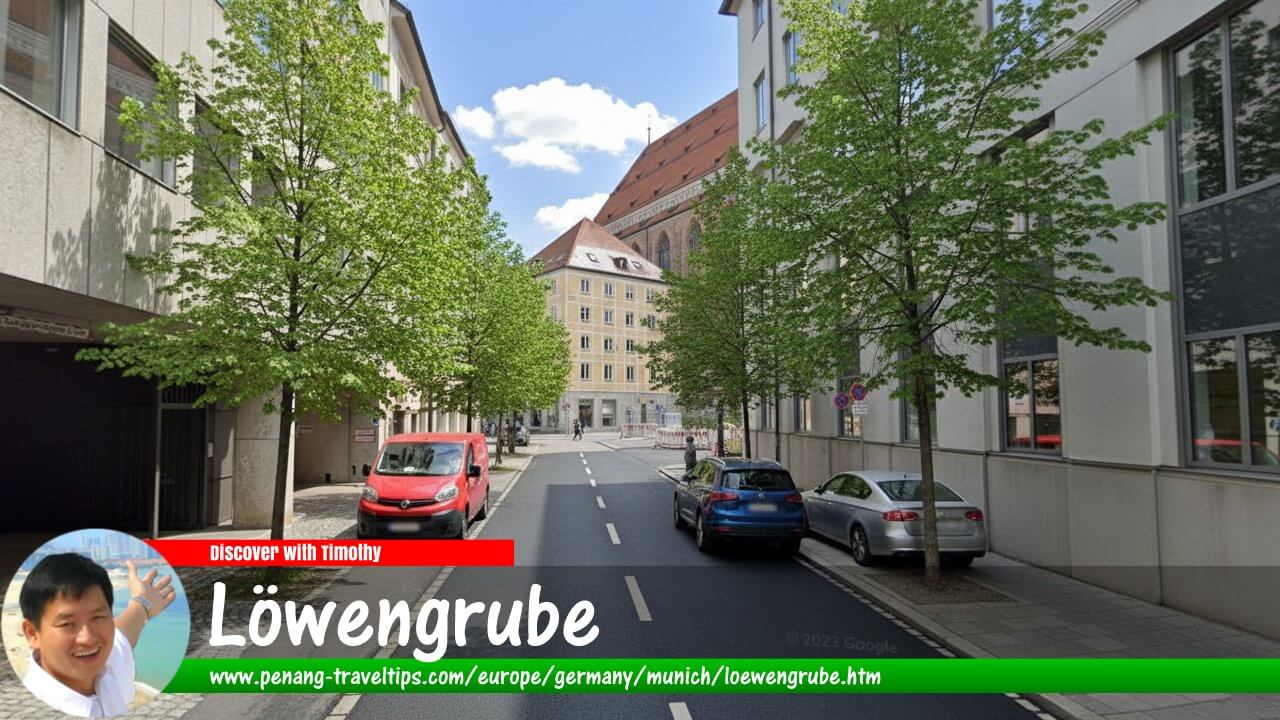 Löwengrube, Munich (AI Generated on 16 February 2026)
Löwengrube is a historic street in the heart of Munich’s Altstadt-Lehel district, running west from Marienplatz to Maxburgstraße. At approximately 198 metres in length, it forms part of the dense medieval street network surrounding Munich’s central square and has long served as a link between the city’s civic core and its former ecclesiastical and residential quarters. 1
Quick Facts
- Location: Altstadt-Lehel, Munich, Germany
- Length: approx. 198 metres
- Street type: Historic city-centre street
- Connects: Marienplatz (east) to Maxburgstraße (west)
- Nearest metro station: Marienplatz
Character of the Street
Löwengrube retains a distinctly old-town atmosphere, characterised by narrow proportions, historic façades, and a steady flow of pedestrians moving between Marienplatz and the quieter western parts of Altstadt-Lehel. While not fully pedestrianised, traffic is limited, and the street functions primarily as a connector for foot traffic rather than a major thoroughfare. 1
The buildings along Löwengrube reflect multiple phases of Munich’s architectural history. Many structures were rebuilt after wartime destruction but follow traditional plot lines and heights, preserving the historic rhythm of the street. Ground-floor uses today typically include offices, small businesses, and hospitality venues, while upper floors often house residential or administrative spaces. 2
Surrounding Streets & Urban Context
At its eastern end, Löwengrube opens directly onto Marienplatz, Munich’s principal civic square. From there, the street extends westward toward Maxburgstraße, which marks a transition into a quieter zone near the former Maxburg complex. Nearby streets include Schäfflerstraße, Damenstiftstraße, and Neuhauser Straße, placing Löwengrube firmly within the historic commercial and administrative core of the city. 2
This positioning gives Löwengrube a dual character: lively and animated near Marienplatz, yet progressively calmer as one moves west. The contrast highlights how Munich’s old town balances tourism, commerce, and everyday urban life within a compact area. 1
Historical Development
Löwengrube traces its origins back to medieval Munich, when the city developed within fortified walls and streets followed practical routes between gates, markets, and religious institutions. The street emerged as part of the western extension of the early settlement near Marienplatz, serving craftsmen, merchants, and clerical households. 3
Over the centuries, the area underwent gradual transformation, particularly during the secularisation of Bavaria in the early 19th century and later urban reforms. Much of the historic building stock was damaged or destroyed during World War II, but post-war reconstruction sought to preserve traditional street alignments and scale. As a result, Löwengrube today remains recognisably medieval in layout, despite largely modern construction. 4
Name, Meaning & Pronunciation
The name “Löwengrube” translates literally as “Lion’s Pit.” While the exact origin is not definitively documented, the name likely refers to a former inn sign, property name, or symbolic reference common in medieval street naming. Lions have long been heraldic symbols in Bavaria, further reinforcing the plausibility of such an origin. 3
In common English-friendly pronunciation, the name may be rendered as “LUR-ven-groo-buh.” In the International Phonetic Alphabet (IPA), it is pronounced /ˈløːvn̩ˌɡʁuːbə/, with the umlauted ö producing a rounded vowel sound characteristic of German. 3
Nearby Sights & Points of Interest
Although Löwengrube itself is relatively short, it benefits from exceptional proximity to some of Munich’s most significant landmarks. Within a few minutes’ walk are:
- Marienplatz: The city’s central square, home to the New Town Hall and Glockenspiel. 5
- Frauenkirche: Munich’s iconic twin-towered cathedral, located just to the southwest. 6
- Neuhauser Straße: One of Munich’s main pedestrian shopping streets. 7
- Former Maxburg site: Historically important as a religious and later judicial complex. 8
Real Estate & Property Market
Löwengrube lies within Altstadt-Lehel, Munich’s most expensive real estate district. As of early 2026, residential prices in this area generally range between €11,000 and €15,000 per square metre, significantly exceeding the Munich citywide average. 9
A compact apartment of around 55 sq m (approximately 592 sq ft) near Löwengrube may be priced between €650,000 and €850,000, while larger properties of 100 sq m (about 1,076 sq ft) can surpass €1.4 million. Rental prices are similarly high, reflecting the prestige, walkability, and limited housing supply in the historic centre. 9
Compared with outer districts of Munich, Altstadt-Lehel commands a premium due to heritage restrictions, scarcity of residential units, and unmatched access to cultural, retail, and transport infrastructure. 9
Public Transport & Connectivity
The nearest metro and suburban rail hub is Marienplatz station, served by U-Bahn lines U3 and U6, as well as all central S-Bahn lines (S1–S8). This makes Löwengrube one of the most accessible streets in Munich via public transport. 10
Multiple bus routes also stop around Marienplatz and adjacent streets, offering surface connections across the city centre and beyond. 10
Fun Fact
Despite its evocative name, there is no evidence that Löwengrube ever housed actual lions. Like many medieval street names in Munich, it likely referenced a sign or symbolic landmark rather than a literal feature — a reminder that the city’s urban vocabulary is steeped in metaphor and tradition. 3
Löwengrube is  on the Map of Streets in Munich, Germany
References
- München Wiki: Löwengrube
- City of Munich – Official Website
- Historisches Lexikon Bayerns
- Süddeutsche Zeitung – Munich History
- Wikipedia: Marienplatz
- Wikipedia: Frauenkirche
- Wikipedia: Neuhauser Straße
- München Wiki: Maxburg
- Immowelt: Property Prices in Altstadt-Lehel
- Wikipedia: Munich Marienplatz Station
Page Details
This page was created on 16 February 2026. Hi, my name is Timothy and created it from my research, for my own entertainment, knowledge and to satisfy my curiosity. I am providing the information to you in good faith and hope it is useful. I try to get the details as accurate as possible. I also try to update the page whenever I stumble on new details. So this and all my other pages are perpetual work in progress. If you discover any error, please politely inform me, pointing out where the error lies, and I will correct it as soon as possible. Your helpfulness will keep this page accurate, relevant and helpful to those who need the information. Latest Pages & Updates
Buy Me A Coffee
If you enjoy the information I provide and want to support the work I do, please buy me a coffee! I appreciate it immensely, thank you so much!
