
Hofgraben, Munich
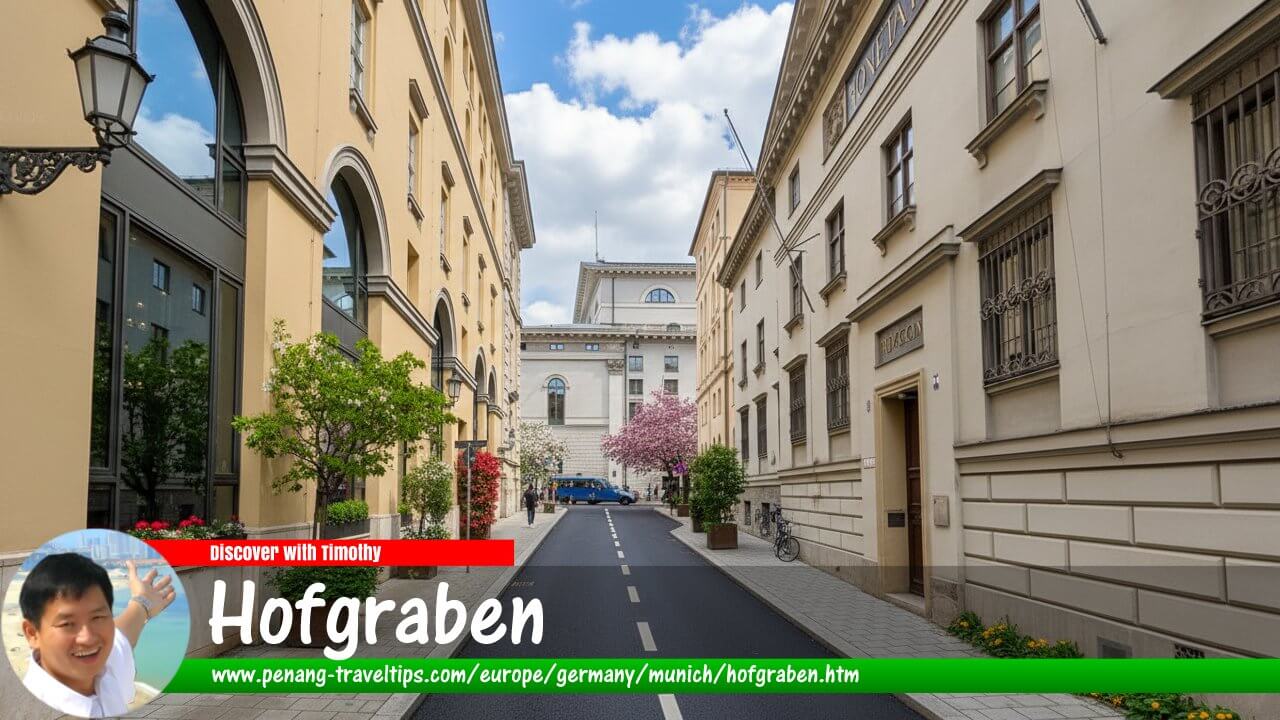 Hofgraben, Munich (AI Generated on 26 January 2026)
The Hofgraben is a distinctive historic street in Munich’s Altstadt-Lehel district, comprising two branches that meet near Alter Hof and the junction with Pfisterstraße, linking Schrammerstraße in the west with Maximilianstraße in the north. This roughly 167-meter urban path sits just steps from Marienplatz and forms a charming slice of Munich’s old town fabric. 19
Quick Facts
- Location: Altstadt-Lehel, Munich, Germany
- Length: approx. 167 meters
- Type: Historic urban street with two branches
- Connects: Schmmerstraße & Maximilianstraße via Alter Hof
- Nearest metro station: Marienplatz
What Hofgraben Is Like
Hofgraben is a short, intriguing street with an unusual two-armed layout that reflects Munich’s layered urban history. Running close to the historic centre, the street’s branches approach from different directions and curve gently into a unified path near Alter Hof, whose medieval ensemble helps shape the street’s character. 19
The street itself is pedestrian-friendly, though it also sees light local traffic in parts. Sidewalks and ground-level shops give it an intimate feel, while cafés and small eateries tucked into nearby buildings — such as the beloved Kleines Kameel café at Hofgraben 3 — add to the everyday charm. 3
Surrounding Streets & Neighbourhood
Hofgraben occupies a central place in Munich’s old town street network. To the immediate north, it meets Maximilianstraße — one of the city’s most prestigious boulevards known for luxury shopping and elegant architecture. To the west, it connects with Schrammerstraße, which in turn leads toward Theatinerstraße and other historic passages. Alter Hof anchors the eastern end of the street, while Pfisterstraße and Dienerstraße sit just nearby. 19
This concentration of historic streets makes Hofgraben a crossroads of old town life, bustling with pedestrians moving between landmarks, shops and cultural sites. 0search4
History & Origins
Hofgraben’s origins trace back several centuries. The street’s name derives from its origin as a filled-in part of Munich’s former city fortification trench (the *Hofgrabenbach*) that ran alongside the small ducal castle later known as Alter Hof. When the defensive moat was filled, the route remained — and the street that formed atop it retained the name “Hofgraben.” 19
First mentioned around 1555, the street’s alignment has endured through Munich’s growth and rebuilding — including the reconstructions following World War II — preserving an essential link between the old royal quarter and the city’s expanding civic core. 0search0
Name & Pronunciation
The name “Hofgraben” combines the German words *Hof* (court) and *Graben* (ditch or moat), a direct reference to its medieval geography beside the court’s defensive structures. In everyday English-friendly speech, the name is often pronounced “**HOFF-grah-ben**.” In the International Phonetic Alphabet (IPA) it is rendered as /ˈhoːfˌɡʁaːbn̩/, with a long *o* sound and a hard *g*. 19
Interesting Sights Nearby
While Hofgraben itself is relatively compact, it sits amid several of Munich’s historic highlights:
- Alter Hof: The medieval ducal residence and one of Munich’s oldest architectural complexes. 12
- Maximilianstraße: Famous luxury boulevard full of high-end shopping and elegant façades. 0search0
- Marienplatz: The city’s central square and cultural heart with the New Town Hall and iconic Glockenspiel. 0search0
- Kleines Kameel Café: A local favourite café at Hofgraben 3 — perfect for a coffee break. 3
- Azuki Restaurant: Contemporary Japanese and Vietnamese dining right on Hofgraben. 8
Real Estate & Property Context
Hofgraben is nestled in the heart of Altstadt-Lehel, Munich’s most historic and prestigious real estate district. Property in this area commands some of the highest values in the city due to its central location, heritage buildings and pedestrian accessibility. According to early 2026 estimates, average apartment prices in Altstadt-Lehel range typically from about €11,000 to €14,500 per square metre — notably higher than Munich’s overall average. 4
Converting those figures to real-world examples: a smaller apartment of around 50 m² (~538 sq ft) near Hofgraben might sell for around €650,000–€800,000, depending on condition and outlook, while larger flats exceeding 100 m² (~1,076 sq ft) can exceed €1.3 million. Monthly rents for centrally located units here trend well above those in outer districts, reflecting the neighbourhood’s desirability and proximity to Munich’s top cultural and commercial destinations. 4
Compared with the wider Munich market — already one of Germany’s most expensive — Altstadt-Lehel remains at the high end, prized by residents, investors and history lovers alike. 4
Public Transport & Access
The closest major public transport hub to Hofgraben is Marienplatz station, served by S-Bahn lines S1–S8 and U-Bahn lines U3 and U6. This makes Hofgraben very easy to reach from across Munich and beyond. 0search19
Several bus routes also stop around Marienplatz and nearby streets, offering surface connections throughout the city centre and adjacent districts. 0search1
Fun Facts
One quirky piece of history is that Hofgraben literally evolved from a moat beside the old city walls and court compound — its name stuck even after the defensive trench was filled in and the modern street was laid out above it. Today, you can walk this former moat pathway as a street rich with layers of Munich’s urban story. 19
Hofgraben is  on the Map of Streets in Munich, Germany
References
- Wikipedia: Hofgraben (München)
- München Wiki: Hofgraben
- Kleines Kameel café at Hofgraben
- Immowelt: Property prices in Altstadt-Lehel (2026)
- Azuki Restaurant Munich on Hofgraben
- Wikipedia: Munich Marienplatz station
Page Details
This page was created on 4 February 2026. Hi, my name is Timothy and created it from my research, for my own entertainment, knowledge and to satisfy my curiosity. I am providing the information to you in good faith and hope it is useful. I try to get the details as accurate as possible. I also try to update the page whenever I stumble on new details. So this and all my other pages are perpetual work in progress. If you discover any error, please politely inform me, pointing out where the error lies, and I will correct it as soon as possible. Your helpfulness will keep this page accurate, relevant and helpful to those who need the information. Latest Pages & Updates
Buy Me A Coffee
If you enjoy the information I provide and want to support the work I do, please buy me a coffee! I appreciate it immensely, thank you so much!
