
Burgstraße, Munich
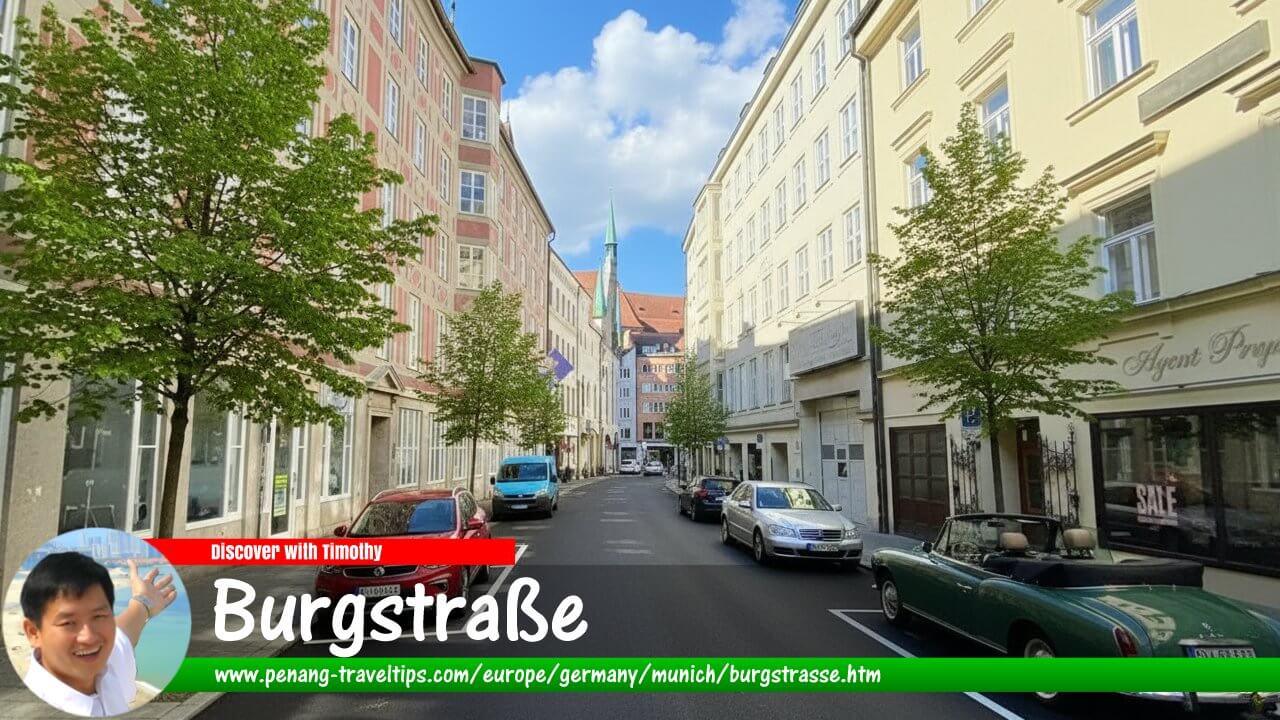 Burgstraße, Munich (AI Generated on 26 January 2026)
The Burgstraße is a historically rich street in the heart of Munich’s Altstadt-Lehel district, running from the medieval complex of Alter Hof near Altenhofstraße in the north down to the vibrant Marienplatz in the south. With parts of the street pedestrianised as it approaches the city’s central square, Burgstraße offers a walk through layers of Munich’s early history blended with modern city life.
Quick Facts
- Location: Altstadt-Lehel, Munich, Germany
- Length: approx. 305 meters
- Type: Historic urban street (partly pedestrianised)
- Connects: Alter Hof to Marienplatz
- Nearest metro station: Marienplatz
The Street & Its Character
Burgstraße is relatively short, yet it carries significant historical weight. The northern section near Alter Hof feels quieter and more enclosed, with narrow sightlines and older building plots that hint at medieval street planning. As the street progresses southward, it gradually opens up, becoming busier and more animated as it approaches Marienplatz, where pedestrian traffic dominates.
Architecturally, the street reflects Munich’s layered past. While many buildings were reconstructed after wartime damage, the street layout itself preserves its medieval alignment. Ground floors are typically occupied by shops, cafés and small businesses, while upper levels often house offices or apartments, reinforcing the mixed-use character typical of Munich’s Old Town.
Surrounding Streets & Neighbourhood
Burgstraße sits within one of the most historically dense parts of Munich. To the north, it connects directly to Alter Hof, the former ducal residence that played a central role in the city’s early development. Nearby streets include Altenhofstraße, Sparkassenstraße and Weinstraße, all of which form part of the compact street network radiating out from Marienplatz.
This area is firmly within Munich’s pedestrian core, making Burgstraße an integral link between quieter historic corners and the city’s most visited public square. Its proximity to major shopping streets and landmarks ensures constant footfall throughout the day.
History & Origins
Burgstraße is among the oldest streets in Munich, with origins dating back to the city’s earliest settlement period in the 12th and 13th centuries. The street developed as part of the area surrounding the Old Court (Alter Hof), which served as the seat of the Wittelsbach dukes before the construction of the Munich Residenz. Its alignment reflects the defensive and administrative priorities of early Munich.
Over the centuries, Burgstraße evolved from a utilitarian access route serving the ducal court into a commercial and residential street. Like much of Munich’s Old Town, it suffered damage during the Second World War, after which many buildings were reconstructed in simplified historical styles that respected the original street layout.
Name & Pronunciation
The name “Burgstraße” translates directly from German as “Castle Street” or “Fortress Street,” referencing its historical proximity to the ducal stronghold at Alter Hof. In common English-friendly pronunciation, it is often rendered as “**BOORG-shtrah-suh**.” In the International Phonetic Alphabet, the pronunciation is /ˈbʊʁkˌʃtʁaːsə/, with the “ß” sounding like a sharp “ss.”
Interesting Sights & Nearby Attractions
While Burgstraße itself is modest in scale, it lies amid some of Munich’s most important historical sights:
- Alter Hof: The former ducal residence of the Wittelsbachs and one of Munich’s oldest surviving architectural ensembles.
- Marienplatz: Munich’s central square, home to the New Town Hall and the famous Glockenspiel.
- St. Peter’s Church (Alter Peter): Munich’s oldest parish church, located just a short walk away.
- Munich Residenz: The former royal palace, situated a few minutes northeast of Burgstraße.
Real Estate & Property Context
Burgstraße is located within Altstadt-Lehel, widely regarded as Munich’s most prestigious and expensive district. Property values here reflect the scarcity of residential space, the historic setting and immediate access to cultural and commercial amenities. As of early 2026, average apartment prices in Altstadt-Lehel commonly range between €11,000 and €14,000 per square metre, placing the area well above Munich’s citywide average.
In practical terms, a smaller historic apartment of around 55 m² (~592 sq ft) near Burgstraße may fetch €700,000–€850,000 on the sales market, depending on condition and outlook. Larger apartments of 100 m² (~1,076 sq ft) or more can exceed €1.3 million. Rental properties are equally premium, with centrally located apartments often commanding monthly rents significantly higher than those in outer districts.
Compared with the wider Munich market — already one of Germany’s most expensive — Altstadt-Lehel consistently sits at the very top, driven by its centrality and historic prestige.
Public Transport & Access
The nearest major public transport hub is Marienplatz station, which serves as one of Munich’s most important interchanges. It is served by S-Bahn lines S1 through S8, as well as U-Bahn lines U3 and U6, offering fast connections across the city and region.
Several bus routes also stop in and around Marienplatz and nearby streets, providing convenient surface transport options within the Old Town and to surrounding districts.
Fun Facts
Despite its short length, Burgstraße traces the route once used by medieval courtiers, merchants and messengers moving between the ducal residence and the city’s main market square. Walking the street today means following in the footsteps of Munich’s earliest rulers — all within a few minutes’ stroll of modern cafés and shops.
Burgstraße on the Map of Streets in Munich, Germany
References
- Wikipedia: Burgstraße (Munich)
- München Wiki: Burgstraße
- Wikipedia: Alter Hof
- Wikipedia: Marienplatz
- Immowelt: Property prices in Altstadt-Lehel (2026)
Page Details
This page was created on 26 January 2026. Hi, my name is Timothy and created it from my research, for my own entertainment, knowledge and to satisfy my curiosity. I am providing the information to you in good faith and hope it is useful. I try to get the details as accurate as possible. I also try to update the page whenever I stumble on new details. So this and all my other pages are perpetual work in progress. If you discover any error, please politely inform me, pointing out where the error lies, and I will correct it as soon as possible. Your helpfulness will keep this page accurate, relevant and helpful to those who need the information. Latest Pages & Updates
Buy Me A Coffee
If you enjoy the information I provide and want to support the work I do, please buy me a coffee! I appreciate it immensely, thank you so much!
