
Shantou, China
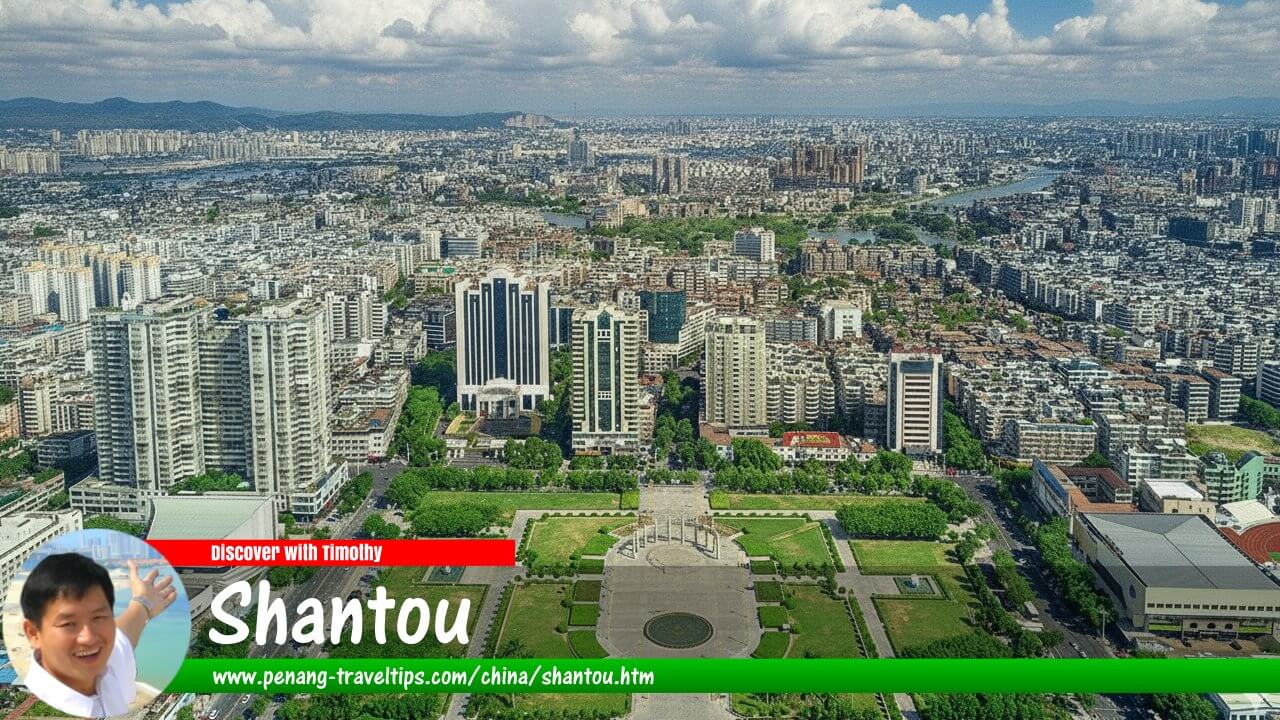 Shantou, China (Photo edited with AI on 16 June 2026)
Shantou (Chinese: 汕头; pinyin: Shàntóu) is a major coastal city in eastern Guangdong Province, China. Located on the shores of the South China Sea at the mouth of the Han River Delta, Shantou serves as one of the principal cities of the Chaoshan region, alongside Chaozhou and Jieyang. The city is renowned for its maritime heritage, distinctive Teochew culture, thriving port facilities, traditional cuisine, and strong historical links with overseas Chinese communities throughout Southeast Asia and beyond.1
The name "Shantou" literally means "sandy headland" or "sand spit." The character "汕" (shàn) refers to a fishing weir or a shallow water area used for fishing, while "头" (tóu) means "head" or "promontory." Historically, the area developed around a sandy peninsula extending into coastal waters, making the name an appropriate description of its geographical setting. Originally a small fishing settlement, Shantou grew into an important port city after being opened to foreign trade during the nineteenth century.2
Quick Facts
- English Name: Shantou
- Chinese Name: 汕头
- Pinyin: Shàntóu
- Province: Guangdong
- Administrative Status: Prefecture-level city
- Region: Chaoshan Region
- Population: Approximately 5.5 million
- Area: Approximately 2,248 square kilometres
- Climate: Humid Subtropical
- Airport: Jieyang Chaoshan International Airport
- Major Port: Port of Shantou
- Main Language: Teochew (Chaoshan dialect) and Mandarin
- Known For: Port trade, Teochew culture, cuisine, and overseas Chinese connections
- Major Industries: Manufacturing, logistics, food processing, textiles, and tourism
Geography
Shantou is situated in eastern Guangdong Province along the coast of the South China Sea. The city occupies a strategic location at the mouth of the Han River and Rong River systems, providing direct maritime access to domestic and international shipping routes. It borders Jieyang to the northwest and Chaozhou to the north, while its southern boundary faces the South China Sea.1
The municipality consists of both mainland districts and offshore islands. Nan'ao Island, located offshore in the Taiwan Strait, is one of the city's most significant geographical features and serves as an important tourist destination. Coastal plains dominate much of the landscape, while low hills and islands provide topographical diversity.
Several rivers flow through the region, creating fertile agricultural lands and historically supporting transportation and commerce. The extensive coastline includes natural harbors, bays, beaches, and estuaries that have contributed to Shantou's development as a maritime center.
Shantou experiences a humid subtropical climate characterized by hot, humid summers and mild winters. Average annual temperatures range between 21°C and 22°C. The city receives abundant rainfall, particularly during the monsoon season. Typhoons occasionally affect the region between summer and autumn, although modern infrastructure helps mitigate their impact.
The coastal environment supports fishing, aquaculture, shipping, and tourism, all of which remain important components of the local economy.
History
The area around modern Shantou has been inhabited for centuries, although it remained relatively small compared to neighboring Chaozhou for much of its early history. During imperial times, the region fell under the administration of Chaozhou Prefecture and developed primarily as a fishing and trading settlement.
Shantou's transformation began during the nineteenth century. Following the Second Opium War and the signing of the Treaty of Tientsin in 1858, Shantou was designated as one of China's treaty ports and formally opened to foreign trade in 1860.3
The opening of the port brought significant economic growth. Foreign merchants established trading houses, consulates, warehouses, and shipping facilities. International trade expanded rapidly, particularly in tea, sugar, ceramics, textiles, and agricultural products. Shantou became one of southern China's most important commercial centers.
During the late Qing Dynasty and the Republican era, the city flourished as a regional transportation hub. Steamship services connected Shantou with Hong Kong, Southeast Asia, and other Chinese ports. Many residents emigrated abroad during this period, creating large overseas Teochew communities in Thailand, Singapore, Malaysia, Indonesia, Cambodia, and Vietnam.4
Japanese forces occupied the region during the Second World War, causing disruptions to trade and economic activity. After the establishment of the People's Republic of China in 1949, Shantou gradually rebuilt its infrastructure and industries.
In 1981, Shantou became one of China's first four Special Economic Zones (SEZs), alongside Shenzhen, Zhuhai, and Xiamen.5 This designation encouraged foreign investment, industrial development, and international trade. Although Shenzhen eventually overshadowed Shantou in terms of economic growth, the city continues to play a significant role in Guangdong's economy.
Today, Shantou combines modern urban development with a rich cultural heritage, preserving historic districts while expanding as a regional commercial and transportation center.
Economy and Products
Shantou's economy is diverse and includes manufacturing, logistics, international trade, food processing, tourism, and services. Its coastal location and port facilities have made maritime commerce a cornerstone of local development.
The Port of Shantou remains one of eastern Guangdong's most important ports. It handles container traffic, bulk cargo, and passenger services while supporting trade with domestic and international markets.6
Manufacturing industries include electronics, toys, plastics, garments, machinery, packaging materials, pharmaceuticals, and consumer goods. Shantou is particularly well known as one of China's major toy manufacturing centers, exporting products to numerous international markets.
Food processing represents another major industry. The city produces seafood products, snacks, preserved foods, tea products, and traditional Teochew delicacies. Shantou cuisine is famous throughout China and overseas Chinese communities.
Fishing and aquaculture remain important economic activities. Coastal waters support the harvesting of fish, shrimp, shellfish, and other seafood products that supply local and export markets.
Tourism contributes increasingly to economic growth. Visitors are attracted by the city's cultural heritage, colonial-era architecture, beaches, island scenery, and renowned culinary traditions.
In recent years, Shantou has also expanded its technology, education, and financial sectors, seeking to diversify beyond traditional manufacturing and port-related industries.
How to Go There
By Air
Shantou is primarily served by Jieyang Chaoshan International Airport, located approximately 35 kilometres from downtown Shantou. The airport serves the entire Chaoshan region, including Shantou, Chaozhou, and Jieyang.7
Major airlines operating at the airport include Air China, China Southern Airlines, China Eastern Airlines, Shenzhen Airlines, Hainan Airlines, Xiamen Airlines, Sichuan Airlines, and Spring Airlines.
Domestic flights connect the region with Beijing, Shanghai, Guangzhou, Shenzhen, Chengdu, Chongqing, Kunming, Xi'an, Wuhan, Hangzhou, Nanjing, and many other cities. International and regional services connect to destinations such as Bangkok, Kuala Lumpur, Singapore, Hong Kong, Macau, and Taipei, depending on seasonal schedules.
By Train
Shantou Railway Station is located in Longhu District and serves as the city's principal railway terminal. The station is connected to China's high-speed rail network, providing convenient services to Guangzhou, Shenzhen, Xiamen, Fuzhou, Shanghai, and other major cities.8
Additional rail connections through Chaoshan Railway Station further enhance accessibility throughout the region.
By Long-Distance Bus
Several long-distance bus terminals operate within Shantou, offering regular services to cities throughout Guangdong Province as well as neighboring Fujian, Jiangxi, Guangxi, and other provinces.
By Ferry
Historically, Shantou has maintained passenger ferry connections with Hong Kong and nearby coastal destinations. Services may vary depending on schedules and operating conditions.
By Road
Modern expressways connect Shantou with Guangzhou, Shenzhen, Xiamen, Chaozhou, Jieyang, and other major cities in southern China.
How to Travel Locally
Shantou offers several transportation options for both residents and visitors.
- Public Buses: A comprehensive bus network serves urban districts, suburbs, and tourist attractions.
- Taxis: Metered taxis are widely available throughout the city.
- E-Hailing Services: Didi Chuxing is commonly used and functions similarly to Uber.
- Shared Bicycles: Bicycle-sharing services are available in many urban areas.
- Electric Scooters: Widely used for short-distance transportation.
Shantou does not currently have a subway, MRT, metro, or LRT system. Traditional trishaws, rickshaws, and tuk-tuks are generally not part of the city's transportation infrastructure. Most visitors rely on buses, taxis, ride-hailing services, bicycles, or private vehicles.
Tourist Attractions
Nan'ao Island
Nan'ao Island is the largest island under Shantou's administration and one of the region's most popular tourist destinations. It features beaches, fishing villages, coastal scenery, wind farms, and historic sites.
Shantou Small Park Historic District
This historic quarter contains colonial-era buildings, arcaded streets, and traditional shops dating from the city's treaty-port era. It provides a glimpse into Shantou's international trading past.
Queshi Scenic Area
Located across the bay from the city center, this scenic area offers hills, gardens, temples, and panoramic views of Shantou's skyline and harbor.
Shantou Bay Bridge
The bridge is one of the city's most recognizable landmarks and offers impressive views of the bay and surrounding coastline.
Zhongshan Park
One of the oldest public parks in the city, Zhongshan Park features lakes, gardens, walking paths, and recreational facilities.
Tian Tan Garden
This cultural attraction contains a replica of Beijing's Temple of Heaven and serves as a venue for cultural exhibitions and community events.
Chen Cihong Former Residence
Located in Chenghai District, this grand residential complex showcases traditional Chaoshan architecture blended with Western influences. It was built by a wealthy overseas Chinese family.
Longquan Rock Temple
This historic Buddhist temple is known for its peaceful setting, traditional architecture, and religious significance.
Chaoshan Historical Culture Expo Center
The museum complex introduces visitors to the history, traditions, customs, language, and overseas influence of Chaoshan culture.
Mayu Island
Located near the harbor, this island offers coastal scenery, maritime heritage sites, and views of shipping activity in the bay.
Shantou, China is  the Map of Cities in China
References
- Wikipedia – Shantou
- Encyclopaedia Britannica – Shantou
- Wikipedia – Treaty Ports of China
- Wikipedia – Teochew People
- Wikipedia – Special Economic Zones of China
- Shantou Municipal Government
- Wikipedia – Jieyang Chaoshan International Airport
- Wikipedia – Shantou Railway Station
Page Details
This page was created/modified on 16 June 2026. Hi, my name is Timothy and created it from my research, for my own entertainment, knowledge and to satisfy my curiosity. I am providing the information to you in good faith and hope it is useful. I try to get the details as accurate as possible. I also try to update the page whenever I stumble on new details. So this and all my other pages are perpetual work in progress. If you discover any error, please politely inform me, pointing out where the error lies, and I will correct it as soon as possible. Your helpfulness will keep this page accurate, relevant and helpful to those who need the information.